


I've been sent on a quest. Someone has to make ti water bottles. Does anyone have any leads? I've the found flasks for *!?*..!! sake.
Topic
Become a member to post in the forums.
I've been sent on a quest. Someone has to make ti water bottles. Does anyone have any leads? I've the found flasks for *!?*..!! sake.
I've seen titanium vacuum bottles on eBay for $200+, though that's not what you're looking for. Perhaps check for the same manufacturer??
Someone said that aluminum is lighter although weaker per thickness and that the desire for titanium is for cases where heat or strength is needed. I forget the physics involved in this. Any scientists reading and knowing the answer for just something to hold cold water.
ps – what is wrong with plastic, William?
My friend is "freaked-out" by plastic and aluminum and doesn't trust what would happen to the baked-on enamel of a SIGG bottle if it were dented. Personally, I use Platy's until they have a lovely brown tinge to them. My friend asked, and I knew that if anyone knew, it would be someone on this forum.
Hi Roleigh…
I use platy's myself…
If your friend won't trust the manufacturers when they tell him that their food grade plastic is safe… then why is your friend trusting manufacturers who use plastic lining for their aluminum and titanium bottles?
I hope your friend isn't thinking that his water will come in contact with bare metal — without the plastic lining?
thought it was about the only lightweight food/beverage container material that is
almost all plastics leach out some chemicals
i thought stainless steel water bottles were direct contact too?
hey – how 'bout a link for that titanium sake flask?
Actually, Ben that was the thought. I didn't think that the ti mugs and pots had a lining. Especially for boiling water.
I didn't either — until someone (Jason Klass) told me emphatically that they do! And upon closer examination of my SP600 and Firelite 550, I believe he is right. Compare both look and feel between the dull exterior wall vs. the more 'reflective' interior wall. Looks lined or coated to me.
Any experts in the house? Ryan?
How does your friend survive? Does s/he eat anything that they did not kill/grow him- or herself?
Matt,
Easy now, it was just a question if anyone knew if the product was available. Ben suggests that because of plastic lining in ti products that the post may be moot. We are soon going to be spinning off into abstract discussions about how plastic is everywhere, and what may or may not be acceptable level of exposure. If she wants to eliminate intake from one source and reduce her exposure, that is her buisness.
The late lamented MSR Ti fuel bottles would have done the trick. I have one that's never been used for fuel, but is dandy for brandy.
As to stressing over what would happen with a dented lined Sigg bottle, mere words fail me.
No harm intended – I just took the question to its logical, applicable conclusion.
>I didn't either — until someone (Jason Klass) told me emphatically that they do! And upon closer examination of my SP600 and Firelite 550, I believe he is right. Compare both look and feel between the dull exterior wall vs. the more 'reflective' interior wall. Looks lined or coated to me.
I don't think this is true, at least for Ti cookware that isn't non-stick. I'm almost certain that most Ti cookware (especially the short-run stuff) is shaped through a process called hydroforming, where a metal blank is stretched over a form (also generally metal) by a pressurized rubber bladder. The different surface textures of the rubber bladder and metal form likely account for the difference in inner/outer finish. There are also a number of ways that metal surfaces can be "finished" which don't include the application of a permanent "sealer." If anything, I would worry more about washing a new Ti pot really well to remove remaining industrial lubricants or other chemicals used in its manufacture.
I agree, there's little reason to coat or otherwise treat titanium, other than for a nonstick cooking surface or for decorative purposes. Plain Ti cookware is just that–plain Ti. Interestingly, Ti self-coats:
"This metal forms a passive and protective oxide coating (leading to increased corrosion-resistance) when exposed to elevated temperatures in air, but at room temperatures it resists tarnishing. When it first forms, this protective layer is only 1–2 nm thick but continues to slowly grow; reaching a thickness of 25 nm in four years."
>>Someone said that aluminum is lighter although weaker per thickness and that the desire for titanium is for cases where heat or strength is needed. I forget the physics involved in this.
Some facts regarding Aluminium versus Titanium:
Aluminium (Al) is considerably lighter than Titanium (Ti). Al has an atomic number of 13 whereas Ti is further down in the Periodic table with an atomic number of 22. Elements get heavier the further down the table they occur.
Al is much softer than Ti. Titanium is extremely hard and has a very high strength-to-weight ratio, among the highest of all metals. Al is a much better heat conductor than Ti.
Al and Ti are highly resistant to corrosion due to chemical reactions with oxygen. Al is the most abundant metal on Earth and Ti is also relatively common. Both (almost) never occur in their elemental pure form, as their strong affinities to oxygen mean that they are almost always in oxide form.
Ti's appeal to lightweight backpackers is because of its hardness and strength, the same qualities that make it appealing to the aerospace industry. Because it is so hard and strong, so much less is needed for any application. Thus weight savings can be made. Its hardness means that it is resistant to deformation so it stands up to the rigours of trail life.
A couple of answers:
We are working on a titanium bottle for 2010 one single wall and a double wall. Yes titanium is inert and the safest metal of all metals.
Thank you
Snow Peak
Peggy Borne
Product Manager
PO Box 2002
16081 SE 98th Ave
Clackamas, OR 97015
http://www.snowpeak.com
Titanium is non-toxic even in large doses and does not play any natural role inside the human body.[26] An estimated 0.8 milligrams of titanium is ingested by humans each day but most passes through without being absorbed.[26]
James:
Why didn't they just come straight out and say that their bottles aren't lined? Or did they?
Sweet, thanks for sharing James! Little did Snow Peak know what good advertising what looks like quick reply to an email would be!
Siggs are lined with a "food grade epoxy." Personally I don't like epoxy resins and such in contact with my food. It's not the end of the world, but I avoid when I can. Kleen Kanteens are completely unlined, only stainless steel in contact with contents–but obviously heavy, about 8 ounces for the 40 fl. oz. bottle IIRC.
Ben,
My initial question was a little obscure "…are your products plastic lined, or is titanium inert, and they are not needed." I shot back an e-mail to clarify, but I haven't gotten a reply yet.
>>Siggs are lined with a "food grade epoxy." Personally I don't like epoxy resins and such in contact with my food. It's not the end of the world, but I avoid when I can. Kleen Kanteens are completely unlined, only stainless steel in contact with contents
Hi Brad. I used to feel the same way about the Sigg epoxy and Klean Kanteen's stainless steel. However…if you look at the tag that comes with the Kleen Kanteen, you'll see that it says 'Made "responsibly" in China'. I'm not sure there is such a thing!
My uncle is an engineer with Tyco Eletronics and they find that electronics parts are often not what they're claimed to be. In other words, stainless steel will often have a bunch of other junk mixed in with it. This makes a big difference in the electronics industires as heat sinks for example with metal impurities don't work the way they should.
Anyway, I think you see where I'm going with this. China is not exactly a mecca of responsible manufacturing. I trust Sweden more when it comes to making a healthy water bottle. Epoxy or no.
That said, I still drink out of my Klean Kanteen. The office water cooler has plastic jugs made from the same stuff that Nalgene recently banned anyway.
Short of making a primitve water bladder from leather or something of the sort, there're always going to be uncertainties. If you think about this stuff too much, you can drive yourself nuts.
I am interested in those Ti waterbottles from Snowpeak thogh.
Ben,
Here we go:
"None of our cooking pots or cups have plastic lining."
The reason some titanium pots are shiny on the inside and dull in the outside, is because the outsides get sandblasted. Most of the pots are draw formed, and the outside takes the brunt of the abuse in the forming process, sand blasting is the easiest way for manufactures to get a uniform finish. Unless it is a "no stick" pot, it is not coated.
As for strength, Ti can be almost as soft as aluminum or harder than steel, depending on the alloy and heat treat, Pots are on the low end of strength.
Also, the heat conductivity of Ti improves as it heats up. So a cold Ti pot does not conduct heat as well as a cold aluminum pot, but as the pots heat up, the Ti will conduct at a comparable rate to the aluminum.
This a few degrees OT but I recall a thread somewhere about using metal water bottles as stove pots. Great dual use for those of us who just boil water for meals. Of course I wouldn't want a plastic lining in this application.
Become a member to post in the forums.
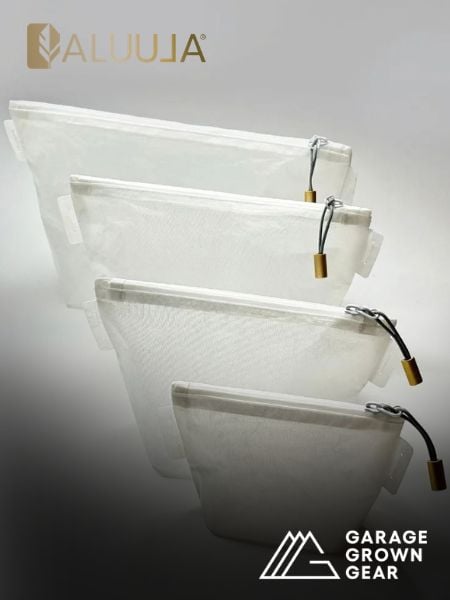 New Gear with Aluula FabricsLighter, stronger, more abrasion-resistant, and highly water-resistant - explore ultralight backpacking gear made with ALUULA Graflyte fabrics. Engineered for exceptional strength, durability, and lightweight performance, ALUULA Graflyte helps reduce pack weight without sacrificing reliability, making it ideal for demanding backcountry adventures.
 © Beartooth Media Group Inc.
 Loading...