Topic

Questions for Ye Rainbow / DR Users

  • This topic is empty.
Viewing 18 posts - 26 through 43 (of 43 total)
PostedMay 16, 2009 at 10:02 pm

I was concerned about wind sneaking in under the side fly walls of my DR. Although I haven't used it in severe weather yet, my yard provides a convenient test pad. Perched on the flanks of Colorado's Front Range, top where DOE torture-tests experimental wind turbine blades.

Last month when a late blizzard was approaching, I staked my brave little tarptent with my best storm pitch. I used plenty of stakes. For the small tiepoints on either quarter-point of the roofline arc, I used two stakes each, creating a sturdy triangle of tiedown power.

I faced one side door towards the wind, figuring you'd want the other door on the better-sheltered lee side. Then I staked the windward door/fly directly to the ground. The bottom of the tent fly was level with short grass. That raised the opposite fly, because the whole tent was now tilted about 10 degrees towards the wind. Thus I discovered a hidden advantage of the DR's one-pole structure. It can be warped and reshaped in ways a conventional crossed-X dome can't. The arc of the roof doesn't have to be perpendicular to the floor.

The storm arrived on schedule, with icy pellet snow flying sideways. Very little snow infiltrated the bottom of the tent. So why did it feel like sitting inside a snow globe, shaken? Because the windward top vent ("beak," in Shires-speak), was funneling in snow from the top. Rain, being heavier, might have might have behaved differently, but these ice pellets hit the fly like bank shots into the side pocket. There was no way to close the beak vent tightly enough to block the snow. Has anyone else had a problem with this?

I love my Double Rainbow. Favorite tent I've ever owned. But I'd trade it for the same thing with two changes, even at the expense of a few ounces: an adjustable closure for the beak vents and a zip-up wind curtain for the sides.

PostedMay 17, 2009 at 2:25 am

Travis
The Rainbow does sit better when staked down in the standard mode. The freestanding version is an option for those situations when that is an easy way out but not the best way of setting it up. In fact very few tents (with vestibules) stand up correctly when not staked down.
Big Agnes, I think, deserve the title as the most non free-standing amongst the freestanding tents… (insert smileys here)
John
Very admirable that you want to push the limits of the DR ( I do that with the Contrail) but there are limits imposed on single pole tents.
I think that if HS put a fully "close-able" vent there would just encourage folk to push those limits even more and be disappointed.
Franco

PostedMay 17, 2009 at 6:49 am

I think you have experienced the limitations of the shelter. You have to give something up for such a light shelter…..

PostedMay 17, 2009 at 1:40 pm

I have added a toggle closure to our beaks. Works great and weighs almost zilch. I thought that was now a standard modification on the DR, but I guess I'm wrong :( It should be standard!

"a zip-up wind curtain for the sides"

Huh? Can you explain this better?

PostedMay 17, 2009 at 7:49 pm

My DR has a little fastener mounted on a one-inch loop of elastic that aims toward another tie point on the fly. It might block the peak beak vent, kinda sorta, if the elastic wasn't much too short for the ends to meet. I know I must be missing something here.

Please don't be dismissive of my suggestion, Franco. (I've always enjoyed your posts, and they were a big factor in my choosing this particular tentlet.) Here's a recent BPL thread that discusses the same desire for a tad more wind resistance:
http://www.backpackinglight.com/cgi-bin/backpackinglight/forums/thread_display.html?forum_thread_id=20721

(Title: The (disappointing) State of the Market in Lightweight Double wall tents…)

Consider the typical summer weather pattern at 8,000-11,000 ft. where I'm likely to go on weekend trips from Denver. Precipitation usually comes suddenly and sideways. Tent ventilation becomes the least of your problems. An hour later, it may be calm again and you appreciate those wide-open tent walls. For versatility's sake, I'd gladly carry the weight of at least one zip-in, zip-out wind wall.

Besides the snow-blowing peak vents, I saw no problem with the way the DR withstood a six-hour, 50-mph snowstorm that delivered about 18 inches of wet spring snow. It's a brilliant design that might not be complete just yet, IMHO.

PostedMay 17, 2009 at 8:25 pm

John, you're not alone in wanting the ability to batten down the hatches when winds whip up. Vestibules with plenty of ground clearance are great for condensation resistance when there's little breeze, but not so good when the wind is whistling through. I agree that the double rainbow would be improved with the ability to extend the fly to near the ground in windy conditions. I've asked Henry Shires about this previously and he's not very keen on the idea. This may be because too many people would put the fly down to the ground even in calmer conditions, resulting in a lot of condensation and then people complaining that the tent is terrible. So I guess the higher fly is a "feature" which ensures that the tent is used properly with plenty of ventilation.

It would seem that your most likely option is to do a custom mod yourself. I probably wouldn't use a zipper. Might be better to sew on some extra length to the existing fly, and use velcro tabs to fold up the extra bit out of the way when it isn't needed. If you do use a zipper, let us know how it goes.

The inability to properly batten down the hatches was one reason I decided to go with the Scarp 2 rather than the Double Rainbow (the other was the usable width). Note however that quite a few Europeans have raised concerns about the height of the fly even on the Scarp. Over in windy and wet England folks like to have a fly which goes all the way to the ground, condensation or not!

PostedMay 17, 2009 at 9:21 pm

It doesn't… that's what I meant when I said that some Europeans have raised concerns about the height of the fly. Many prefer a fly that goes all the way to the ground. The Scarp doesn't, but it does go lower than the Double Rainbow.

PostedMay 17, 2009 at 11:24 pm

John
There are several mods that HS has implemented in his shelters because of customers suggestions or his own findings.
For example what I call the Contrail 08 is the third version of that shelter. However you will notice that what would provably be the most common suggestion ( to have the front panel closer to ground level) has not been implemented, and that is simply because it would dramatically change the air flow inside that shelter.
If HS made a version where the fly could be set at different heights, you would still end up seeing comments about excessive condensation from folk that would always use it in the lower position for "extra protection". And that comment would be repeated in the various forums with most not bothering to trace the source to find out what really happened.
The Rainbow has also been upgraded and there is no reason for that to stop. The trick is to "improve it" for most, not fine tuning it for some.
No doubt he will still please most but disappoint others.

Franco

PostedMay 18, 2009 at 1:37 pm

This really shouldn't be a big problem. We've use the DR in sideways gales force rain. You just have to be creative. Cross stake the windward fly to the ground and/or dig holes to lower the tent corners. Safety pin the vent closed. Use the grommet pole supports. Add a tie-out to the cross struts, etc…the DR is clearly specified as a 3-season tent, and it does a really good job in those conditions. To push it further you may just have to do your own mods.

PostedMay 19, 2009 at 7:24 pm

… as with the peak vents. Maybe I wasn't clear enough, but I was able to get the fly very low and close (3 inches, more or less) to ground level when I tipped the main pole towards the wind. That ability to set up asymmetrically seems to distinguish the DR from its two-poled competitors. I wouldn't want any mods on that score.

What I do want before I face windy weather again is an easy way to block one or other peak vent, so sidewinds won't turn them into funnels. I probably could find several homegrown remedies for that issue, but I thought this problem was worth sharing with the rest of the class. Including some folks who have far, far more experience with this tent.

BTW, I've emailed HS twice now about this concern, with no reply. That doesn't seem like him.

PostedMay 19, 2009 at 7:29 pm

The "fix" to your problem is to install a toggle and loop closure on the vents. Maybe Henry would do this for you if you don't have the MYOG skills….?

Travis L BPL Member
PostedMay 20, 2009 at 7:52 pm

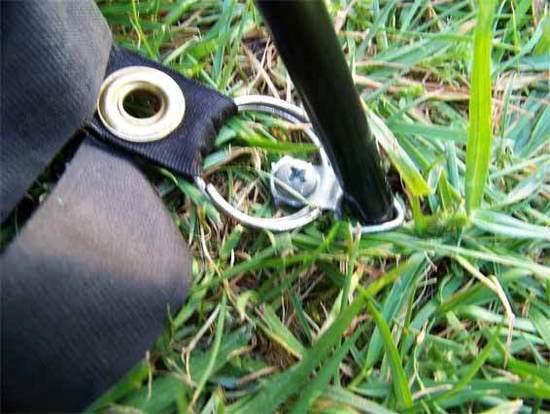
I'm currently experimenting with an alteration that would allow the main arch pole to be adjustable. Basically, it would be adding a buckle and extra length of strap to the bottom strap that connects the two grommeted ends of the arch pole. Slight adjustments to this seem to allow the DR to be pitched in a variety of heights, including very close to the ground. When I'm able to to actually test this, I'll try to post.

PostedMay 20, 2009 at 8:45 pm

My first version of that. It was originally done to cope with the fly shrinkage . You need a bit more latitude than this, but one on each side could do it.
Franco
Rainbow pole shift

PostedMay 21, 2009 at 12:05 pm

I still like Franco's idea of just digging a couple of holes for the pole ends to go into. Maybe not so practical on hardpack or solid rock though. Maybe a short length of chain would allow and almost infinite adjustment downwards, each link lowering the canopy a little more?

Travis L BPL Member
PostedMay 21, 2009 at 3:39 pm

>Maybe a short length of chain would allow and almost infinite adjustment downwards, each link lowering the canopy a little more?

Thats basically what I'm going to try with a strap and buckle. We'll see how it goes!

PostedMay 21, 2009 at 4:12 pm

Travis
I cannot remember now because I did that when I first got the Rainbow but I suspect that I did not pursue the idea because by spreading the pole it deforms the shelter. It is possible that whilst I was doing that someone dangled some shiny objects in front of me and forgot what I was trying to do… (I have a very short attention span)
Whilst you are doing that, try a combination of spreading and digging.
Franco

Travis L BPL Member
PostedMay 21, 2009 at 8:49 pm

Franco,
Yeah, I'm going to be very careful with what I do, and make darn sure it'll be worth it before hacking into Henry's tried and trusted design. I'm always weary of messing with a good thing.

Oh….and watch out for the shiny danglies….don't let them get the best of you!

Viewing 18 posts - 26 through 43 (of 43 total)
Loading...
