Topic

Cuben Fiber Fragile- Huh?

  • This topic is empty.
Viewing 23 posts - 26 through 48 (of 48 total)
Ron Bell / MLD BPL Member
PostedNov 18, 2008 at 8:10 pm

Many Thanks everyone for all the feedback.

I can see from this thread, other related threads and from various other sources there is a very wide opinion range about Cuben and Spinnaker fabric suitability for UL shelters.

I'd like to say that there are many weights and styles of Spinnaker and Cuban Fiber and the lighter the fabric, more craftsmanship and different construction methods are required to build a strong quality product and there are some that are too light or not suitable for shelters too.

Most of the negative perceptions I have seen were based on something other than direct experience, which is not a surprise. -Due to it's cost few people have any gear made from it.

I note that of the users that do have direct experience- at least with MLD products, almost all those responses were positive.

Just breaking it down, the perception that it is not a good UL Shelter material seem to fall into one of these two main areas:

Low Performance Perceptions:

1: Based on Indirect Experience or Information- Information mostly from online forum reports from others that may or may not be direct users either.
– Too Fragile
– Too Noisy
– Does not last long
– Not waterproof
– Requires extremely gentle care
– Not storm worthy
– No mfgr warranty offered

2: Based on Direct Experience with some type of Cuban or Spinnaker product- Fabric Style, manufacturer and weight possibly unreported. (Few response of this type were noted and the fabrics referenced may not have been in a shelter product.)
– Too Fragile
– Too Noisy
– Does not last long

Negative Cost Perceptions
1: To expensive for an individual's budget regardless of performance.
2: Too expensive for initial investment based on a projected short service life.
3: Individuals could afford if desired but have a moral/philosophical objection to the cost when lower cost alternatives that are available. ( Yeah, I see a whole other tread coming from this one.)

I may not have captured it all, but it's starting place. In the next few weeks I will work on a general Pros /Cons explanation as best I can and add it to the MLD Fabric Mojo page for customer reference.

If anyone would like a sample swatch of Silnylon, Spinntex EXP and Spectralite.60- Send me a SASE (reg letter envelope self addressed with one first class stamp) and I'll send you a free set to destructo test.

Roger Caffin BPL Member
PostedNov 19, 2008 at 1:07 am

Hi guys

Yes, you are right about the Cuben being fragile when wrongly used. As a sail it is great (until the spinnaker bursts), but sailmakers go to great lengths to NOT weaken the fabric. They reinforce, laminate at different angles, and tape rather than sew. They engineer the construction.

Sewing a guy rope attachments onto a single layer of Cuben with a bar-tack is a totally different thing. The sewing puts a heavy row of holes through the plastic film, turning that region into a 'rip here' site. OK, the embedded threads reinforce it a bit, but it is a mistake to think they can handle the whole load. We know from experience (and photos) that heavily-sewn regions in Cuben are weak. They rip under load.

The other problem with Cuben, and to a lesser degree polyester spinnaker, is that the fabric does not STRETCH ENOUGH. Without some stretch in the fabric you either get a sloppy pitch or very high localised stresses. Interesting fabrics, but they need a very different sort of *engineering* to be reliable in a tent in bad weather.

Cheers

PostedNov 19, 2008 at 11:33 am

>The other problem with Cuben, and to a lesser degree polyester spinnaker, is that the fabric does not STRETCH ENOUGH

I agree. This is both a blessing and a curse. The design and manufacture of cuben shelters needs to take this into account, just as sailmakers do.

To be fair (it may not be obvious in the photo), The refuge-X side guy-out that ripped WAS reinforced with a piece of heavier fabric on the inside of the tent, but there was still way too much stress on a very small area of fabric.

Refuge-X tear

With Roger's help I am working on improving this attachment. In the mean time I consider cuben to be excellent fabric for things like stuff sacks, bivy bottoms, ponchos etc…basically anything that is not shaped and stretched too taught. That is until someone can design shelters using sail-maker techniques to evenly distribute the expected loads without weakening the fabric. But I will always be mindful that, when the racing is serious, those big boats always carry THREE spinnakers just in case…

Roger Caffin BPL Member
PostedNov 19, 2008 at 12:05 pm

DISGRACEFUL!!! UTTERLY DISGRACEFUL!
> anything that is not shaped and stretched too taught.
TAUT!
Taught is the past tense of teach.

> The refuge-X side guy-out that ripped WAS reinforced with a piece of heavier fabric on the inside of the tent,
Possibly so, but obviously the reinforcing was not designed correctly. For proof, see photo.

Cheers

PostedNov 19, 2008 at 12:13 pm

Looks like a little vector analysis is in order.

The
pull on that tab looks to be on the bottom line of stitching
only.

I like cuben fiber. My avatar alphamid is made from it.

It is hard to get a lot of field testing done on
various prototypes when a simple shelter can run $500
and you may only sell 4 or 5 in a year.

PostedNov 19, 2008 at 12:26 pm

>Taught is the past tense of teach.

I am deeply ashamed of myself. I am obviously not too taught myself ;)

PostedNov 19, 2008 at 12:28 pm

>The pull on that tab looks to be on the bottom line of stitching only.

Agreed.

Allison, this might be something that Six Moon Designs would want to know about. If you sent them that picture, they might decide to redesign their side-tie outs so the pull out tab gets sewn to the middle of the reinforcement patch, not the lower edge, on future tents.

PostedNov 19, 2008 at 12:36 pm

Roger just learned us something….
Mr Caffin's comments about "The sewing puts a heavy row of holes through the plastic film" reminded me of when as a kid I used to puncture holes around a figure on a piece of paper to then "cut it out" just by pushing along the holes.
Franco

PostedNov 19, 2008 at 12:46 pm

>when as a kid I used to puncture holes around a figure on a piece of paper to then "cut it out" just by pushing along the holes.

AKA Perforation.

I have let the guys at SMD know about the problem, and hopefully they may also have some ideas since they have been working with this fabric longer than most of us.

PostedNov 19, 2008 at 1:43 pm

SMD Refuge-X with MLD poncho awning

Refuge plus awning 1

Refuge plus awning 2

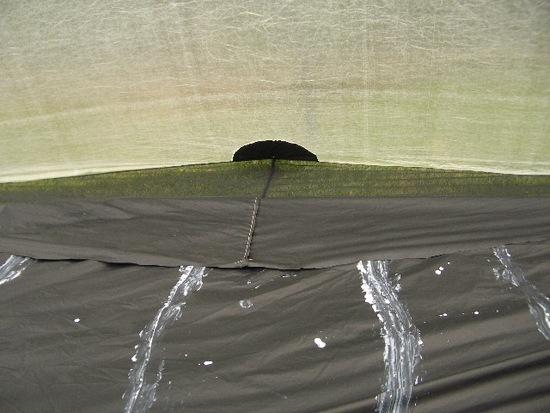
Refuge-X with extra floor perimeter

Refuge plus perimeter

With floor perimeter folded back for ventilation

Refuge minus perimeter

The white goop is just silicone sealant on the floor for grip, and on the seam of the floor perimeter for waterproofing. This treatment addea a few ounces.

PostedNov 19, 2008 at 2:32 pm

Nice set up! I'm cringing at the pictures of the floor, though. Clear silicone caulk looks so much tidier than white, especially on a black fabric.

PostedNov 19, 2008 at 2:40 pm

>Clear silicone caulk looks so much tidier than white, especially on a black fabric.

Agreed. It's just that I have a lifetime supply of white silicone sealant, so am loathe to go buy some clear for the sake of aesthetics. I guess I'm just not that "house proud".

All up, it's a luxurious shelter for two, with total weight (including seam sealants, guylines, awning and extra floor) of 650g (23oz). Now if we can just get it to stand up to a stiff breeze…………..

Brad Groves BPL Member
PostedNov 19, 2008 at 4:53 pm

Hi-
I posted some pics of .44oz cuben that tore when lightly pulling the fabric in opposite directions with my hands. Not sure how to link to the exact post, but about 2/3 of way down the page:

http://www.backpackinglight.com/cgi-bin/backpackinglight/forums/thread_display.html?forum_thread_id=2346&startat=80

Perhaps I am the only one who has experienced such fabric failure. But it does cause me hesitation in buying 15 yards to make a tent.

Also, I think there's merit in the static nature of the fabric. Just as an example, I have 500# Spectra line that breaks when a 80 pound dog hits the end of it chasing a squirrel. 500# paracord never has broken in those situations. Static/no-stretch line vs. dynamic/stretch line. Obviously, I understand that sails get hit with sudden forces, and I understand why a static fabric could be favorable. But I think that you can't just make a shelter out of cuben using the same techniques that you would with other materials… my 1/2 cent.

Ron Bell / MLD BPL Member
PostedNov 19, 2008 at 5:26 pm

Hi Brad,

I checked out your pics.

1: The .44 weight is only half the tear strength as the .6- .7 weight in a pure tear test but really only about 1/3 to 1/4 the strength when stitched and made into a tarp/shelter.
2: Some of the older Cuben had more manufacturing mistakes/voids than the newest stuff, and more so in the lightest weights. I don't know how long ago yours was made.
3: It take a bit of experience to see the possible problem areas and to discard those sections.

It all depends on the weight of the cuban fiber and how it is assembled.

PostedDec 10, 2008 at 7:38 pm

Five to ten years ago, Quest Outfitters sent me a sample of the cuben fiber light weight fabric (around 1 oz/sq yd). The price was between $15 and $20 per running yard.
It was a nonwoven fabric with the fibers held together by a material similar to mylar. I was able to shred the fabric just by rubbing it between my thumb and forefinger.
While I gather from these posts there is a heavier cuben fiber product used in packs and similar gear (I'm good with spectra gridstop), I have not seen any significant improvement in the light weight fabric over the product that Quest first sent me. There is no way I would depend on such a material for safety and survival in a tent (or tarp-I use only tents). The spinnaker fabric is another matter. I asked the company that features spinnaker in their tents regarding purchase of the fabric, and got the brush-off. Later, I located spinnaker readily available on the sailmaker web sites. However, the silnylon has proved so strong and reliable for me, that there is little inclination to switch. Ditto, Henry's tarptents, and Stephenson's here in NH with their tents, and they have been at it since the sixties. Note: The quality of silnylon does vary. One can just poke it through a circle made with your thumb and forefinger, pour in a little water, create a pouch, and see how much pressure it takes to drive water through the fabric. Admittedly crude, but works well enough to identify inferior quality silnylon. I have found the material from Quest and Jack's to be excellent. Because the coating permeates the fabric, there is nowhere near the degree of stretch one sees with urethane coated nylon (note the photo in a recent BPL article of the Montbell Crescent 1 after heavy rain). Also, the silnylon is very strong and water resistant (there is no such thing as "waterproof"). So there is little motivation to switch to the Spinnaker to save less than 2 oz on a tent (You have to do your own math on this one, but a good design will use less than 50 sq ft, a little over 5 sq yds, for the fabric which forms the sheltering portion of a one person mountain tent). Also, if the tent is constructed taking into account the direction of the threads in the fabric, as well as the catenary cut, the stretch factor can be used to increase the tautness of the fabric when stretched over a frame (the poles). The only significant drawback to the silnylon I have found is the high flammability. (Similer issue with Epic, but that is another matter). For this reason I am intrigued by the lightweight polyester fabric used by appytrails and claimed to meet government flammability standards for tents. We are forever learning, but in order to get a tent done, it is necessary to stop at some point and use what is then known to work best, balancing durability, water resistance, weight and other lesser factors (e.g. UV resistance, but I don't use my tents in bright sunlight).
Please note that the above is based on direct observation, not hearsay. We could use less of the latter on these posts. Thanks for the opportunity to be heard.
Sam Farrington, Chocorua NH

PostedDec 10, 2008 at 7:56 pm

Re: " I have not seen any significant improvement in the light weight fabric over the product that Quest first sent me…. Please note that the above is based on direct observation, not hearsay." Exactly what direct observations did you make on modern Cuben Fiber? What products did you test? What experiments did you run? What were the results of those experiments? Do you have quantitative measurements of those results, or are you using subject impressions and gut feelings?

Brad Groves BPL Member
PostedDec 11, 2008 at 9:47 am

I say this in the more general sense of the forums: "Observation" and "Experimentation" are not synonyms. We all like experimentation and data; indeed, that kind of info is part of BPLs mission. However, it would be absurd to ignore real-world observations because they lack data. Have you noticed misting with your silnylon tarp? If so, do you ignore that because you don't have any calculated data on hydrostatic head in hand? Just a thought…

On a lighter, corollary note, my great aunt was testifying in court back in the 40s about smelling alcohol on a man's breath–and the lawyer tried to "catch" her by saying "I was under the impression you weren't a drinking woman… How would you know what alcohol smells like?" To which she responded "I don't eat roses, but I know what they smell like!"

Cheers.

Hiker 816 BPL Member
PostedDec 11, 2008 at 10:20 am

Ron Bell was nice enough to send me some fabric samples to "destructo test", including a sample of the spectralite Cuben Fiber. I haven't yet tried sewing it to see how much sewing would weaken it, but I can tell you that I could not come close to ripping it with my hands — and I put some serious effort into it. Seems like a pretty good shelter material to me.

PostedDec 11, 2008 at 2:07 pm

Re: "… it would be absurd to ignore real-world observations because they lack data." Fair enough. Forget controlled scientific experiments with quantitative data, how about the simple experiment you originally mentioned: “ I was able to shred the fabric just by rubbing it between my thumb and forefinger.” Did you try doing that with modern Cuben fiber? If so what were the results? What fiber did you use? Have you ever rubbed a Cuben tent, bivy, or other commercial product between your thumb and forefinger, what was the result, and what were the commercially-made products?

Jim Colten BPL Member
PostedDec 11, 2008 at 2:33 pm

This old snail has no opinions about cuben fiber’s fragility or lack there of because he isn’t interested in the product (yet). But THIS ULTRA LIGHTER concluded that his cuben tarp wasn’t up to the task on the (apparently mild weathered) 2008 TGO Challenge. (click on TGO 2008 gear review 1). Granted, in his case it appears that many (all???) of the problems were due to manufacturing issues but lacking detailed know-how about what works well (if any) and what does not there’ll be little progress in this discussion.

It might actually advance our state of knowledge if some cuben-interested MYOGer would do some Jay Ham quality tests and write them up.

PostedDec 12, 2008 at 9:56 pm

Christopher: Thank you much for your feedback about cuben. Sounds like it is time for me to take another look, but at a current sample of the material. Would hate to put many hours into a new tent with sylnylon and Epic if the cuben would work as well as the sylnylon and significantly improve the strength/weight ratio. Will advise outcome.
Sam Farrington, Chocorua NH

Miner BPL Member
PostedDec 12, 2008 at 10:45 pm

I've been pretty impressed with my MLD Grace Solo made with Cuben Fiber over the past year (bought before the sewn on linelocs were added). Just a month ago, I was on an exposed saddle at 10,500ft with variable direction winds gusting up to 50mph which often drove snow horizontally and I had no trouble (~3 inches of snow by morning). And this was not the first time I had been in windy storm conditions with it. Then again, I have better sense then to only use 3 stakes along the sides in that sort of wind. Lacking enough stakes, bowling ball size rocks along the sides have served me well.

Until I read this thread, I had no idea people considered CF to be somehow fragile. My impression was it was suppose to be stronger despite being lighter. Well, unless you are talking about the really thin CF that Zpacks makes their Stuff Sacks out of and even that stuff didn't seem to be that fragile to me, though I wouldn't want a tarp out of it.

PostedDec 13, 2008 at 5:53 am

The "lighter" material Joe uses for his stuff sacks is still a 0.6 oz/sq/yd weight cuben. I do have a flat tarp made by him and it is a very solid piece of gear.

Viewing 23 posts - 26 through 48 (of 48 total)
Loading...