


I don't think the gas canister is going to get very hot with this pot in place. But I would still be a bit concerned about whether enough air was able to get to the flames for complete combustion.
Can the stove itself suffer? Most unlikely.
Cheers
Topic
Become a member to post in the forums.
I don't think the gas canister is going to get very hot with this pot in place. But I would still be a bit concerned about whether enough air was able to get to the flames for complete combustion.
Can the stove itself suffer? Most unlikely.
Cheers

Roger is correct. I'm going to add some air itake holes between the pot stand slots and fairley close to the burner opening.
I guess what I am wondering about is whether it is better to have a windscreen that sits directly on the ground (option #1) or one that sits above the cannister on an integrated heat reflector (option #2), as Ryan Jordan's and others do. As I see it, here are the pros and cons of each option:
Option #1
Pros
-simpler design
-easier to fold and store in your cookpot
-can be made with lighter gauge foil (Reynolds' heavy duty aluminum foil seems to work OK)
-transfers heat to your cannister to counter-act evaporative cooling
Cons
-may not stay in place as well
-requires more material to make?
-heat transfer to cannister may cause it to explode
Option #2
Pros
-bottom part holds windscreen in place
-heat reflector reduces heat transfer to cannister
-requires less material to make?
Cons
-harder to make, more complex design
-more difficult to store, since there are two parts
-may not allow adequate air flow for oxygen intake
-requires heavier foil to make
Greg,
I just re-read the thread you referenced. I'm curious–you said you cut off the rim of an oven liner–you mean something like you would use to roast turkeys, right? If you cut off the rim, how did you retain the bottom? (The windscreen you have in the picture doesn't seem to show any cuts).
> whether it is better to have a windscreen that sits directly on the ground (option #1) or one that sits above the cannister on an integrated heat reflector (option #2),
Well, both work of course, so now we start looking at the details. My opinions follow.
#1 is simpler, and cheaper (than if you use a Ti pot!), and does allow thermal feedback in cold weather. Conversely, in hot weather the thermal feedback can be a problem, although a small radiation shield works wonders then.
BPL has an article on thermal feedback and the hazards here:
http://www.backpackinglight.com/cgi-bin/backpackinglight/exploding_gas_canisters_the_hazard_of_overheating.html
and several on windscreens here:
http://www.backpackinglight.com/cgi-bin/backpackinglight/taming_those_large_flexible_foil_windshields.html
http://www.backpackinglight.com/cgi-bin/backpackinglight/wind_dynamics_and_windscreen_design_part_2.html
Cheers all
Roger
I know this is an almost year old thread… but I just got the SP Gigapower Lite Max so I thought I'd respond and ask for any updates if anyone had any.
I've been using a jetboil and am super stoked to lighten the load so significantly (combined with my new SP 700 TI pot, I've reduced pot & stove weight by 51% over the jetboil setup).
Boil time on 2 cups water was 50 seconds longer with the SP. Something I expected (don't think anyone's ever argued the efficiency of the jetboil). Nothing I can't live with. This, of course was in my house in basically perfect conditions… so definitely not a good real world test.
My concern based on what I read here is the wind. Looking into windscreens now.
Anyway, just thought I'd post see if anyone had any updates. Thanks!
The SP LiteMax is, except for the pot stand, almost identical to my Vargo Jet-Ti stove.
Now that I have a Brunton Flex I prefer it B/C it is only a teeny bit heavier but has a much wider flame ring.
Become a member to post in the forums.
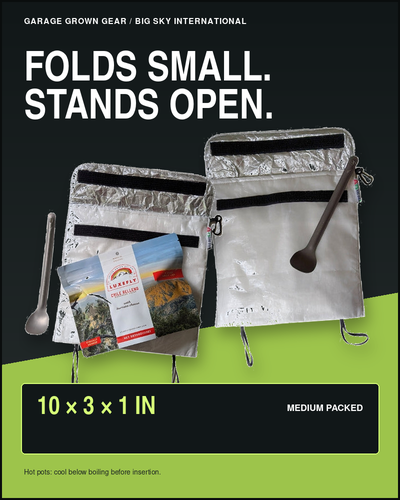 Insulated Food PouchLightweight insulated pouch that keeps trail meals hot while they rehydrate.
 © Beartooth Media Group Inc.
 Loading...