Topic

Snowpeak Litemax stove

  • This topic is empty.
Viewing 25 posts - 26 through 50 (of 56 total)
PostedJun 25, 2008 at 8:39 am

With either stove, I would definitely use a windscreen of some kind. I have been using heavy duty aluminum foil, tall enough to reach to the top of my pot and long enough to wrap around the pot/stove with small gap to check the temp of the cannister.

I'm curious what others are using as a windscreen for their cannister stoves.

John G BPL Member
PostedJun 26, 2008 at 10:59 am

I used to use a PR, and switched to a Gigapower. The PR's swaying pot support arms are what caused me to start looking around, but I also ran some tests in my kitchen…

For my tests I used 2 brand new MSR large (4oz?) canisters, and a fan aimed directly between the two stoves (the stoves were about 15" apart), and 2 identical 1.5L steel & copper "kitchen" pots that were about the same diameter as my MSR 1.5L pot. I measured 2 cups of water into each pot, and set each stove's gas valve so the flames heated the bottom fully, but didn't spill up the sides of the pot much.

With no wind (fan), the bubbles started rising at a "low simmer" type of rate at about the same time on both stoves.

With "wind" (medium speed fan), the SP was a LOT faster than the PR. The PR's flame was being blown sideways MUCH more than the SPs. Approximately 75% of the SP's flame was still on the pot, but only 45% of the PR's.

With a "breeze" (low fan speed), I got results about in the middle.

With "Gusts" (high fan speed), the PR usually blew out, and the SP's was out on the side nearest the fan, but OK on the other side – but the flame was bent enough that only half of it hit the pot. It was obvious that the side-ways flame pattern was MUCH better in wind, because the central cone shielded one side of the flame from the wind (so it took about twice as much wind speed to blow it out) – and that side would re-light the blown out side after the gust subsided. The PR had to be relit by hand.

I also tried the medium speed test again, but this time I switched the gas canisters, and also switched which stove was on the left versus right (in case the fan didn't blow evenly) – but got the same results.

I also noticed that the SP was HUGELY more stable than the PR with my MSR 1.5L pot at 4cups of water.

I'd guess that the litemax would work even better in the wind due to the shielding from the pot supports. I'd worry more about the long-term stability of the pot support joints, and whether the lighter (less dense & softer ?) central stalk gets eaten up by the hard canister threads even faster…

PostedJun 26, 2008 at 12:12 pm

Interesting results. These seem to conflict with Ben's experience of the PocketRocket performing BETTER, not worse, than the Gigapower in wind.

Yesterday, I performed several tests of the PocketRocket vs. the Litemax in calm (no wind) conditions. I hope to have the results tabulated in Excel. (How do I post an Excel file here?). Today, I'll try the fan test with both and let you know what happens.

Stay tuned…

Martin Rye BPL Member
PostedJun 26, 2008 at 1:19 pm

All I know is on top a Scottish Munro once I had a gigapower and friend a Pocket Rocket. We each had a same size pot and were melting snow for a brew. He got a brew faster no doubt and his pot has blue marks to this day from the heat of his stove (it sorted warped the base a bit). The Pocket Rocket is fast in the wind vs the gigapower….. Saying that I hated that stove, slow to boil compared to a PR (which I own one as well), it flared up once with a fault. It got recycled a while back

EndoftheTrail BPL Member
PostedJun 26, 2008 at 4:24 pm

Yeah, having owned both stoves (PR and Gigapower) — I have to say that my experience differed from John's — as stated in my post above.

I carry a sectional blue foam pad that functions as the foot section of my sleeping bag, camp chair, and also windscreen when needed. I've found that I reach for my blue foam "windscreen" more often with the Gigapower than with the PR.

PostedJun 27, 2008 at 10:21 am

How does everyone carry the litemax? The pr's durable triangular case is very cool, but I've read that the litemax only comes with a cloth case. Is it fairly durable folded and packed away?

PostedJun 27, 2008 at 10:41 am

The litemax compacts so small it can fit inside my 400 mL MSR Titan mug(!). I would wrap it with an UL dish cloth or handkerchief of some kind.

EndoftheTrail BPL Member
PostedJun 27, 2008 at 10:46 am

Bobby:

I like my kitchen to be "self contained" — everything together in one place.

When I had the PR, I filed and rounded off all three pointy edges of the potstand so that I could fit the stove, a fuel canister, a BIC lighter and a towel all inside my Snow Peak Trek 700 pot/mug — nice and fully protective. However, that pot/mug was actually bigger than what I needed — and so later…

I sold both PR stove and Trek 700 pot/mug and replaced them with the smaller SP Gigapower stove and and SP600 pot/mug instead. This is the most compact "all in one" arrangement that satisfies my need to boil 1 pint of water at a time.

My understanding is that the LiteMax is even smaller than my Gigapower stove, so it too should fit nicely inside an SP600 pot/mug — nicely compact and fully protected.

I never used the plastic cases that came with the PR or the Gigapower.

PostedJun 30, 2008 at 7:26 am

After hours spent in my chemistry lab and contributing significantly to global warming through CO2 emissions, I have collected quite a bit of data to share with you regarding the Snowpeak LiteMax and MSR PocketRocket cannister stoves.

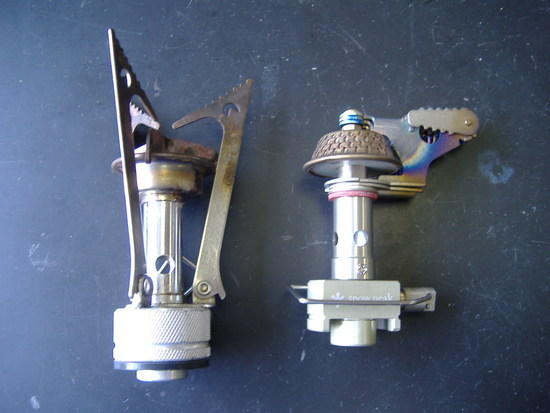
Here are the stoves side by side. As you can see, the LiteMax is signficantly more compact.
LiteMax and PocketRocket side by side

Here's the data:
http://spreadsheets.google.com/pub?key=polDrnWwATfekhIh3myF5Gg

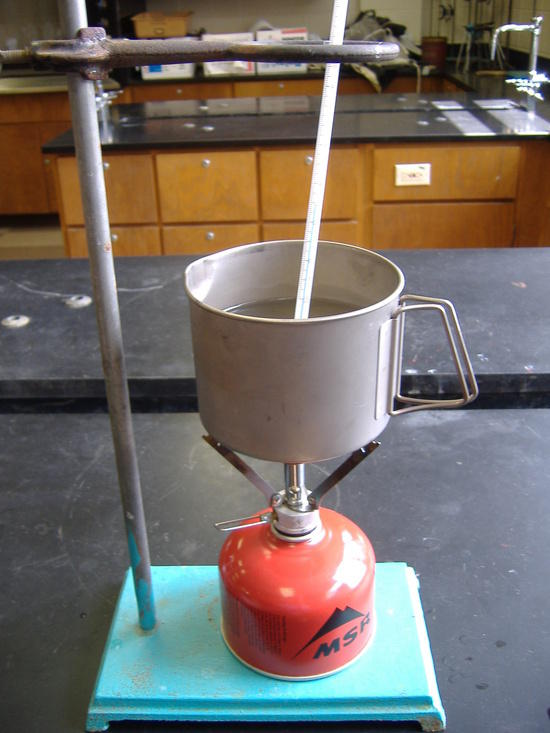
In my experiment, I performed two separate tests. For both tests, I used 500 mL of water at room temp (measured each time prior to heating), MSR or Snowpeak fuel cannisters (noted in data table), and my MSR Titan pot. Tests were performed near sea level.

Here's what the experimental setup looked like:
experimental setup

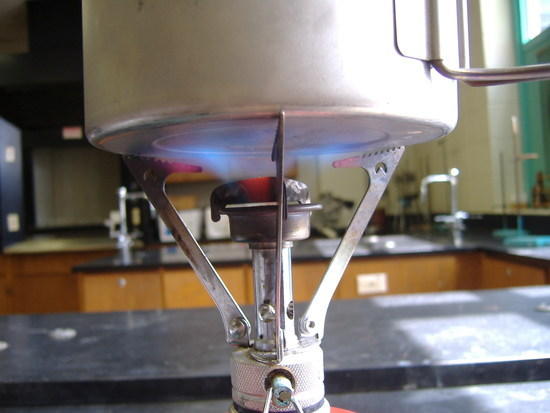
Test #1: The first test measured the relative efficiency of both stoves under calm conditions (no wind) in terms of their fuel consumption and boil time. As you can see from the data, the PocketRocket had a slight edge over the LiteMax in both fuel consumption and boil time. Boil time was about 30 seconds longer with the LiteMax.

Here's the PocketRocket in use:
PocketRocket in use

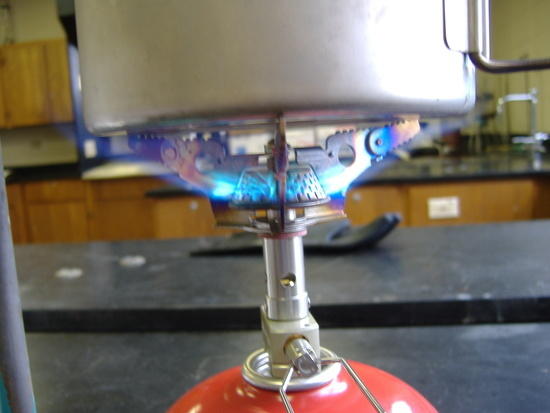
The LiteMax in use:
LiteMax in use

Test #2: In this test, I measured the performance of both stoves under windy conditions. For my setup, I used a large electric fan placed approximately 0.5 meters from the stove setup. For this test, I measured fuel consumption and time at end temperatures less than boiling. Here the difference in performance was shocking. The PocketRocket consumed about half as much fuel as the LiteMax and took about a third of the time to reach the desired temperature. The side-shooting flames of the LiteMax were clearly being blown downwards and sideways–away from the pot bottom–while the PocketRocket's flame was shooting steadily upward. Even watching the mercury rise in the thermometer, it was clearly obvious that the PR was much faster. Another concern with the LiteMax is that the side-shooting flames. combined with its lower profile, tended to heat the fuel cannister to the point where I was worried about sticking my face too close to the experimental setup. With the PR, the flames stayed vertical and its higher profile allowed me to feel alot more comfortable whilst eyeing the stove at close range.

Data analysis and other observations: I was rather disappointed with the LiteMax. I really wanted this little stove to win. I love the fact that the fact that the LiteMax is an ounce lighter than the PR (2 oz vs. 3 oz) and packs up so small–small enough, in fact, to stow inside my 400 mL Titan mug. The PR, on the other hand, is rather bulky and inconvenient to store. The edges on the pot supports are rather sharp. Use of the plastic case would help but would add an extra ounce to the setup–making the PR twice as heavy as the LiteMax. On the plus side, though, the PR is more comfortable to screw on than the LiteMax and feels more solidly set once screwed on. The PR has an ergonomically rounded, knurled base, while the LiteMax's base is squared off. The LiteMax also lacks a rubber washer between the stove base and the cannister. Another advantage of the PR is that the knurled base cools significantly faster than the LiteMax's. Within a minute or two, the PR could be detached without burning your fingers, while the LiteMax took five minutes or more. Regardless of these advantages and disadvantages, the LiteMax clearly can't cut it in wind. The question remains whether the LiteMax could remain competitive if used in conjunction with a good windscreen. (Perhaps it's time for test #3!).

Conclusion:

PocketRocket Pros
-Slightly more efficient in calm conditions
-Significantly more efficient in wind
-Seats comfortably and solidly on fuel cannister

PocketRocket Cons
-Takes up more space
-1 oz heavier
-Pot supports are sharp
-Pot stability not the best

LiteMax Pros
-Folds up super small
-Super light (2 oz!)
-Pot stability slightly better

LiteMax Cons
-Slightly less efficient in calm conditions
-Performs horribly in wind

As you can see, there is a trade-off in terms of features. None of these stoves is perfect. To me, however, the extra ounce of weight and extra space for the PR is worth its significantly better performance in real-life, windy conditions. I think it boils down to (no pun intended) the question of whether a good windscreen would level the odds and make the LiteMax a useful stove.

I'm curious to hear from you guys what windscreens you use for your cannister stoves and how effective they are in increasing stove efficiency. In particular, how do those of you who own the LiteMax deal with its poor performance in windy conditions?

PostedJun 30, 2008 at 7:54 pm

Just updated above post with pictures. Feedback?

PostedJun 30, 2008 at 8:32 pm

My (partly) titanium Vargo Jet-Ti burner is almost identical to the Litemax. The Litemax has slightly wider pot rests but otherwise it's the same burner.

And, yeah, canister cooking is as clean and easy as it gets. Its's my summer stove of choice if I have an easy trip of 3 or 4 days W/ no steep climbs where I want less weight.

Eric

PostedJun 30, 2008 at 8:41 pm

Eric,

How does your Vargo handle wind? What type of windscreen are you using with your stove, and have you noticed comparable fuel consumption with said windscreen?

Jason Brinkman BPL Member
PostedJun 30, 2008 at 11:23 pm

Wow, great work David. Those kind of results are certainly pretty definitive.

Now I am wishing for a third parallel test of the Giga Stove GST-100.

I purchased a Snow Peak Titanium Bowl a while back that weighs 1.6 ounces. It should be big enough to fit around a mid-size pot as a windscreen. I saw pictures here a while back from someone else who did this – they fit the bowl under the burner head and pot supports, but above the cannister. This may help the Snowpeak burner head be a little more efficient. I plan to make one to go with my inverted canister winter stove setup, but I haven't done it yet, so nothing to share.

PostedJun 30, 2008 at 11:37 pm

The much maligned "narrow flame" of the Pocket Rocket becomes an asset using narrow pots. I have the Kovea version of the Lite Max ( as Roger hinted , the Vargo,Snow Peak and Kovea are similar…) and it suffers in the wind, so I used a wind screen. Using that a wider pot and low to medium setting makes a big difference on fuel economy, but without protection in the wind you need full flame and good luck.
But of course I have gone to the Caldera Cone now…. ( Hi Ben)
Franco

John G BPL Member
PostedJul 1, 2008 at 6:44 am

I think I see why I got different results…

I used (kitchen) pots that overhung the pot supports by a couple of inches. The width of the pots was between the width of the MSR 1.5L and 2L pots, but a little closer to the 1.5L width. I also adjusted the flame on both stoves to the point where there was no "wasted" heat going up the sides – or bouncing off the bottom of the pot, and going back toward the fuel cannister.

As a result of these 2 things, I suspect that the gas valve was more open on the SP than the PR. If so, the higher flame velocity would have given the SP an advantage in the wind test. If I would have tracked fuel consumption, I would know for sure…

The SP is still a LOT more stable with 1.5L pots though, so I probably stick with it unless the PR gets significantly better fuel efficiency.

PostedJul 1, 2008 at 1:18 pm

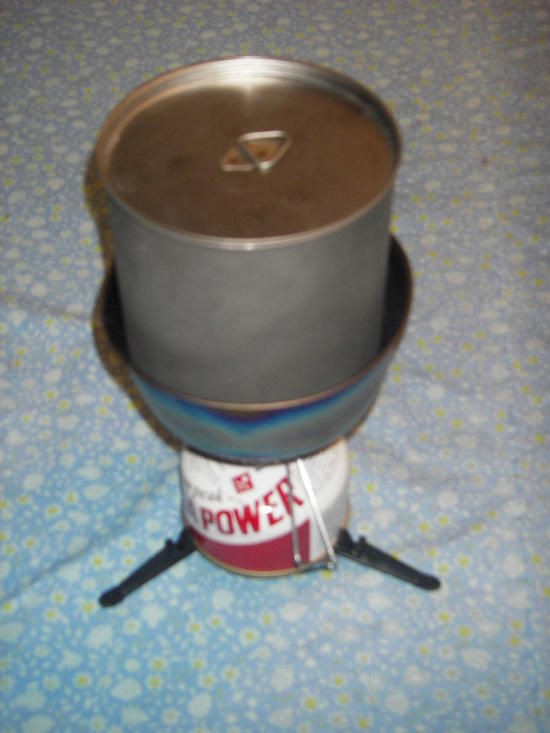
Here are pics of the Snow Peak bowl "GigaWind" screen.
SnowPeak Giga-Power Stove with FireLite SUL-1100 Pot
It works great with the BPL SUL-1100 pot, or a pot of lesser diameter. Any larger and there's not enough exhaust space. I've had this out in about 15mph+ wind and it worked very well.

EndoftheTrail BPL Member
PostedJul 1, 2008 at 1:37 pm

Denis:

Can you tell us more about your windscreen? Where did the material come from? How much it weighs? Thanks.

PostedJul 1, 2008 at 3:00 pm

Ben2,

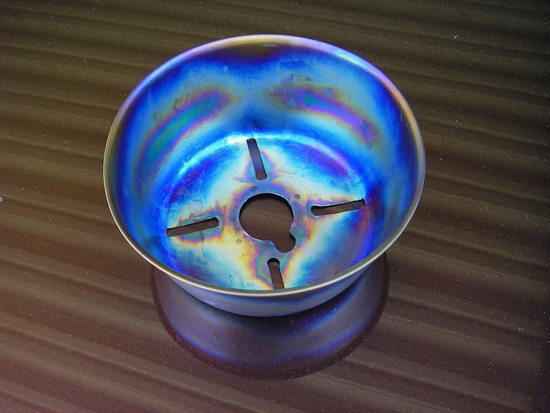
I used the Snow Peak Titanium Bowl and a drill and Dremel Tool to cut the slots/hole. I just took the photo and weighed it. It's 1.69oz. as shown. If one were less ham handed than I the cuts could be made much smoother. The most important fit is the large diameter hole for the burner head. It should be a fairly close fit. I used the standard Snow Peak Giga Power "Wind Screen" for a pattern, and scribed the "holes" onto the bowl. This made it much easier to get everything lined up. The outside end of the slots for the pot stand should be trimmed only long enough to allow the pot stand legs to fully deploy. I cut mine to match the standard wind screen and the bowl wobbles a bit. It still works but could be better.

Snow Peak Bowl modified for use as wind screen
Snow Peak Titanium Bowl modified for Giga Power Stove windscreen.

PostedJul 2, 2008 at 11:39 am

Denis,

Interesting setup. Does add a bit of weight, though, don't you think? Also, the bowl will take up space whereas a foldable windscreen is easily stowed in your pot.

I'm curious whether you think the holes underneath provide enough ventilation for oxygen intake.

I'm also curious what others are using as windscreens for their cannister stoves. I'll post pics of mine when I get a chance.

PostedJul 2, 2008 at 5:49 pm

David,
I got some input from Roger Caffin. He said that the exhaust was some more important. The exhaust area for my setup is about 5 square inches. Sans Roger's level of laboratory testing, it seems to breathe alright. One thing about the Snow Peak bowl: I never worry about it blowing over.

PostedJul 3, 2008 at 11:18 am

Thanks for the link.

I ran across Ryan Jordan's windscreen here:
http://www.backpackinglight.com/cgi-bin/backpackinglight/00041.html

He made a heat reflector that sits above the cannister to support the windscreen. This way, the stove is entirely enclosed. I've been setting my windscreen on the ground, but this requires a larger windscreen and is not always the most stable.

I'm wondering if there are any DISADVANTAGES to the heat reflector option. Could the stove itself overheat and cook? (I think I remember reading something about this in one of Roger's articles).

PostedJul 3, 2008 at 11:23 am

David,
My post above contains pointers to the articles you are wondering about.

I'm curious….did you read it?

Viewing 25 posts - 26 through 50 (of 56 total)
Loading...