


Request for ye owners… I've viewed the video and read the comments but am interested in more feedback. Please post any additional impression and/or actual experience here or at the User Review section. Thanks in advance.
Topic
Become a member to post in the forums.
Request for ye owners… I've viewed the video and read the comments but am interested in more feedback. Please post any additional impression and/or actual experience here or at the User Review section. Thanks in advance.
Hi Ben. Good to see you back. Been traveling? Any place good?
I just got back from a three day walk with the One yesterday. It was great, just what I wanted. It’s still very much winter in the mountains here, so it wasn’t exactly the warmest shelter around, but it did exactly what I expected it would/ And since it was pouring rain, freezing cold, and quite windy, I had a chance to see how it did when the weather gets bad.
I don’t have time at the moment to go into more detail at the moment, but suffice it to say that I love the One and it will probably be the shelter I use for most trips from now on. I can’t see anything else replacing it.
Here are some pictures (the last picture I rushed to set up the One just to get Mt. Fuji in there, hence the awful pitch):


Wow…nice view to wake up to. Thanks for the photos. Looking forward to more comments.
Yes, very nice pics, and thanks, Miguel.
I'm in Tel Aviv right now, heading back home to LA tomorrow. Looking forward to more feedback from you and others.
This shelter looks very similer to the Hilleberg Rajd tarp tent. Has anyone used the Hilleberg Rajd?
Just a quick comparison shows:
The GG shelter "The One" sleeps one, has 17.5 sf of tent area and weighs 1.2 to 1.5 pounds.
The Hilleberg "Rajd" sleeps two, has 25.8 sf of tent area and weighs 2 pounds.
If a person likes the GG "The One" but would prefer more room or the ability to sleep two the Rajd looks to be a good alternative (at about twice the cost).
nm
Definitely similar construction. The condensation ventilation is probably not quite as effective, because there does not appear to be a bathtub floor attached with bug netting, and the front entrance only has partial netting. No doubt better storm resistance though. An interesting tradeoff, thanks for posting that.
BTW, I recently purchased The One myself, and am looking forward to getting out there with it. I'm going to set it up this weekend and do the seam sealing.
I have been using this shelter for the past month as my shelter of choice. Gotta say I love it! :)
In case you have not read a previous thread, check out my photo and comments at:
http://www.backpackinglight.com/cgi-bin/backpackinglight/xdpy/forum_thread/11751/index.html
Here is another pic to show its sleek appearance:
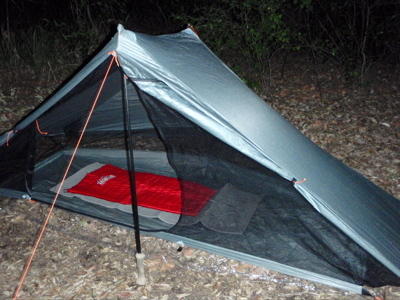
I like the fact that hikers can us a multi-support system: 1) adjustable trekking poles, 2) fixed length trekking poles (120 – 130 cm) or 3) segmented tent poles available through GG. I love my 115 cm fixed length Lightreks so much that I just use a rock to increase the height of the rear pole.
I have repacked my One into one of the new GG spinnaker stow sacks(Size Small); fits better in my GG Miniposa. Total weight including stakes and polypro = 21 oz.
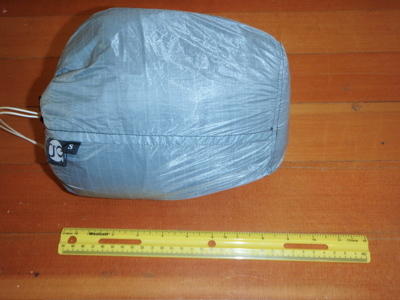
I will be using The One on my PCT Section A hike next week (3/31 – 4/3/08) and will post more photos and comments.
A single wall tent I own that is similar in length, weight and area of covered protection is the BD "OneShot". This little tent is, in my opinion, a very worthy alternative that is basically free standing, requires only four stakes, provides good weather protection with it's epic shell and has descent ventilation. With it's low profile it performs well in above tree line wind conditions. Draw backs to the OneShot are it's limited head room at only 36" and it takes some practice to dial in the interior pole setup (think Bibler). The epic fabric has its limitations but has performed well for me. If your under 6' this is a very nice little tent, again in my opinion.
David,
The One has replaced my Rainbow. I now use the Rainbow as a loaner for backpacking friends to introduce them to a lighter shelter, and in car camping.
Compared to a Rainbow, the One is:
1. Lighter – The One (15 oz) vs Rainbow (34 oz). (With my 6 stake and GG poly pro ground cloth setup)
2. Easier to set up. I have it down to 3 mins.
3. Easier to close – zipper vs velcro
4. Sturdier with two pole support; works better in windy environments.
Shelters just keep getting better (and lighter)! :)
I think some people are called gear whores for a reason… :)
On paper, anyway, I'm liking the Contrail more. Though about 7 oz. heavier, it it also $76 cheaper and seems to have more space.
I use a SMD lunar duo for most trips but am planning to get a one-man this year.
Any thoughts?
nm
I like my one shot, its the lack of a vestibule that is a concern for me. Do I need a vestibule? Probably not given that I am happy to use an Integral Designs Bivy.
Roger, Send me a PM and I will share what I've done for a vestibule on the OneShot, I think you will find it interesting. I don't want to take this thread in a different direction and away from the GG "The One". I would likely qualify for that "gear wh…" comment but I take no offence.
Thom:
Gear whorre describes those of us who are forever lusting after new/better gear — and this definitely includes the guy who started this thread. :)
Like I said, I qualify.
Right, so now I've got a bit more time to sit down and answer the questions a little more carefully.
I took the One on a three day traverse of the westernmost section of the Tanzawa mountains west of Tokyo (and east of Mt. Fuji). The mountains are not high and lie right along the Pacific coast in the southern half of Japan and so don't get the deep snow and Siberian temperatures of the Japan seacoast side of Japan (my friend in Nagano reported five meters of snow outside his door three weeks ago!). I figured that most winter weather in the Tanzawas would be equivalent to the coldest summer weather I would get in the Japan Alps in summer and so wanted to try and see how the One fared as a mountain tent.
I practiced setting up the One outside my home quite a few times, so that once I got into the hills it was a snap to set it up. I think it takes me about three to five minutes if I'm not in a big hurry. Setting up the One is a little bit tricky since you have to get the corner tie-outs at just the right tension and spacing so that the bathtub floor is even and the walls don't sag when lifting the tent up later with the rear pole. I found that the trickiest part was positioning the rear hiking pole just right. You have to get it the right length (I found that adjusting it to 125 cm, as per the front pole, seemed about just right) and then pull it back far enough so that the bathtub floor side section is taut, but not so far back that the bathtub floor gets pulled out of shape. I also found, every time I set up the shelter, that using my Titanium Goat adjustable poles with their rounded foam handles, had a tendency to twist out of the "boot" that holds the handle end of the pole at the base of the tent, while the flared handle of my regular hiking pole (which the GG Light Treks also have) held in place. I've spoken to Glen about this and he said he would look into it, but it's really not a big problem if you tension the rear pole enough.
Once the rear pole is up the rest of adjusting the tent is easy as pie. Just insert the front hiking pole, and then walk around the shelter pulling on the guys until the walls have a nice, tight, thrumming pitch. When all is done if you tug on the roof ridge you will find it very stiff and sturdy, very ready to handle strong winds. The tent has a very reliable feel to it and the lines immediately make it obvious that they will shed wind.
During the trip it rained very heavily for two days and on the second day the rain was accompanied by strong winds (though not a storm). Never once did I get wet inside or feel unprotected. The winds buffeted the tent at times, but with the two tent poles, unlike with the Gatewood Cape, the walls stayed pretty much firm and didn't shake as much as the Gatewood tends to do. For those who use the Rainbow the feel of the tent was very similar… both are very sturdy and trim and handle wind quite well, but unlike the Rainbow the roof ridge also stayed put, not giving so much to the pressure of wind from the front or rear. A surprise was how quiet the material was when wet. There wasn't much difference in the wind between the sound of silnylon and GG's spinnaker cloth. In dry conditions that is another matter, though with a taut pitch I didn't find the sound annoying at all.
One thing I made sure to bring were two eight-inch front and rear thick aluminum stakes just to be sure that the front and rear guylines were very securely pegged into the ground… the tent's stability is determined by these two points. Even with the longer stakes I found it was easy for the stakes to get pulled out of very wet, loamy ground.
One thing I am concerned about is the open front vestibule. Even with the tent lowered directly to the ground against wind, the vestibule was still quite open and cold air blew through the tent while I slept. Rain never got in, but I suspect that if I would take the tent up to alpine regions where the wind often blows horizontally, I might have problems with rain getting in the tent. I brought my Vapr Bivy so as to keep warm in my quilt and the quilt did a good job keeping me dry with the foggy clouds that rolled in throughout the trip.
Condensation was as expected… a thin film over the walls come morning. But the interior of the tent is roomy enough that I never brushed much against the walls and so the condensation wasn't a problem. With the open vestibule, side vents, and large rear window air flowed well through the tent.
For larger and taller folks I think the interior dimensions, like the Rainbow, will please a lot. It doesn't have quite as much floor space as the Rainbow, but it is long enough to accommodate over 6 footers in their puffy sleeping bags, with a little room to spare.
I haven't tried yet changing the corner guyline configuration, so I can't say whether setting up the tent with them attached or separating them is better. There are still a lot of things I will be finding out about the One as I use it more. I only just got it and haven't had any time to go hiking in a whle, so it's pretty new to me, too.
After I bought the Rainbow and learned of its limitations I was determined to be very careful about my next purchase, in great part because I've reduced the belongings I have at home and don't want to start accumulating stuff again. Things I didn't like about the Rainbow:
1) Having to bring an extra tent pole in addition to the hiking poles I always bring. Plus this hiking pole was very long and ungainly. I felt its length was a weak point in the tent's strength.
2) The unstable cross-sectional apex ridge pole that easily gave under pressure from the hand.
3) The velcro in the doors… probably more than anything the part I most disliked about the tent, especially in strong, windy, rainy weather.
4) The inordinate amount of seam sealing I had to do for a very leaky shelter.
I chose the One,
1) Because it was much lighter than the Rainbow.
2) Because it made use of my already available hiking poles.
3) It used two hiking poles for extra strength.
4) It had a small footprint (which the Rainbow also has) for those mountain sites where space is at a premium.
5) Was made of spinnaker cloth which doesn't stretch much in the rain.
6) Had a zipper door for easy opening.
7) Packs down really small for packing.
The One is truly what I've been looking for and is the shelter I wish I had had last summer in the Alps. My only concern in the open vestibule, which, after using the tent for a good while, I will have to determine whether to modify with extra to-the-ground flaps to keep out wind and wind-blown debris. For now I am very happy with it as it is.
Thanks, Miguel… great write up and many points to ponder over.
Definitely, cut & paste this into a reader review!
Interesting.. all these comparisons with the Rainbow.. yet when I look at it it looks very much like a Lunar Solo except with a second pole at the back to make the ceiling higher + reduce the footprint.
Become a member to post in the forums.
 Tactical Wool Thermo ShirtSuperfine merino wool-blend mesh baselayer with a slim unisex fit and densely knitted shoulder panels for pack-carrying comfort. Weighs 4.9oz | 140g
 © Beartooth Media Group Inc.
 Loading...