At last there's a full length bug net that's shaped to fit under an A-frame tarp. The Prismnet also works well on its own when skies are clear and you just want to stargaze. Made with high quality .67 noseeum, the 4.6 oz Prismnet provides the worlds lightest head to toe barrier against insects.* It also features 8 double reinforced tieouts to ensure bomber strength at the highest stress points. Dimensions are 29" high, 39" wide (base) and 6'6" long.
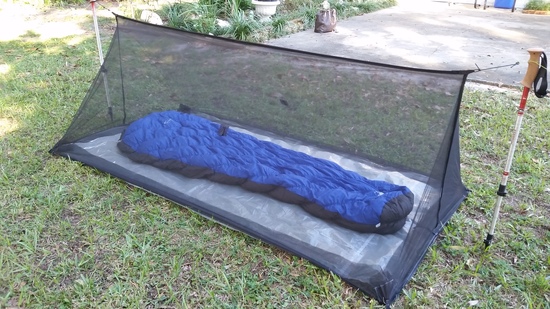
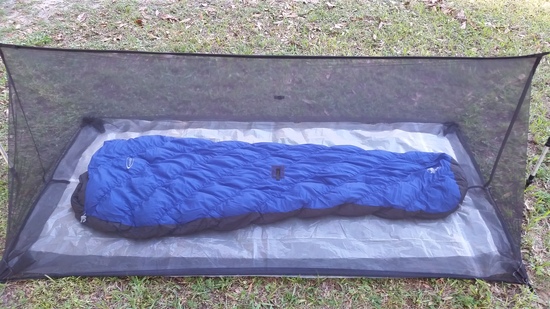
Who needs zippers when all they do is add weight and make it harder to get in and out of a bug net. A corner rock pocket on the Prismnet allows you to easily secure it upon entering. And the 5 inch wide underflaps, when combined with a proper fitting groundsheet, makes the Prismnet virtually bugproof. Also provides much more space than a confining bug bivy.
.It takes many many hours to make this net. The ridgeline is folded, pinned, ironed and sewn 3 times to provide 8 layers total. The doble reinforcements (.9 noseeum) and 1/2" grosgrain tieouts are very time consuming. Cost for materials on the Prismnet (wholesale) is about $25. *S2S Nano isn't made from noseeum and it's almost useless unless the single pullout is pitched 4' high. Basically unworkable under a tarp.
Topic
Prizmnet- lightest ever full length bug protection!
Become a member to post in the forums.
- This topic is empty.
It looks like a bug crawling along the ground could easily walk on top of the ground sheet and under a fold in the bug net. How do you deploy the mid-panel tie-outs when pitched under a tarp? Is this for sale somewhere?
Good question. Actually the groundsheet is meant to be placed OVER the underflaps. I just showed it this way so the flaps could be seen. If the groundsheet is cut to just the right size it's really hard for ants to get in. Not impossible though. I would make some to sell if people were interested. For years I searched for a bug net that would fit under an A-frame tarp, but I finally gave up. Then I just decided to make one myself. This is my 4th prototype. The first 3 were not the right dimensions. Mid panel tieouts could be fastened to a cuben tarp by simply sticking on a couple of tape-on tieouts. With silny I'm not certain, but I'm sure there's a way.
One thing that has always kept me from moving into tarp freedom is bugs. Mosquitos love me, and I'd have to have a way to keep them out. Crawling critters don't bother me much, although a nearby ant hill might change my tune. This looks like it might be a viable alternative to a bivy. Can't stand a bivy's confining space, that's why I quit using mummy bags to begin with. 4.6 ounces for the bug net, plus a tarp might be an attractive low-weight solution.
If I understand correctly , you enter and exit via a corner. (?) How does that work when you have an A tarp over it ?
Interesting concept and nice execution. Have you thought about adding a few velcro tabs to the bottom of the net and to the ground cloth to keep it better secured? Velcro sucks around mesh, so i would put the soft part on the mesh and the hard, grabby part on the ground cloth.
Are you selling these Monte?
INFO
I find that out West that you do not need nano or even noseeum netting. Don't have those pests here. It's bad where you live. It blocks too much air movement. Option for plain mosquito netting would be great.
Franco- When pitched under a tarp, you can enter from the end by just raising up one corner of the net. Opens up plenty large enough. While doing it the other 3 tieouts stay amazingly taught. Just In Time- Good idea about the Velcro. Justin- Yes I will make some to sell, but with the high cost of materials and the 12 or so hours it takes to make one, I'd have to charge $65 plus $4 shipping. A non noseeum net would be a little cheaper. Ken- You are right. I spent 8 years in Arizona and all I used was Stansport rectangular net WITHOUT noseeum. I'm going to look into regular mosquito material for the Western market. It's considerably cheaper and I think some of it comes in wider widths than the noseeum.
Monte, good job. I think a vid demonstrating entry/exit would be helpful. Noticed yoir locale. Living in gainesville now, it's starting to feel real nice down here! Looking forward to some ultralight forays into Ocala soon! Got materials for my inide out tent prototype yesterday. Looking forward to building it this weekend. Happy trails.
Matt, soon I'm going to do a 78 mile Ocala thru on the FT. PM me if you think you might be interested.
Running the numbers on your dimensions, your 8 guy points only added 0.6oz. Tarps generally add 2 – 3 oz. Nice work! If you taper the foot so it can fit under a tapered tarp, you could take another ounce off. Some options that come to mind to reduce the effort on the ridge line: – leave it at a double layer and add 1/2" grosgrain; adds about 0.1oz – sew a channel and thread it with 1.25mm z-line; about the same weight – put tie-outs in the middle of the net and tarp ridge lines and then you don't beef up the net's ridge line; probably about the same weight, maybe lighter
Speaking of UL guyout points. I've had some left over cuber fiber scraps, to which i sew some silnylon on the inside. Makes awesome UL guyout. The silnylon on the inside deals with the abrasion and the cuben takes care of the tensile strength.
Thanks Rene. I did think about making a net with a tapered foot end. Not sure it would knock off a whole ounce, but I could at least get under the 4 oz mark.
Yup, my bad. Must have fat fingered the calculator.
I think you've got something here Monte, especially for the long distance crowd. $60-$70 seems like a good price point to me for full bugproof comfort. It would be quilt a bit cheaper than a full net tent, and more versatile. I, too, would love to see some exit/entry vids or pictures. Great stuff
Kelly, thanks for the good word. Tomorrow I'm going to take a bunch of pics showing entry and exit. It's actually quite easy. The only tricky part is placing the groundsheet back just right. Takes a little doing, but that's the only real drawback. Rene, yea, now you got me to thinking about building another prototype with a taper/slope (shorter and narrower at foot). I figure I could get the weight down to about 3.9 oz. Of course sometimes I wonder just how many SUL minded people are still around to appreciate such insanely light weights.
Super Monte, pushing the boundaries. There are definitely some around that still appreciate such work and thinking. Playing around in this prototype for a while might be beneficial on working out dimensions that work for you. In my experience when relying on various (albeit all bought) mosquito nets to avoid catching nasty stuff in various places (Malaria, Dengue, Japanese Enceph, Tsetse…), one tends to brush up against the net when sleeping and/or sitting and doing camp tasks inside, a (personally) disturbing amount. I think the foot end is a big place to save weight on dimensions, but then you risk ending up with your feet against the netting while asleep in the night…on a night where you are in a quilt or bag or wearing pants and socks its not a big deal, but on very hot nights it could be. A possible alternative while still saving weight on dimensions is to work out where this might happen and make those parts out of solid fabric, on the assumption that the bad things can't bite through it (not always a solid assumption with lighter fabrics…). You give up a tiny bit of cross air flow, but you can still lay there practically naked in the heat. Bathtub groundsheet sides that are ~8-12inches high at the foot end might effectively achieve the same purpose if built in. Of course, you might not ever want to use this thing in such conditions :-)
Become a member to post in the forums.