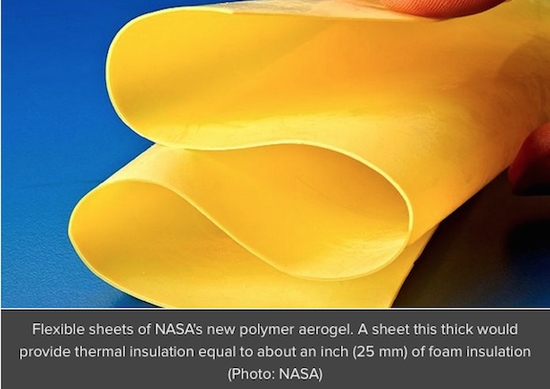
Weird….wonder how much it weighs…. https://www.kickstarter.com/projects/1338531979/lukla-endeavour-outerwear-for-the-21st-century-adv/description
Topic
Become a member to post in the forums.
Weird….wonder how much it weighs…. https://www.kickstarter.com/projects/1338531979/lukla-endeavour-outerwear-for-the-21st-century-adv/description
Seems like Aerogel products keep coming out over the years,Here is a Kickstarter project from 3 years ago Aerogel insulated jacket, by Anser and if you do a search on BPL you will see different Aerogel products that have come out and talked about but never seem to go anywhere
The hot new thing that's neither.

maybe a good product to have a kickstarter campaign for, would be aerogel kickstarter campaigns?
Here is a link I posted in 2010 about AeroGel clothing coming out : http://www.trailspace.com/blog/2010/01/22/outdoor-retailer-thinnest-extreme-suit-for-everest.html BTW, as I posted at White Blaze, AeroGel has been around since 1931

If they can ever make a more compressive and flexible aerogel, then it might be practically useful. But the stuff is brittle and doesn't compress. Accidentally fall with the jacket on, good bye chunks of insulation–now a powder. Also, how can they advertise it as air permeable? I thought that it was air impermeable? Isn't that how it insulates, by trapping lot's of air pockets that aren't subject to convection? The only possible use i could see for it in current forms, is winter outings with a pulk (where bulk is not as much an issue), and then sandwiching a layer of areogel between two layers of foam on either side to protect it from compressive forces (i may be saying it wrong, i don't know all the physics lingo). It might be "ok" in such a situation, but it won't be "breathable" even if the outer foam layers are perforated or even have large areas cut out.
"I thought that it was air impermeable? Isn't that how it insulates, by trapping lot's of air pockets that aren't subject to convection?" Yes, aerogels insulate by having very low heat conductivity – not only the solid portion which is minimal and not in a straight path, but thermal conduction in the >98% gas portion can be less than in 100% gas because the solid mess with the mean-fee-path (average distance between collisions) of the gas molecules. Aerogels also insulate by reducing convective heat loss – air doesn't circulate within them as it would in many conventional insulations. Aerogels don't reduce radiant heat transfer much because IR goes through them. But that can be easily, lightly, and thinly fixed with a radiant heat barrier (i.e. aluminized mylar, etc). I like that it was "invented by NASA in the 1930's" and while aerogels were discovered in 1931, NASA wasn't established until 1958. And if it feels TOO warm, you just have whack at it to collapse the aerogel. Alas, that process is irreversible, so you might want to buy yours from a place with a better return policy than Kickstarter. Edited to add: I wish appliance manufacturers would use aerogels in refrigerators. They put as much useable space inside a given size as they can, thereby skimping on insulation as much as they can because that's how people shop for refrigerators (limited by energy-efficiency standards). Aerogels would allow very high R values in almost no thickness. And unlike me while skiing, my refrigerator almost never falls over.
"A new class of mechanically robust polymer aerogels discovered at NASA's Glenn Research Center in Ohio" From Wiki : Aerogel was first created by Samuel Stephens Kistler in 1931, as a result of a bet[citation needed] with Charles Learned over who could replace the liquid in "jellies" with gas without causing shrinkage
Interesting about the polymer aerogel. I see that the article was written 2012. Almost 4 years later, where's all the polyareo gelly bling bling?
"And unlike me while skiing, my refrigerator almost never falls over." If it's not falling, you're not refrigerating hard enough.
With double paned windows, you get insulation up to about 1 inch. Skin effect of air against the glass. More than about 1 inch, air currents inside will reduce the amount of any additional insulation. If the aerogel would just made a space of 1 inch between an inner and outer fabric, it would produce a lot of insulation. If the material that makes up the aerogel obstructed air flows inside, it would provide a little more insulation, especially as you go over 1 inch. The percentage of volume that's the aerogel material is very small. It's almost all air. The aerogel material (aluminum?) has a much higher conductance than air, but when you multiply it be the percentage that it is in the volume, the heat conductance effect is small.
Did a little digging into currently available commercial forms of aerogel. Since the Kickstarter folks say it's breathable, i believe they are using woven blanket versions of the material. Basically the aerogel material is bonded to fiber glass or similar relatively flexible materials. Since it's woven, it probably is technically breathable/air permeable. However, it's going to be significantly heavier than other forms of the aerogels. If you read the comments on the Kickstarter, some people commented that it weighed more than they thought it would. It's probably a 3.5mm or 5mm thickness. If they are using one of the blanket materials, every time the material flexes, it will lose a little of the aeorgel material off the fibers, so eventually it will probably lose significant thermal retention efficiency.
"The percentage of volume that's the aerogel material is very small. It's almost all air. The aerogel material (aluminum?)…" It can be made out of various different materials, but the most common and well known is silica. Silica has much lower thermal conductivity than aluminum or other metals. The polymer form that Greg posted, has a lot of potential for practical applications. Super VBL for extreme cold weather? Thin layer on top of simple, UL air mattress for sleep pad? Super cozies for bottles?
Become a member to post in the forums.
 Brynje Mesh BaselayersBrynje baselayers use open mesh construction to move moisture away from the skin, create insulating air pockets, and help regulate body temperature across changing conditions and activity levels.
 © Beartooth Media Group Inc.
 Loading...