Topic

What size pot for winter?

  • This topic is empty.
Viewing 24 posts - 1 through 24 (of 24 total)
PostedAug 27, 2015 at 7:33 am

I haven't backpacked in winter but this is the winter that is going to change (woo hoo!). I know I will need a bigger pot for melting snow, but how big do I need to go? I've never needed to melt snow before. I FBC but because my caloric needs are substantially less than most guys, I'm able to get by with pint sized freezer bags meals. So it would be 2 FB meals/day + water for drinking. I currently use a 400mL pot solo or a 600mL pot if I'm with a buddy. Should I move up to a 1.3L? Or would 1.9L be better (this would be for solo use)? Obviously would love to stay with as small a pot as possible but not at the expense of sitting around forever waiting for snow to melt. Thanks for the help!

Mike M BPL Member
PostedAug 27, 2015 at 9:45 am

1.3 if you're relying on snow only; I'll use a 900 if there is some running water here and there

John DeMorris BPL Member
PostedAug 27, 2015 at 9:46 am

A short wide pot is the ticket. Word is the Evernew Ultalight 1.3L is great for melting show.

Mike M BPL Member
PostedAug 27, 2015 at 9:51 am

Agreed the 1300 Evernew is very nice for winter, pretty light for the size of the pot; my 900 is an Evernew as well

PostedAug 27, 2015 at 10:23 am

There are a lot of great comments in this thread. There are two that I would add. First is the the emphasis on an insulated board to support your cooking system (particularly if you are on a snow bank). I have seen more than one cooking system melt the snow substrate enough to shift in the snow and dump the contents. Second, camping in the snow requires a lot more fuel. Keep in mind that you will more than likely be melting your drinking water as well. I would guess that you would need 3X-4X the amount of water for drinking than you would use just for cooking. From the web; Melting ice How much heat would be required to melt the 50g of ice? The latent heat for melting ice is 80 cal/g. That means that 1g of ice requires 80 cal of heat to melt. Thus, 50g requires 50 x 80 = 4000 cal to melt. Heating water How much heat is required to heat 50g of water from 0oC to its boiling point of 100oC? Since the specific heat of water is 1.00 cal/g-oC, that means that 1.00 calorie is needed to raise 1g of water 1oC. Thus, it would take 50 x 1.00 calories to raise 50g up 1oC and 100 x 50 x 1.00 = 5000 cal to raise the water to its boiling point. That being said, it takes a while to melt snow. Resist the temptation to crank up the stove in order to melt the snow faster. If you do so, your stove efficiency will probably drop off. My 2 cents – Have fun.

David Thomas BPL Member
PostedAug 27, 2015 at 11:46 am

I use more hot water in Winter – a lot more – because I'll have hot tea and hot chocolate far more than in Summer. Partly because it is cold. And also because short days and long nights make for more time in camp than in the Summer. And then, if melting snow, it takes almost as much energy to melt snow into a liter of water as it does to boil a liter of water from liquid, 32F/0C water. Another issue with melting snow is that snow is really fluffy – you need 4 to 10 liters of snow to make a liter of water. Once you get the first load of snow melted and kind of warm, you can dump more snow into that warm water and it will settle into a dense slush quickly. I'd suggest you have some kind of scoop to transfer multiple loads of snow into the pot. That might be a bowl you brought anyway. It could be a avalanche shovel you brought for safety reasons or to dig a snow cave. If nothing else, a cut-down HDPE milk carton (1/2 or full gallon size) makes a very lightweight scoop, they're good below -40F and above boiling, dishwasher-safe, and they're free at the "#2 HDPE" bin at the recycling center. I like a pot with HX fins, but I'm usually out with my family of four. For 1-2 people, over 1-2 nights, the extra weight probably isn't worth the fuel saved. I use a little square of 1/8" plywood as a stove base. It insulates the canister from the snow and more importantly, give a stable base so you spill your noodles into the snow bank less often. Another option is to cut a 5"x5" piece of waxed cardboard cut from a produce box found behind a grocery store – that can double as a great fire starter. Or, a bit lighter: cut a square from one of those corrugated plastic campaign or "lose 30 pounds in 30 days (by yoyo'ing the JMT without enough food?)" signs. I've got all those materials laying around; if you want me to drop a chunk in the mail, PM me. Then there's the topic of keeping your butane-propane canister warm enough to keep working. That's worth a whole other thread (or searching for one of there existing ones).

Dale Wambaugh BPL Member
PostedAug 27, 2015 at 12:38 pm

Large aluminum pots are fairly inexpensive and will work fine for snow melting snow. A 2-quart Open Country pot is $16 at REI and weighs 8.2oz. It seems big, but you can fill it with other with other stuff to offset the volume. We have a set of the MSR Blacklite pots that do double duty for car camping. You can experiment at home with crushed ice (blender?) to get an idea of the process. The whole snow melt thing is the volume needed. The ratios vary with the type of snow, but it takes a lot. 10:1 is a common ratio given, but it might be 5:1 or 13:1. Anyway, your big old pot of snow won't look like much when melted. Having a way to add more is a good thing. Trying to add snow to a 1300ml pot is something to consider— I would like a bigger "target." Don't melt old snow that has red (or any color) streaks in it. Algae grows in snow and there are other bacteria and parasites that feed on it. Yellow is obviously an issue :)

PostedAug 27, 2015 at 12:59 pm

Thanks for all the great input. I like the idea of trying a cheap aluminum pot first to nail down size. Once I know that, I can spring for a ti pot. I will likely have a lot of dry, fluffy snow so I'm thinking that may make me want to a larger pot. Was thinking about trying a piece of reflectix under the pot as I have a ton of the stuff & carry a piece with me anyway. Thoughts?

David Thomas BPL Member
PostedAug 27, 2015 at 1:16 pm

>"Was thinking about trying a piece of reflectix under the pot as I have a ton of the stuff & carry a piece with me anyway. Thoughts?" Pros: lightweight highly insulative AND reflective of IR (helps keep canister warm. multipurpose (sit pad, padding against your back inside your pack, maybe a pot cozy.) It would largely protect the snow from the heat of the stove and spread the weights of the stove legs somewhat. Con: Not rigid. Snow underneath can be firmer on one side than another and/or weaken differentially as you use your stove. After multiple jigglings of the stove and adding weight to the pot, it might still dump your set up over. At about the same weight, I'd prefer the corrugated plastic sign material for its rigidity. It could be painted silver or covered with aluminum foil for the IR reflection benefit. Oh, wait. You said under the POT. As a place to park the pot when it is off the stove burner, it would be great – especially since you bring it anyway. If you meant under the STOVE (what I was talking about), it would help, but not be the most secure option.

Paul S. BPL Member
PostedAug 27, 2015 at 1:48 pm

I have no experience with them, but JetBoil and MSR have rigs to hang your pot/stove off the ground. You'd need their whole system as they have to lock together to work, won't be the lightest option for sure.

Jim Colten BPL Member
PostedAug 27, 2015 at 3:59 pm

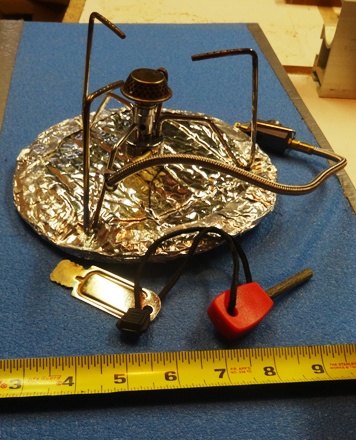
I made a double layer reflectix stove base last winter … taped together at edges with aluminum tape … all materials left over from insulating heat ducts. Not as rigid as plywood or corrugated signboard but it worked well enough.

Roger Caffin BPL Member
PostedAug 27, 2015 at 4:04 pm

This was for the two of us (wife + me), one snow trip. Cooks dinner, eats dinner. Heats a little bit of water for washing up. Starts washing bowls and cutlery. Dries cutlery. Chips thin film of ice off the bowls. Yeah, things froze that fast! Figure on using twice the amount of fuel as for summer time. Some of that is for melting snow, and some for more hot liquids. If it going to be really cold and no surface water likely, maybe even more fuel. Cheers

PostedAug 27, 2015 at 5:27 pm

Jim, you used the double-layer reflectix under the stove? That's what I was thinking — kind of tamp the snow down a bit to firm it up, then use the reflectix. I plan on using an MSR Windpro II, so won't have as tall a set-up as some — hopefully a little more stable.

Jim Colten BPL Member
PostedAug 27, 2015 at 6:11 pm

Jim, you used the double-layer reflectix under the stove? That's what I was thinking — kind of tamp the snow down a bit to firm it up, then use the reflectix. Yes, photo below. Try to get the platform as flat and level as you can. Whatever base you use will tend to slide easily. This winter I'll bring a couple nails to stake it down in one place. I FBC but because my caloric needs are substantially less than most guys, I'm able to get by with pint sized freezer bags meals. Be careful about that. I won't question how much food you need compared to anyone else but in winter cold enough for snow you'll likely want more calories than you find adequate the rest of the year. stove base

Bob Moulder BPL Member
PostedAug 27, 2015 at 6:12 pm

For solo, 1.3 liter, for 2, 1.8-2.0 liter. As Roger said, at least 2x summer fuel consumption and, I would add, at least 3x if depending entirely upon melted snow. Much more HERE about my go-to setup. I have no experience with Reflectix as a stove base, but for the remote-canister stoves I would make sure that the stove + windscreen + pot would not warm up it up enough to melt it. As with any critical item (and with UL they’re all critical, especially in winter), my suggestion would be to test it thoroughly before committing to an important trip. There’s absolutely nothing wrong with doing a quick car-camping trip with a short pop into the woods to test things. Combine a trip to test stove, shelter and sleeping system… very valuable experience. edit… fix link as usual

PostedAug 27, 2015 at 7:39 pm

Jim, thanks for the photo — that's pretty much what I was thinking. I like the nail idea. Not too worried about calories — I'm probably not headed out on anything but 2-3 nights at most and my super-slow metabolism serves me well. For 3-seasons I don't even fill the pint-sized bags. ;-) Bob, yes, a practice run was what I was planning. I'll cook first out on a day hike, then do an overnight near a TH. Since I'm almost always solo I'm pretty careful about testing everything in advance.

PostedAug 27, 2015 at 7:59 pm

I have two 2 liter pots, one a JB pot W/ bottom heat x-changer fins and one "normal" pot. I've had to grind a groove with my Dremel tool around the diameter of the JB bottom fins so they would fit over my Trail Designs Sidewinder cone. (i.e. the cone top now fits inside the groove.) Before that the pot "balanced" precariously on its fins so I did not take it. I'll still have to test it to see if it is any faster than my "normal" 2 L. pot. Oh yes, I'll likely have to remove the JB neoprene "pot cozy" or it may go up in flames and black smoke. BTW, The OP asked "what size pot for winter?" (i.e. for the OP) It depends; 1. group size 2. largest fuel efficient pot for your stove(s)

PostedAug 28, 2015 at 8:27 am

you put snow in the bag and leave it out in the sun. the bag warms-up and speeds your melting. try to have some water (an inch?)in the pot that's been heated before you start adding snow. if you have two pots that can be stacked, upper pot becomes the lid for the lower pot and gets warmed by the waste heat. make sure the pot you get has a pour area along the lip or can be bent to create one. if you are using a small neck (nalgene) water bottle, it's also helpful to have a funnel.

Bob Moulder BPL Member
PostedAug 28, 2015 at 10:40 am

Also helpful to have something to strain out spruce needles, bits of bark , etc. Lotsa bio-junk in the snow that you don't see until you melt it. One of those reusable plastic coffee filters works very well.

David Thomas BPL Member
PostedAug 28, 2015 at 5:35 pm

>"Lotsa bio-junk in the snow that you don't see until you melt it." True that. Or leave it in, call it tea, and leave the tea bags at home.

PostedAug 29, 2015 at 7:39 am

Lots of great advice/insight here — looking forward to some winter experiments. :-)

Russell Lawson BPL Member
PostedAug 29, 2015 at 5:45 pm

1.3 toaks with the bail handle switched with titanium wire, and the coated handles switched with titanium rod, and lid for steel foil. 3.3 ounces

Viewing 24 posts - 1 through 24 (of 24 total)
Loading...