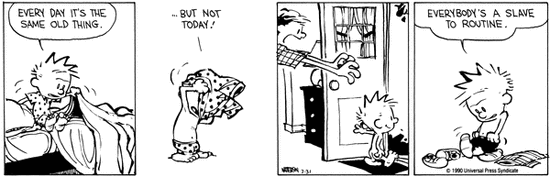
What? You mean you guys don't:
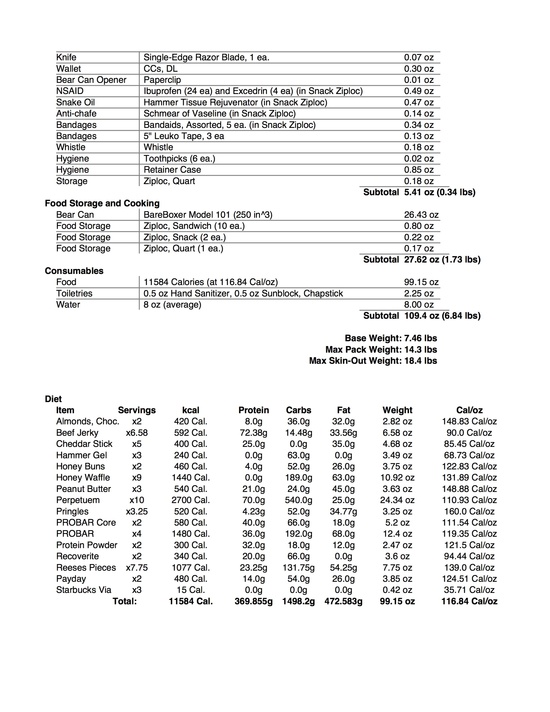
First, create your gear list. This is done, of course, using the Python code that you've written to generate a gear list, and spit it out as a pdf.

You have to run the code a few times, of course, as you tweak both the gear, and the food. The food needs are determined–obviously–by the algorithm you wrote to calculate caloric needs based on pertinent parameters of the hike. These are given to you as raw code outputs:

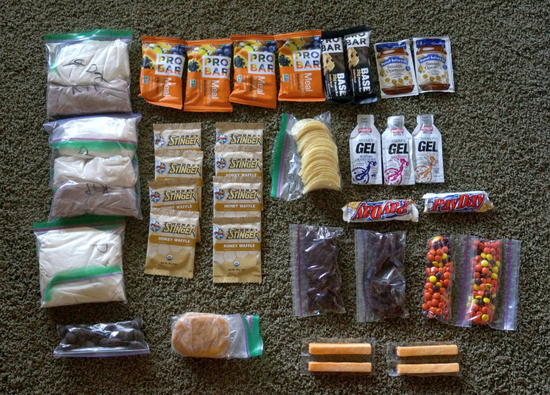
Once that's all squared away, it's time to pack. You don't just throw it in your pack; this involves a photoshoot, with some amount of glamour and aestheticism:


Everything is checked off as you pack it.
Now, how long is this hike going to take you? You could assume 3 mph, but instead, you extract the profile of the route, and run it through an algorithm that calculates–based on the model you developed from your own GPS data, of course–how long it takes you to hike, as a function of grade. This generates a profile where time is the x-axis:

But that–and the maps you already have–aren't enough. What if you want to know exactly how much climbing is between where you are, and where you'll be next? Better create a table of splits!

(only the first day is shown, because, you know, you get the idea)
Oh what's that? Something at work has come up and you can't go hiking? Oh, okay. You weren't really prepared yet anyway.
Kidding about the work. But, all this for a trip that was 48 hours long. AND, I'd done it before.
Not what I usually do (or recommend!). I think I get in a mindset that–when I have a hike coming up–I use whatever available freetime to try to do something productive towards that hike. This is the result of that. In that same vein, I've caught myself stretching out my quads four days before a trip.