Topic

TT Rainshadow2: Did I pitch it right?

  • This topic is empty.
Viewing 23 posts - 1 through 23 (of 23 total)
PostedNov 5, 2007 at 2:34 am

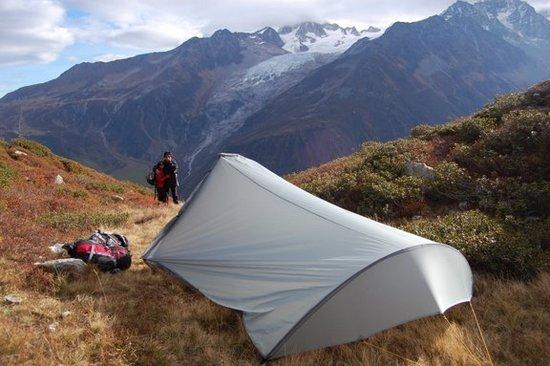
I pitched the Rainshadow2 with the tail end into the wind. There was a steady breeze that blew in from the bottom right corner of the photo.

TT Rainshadow2 pitched correctly?

It did a good job eliminating any condensation BUT it became really cold inside the tent. Did I pitch it right? What else could I have done to minimize the air flow in the tent (ambient temp 0degC that night)? I tried shielding the tail end with our packs but in vain. I also had the "beak" buttoned down. Could I have pitched it perpendicular to the wind? Or this is the inherent nature of a tarptent and I just have to live with it? Any feedback appreciated? Henry…?

Jim Colten BPL Member
PostedNov 5, 2007 at 5:14 am

Or this is the inherent nature of a tarptent and I just have to live with it?

It is inherent, and probably a major factor in you not having condensation. Site selection can help a lot … but from the photo it looks like there might not have been a place screened from the wind where you were located.

Looks like you woke up to a terrific view though!

Doug Johnson BPL Member
PostedNov 5, 2007 at 6:01 am

Hi Shah,

Yes- winds move through the Rainshadow, as they are designed to do. This is wonderful on a hot summer day and less so on an exposed ridgetop in November.

A couple of ideas:
– stuffing your packs at the foot end will cut down on breezes (which you did). Last weekend I used a nearby log and some rocks to create a windbreak too (my spot was just as exposed as yours)
– to eliminate the side collapse in this picture (you may already know this stuff), pull the hoop back and press the tips hard into the soil. Some folks use stakes at this spot and I've jammed trekking poles there as well. Also the side stake outs help in windy conditions.
– A tarptent is at its worst when pitched perpindicular to the wind- they flap a fair amount.
– In cold or windy conditions, site selection becomes key. A protected spot will keep you warmer. These things will work on ridgetops but they will be colder. Another option is using a bivy when pushing a Tarptent to tougher conditions.

Just ideas- hope there's somethign useful there!

PostedNov 5, 2007 at 6:46 am

Thanks Jim

Darn it! I was hoping it was a scr%w-up on my part. I so badly want the R/S2 to be my perfect family tent.

Yes…we woke up to a terrific view and had a wonderful breakfast.

PostedNov 5, 2007 at 7:14 am

Thanks Doug.

>Yes- winds move through the Rainshadow, as they are designed to do.

I kinda under-estimated the effect of fall/autumn at 2100m in October in the tent. I had found a "perfect" spot 1/2 hour earlier down the trail but it did not have a VIEW (sheltered behind big boulders)and too close to where the ibex were grazing…oh well, the compromises we make.

I wonder if it worthwhile carrying a small tarp and rig it as a lean-on to deflect the wind. It may seem I am complicating this setup, but next summer I plan to pitch the R/S2 on ridges where I can wake up to views similar to this. Maybe I should rethink and carry the BA SL3 which has a slicker streamlined design to deflect the wind. But aahh too heavy! Hopefully, summers in the Alps will not be so cold and windy.

Thanks for the feedback.

PostedNov 5, 2007 at 7:49 am

Hi Shah,

Doug said most of what probably answers your questions. The TarpTents are great tents, but be careful up on ridges in the Alps. Like you've probably heard the weather there is notorious for suddenly changing and powerful winds and heavy rains are very common. It is usual for rains to come evey afternoon, and often snow at higher elevations (about 2,000 meters and up), even in mid-August (it snowed three times while I walked last August, once down to about 1800 meters). TarpTents are not designed for alpine storms, so you may want to give your wife and daughter a chance to get more used to being outdoors before they face an above-treeline storm. Also, be very careful of thunderstorms on the ridges. They are very frequent in the Alps (much more frequent than here in the Japan Alps). If lightning is in the forecast I strongly recommend getting down off the ridges and not camping up there.

From the way the tarptent is pitched in the photo it looks like you didn't pull the front corners out far enough. What I usually do it stake out the rear first into the wind, then pull the front apex out with the hiking pole set into the grommet, staking that out with the guyline, and finally pulling out the front corners and staking them down. Usually if the weather is fair lifting the front end of the tarptent up to allow airflow will work much better in airing out the tent, but the flat apex strut of the tarptents make for a fairly unstable unit in the wind, so then you may want to lower the front and pitch the whole thing right down to the ground. As Doug said staking out the long sides of the tarp make a very big difference. Just be careful not to pull them out too far or the roof of the tent begins to lower.

I think TarpTents are fine for the TMB, but only for the lower level campsites, which are very common along the trail. It's one of the things I really worried about all summer before I left. After having experienced the trail and gone through some bad weather (there were some torrential rains for four days when I first arrived that took out an entire mountainside just north of Courmayeur, with temperatures at 5º C down in Chamonix. I don't know what the trail was like because I didn't walk for those four days) I would now be comfortable with a TarpTent, but would make very sure that I was out of the wind. If you want to camp higher up I would recommend a more wind-stable tent, at least until all of you have more experience. Alpine ridges are no place to begin learning how to pitch your tarp. Practice a lot before you go. I've gone so far as to practice pitching my tarps outside my apartment at night during typhoons just to learn what to do in unusual… and extreme… conditions. It's one thing to pitch a tarp on a calm summer evening, quite another when the fabric is flapping all about your face and you have no idea where that stake went and your fingers are cold and wet and stiff and you are exhausted from a long day's climb!

One thing I think is important here on BPL is that more emphasis be placed on learning techniques and practicing them until you have them down pat, than so much on gear. The gear is important, of course, but it does no good if you don't know about good sites and weather and what to do in bad conditions.

Keep in mind, those ibex at the lower elevation campsite that you found knew very well what they were doing. There is a reason why they frequent that place and not higher up.

EndoftheTrail BPL Member
PostedNov 5, 2007 at 10:36 am

Tarptents are perfect for use in temperate areas with low to moderate humidity. But they have their limitations.

Tarptents are suboptimal in places where cold winds blow continuously through the night — as OP has found out for himself. And yet, because tarptents require a flow of air to control condensation, closing up the mesh (even if you can) will just invite condensation — no good either way.

At the other end of the spectrum, tarptents also perform poorly in warm, sultry nights. When it's humid and there's no wind, all the mesh vents in the world won't help.

Tarptents have their place. I have one and love it. But I wish folks who heartily recommend tarptents will take a bit of time to describe conditions where tarptents are suitable — and also conditions where they are not!

Recently, one poster asked about a light weight 3-person tent — to be used in fairly humid places with kids who are pretty rough with gear (as many kids are). Despite spelling out his criteria and conditions, some folks rushed in with tarptent recommendations — touting their incredibly light weight — and leaving out everything else! Writing only about tarptent's light weight and spaciousness while glossing over (or even completely ignoring) their limitations is a disservice. Folks need (and deserve) a more complete picture — to make selections that will match their needs — and also to know what they need to do to mitigate gear limitations (such as locating a more protected spot (if at all possible) to reduce the inevitable draft where cold winds are present.).

PostedNov 5, 2007 at 11:36 am

Writing only about tarptent's light weight and spaciousness while glossing over (or even completely ignoring) their limitations is a disservice.

I strongly agree with this point. One of the problems with focusing so much on gear and not enough on technique and knowledge is that newcomers who may not have a lot of experience may assume, after hearing the mantra that UL is just as safe as traditional heavier weight systems, they can take the system anywhere that others go. So much of what members here do with their equipment is done sight unseen so the mistakes people make and the limitations of gear that Ben talks about will not be obvious. I think it behooves BPL to focus a little more on dealing with and learning about things like site selection and terrain, weather, elevation, seasons and climate, trail finding and navigation, fitness and health maintenance, emergencies, first aid, and rescue techniques. Way too much time is spent purely on gear and its quality. What happens if you lose that pack or tent? What do you do? Or if that awful storm comes barreling in? How do you deal with it? If your gear just doesn't keep you warm enough with that freak snowstorm, how do you make a fire? Sure all these things can be found elsewhere, but how to tie it all in to UL? Surely these things are just as important and there are specific needs we as ULers have?

Sorry Shah if I'm going way off-topic, but I feel safety is important and should be part of the discussion.

PostedNov 5, 2007 at 11:59 am

Shahrin,

It looks like lots of others have already chimed in about wind and cold airflow and I don't have anything to add except to agree that it's always good to use natural windbreaks to limit the wind (for Tarptents or any other shelter). In the absence of rocks or trees, even a few meters down the leeward side of a slope can greatly limit how much wind you experience.

The one thing I see from your photo is the placement of the rear arch. Even if you set it up correctly initially, the rear arch tips can move forward, especially under wind buffeting, and the solution is to place a small stake just in front of each pole tip. That locks the arch position in place and allows you to maximize the forward tension and canopy tautness. (FYI- the same thing applies for you Virga, Squall, and Cloudburst users out there).

-H

PostedNov 5, 2007 at 2:09 pm

Ben/Henry/Miguel
Good feedback from all of you. The reason I bought the TT was to find out what the TT fuss was all about. The reason I did the recce trip in Chamonix was to test the limits of the gear and the people (wife & daughter). On that overnight trip, I may have pushed the limits slightly pass the comfort zone.

Lessons learnt:
1. Women need more insulation to be comfortable compared to men.
2. Tarptent has limitations. Know how to deal with them.
3. Alpine weather can change in a blink of an eye. Be ready with an EXIT strategy.
4. Understand how to manage body heat effectively i.e hot soup, good pad, cover head, hot water bottle etc

Even though the TMB is a well-traveled trail, I have to plan this trip differently than if I was to walk it solo. Safety has always been my #1 concern. The last thing I want to do is compromise the safety of my family.

Back to the subject matter. I still believe the TT is a great product. In the next 6-8 months, I will test its limits and its usefulness in the desert, in the tropics, and in the alps.

PostedNov 5, 2007 at 4:36 pm

Hi Shahrin
Your initial question was "did I pitch that right?" , to that I will answer : NO
Everybody else has offered good advice but skirted around the problem.
It is obvious from your picture that the back arch pole (as HS mentioned) was not pulled back correctly. Also it appears that you have pitched the Rainshadow on the ridge, maybe the flattest place but not ideal weather protection.
I have stated many times before that if you see loose fabric and or lots of wrinkles in a Tarptent (and most other well designed shelters) , the set up is wrong.
Please don't take this as a criticism but as a learning experience. During a particular nasty downpour, I learned why HS had added a guyline at the center of the back of the Contrail. Coming back from an afternoon walk, I found that the base of the Tarptent had collected several liters of water and was about to collapse. From that day on, I have used my extra pole in the middle.
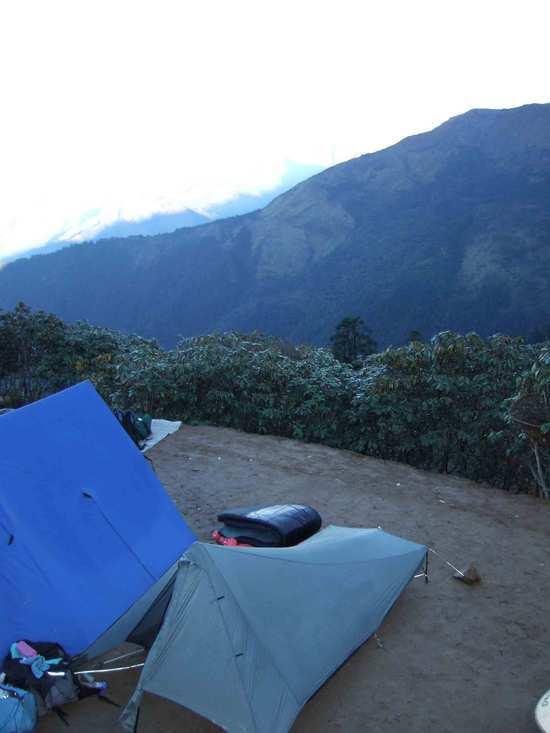
This picture was taken the morning after a 10 hour continuous heavy rainfall at around 2800 meters. It had stopped about 3 hours before . It may not be visible in this shot, but the fabric of the Nepalese tents has wetted out and some water dripped inside. The Contrail remained dry. Note the taut set up.
About three feet in front of the tents there is a three foot wall with a ditch at the bottom. The newly constructed platform ( it will be part of a new route to alleviate the congestion in other areas) has a slight slope, hence no puddles.
Granted, I would not recommend a Tarptent as a first "family tent" but apart from the Sherpas and the porters, I was warmer* and drier inside the Contrail than the occupants of the Blue Palaces.
* A combination of having the warmest mat,(Exped Downmat), having had a full wash ( after a wipe down in freezing water, you feel warm when you stop)
having dry and clean clothes on. Also my WM Ultralite draped on top of me was just pure luxury. That big black blob at the back of the Contrail, is one of the standard issue mats. Bigger than my duffle bag.
So I would suggest that you keep practicing with the Rainshadow , keeping in mind it's limitations.
Franco
Contrail tips : not obvious, but those rear poles are about one inch in the soil…
I used 4x 9" Easton stakes often with stones around them….plus another 4 stakes

And BTW, I had to choose between "safe" and "nice" in other locations, I always chose "safe" . I am a wimp after allNot wet

Ross Bleakney BPL Member
PostedNov 5, 2007 at 5:32 pm

The standard line on tarp tents is that they are a bit colder but a lot lighter than double walled tents. To make up the difference, you have to add insulation (to your pad and/or your sleeping bag). In other words, you may need to add a half pound to your sleeping bag, but you will still be ahead, as your tarp tent weighs a pound less than a similar sized double wall tent. At some point, though, I would assume that a double wall tent comes out ahead. For example, if it is really, really windy, then the drafty nature of a tarp tent would make it difficult to compete against a double walled tent (even with the added insulation).

In general, I think you want the wind blowing from the rear, so that it isn't so bad on your face.

Also, as has been implied (or specifically spelled out) there is a big learning curve with a tarp tent (presumably even more with a tarp). In some cases (if it is windy or really cold) you may decide to just anchor down the edges and live with the condensation. If it is really windy, you'll get enough of a draft to solve the problem. If it is really cold, you may choose condensation over frigid temperatures (I have done so several times). For example, it looks like you don't have a beak at all; this will be great for getting rid of condensation, but be a bit cooler than if you had it zipped up. The tricky part is often finding the right middle ground.

Doug Johnson BPL Member
PostedNov 5, 2007 at 8:24 pm

Hi Ross,

I agree that they're a bit colder than most double walls in windy conditions. But the lightest double walls are about 3 pounds and most 2 person lightweight double walls (Big Agnes SL3, MSR Hubba Hubba,SD Lightning) are 4 pounds- 2 pounds more than a Squall 2 and 2.5 pounds more than a Gossamer Gear/Tarptent Squall Classic. But even if you're trading in all the weight, that extra 2 pounds means a 0 degree bag AND a UL bivy sack- WAY warmer than trading the Tarptent for the double wall.

But you're right that there are conditions where the double wall will smoke the Tarptent. But I'd say that these are conditions that would tax the double walls that you'd be comparing. The mesh inner tent will ALWAYS be drafty. Now, if your'e comparing a lightweight 4 season double wall such as a Hilleberg Nallo, you'd be right on. But that tent is in a whole other league, and really isn't that nice in summer conditions- it's way too warm. That said, when camping on an exposed ridge in the winter, I'd never consider a Tarptent at all (or any of the 3 season double walls). You're totally right that there is a point that the Tarptent is no longer a rational choice.

When really pushing the matter, though, it's not a single or double wall comparision at all. It's more about airflow and tent structure- many of the most bomber tents are single walls. I'm convinced that my Rab Summit Extreme, for example, can sit on any ridge in the world and outlast anything.

But I'm back to the first point. Used in the 2+ season conditions that it's designed for, I don't see much of a learning curve with a Tarptent- it's just a marvelous shelter. But pushed into the shoulder season in less than ideal conditions, you'll need to have a strategy.

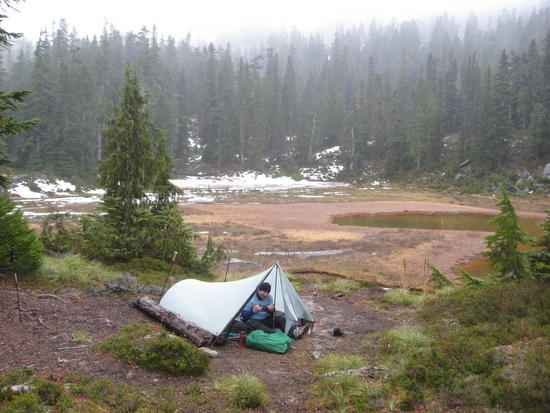
Here is a pic from last weekend. 20-30 mph winds, 30 deg F, constant drizzle to rain. The trees were very thin here and I felt the spot was pushing it. But we put a log and rocks by the tent for a wind break and put our packs in the foot end. It ended up fine, but this was pushing it.

dfkjsl;fjsdal;fjs

PostedNov 6, 2007 at 7:24 am

Not to hijack this post, but I fully agree with Benjamin and Miguel!

Benjamin, as you know, I often ask about products and due to the fact that I'm new, I expect to find a "best" item for a large variety of situations. You have taught me that this just can't happen. Great for me for wanting to save money by getting the most versatile gear, but I've come to the realization that backpacking is about specialization. Gear is made for certain situations and until you know HOW to use the gear it's going to be tough, uncomfortable, or both, to stretch the intended uses. I don't think I would have a problem with a tarp tent in most of the conditions I camp, but once it gets to this time of year I might be more hesistant to take it along unless I had some experience with it.

I think it would be AWESOME if what Miguel is suggesting were to become a reality. I think that many people join this site to learn, not just about the quality of gear, but how to use it as well. I do glean some information from reviews which say things about wind protection being necessary or the like, but more detail would never hurt.

Anyways, As I typed this post yesterday (I forgot to post this somehow) I was struck by an idea and wrote a long post about it! The thread is "I just had a great idea" and I think it would make BPL an even more amazing resource!

PostedFeb 7, 2008 at 2:22 pm

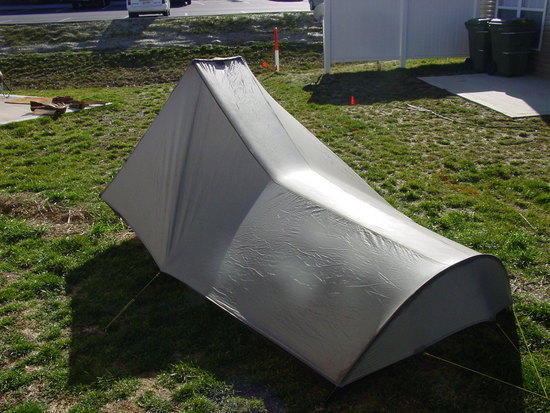
You have pitched the side tieouts way too tight. Let the ridge take its natural catenary shape before really tightening down on the tieouts.

PostedFeb 7, 2008 at 3:11 pm

"You have pitched the side tieouts way too tight"
Yep, I see that often, including in my own set-up….
As I mentioned before, an almost wrinkle free set-up is a good sign that you have your TT pitched correctly.
I think that the "just in case" mechanism kicks in so we give that mid tie-out point another pull. But of course Jon is right, no point in distorting a good design. Apart from that I would say that it's a pretty good pitch for the first time
Franco

PostedFeb 7, 2008 at 3:44 pm

First of all, as Franco has pointed out, your Tarptent pitch was just plain aweful. I alway carry an extra 4 stakes to hold the corners of my CloudBurst in place, otherwise it ends up looking like your pitch which would no doubt be drafty AND noisy flapping in the wind…

A few weeks ago, I discovered that a Double Rainbow CAN be pitched in strong winds without being drafty. Not that this helps you with your Rain Shadow, but I disagree that tarptents HAVE to be drafty. In fact, the DR was battened down so well that we developed condensation, and that was with one rainporch fully extended!

For most excursions, I always carry a bivy bag anyway. It extends the comfort of a tarptent by quite a lot, but may not be practical for 3 person tarping.

PostedFeb 7, 2008 at 5:14 pm

As for the Rainshadow and Cloudburst recommendations, you may find it helpful to stake down the two back corners where the pole comes out. This will prevent it "walking" forward in windy conditions.

PostedFeb 8, 2008 at 12:30 am

"Recently, one poster asked about a light weight 3-person tent — to be used in fairly humid places with kids who are pretty rough with gear (as many kids are). Despite spelling out his criteria and conditions, some folks rushed in with tarptent recommendations — touting their incredibly light weight — and leaving out everything else!"

Learned that one the hard way. I fell in love with the Tarptent design, and bought a Rainshadow for my wife and toddler. Less that five minutes after setup my son tripped over the ridgeline guyout and spit his lip open. Still love the Tarptent design, but it's now a Hex 3 for kids, since there are no long, hard-to-see thin wires poking out of the ground five feet from the shelter.

Mark Verber BPL Member
PostedFeb 8, 2008 at 7:50 am

I have used tarptents in a wide variety of conditions including trips with continuous hard, cold rain with strong winds. As other have noted, the combination of using natural wind breaks, a lower pitch, and placing packs on the windward side can help some but it will be still quite breezy. The inside of your shelter is not going to the 10F you get will a solid double walled shelter. If you are using a tarptent (or a tarp) you need to bring appropriately warm sleeping bag in view of no warmth boast from your shelter and that there will be some wind blowing over you.

I also have used a tarptent in high humidity locations. Yes… you get condensation. My experience is that this isn't a big deal so long as you are controlled enough with your movements not to brush against the sidewalls. Of course when it's really hot and buggy, it is nice to have as little blocking any wind you might get. In very hot humidy conditions I would rather not have a tent or a tarptent. I would want a bug nest/bivy with a separate, extra large, unshaped tarp to maximize air circulation even if it is raining.

The following are times I don't take a tarptent:

  • With kids that can't be gentle with gear, or who are accident prone… e.g. really likely to trip over things due to coordination or carelessness.
  • With kids who move around. Before the first trip with my daughter we set up my Squall 1 in the backyard and got in. She couldn't stop herself from swinging her legs around. While dealing with condensation on the walls of a tarptent isn't normally a big deal, having someone running their sleeping bag enclosed legs against large section of the shelter can be a problem. For a few years my daughter really needed something between her and the outer wall.
  • Snow. The also applies to 3 season tents with mesh walls. A little bit isn't a problem, but when there is enough to pile up and get blown in… ick.

–Mark

PostedFeb 9, 2008 at 2:05 pm

Some of the problems with tarptents such as brushing against the wet side walls and tripping over guylines can be mitigated by good design. For instance, the Double Rainbow is *almost* impossible to brush against wet side walls, and can be pitched without guylines as long as it's not too windy. Haven't used it in snow yet…

I'm just waiting for a DR in 0.6oz spinnaker fabric ;)

Viewing 23 posts - 1 through 23 (of 23 total)
Loading...