Yes, I have my own test rig. I built it myself over several evolutions. I think Richard bought his.

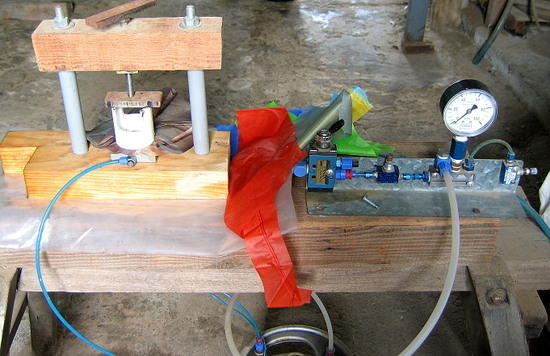
Compressed air goes through a double needle valve bleed system to create a controlled slowly rising pressure. This pressurises water on the underside of the sample with a rising 'head', which is measured by the pressure gauge and by a static water column which is not shown here. I can freeze the system when the required 3 drops of water appear on the top surface. That is the 'HH' according to the Standard, but we usually want to know a bit more about the fabric behaviour.
The seal is between the fabric and a layer of rubber on the underside. Note that if this seal leaks slightly, it simply does not matter. Pressure is pressure. The seal is driven (forced, loaded, whatever) by either PVC tube or clear perspex tube, on top. That's controlled by the screw thread at the top.

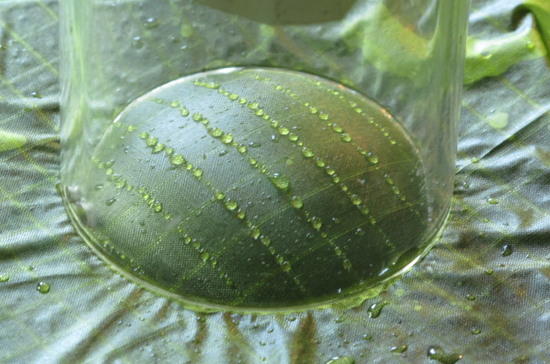
Here we have some silnylon fabric leaking under pressure. The drops of water ALL appear along the ripstop thread lines, because it is those thicker threads which destroy the effectiveness of the silicone coating. Use plain weave rather than ripstop and the HH goes way up, but the gear mfrs are mostly ignorant of this and like the techie term 'ripstop' for marketing reasons.
I have tested a lot of fabrics like this, way past their nominal HH value which is when just 3 drops appear. The leak rate is sort-of linked to the over-pressure. In some cases you get micro-sprays of water appearing.
Someone wrote a PhD thesis recently which claimed to be the first to ever test beyond the nominal HH. Obviously, their literature search did not include BPL! Oh well, no matter.
Cheers