


I'm not sure if this has been mentioned yet but I wanted to start a discussion about what the aluminium battery will mean for ultralight hikers in the future. I'm guessing all our lithium powered gadgets will be much lighter.
Topic
Become a member to post in the forums.
 .
.
I'm not sure if this has been mentioned yet but I wanted to start a discussion about what the aluminium battery will mean for ultralight hikers in the future. I'm guessing all our lithium powered gadgets will be much lighter.
Especially the life cycles of the battery, and the abundance, cheapness, and ease of recycling aluminium….these could be a huge win for power storage for just about everything. No doubt improves on the embodied energy for construction to lifetime storage capacity equation (lithium batteries are around the 10x mark).
Sounds like they still have some challenges with energy density (energy per weight) compared to Li based batteries but as its early days I've little doubt they'll quickly bring that towards the same.
:-)
Interesting. But I wouldn't get too excited yet. I would guess it will take about 10 years to perfect the battery, get investors to build the battery plant, and get into production, and get a distribution chain throughout the US. Assuming there are not lawsuits over who owns the rights to this new product.
billy
Billy, the battery research happened at Stanford. There are about a hundred venture capital firms within rock throwing range of there, and they would just love to get a few million dollars rolling into the development.
–B.G.–
Bob,
Regardless… (irregardless?:),
It will take years to do all that needs to be done to have them in your local store.
Regardless of how much money you throw at it.
Billy
Billy, I'm not throwing any money at it, regardless of your suggestion.
The venture capitalists of Sand Hill Road drop millions on projects that seem pretty silly compared to a revolutionary battery.
–B.G.–
As Adam points out, there is the issue of energy density (watt-hours per kilogram). Since they didn't tout it in their press release, it isn't as good as alkaline nor lithium-ion nor is their any potential for it to get there. Aluminum is lighter than iron or lead but its atomic weight is 27. Lithium's is 7. 7 is less than 27. By about 4 times. Unless they're doing something very impractical like stripping four electrons from each atom there's no way around that. They are aren't going to find some lighter, fluffier isotope of aluminum.
Another hint at low energy density is that you can drill through their aluminum battery and NOT start a fire. When you short a battery, it discharges all of its energy internally. Then it blows up. We all did that as kids, right? Unless it has low energy per mass. Then it heats up somewhat without blowing up.
Reading between the lines, the high charge rate could help in some applications (charge your car during a stop-light cycle?) and certainly in fixed service like storing power on a home- or utility-scale. Then it is all about the cost of storing the energy, not the weight.
And just because something is in the Alumni Newsletter or on the cover of Popular Science. . .
I"m still waiting for my flying car.
Bob… doesn't matter what you think or who is throwing money at it… that's not the point. Point is it will take time. If it EVER hits the market. AND if it hits ANY market, there is no way to tell at this point if it would hit the gadget market the other posters here are hoping form. Too many unknowns. And lots of time.
billy

date of article was April 6, not April 1…
It appears to me that the main thrust of that battery is low cost.
–B.G.–
When the lithium battery cells (A123) being used in tesla electric cars first hit the market (years before tesla got to market) they were being used inside dewalt power tool battery packs, not cars yet… The dewalt tool batteries are very expensive and they seemed to embrace the most updated battery technology before anybody else, there's nothing that says our consumer battery packs are the most power dense thing available, many consumer battery packs are engineered towards cheap cost I'm pretty sure rather than weight, although if you're using lithium cells and most of your weight is battery you are doing pretty good.
I work with model aircraft and electrically powered unmanned aerial systems. We use LiPO batteries mostly because they are lightweight and energy dense–most of your little carry batteries for your phones run these with the charging circuitry handled already. You can also acquire much larger "hobby grade" LiPO battery packs and step the power voltage down to 5v/12v/usb connectors if you need to scale those battery packs cheaply, but you also need a lithium battery charger at that point and you have to make sure you don't run the batteries outside the voltage range they like or you may ruin the cells.
However there is a slightly higher energy density cell that some use, you have to solder your own custom battery packs together to use these, but you order several Panasonic 18650 style lithium battery cells together, it comes out to a higher energy density than many traditional battery packs. This is how laptop batteries are made, 18650 cells in a pack which are managed by a battery charging circuit on the laptop hardware. The downside to these cells is that they cannot be charged quickly. They would be ideal for a solar kit but very bad for trying to top up while pausing in town for a couple hours. This is because the cells "C" rating is too low, they do not allow you to discharge or charge them at a high rate like the gadget lipo packs and hobby lipo packs.
I'm intrigued by the idea of a MYOG super ultralight battery pack–what is a battery pack currently considered light, and large enough to be worth carrying, should we "white room reverse engineer" it from a requirements standpoint to see what the result looks like? This basically means we just want to look at what it claims it is capable of and produce a similar device without looking at any of its specific technology implementations or approaches. We wouldn't be looking at what kind of charger circuit they are using, we would come up with our own, which means the design could be made open sourced hardware.
I was watching a video last night of a post PCT thru hike gear list–there are around 3 different USB cables the guy was carring for charging devices. I started wondering if people want wire harnesses made that will put their kindle, ipod, etc, end connectors onto the same usb cable. Basically it just means there would only be one "power end" USB connector… for that matter, remove the connector and solder it straight into the battery pack with the kindle/ipod shuffle/etc hydra cable at the other end. Seems like it would shave a bit but maybe people who care that much leave the electronics at home? Leave the USB connector on so you can use other peoples battery in an emergency (alligator clips small enough to go in usb connector ends when needed would be 100x more versatile in a doomsday situation).
Well, as you say batteries need to be:
Light weight
Energy dense
Reduced recharge time
High number of discharge/recharge cycles
Since these are only temporary, you still need a power source for recharging on the trail and as you mention a universal connection for both charging/discharging.
A fine DIY project.
A fascinating read but I'm not so sure that there will be UL Hiking applications of this technology any time soon. As mentioned earlier Aluminumm is 4 times heavier than Lithium and the article seems to indicate the power density isn't that high. What is interesting is the fast charge and discharge rates, cell longevity and the mentioned flexibility. Seems like a technology that's most likely to be used with grid infrastructure. Still, thanks for the link.
>"there are around 3 different USB cables the guy was carring for charging devices."
These doodads save on cable weight by being shorter and combined into one unit. But most chargers won't support anything more than one high current (tablet) device. Two phone at once? Maybe.
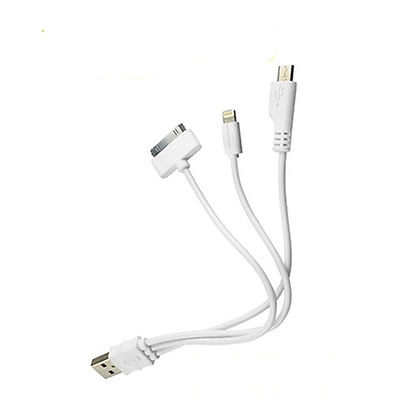
$4 on eBay. Free Shipping.
Cool link, but sounds like it has limited near-term applicability to the limited electronics I use on the trail.
I'm more excited about the Ampy kinetic charger this June(?)
Also can't find a link at the moment but I heard a year or so ago that they had a breakthrough in nanostructure for lithium battries. A nano honey comb structure was supposed to help disperse heat faster and thereby triple the battery capacity, and accelerate charge time that was being manually slowed down to avoid overheating issues. I have not seen phone battery life tripple yet so I assume its still being worked on somewhere. It was a major DOE project so I don't think they would let it slip.
$4 on eBay. Free Shipping.
be wary of unapproved chargers AND cables …
http://www.macrumors.com/2014/06/19/iphone-5-faulty-chips/
According to UK repair company mendmyi and first reported by iMore, cheap third-party iPhone chargers and USB cables can possibly damage the U2 IC chip on the logic board of the iPhone 5, which might the device to fail to boot up or charge past 1% battery life after the battery drains.
The U2 IC chip controls the charge to the battery, the sleep/wake button, some USB functions, and regulates the charging power to the power IC that actually charges the phone. When damaged, the chip can fail to work properly, which prevents an iPhone 5 from turning back on. While a fresh replacement battery will power the iPhone, once the battery is depleted, the issue resurfaces.
Mendmyi says that it has seen multiple iPhone 5 devices with a damaged U2 IC chip and has narrowed the problem down to third-party chargers and USB cables, which do not properly regulate voltage.
dont wreck a 600$ iphone to save 15 dollahs
;)
I always thought the sulfur based design had a pretty good upside, but could still be years before we might see anything from it.
Ryan
Craig, the Hobby LiPO batteries branded "turnigy nanotech" may already use a similar technology. They do indeed have a crazy charge rate but the charger needed to charge them quickly is not small. Solar could charge them using a DC trickle charge, but a large AC-DC power supply and fast lithium battery charger is large.
People use those nanotech cells specifically for the energy density, RC helicopters pull a crazy amount of power so those guys buy the most dense batteries usually. There's also usually a trade-off of fast charging and cell weight, you can get slightly lighter cells that do not charge as fast. You would want those if you are slow charging off solar but not for charging up in town–but it's a tiny weight difference.
I'm pretty much laughing about the "don't use non-apple accessories" link that was posted… Yes, there is horrible garbage being sold out there, and lithium batteries can explode and start on fire. However internal damage to components because a cable isn't exactly in spec, sounds like low quality components being used by apple to me or bad design. I'm pretty sure everybody else's phone runs great on an average microusb cable, so apple failed to engineer a safety check here to protect the internal components. consumer electronics seem to be engineered to fail at the first opportunity–but manufactured obsolescence is part of our culture and our economy these days, the largest company (by market capitalization) in America is dependent on selling the next iphone and can't do it without the old ones failing.
Apparently that caution is supposed to apply to USB cables? As long as I create a battery that has standard usb voltage output, it has nothing to do with apple approved accessories since they claim to comply with USB standards. So just plug your apple usb cable into the custom/tested or aftermarket battery, you can plug it in for the same reason you're allowed to plug your iphone into any other laptop, or any other port complying with the USB specifications. Otherwise you wouldn't be able to plug your iphone into a dell computer.

Was reading an article about this early this morning then saw this post. Could be some great possibilities for the technology. The link below has some additional information, and address some things like voltage and problems of scale.
http://www.bbc.com/news/science-environment-32204707
-Chris
It sounds like these might make a good replacement for lead-acid batteries. They only have a voltage of about 2 volts per cell (Li-Ion is 3.6 iirc) and lead is getting more scarce, and it's heavy.
In an automative use, much of the battery's size, weight and cost is related to cold-cranking amp requirements. If a battery chemistry has inherently high discharge rates, it would be an advantage in traditional (IC engine) automobile use.

I was thumbing through this thread on my iPad while dozing off, and I think I accidentally reported a post by Larry De La! I don’t see a way to un-report it… Sincere apologies, Larry.
<hr />
Fixed.
Roger
Battery research is the new hotness for “vulture capital” types.
(Remember, it was a carbon style battery that caused the fires in Boeing’s Dreamliner.)
EX. A really inexpensive (around $1,000.) and high capacity large battery (say 4 ft. X 6 ft.) for home use combined with rooftop solar panels would allow most of us to get off the grid forever.
And inexpensive but “much-better-than-Li-ion” car batteries for hybrid or all-electric cars is the holy grail of the auto industry.
There are likely few tech areas as intensely researched as batteries.
Become a member to post in the forums.
 Brynje Mesh BaselayersBrynje baselayers use open mesh construction to move moisture away from the skin, create insulating air pockets, and help regulate body temperature across changing conditions and activity levels.
 © Beartooth Media Group Inc.
 Loading...