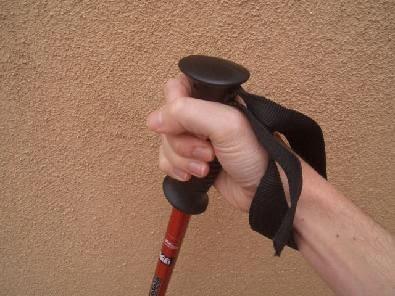
I'm going to add my 2 cents. I used to get calluses using my Leki poles. Due to that and a wrist issue I switched two years ago to the Pacer Poles, now I use bike gloves cause I live in Arizona and need to protect my skin, but he gloves also help me not break blood vessels in my hands which I am prone to from age, but IMHO the Pacer Poles handle made a huge difference in comfort. If you use the poles the way they were designed there is minimal stress on the hands and wrists as the handle is designed to enhance the natural motion of the forearms rather than forcing the forearm and hand to adapt to an upright handle. I will never use a standard hiking stick handle again.
Topic
Trekking poles/blisters
Become a member to post in the forums.
- This topic is empty.
"Also I would caution against Tom's suggestion of cupping the top of the pole in your palm. Pretty easy to damage the palmar nerve that way if you do it lot"
That's odd, Paul, because I do it a lot, and I don't have any nerve damage, even with the small diameter of the handles on my CP3's. I don't have tough carpenter's hands either. Extrapolating from your own anecdotal experience to make a generalization is not a very strong argument. A number of others on this site also cup. Hopefully some of them will post their experience about nerve damage, or lack thereof.
I've got cervical spondylosis. Gripping for long periods, sometimes minutes is out. Cupping I find to be easier on me. YMMV.
I really want to give Pacer Poles a go.
Tom, I'm not extrapolating from my experience, because I didn't damage my hands that way, my nerve damage is different. I'm passing along a hand specialist's advice against forceful use of a tool pressing into the center of the palm based on his experience with other craftsmen he had treated. And of course everyone's experience may vary. But since I was warned by a doctor, I pass it along.
I don't get blisters, I sea kayak and never wear gloves when doing physical labor. So I guess it's conditioning.
I do use the straps now. I tend to bear down on my poles because of arthritis in hip and knee.
I used to suffer from tendinitis in both thumbs for several weeks after long overnight trips. That was until I started using the straps.
And yes, like Franco's photo.
I really want to give Pacer Poles a go.
It may be worth a try, Ken.
I have some damage from years of working with my hands and was about to completely give up on trekking poles. It took a bit of a leap of faith to order Pacerpoles because I had to do it without trying them out first. But I figured that I all I had to lose was return postage. (Back then it was just back to Utah when Brian Frankle of ULA was carrying them; now they're only sold in the UK.) For me, they were a game changer.
"Rub your hands in the dirt. Your hands are too slick."
I'd say the opposite. Slick reduces friction which should reduce blisters.
Try some 'Body Glide' or some other such friction reducer. These products can reduce blisters on your feet, why not your hands?
RE gloves: I would think cross country ski gloves would be better than bike gloves as the xc gloves don't have the padding… you can cut off the finger tips if you want them fingerless.
RE cork handles: I find the cork dries out my hands. Cork will absorb. Dry = more friction. Perhaps try some other type of grips. Or do something to the grip to reduce the friction at the spot where your blister spot makes contact… some of the Body Glide on the handle too?
Blister Products: or.. try some of the blister products where you get the blisters… maybe apply 'second skin' before you get a blister to protect? Or some other such product that protects?
good luck,
Billy
i have a pair of BD Ergo Cork poles with lots of grip ridges and a hard top to the handle. I have learned to hate the grip. And for me the straps are just too hot. I have noticed on the version now available that they have smoothed the handle,maybe making them less hard on the hands. As Billy Ray has suggested maybe a different grip. The REI carbon power lock poles seem to have a smooth soft grip that might stop your hands from getting blisters.
I have Gossamer Gear Lightrek 4 poles, minus the straps. The poles that had straps (Komperdells) hurt my wrists. I have worn OUT sun gloves (Outdoor Research) and bought thicker ones (Buffwear).
Those of us who are prone to repetitive motion injury (have been assessed for carpal tunnel a few times over the years, get tendonitis related to typing a LOT) perhaps have a different perspective than some. I don't use anything that requires repeated flexion of the wrist combined with pressure. I grip the handles when the pole is in contact with the ground, loosen when it is not, and keep my wrist straight as much as possible by adjusting them to that 90 degree angle. Uphill/downhill, I move the handle up or down in my grip slightly.
I don't seem to have the blister issue with the poles, but have blistered when kayaking. Which is not something I do a lot of.
$3 gloves from walmart fix the issue. They sell breathable ones for weight lifting. Try to only wear them when you feel "hotspots" coming on your hands.
Sometimes it helps to just change your grip on the handles when they start rubbing you raw so that it moves the pressure point to another spot.
I wear my straps differently than the pictures posted here. Not sure which is the "correct" way. But I tighten the loops so that they wrap firmly around the outside of my hand. (picture alternatively showed the the user gripping the excessive straps in his hand. To keep them tight, I grab the pull and lever down. This means when I push against the holds, I pushing against the straps, and they alternatively are pushing my hands against/into the grip.

This example image is similar to what i do, except his strap is to loose, so it wouldn't take the force off his grip. Rather than tightening the strap, I'd probably just slide my hand further down the grip to lock it in.
Jenn,
another approach might be to call Black Diamond and explain the problem. They are a really good outfit and might just offer to send you a different set of grips to try.
Grips can be changed. Or they might even send you a whole different set of poles.
Billy
"I'm passing along a hand specialist's advice against forceful use of a tool pressing into the center of the palm based on his experience with other craftsmen he had treated. And of course everyone's experience may vary. But since I was warned by a doctor, I pass it along."
Fair enough, Paul. although you didn't mention a doctor in your original post. That said, what I have found interesting over the course of several threads about trekking pole injuries/discomfort/fatigue, is that, AFAIK, they always refer to holding the poles in the standard manner, never cupping. I used to as well, but figured out a number of years ago that most of the issues had to do with the ergonomics of how the pole is held. The standard grip puts pressure on the wrist cross ways to the natural flexing plane, which seems to me to invite fatigue and possibly injury if done repetitively. The cupping technique applies force in line with the natural flex plane of the wrist, which allows the wrist/flexor muscles to function as a shock absorber, analogous to the knee and quadriceps complex. Lots less stress, IME, particularly going downhill. With the butt of the pole seated in the palm, it is basically a universal joint, which allows very precise pole tip placement with just a bit of assistance from the thumb-index finger on one side and the ring-pinky fingers on the other. Very little effort is involved in gripping the poles with this method. I can do it all day with no fatigue whatsoever, and I am not a big strong guy by any means. I can see where applying a lot of pressure going uphill might be uncomfortable if done continuously , but I don't do that, simply because I don't see the arms as offering much more than a slight assist to the much more powerful quad/glut/hamstring complex. Better, IMO, to condition the legs to do the work, downhill and uphill, but especially uphill. For me, the poles are primarily for maintaining control going downhill, and sometimes to maintain balance on really nasty talus(one pole only, to leave the other hand free to grip the rock). Anyhow, I am not here as an evangelist and, like yourself, am merely passing along some of what I have learned on my own personal journey. GYOP, as always.
Cheers
Craig,
One of the reasons for having the strap the other way is because it can be safer .
See how in my video at 2 :40

I could try calling Black Diamond, or returning them to MEC where I got them…where my husband just got a job! Huh! MEC is good about returns though I've used them for a bit.
Franco, Thanks for sending the link. Yeah I see a couple videos that agree. Honestly though in the example you provide in the video, I'm a little confused why I would want to drop the pole for safety. I've never been pulled over by my pole. Quite the contrary I've stumbled and been glad that I didn't loose my pole off a cliff. Using the straps through the hand doesn't seem as comfortable either.
Since multiple videos seems to agree with you I'll just assume I'm missing something.
"Franco, Thanks for sending the link. Yeah I see a couple videos that agree. Honestly though in the example you provide in the video, I'm a little confused why I would want to drop the pole for safety. I've never been pulled over by my pole. Quite the contrary I've stumbled and been glad that I didn't loose my pole off a cliff. Using the straps through the hand doesn't seem as comfortable either."
Franco's video shows the standard cross country ski pole grip. Much better for putting the force on heel of your hand or your wrist than having to grip so hard with your hand. Standard xc ski lession one. As for the grip being better for getting rid of the pole when falling… hmmm… any time I have fallen forward like he shows in the vid my experience is a lightning quick reaction to put my hands in front to break my fall… never even occurs to me to get rid of the poles. So, basically, I think this scenario of Franco's is a mental construct that may not apply in a real situation… at least from my experience.
Many other things in the vid don't make sense with how I use poles. I would not want shorter poles for going up hill.. just the opposite… I want longer poles to reach behind and down so I can push my self up the hill; I do note put the pole in front going up hill to pull myself up as he said. You get much more power by pushing off the pole when it is planted at your heal and continue to push off as you move forward away from the planted pole… hence the need for a longer pole. The only time I might have the pole in front of me going up hill might be for balance on some really steep off-trail stuff for balance.
Billy
"I would not want shorter poles for going up hill.. just the opposite… I want longer poles to reach behind and down so I can push my self up the hill; I do note put the pole in front going up hill to pull myself up as he said."
Just for fun, for the ones that have trekking poles and stairs at home (or a hill outside the door), get your poles out and try both ways described above and let us know how it works out.
Become a member to post in the forums.