


I have a wonderful athletic miniature Australian shepherd rescue that I want to take with me on my trips. I need advise on gear for her! What do you use for your pets?
Topic
Become a member to post in the forums.
I have a wonderful athletic miniature Australian shepherd rescue that I want to take with me on my trips. I need advise on gear for her! What do you use for your pets?

I use a Mountainsmith dog pack and let my standard Aussie carry light loads like food/treats, a little water, poo bags and his Sierra cup. I provide him with a CCF foam pad to sleep on.
As with your dog, he has heavy fur and I don't use the pack when it is hot and I keep an eye on his comfort level.
I have him on a lead whenever there are others on the trail. I just got a collar with a retractable leash that has great potential for hiking. The other option that works is to have a short lead that tucks into his pack.
Do consider what you dog will do while inside your shelter at night. Having her chase critters like skunks or porcupines could be disastrous, let alone altering to nocturnal visitors and knocking your tent down.
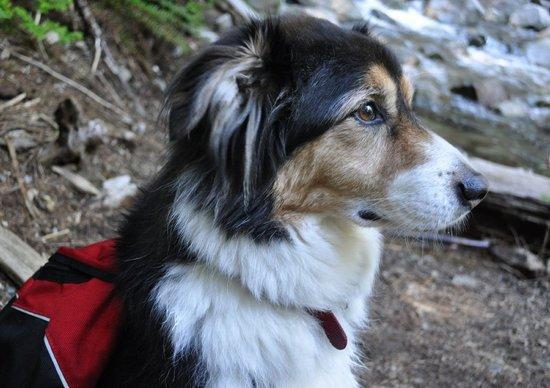
I've had numerous dogs and packs for them in the past. For week long trips, would be hard for me to pack their food also without them carrying a pack. Since I am UL now, it would cause me to get some slightly heavier shelters to accomodate a dog. I keep them inside to avoid unwanted interaction with wild animals and to be a little more PC. My dogs were outside dogs, they went for walks quite often with me after work, so their feet were used to soil gravel here in the mountains.
Duane
Good comments from those above. My dogs also stay in the shelter with me/us.
One other thing to think about is caring for your dogs' paws. Conditioning their pads with shorter hikes/runs is important prior to a longer trip if the dogs aren't out hiking regularly as it is.
I also carry some supplies in the event that one of my dogs cuts a pad or the pads get too dry/cracked from snow/ice, etc. At minimum, I use some climbers' balm on their pads at night (although they like to try to lick it off). I also carry a small tube of wound glue that I could use to seal up a pad cut and a pair of dog booties they could wear to protect a wound or for particularly bad conditions. They hate to have the booties on their feet and they almost always end up staying in the dogs' packs, but seeing as my dogs are 60# and 100#, I can't easily carry them out in the event of a paw injury, so it's good insurance.
Maybe you know about this already, but you can get very high quality dehydrated dog food. Somebody here on BPL put me on to this stuff sometime last year, and it has turned out to be excellent. It is now part of his daily diet and he loves the stuff.
The Honest Kitchen dehydrated dog food: http://tinyurl.com/p4mfhr8
Golite SL3 (Dog and shelter in avatar). Fly only. No floor=no mess with a water loving dog.
REI or Mountainsmith Pack.The REI is a little smaller but still good for a week. I like the fit better. If taking both dogs, I switch the male to the Mountainsmith and put the REI pack on the female. I clip a flexi leash to the pack and thru my hip belt. No slack that way and hands are free for trekking poles.
Long lead and a stake to tie him out at night since the shelter won't keep him in. He can go in and out all he wants just can't go very far. I pitch the SL3 as high as possible unless it's really cold AND windy to minimize condensation and to give him enough clearance to crawl under it. But I've still had some condensation knocked down on me a few times.
Frisbee for food dish. Collapsible water dish.
2 empty Gatorade bottles in case we dry camp.
2 cans of beer so I won't be dry in camp. (Short trips only.)
Small amount of Musher's Secret. We live in the same terrain we hike in so their pads are already tough and I've never had a problem. But I've heard really great things about it so on week long trips I take it and apply it every other day.
Small bottle of Pepto Bismol (recommended by my vet).
Tube of super glue for emergency pad treatment (also vet recommended).
Same kibble they normally eat. (I may have to try that dehydrated kibble that Bob mentions.) In doubled ziplock bags to keep it dry. Had a problem once with food getting wet so I try to be careful. I also bring along some gravy packets to spice things up. Well, he brings them along. :)
Treats. Usually home made jerky.
7 panels of a cut down Z-rest. My male, who's always with me, sleeps very, very warm and doesn't need it for insulation. He's got a really thick coat and always seeks the coldest spot to sleep. But just like at home, go to bed means go to YOUR bed and stay off of mine. He knows that our bed is off limits and so is my bag. I don't want him on my bag at any time and I REALLY don't want him on it when he's wet. I have another 6 panels for when the female joins us.
CharlieDog and I have been backpacking together for about 7 years now and made the UL switch together.
He sleeps in the shelter with me, primarily because he likes to look around by himself just before dawn. Of course, by day 3 that's done, but I still feel better having him enclosed with me.
He carries a pack (ruffwear Palisades – with the detachable harness. that way he can take his pack off when I do…very nice for him) and all his food, water, bowls (made of cuben fiber – OF COURSE!), and two boots (for emergencies). I carry his first aid kit (which will include special vet wrap – change it out frequently. it goes bad/sticks together).
I worked VERY hard to train him on trails, so now he's quite good off leash. I'll keep him leashed in areas with known rattlesnakes, or with a lot of people/horses just to make sure he doesn't upset anyone.
I really need to get him the dehydrated dog food…..
Most of all, get your dog used to wearing a pack, walking on trails, sleeping in a tent, seeing trekking poles or fishing poles, etc. Make sure he's either on leash all the time, or has PERFECT recall. DO NOT SKIMP here – for both the safety of others as well as that of your dog. And remember that any training you do in your kitchen, or on a walk around the neighborhood, would NOT be applicable on a trail (dogs are contextual learners – they cannot transfer a skill from one environment to another). So try little day hikes as training hikes and practice recall, heeling on the trail and NOT running ahead, etc.
Good luck! there's very little in the world better than hiking with your dog!
Whoa! That's some expensive dog food. I feed ours a really high quality food and it's just over $1/lb. Based on the equivalency table, the dehydrated food is over $3/lb!! I could see it for longer trips but I don't like to suddenly change foods. And that's just too pricey to feed everyday even just mixed in unless it was a very small percentage. With a smaller dog it likely isn't as big a hit to the wallet.

Anybody have any issues with cuban floors and dog claws?
"… PERFECT recall …"
+1
Our dog knows to return to us when hearing or seeing a car (we walk on country roads), and when seeing a stranger on the trail. She gets it right about 95% of the time, and if she "forgets", a simple HERE is all it takes as a reminder to come and sit.
For the trail she also knows "Behind", as in "follow me, and stay with me".
Figure out the minimum "command set", keep it simple, and be consistent. There are very few "bad dogs". Owners, on the other hand …
"Make sure he's either on leash all the time, or has PERFECT recall. DO NOT SKIMP here – for both the safety of others as well as that of your dog. And remember that any training you do in your kitchen, or on a walk around the neighborhood, would NOT be applicable on a trail (dogs are contextual learners – they cannot transfer a skill from one environment to another). "
But those points are contradictory Jen. If you haven't trained your dog around deer, elk, bear, moose, llama, etc, how can you say they have perfect recall? Perhaps the dog just hasn't found what will cause it to bolt yet? I've had 3 close up encounters with moose and even though my dog showed no sign of interest I was sure glad he was on a leash. I had a offleash dog rush off the trail into camp on the 4 Pass Loop, where leashes are required and one of my llamas that was staked out snapped his halter but luckily ran to my buddy and we were able to get a rope on him. The guy didn't even apologize until the group he was with shamed him into it. They all had their dogs leashed.
I posted this story a few years back:
A dog trainer I worked with had a student with a GSD that put an OTCH (Obedience Trial Champion) title on his dog. That's no small feat. He worked relentlessly with the dog and the dog was flawless. Then he moved to the mountains and some deer went through his yard and the dog took off. The guy wasn't worried and called his dog. The dog kept going and he didn't see him again until the next day. He started training around deer and got to where his dog was reliable on recall around deer. But a deer is not a porcupine or a bear and it's a lot tougher to find them to train with.
I'm not saying your dog or others aren't wonderfully trained. But all one can say is their dog has perfect recall so far.
I met a guy one time who came bursting onto a trail right in front of us and had a dog REALLY pulling on a leash. The had just bushwhacked up to a peak and back. I was laughing because he was clearly along for the ride. He said he had never leash trained his dog. He lived in the country and his dog was pretty well trained with voice commands and he never had a problem hiking with him. His dog would always come when called. But one day his dog saw a porcupine and took off. And caught it. It got it pretty bad and now he was trying to teach him to hike on a leash. I'm sure he got it eventually. But it was a funny sight at the time.
yep randy, you are absolutely correct and I fully admit it. There is no such thing as perfect recall…no matter how much we try to delude ourselves into it.
I am very picky about where my dog goes off leash – sometimes it's for MY safety at the expense of my dog's (a steep, rocky downhill when having an 80# animal attached to me isn't always the best option for either of us – and thankfully he waits for me at the bottom to hook him back up) – or places with benign wildlife that I'm very familiar with. Unfortunately I don't have the opportunity to hike many places with him where there are moose, or elk, or actually interesting animals. of course, my idea of interesting is not necessarily his…
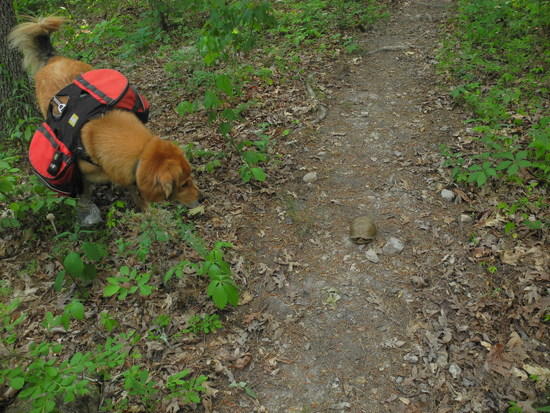
It's a huge responsibility to take your dog hiking with you – but wow is it awesome!
This might be a bit controversial, but my two dogs had very far from perfect recall, and backpacking with a dog on a leash is a challenge. I also don't feel it's fair to the dogs; they want to explore. I will admit, however, it's the most respectful thing towards other humans, but after several years of hiking with them off-leash, I've yet to have an incident or complaint (it could be the people were just being polite, however).
What made the difference for me is a remote dog trainer. My process: call "here". If they don't come, use the vibrate function once or twice. Only if they still don't come, is the shock function needed. In the past two years, I've rarely had to use the vibrate function, and I've had to use the shock function no more than three times. Now, they almost always come immediately when I call "here", but it wasn't always that way. The remote trainer is what made this possible.
I try to take my dogs times and places where we won't see many people; I prefer the solitude and they prefer the off-leash time. Wildlife consists mostly of squirrels and birds, and while the squirrels attract their attention, it's only momentarily. If I were in bear or moose or cougar territory, I probably wouldn't take the dogs at all, and if I did, I'd keep them on-leash. But I don't, and the dogs definitely prefer the freedom of being off leash.
As for gear, I use:
– A small square of Tyvek for their food. Cuben or polycro will save you 0.1-0.2 grams.
– A Guyot Designs silicone bow for waterl; there's definitely opportunity to reduce weight here.
– Ruffwear Quick Draw leash, which attaches to their collar ring, wraps around their collar, and sticks with velcro. If we do encounter another person or dog on the trail, I quickly have a short lead to keep them close until we've passed.
– Some paracord with a mini-carabiner to use as a longer lead, to use when going from the trail head to the car, or if we're on a stretch with higher traffic. For road crossings, I just use the Quick Draw leash.
– I just got a Mountainsmith K-9 pack and Ruffwear Approach pack, which we'll be taking out on the trail soon. I think I like the K-9 pack better.
My last dog was partially trained in SAR. A trainer complimented us on how well we "read" each other. Maybe that comes from having dogs around as a kid. Very cool to have your dog "alert" the first time. Pooch, go find the body, search. :)
Duane
Context matters.
Some of my Russian friends let their dogs loose when they visit Siberia and the Urals. They don't feed them. The dogs basically fend for themselves as there are plenty of lemmings. The whole idea of bringing food, water and using a backpack on a dog is sacrilegious. At most they would have a very light leash if a dog is horrible at chasing reindeer.
Of course, when they come home to America after visiting their families in the homeland, they always get in trouble with the laws because of the cultural differences.
Both acts would be considered forbidden almost everywhere in North America except northern British Columbia and other remote locations. And even then, game laws restrict what dogs can and can't get away with.
Honestly, the best thing I came up with is Ruffwear Palisades, performance kibbles designed for mushing (eg. Inukshuk, Redpaw). Dehydrated foods don't really chalk up to high-calorie kibbles. If one really want to go "ultralight" with their dogs, they better should invest into food which is between 4 000 to 5 000 kCal/kg.
Here are performance kibbles recommended by mushers and hunters:
http://www.sleddogcentral.com/dogfood.htm
I tend to go for 30/20 protein-fat ratio. Too high in protein, and the dog starts drinking a lot and peeing all the time.
But too high in fat, and the dog gets loose stool. One can go really high in fat, but then the kilometers have to be put on in order to burn off the energy to prevent loose stools. Sometimes I go for 30/30 ratio if I am planning a really hard hike.
And in regard to the above, where the dog came from is important. The breed does not matter, and the romanticism should be held with caution. There are plenty of dogs with amazing working history, but lost the functional anatomy or tough pads because they were babied by conformation breeders. So, just saying one has a breed doesn't matter much if it doesn't come from a home where they are worked hard (eg. ranch-bred Australian Cattle Dog are tougher than pet-bred Cattle Dog).
So, I find long hikes make or break a dog, and they will break a dog if they are not built for it. I have a dog whose parents were imported directly from West Siberia and Kazakhstan and he puts on the kilometers much better than any American-bred or European-bred dog I have seen; and can put up with the daily grind with minimal training.
All the other dogs I have had to be conditioned to long hikes, or left behind because their joints can't take it. For some reason, western-bred dogs, even from mushing and working lines, need their paws taken care of all the time. It's weird.
But I wouldn't put any dog through that kind of life unless they come from the harshest environment no more than three generations removed. It seems like after the third generation, the dogs begin to loose the characteristics which made them so hardy in the most remote wilderness.
Anyway, because the dog is impervious to any weather conditions from +40C to -40C no matter the terrain, I don't really pay much attention to the paws or the comfort. I tried bringing comfort for him along but he never used them as he preferred laying under trees ontop of soft mosses or against the sleeping bag. In the winter, he chooses to make his snow-cave over sleeping with me for some reason. So, I kind of gave up packing anything more than soft water-bottles, a bowl made of fabric and kibbles.
He stay leashed at all time, especially in popular areas, in the summer and spring only because I can't really punish him for his prey-drive if I use him for hunting in autumn and winter. Besides, it's a pain in the ass to find a dog 20 kilometers away treeing a marten if one doesn't have his bush-whacking gears on. GPS collar would make everything easier, but who the hell brings that on a multiday outing?
It's really hard to find a backpack for a dog which can stand up to being brushed against the harsh undergrowth though.
I've used mountainsmith packs and ruff wear (not sure which model). I preferred the ruff wear which I thought was a better design. First aid kits, of course. In case of paw injuries I get booties from dogbooties.com–the 1000 denier cordura ones hold up fairly well and are reasonably priced. I have had them carry ccf pads occasionally but they aren't always interested in using them. A jacket (or something similar) can help keep them warm and also keep them from getting your fancy bag/quilt too wet and smelly if you let them sleep with you at night.
"I am very picky about where my dog goes off leash – sometimes it's for MY safety at the expense of my dog's (a steep, rocky downhill when having an 80# animal attached to me isn't always the best option for either of us – and thankfully he waits for me at the bottom to hook him back up) – or places with benign wildlife that I'm very familiar with. Unfortunately I don't have the opportunity to hike many places with him where there are moose, or elk, or actually interesting animals. of course, my idea of interesting is not necessarily his…"
Same here. I've hard to work my way through some nasty rock and scree fields where I had the dog stay and I'd proceed a ways, then call them, rinse and repeat. And some heavy bushwhacking where I just had to carry their pack up high so they could even get through.
In the Winds last year we were off trail coming down a steep section and we were both picking our own way down. I wasn't really paying close attention and didn't realize the pack had slid over his head until we go to where it flattened up. Had to hike about a 1/4 mile back up and find it. He sure looked happy to be pack free. :)
Hopefully you'll get a chance to see lots of interesting animals on your CT trip!
Add a dog pack-towel to your kit.
It's going to rain.
There will be creeks.
If you encounter either just before camp, your dog will be a sodden mess.
You want something will will suck up water, but be easy to wring-and-repeat.

Just wondering if this is a factor in weight planning for your canine. My GSD has mild displasia; to me this means that any extra weight being carried adds to hip wear and tear. We keep her thin for this reason and our vet agrees. With so many larger dogs having varying degrees of hip displasia (due to poor breeding, I might add), I'm hesitant to add any weight to her for fear of shortening her years of (relatively) pain-free activity…
I would just avoid using a pack on a dog with any mobility issues. Dog packs are fun, but no sense in doing harm.
Probably best to ask your vet as they would know your dog's condition. The packs generally ride closer to the shoulders so maybe a light pack would be OK. But I sure wouldn't try it without vet approval. If my dog gets to the point he can't carry any weight, I'll just start carrying it for him as long as he's OK to come along.
There is growing evidence environment and diet plays a large role in hip dyspepsia. Genetics certainly is a component, but doesn’t necessarily tell the whole picture.
Brief summary for those who don’t have the time to read through the studies:
Dogs which live in urban environments are more likely to develop HD than dogs who live in rural environments; and lean dogs are less likely to develop HD than fat ones.
Not really a surprise. Pedorthists have known for a long time people who lives in cities are more likely to have collapsed arches than those who live in the countryside. Same thing with overweight people versus average weight.
So, basically the main advice is to walk on grass as much as possible, and keep the dog lean.
When my girlfriend and I were touring Yukon last year on the road, we came across a cultural centre in Kluane National Park which had this on display:
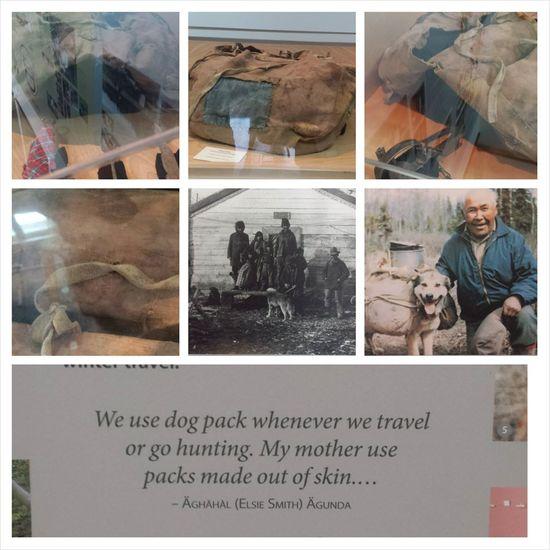
Now, she breeds dogs and is immensely concerned about anatomical function since her breed of choice's main characteristic is dwarfism. She noticed aboriginal dogs have much better functional anatomies than pedigreed breeds.
She also noticed dog-packs designed by aboriginal people are much easier on the dog's spine and joints compared to backpacks made by commercial ventures. But again, most dog-packs available in retail stores and online are nothing more than modified bicycle panniers, and it is a real shame.
Hopefully by attaching the grid gallery above, maybe it will spark inspiration in DIY community.
CharlieDog actually has rather severe hip dysplasia; his pack rests entirely on his forward shoulders and NOT on his back. This is why we ended up with the Ruffwear Palisades pack – it sits exactly where it needs to for HIM.
Just like humans tho – fit is personal, right?
Anyway – I also make sure he has plenty of pain medication on hand (tramadol works really well for him), but since we've moved out of Chicago and he doesn't have to schlep up 4 flights of stairs to my condo 3 times a day he actually hasn't needed any of his meds at all. He seems to do way better hiking on trails than walking around the city, just as the previous poster mentioned
The vet and I talked at length about how to condition him for hiking and how to make him comfortable. Since I'm a PT I also have a bit of a head start myself because I can actually treat him on the trail sometimes, too. He can't do high mileage days anymore (he's 8 or 9 now) and I make sure to watch him for ANY signs of distress during a hike – and I'm ready to camp early if we have to. Sadly he's staying home while I do my Colorado Trail hike this summer (sniff, sniff).
There is dog PT out there – underwater treadmills are the BOMB for hip dysplasia – if you can afford it. Otherwise just make sure to rub down his hips and back VERY well at rest stops and at the end of the day. It really makes a difference for their recovery.
That's pretty cool. I have never heard of such a thing.
In the late spring and summer, I'll take my dogs to the river. They enjoy the water and it helps them cool off. Best of all, the current gives them plenty of exercise.
The way I do this is keep them on a leash. I stand in the water up stream from them. The water is plenty shallow for me to stand in, but they need to doggy paddle to stay afloat. I wonder if this works similar to how an underwater treadmill works.
Understand this is a shallow, relatively slow moving river (the Chattahoochee). You obviously wouldn't want to do this in a very cold, deep, or rapidly moving river. I should also note neither of my dogs have hip dysplasia, but the mention of a treadmill made me think of this. It's good, zero impact exercise that might be beneficial to dogs with it.
Become a member to post in the forums.
 Magic 100 Sleeping BagMinimalist 900-fill-power down sleeping bag with a 55°F | 13°C comfort rating. Weighs 8.46oz | 240g
 © Beartooth Media Group Inc.
 Loading...