Topic

Help with titanium pots

  • This topic is empty.
Viewing 24 posts - 26 through 49 (of 49 total)
PostedFeb 24, 2015 at 7:02 pm

While Trail Designs pricing on their Open Country pots are OK, tbeir pricing on many Evernew pots is highway robbery. Retail on that Evernew 1.3 is only $69!

Moontrail has 11 Evernew 1.3 pots in stock for $59 Which is about average for Evernew 1.3 pots WHEN they are in stock. My advice to Mr Smith is he strikes now and gets a pot before trail season starts and dealers are all out if stock.

Also, Four Dog Stove sells the complete Open Country Hard Annodizd cookkset for only $38 shipped.Thats the 2qt pot and lid, 3 cup pot and lid and the pot grabber, plus shipping to your door. It is without a DOUBT the best value in quality lightweight camp cookware on the market. The whole set weighs only 11 ounces ,has a total of 2.6 liters of capacity and 100% US made.

PostedFeb 24, 2015 at 7:09 pm

Chris,

From my perspective a .9 Liter pot is a ONE PERSON pot size. 1.3 is pushing it. A 2 person is a 2 Liter pot. Yes, this is heresy to some here. I base this on reality though – even if all you do is boil water, it is easier to boil water for your food and a hot drink all at once.

When you have 4 people, it is yes, much easier to take 2 stoves and 2 pots – safer as well, so you are not balancing a large 3 Liter pot on a tiny stove.

Don't expect to be able to cook in a pot for 2 in under 1.3, especially if there is any draining required. You need a 2 Liter to do that :-)

Anyhow….I am going to put in my 2 cents here: Ti isn't all that. In fact, you can often do much better with Hard Anodized Aluminum pots – they are much cheaper and can be about the same weight if shopped well. As well, HAA distributes and holds heat more efficiently than Ti does. Ti can burn/scorch easily as well and non-stick linings are useless in them!

Roger Caffin BPL Member
PostedFeb 25, 2015 at 1:55 am

Hi Sarah

> Don't expect to be able to cook in a pot for 2 in under 1.3
Well … that might be a little harsh. I use a 1.5 L ti pot for Sue and myself, and have been happy with it for the last … 10? years. I am sure I could use a slightly smaller pot just as well. OK, 1.5 L is a bit more than 1.3 L, but it's a fair way under a 2 L pot.

Yes, HAA pots can be good, but they can be damaged much more easily. I know, I know: look after your pots! :-)

Cheers

Richard May BPL Member
PostedFeb 25, 2015 at 6:20 am

> From my perspective a .9 Liter pot is a ONE PERSON pot size. <- snip -> … it is easier to boil water for your food and a hot drink all at once.

Sara, this is the only reason I'm probably going to get a larger pot. I also like the taller shape (even if it's less efficient) so it doubles as a cup. For overnighters (95% of what I do) the fuel penalty is negligible.

PostedFeb 25, 2015 at 9:09 am

I've damaged Ti pots – don't ever, ever let them go dry. You know if say you are using a freaking brand new pot you just dropped $100 on…..

The HAA pots I've done OK with.

Disclaimer: An HAA pot will fare worse if you have a habit of dropping them, loaded, on rocks. Ti will fare better ;-) Lol….. Dumb right? Yet….this was something Backpacker required I do when I did a freelance article a few years back on pots. DUMB. DUUUUMMMMMBBBBBBBB.

Chris Smith BPL Member
PostedFeb 25, 2015 at 7:02 pm

Thanks again, especially to Jimmer and Sarah!

I ended up splitting the difference. I ordered the 1.3 liter Evernew from Moontrail and the Four Dog set. I figured that combination gave me the greatest flexibility for the least cost and weight. Also, I get a bonus third .75 liter pot with the Four Dog set!

PostedFeb 26, 2015 at 9:44 am

That's good to hear. Chris. Those pots will serve your immediate cooking needs AND allow you to start off comparing materials with the best of their respective breeds.

In regards to both pots, neither respond well to being dropped on any rough surface, rock etc. They seem super light and fragile, but really are pretty tough.

Both can get food scortched in tbem since they are so thin but the HA will be more forgiving. Both respond best to taking a bit of water on burned spots before cleaning.

If you use an abrasive pad,be careful with both sets, The titanium will scratch if you get too rough with it. The HA pot surface is actually harder than the Ti and holds up well, but still can wear thin if you are too agressive with cleaning it.

One tip I have for the Open Country set is what I call a "silent carry" mod.

I hate noisy gear in my pack and the little wire bail handles on the OC pots drove me nuts.
I cut them off. On the little pot, I just use a spork or fork tine in the raised slot on the lid to lift it. On the big pot, it has a riveted loop on the lid. I ran a small loop of paracord through it. It works great and both pots are now a silent package.

PostedFeb 26, 2015 at 11:28 am

Another trick for noisy pots is paper towels. Stops clanking and later on makes a great cleanup item if needed. I like paper towels. I'm willing to carry the minimal weight. Makes a good food prep surface as well.
As for cleanup, a paper towel wipes off grease like nothing else!

PostedMar 1, 2015 at 3:33 am

I was thinking I had seen an article or discussion on here before about heat exchangers, but couldn't find it now.

Like the OP, I have been looking at larger pot options for groups of 4. Besides the debate ti/alum, I have been wondering where to find data on the advantage of heat exchangers. Maybe this has become less of an issue due to all in one solutions like Jetboil, Windboiler, Reactor, etc. But in situations where a liquid fuel stove is the only option due to limited fuel availability, how much is gained by pots like the ones from Primus/Optimus that have heat exchanger fins on the bottom?

James Marco BPL Member
PostedMar 1, 2015 at 9:00 am

To begin with, ti is not a good conductor of heat. It does not make good heat exchanger units. So, you are pretty much tied to aluminum. Attaching aluminum to ti is problematical. Even with low output burners, like JetBoil, they have been known to melt the fins from a ti container. Many other stoves are between 8000-12000BTU but I believe JetBoils run between 6000-6500BTU. Even JetBoil has dropped the SOL-ti from manufacture.

Heat exchangers, generally, save around 25%. They vary about 5% with diameter. No where near as simplistic as this, of course, but this works pretty well. This is about the same as HEAT 6500BTU stove x 130% or 8450BTU. OR TIME 2:30min x 1.30% or 3:15min. OR FUEL .25oz x 1.30% or .325oz. In each case the difference is the same.

It really doesn't matter the fuel source. But higher power sources generally have greater heat losses. This is the primary part of how heat exchangers work, by otherwise recovering lost heat. The smaller the stove output, the less efficiently a heat exchanger works; there just isn't that much heat loss to recover. This is why esbit and alcohol stoves generally don't work all that well with a heat exchanger. Recovery ls likely less than 10%. (Of course, wind, radiative loss, etc is ignored.)

WG is used because of it's high heat value (about 19500BTU) and easy portability. It does not require a heavy canister to contain pressures. Nor is it prone to failure at sub-freezing temps. The down side is providing a fuel vaporizer (commonly called a generator) and a mechanism to keep the vaporizer supplied with liquid fuel. (Everything that burns needs to first be vaporized, generally.) This results in a fairly heavy stove.

David Thomas BPL Member
PostedMar 1, 2015 at 2:27 pm

When I've run the numbers for myself and my family, over about 10 person-days, the heat-exchanger pots come out ahead. More pot weight, but less fuel weight. Family of 4 for a 3-day trip? I bring a HX pot. If someone was super-efficient with their cooking (think Roger), it would take more person-days to come out ahead (and you only carry your average fuel weight half way, your HX pot makes the whole trip). Whereas my wife likes more "real food" and so cooking is sometimes more than boil water, add to food. At least I've got her trained to heat – put in cozy – reheat briefly – put in cozy, now.

I always bring a HX pot in the Winter – more hot drinks, sometimes hot drinks instead of filtering / UV, and with 6-hour-long days, more time in camp to cook, sip tea, etc. More so, If the lake is frozen 2 feet thick, and I can't find surface water, I'll be melting snow. For any trip with snow melting, an HX pot saves not only fuel but also a lot of time – you boil a liter of water for dinner, but melting 3 liters x 4 people for drinking water takes almost as many BTUs per liter so 10 times more fuel is used.

PostedMar 1, 2015 at 11:30 pm

James and Dave,

Thanks for the thoughts/clarifications.

My question is specifically about groups in cold weather, and also liquid fuel stoves burning (less than ideal) petrol. Most of the time, cooking, not just rehydrating food. Where I spend most of my time (North India), the idea of saving energy and impact via weight reduction and efficiency is something just starting to be considered.

It seems from you are saying, my own experience, and other research that aluminum pots with heat exchangers (such as Optimus and Primus make) are the best option.

Are there other pots/brands I should be looking at for group cooking? MSR has long had a heat exchanger that wraps around the outside of a pot, how much different in efficiency is this than pots with a HX on the bottom?

When weight matters less such as base camp and animal supported trips, the light weight pressure cookers already in use win out.

David Thomas BPL Member
PostedMar 2, 2015 at 12:48 am

Garret,

Yes, weight matters less in base camp. But in what way? You bring the heavier HX pot? Or you bring a larger volume of fuel?

I have every BP pot my wife and I ever bought (we met on a BP trip). So initial cost seems minor to me over 20-30 years. In base-camp use, pot weight seems minor to me – carry it in once. But fuel weight has to carried in all season and fuel is not free (wallet, planet, etc).

And time is worth something. Not only could the extra 5 minutes of non-HX snow-melt time be spent reading a good book, but I boil-over and scorch food more often if I get bored minding the stove.

Canister use indicates HX pots before white gas use does (canisters = more expensive fuel and more metal hauled in and out per fuel weight). But base camp use, to me, screams HX pots.

James Marco BPL Member
PostedMar 2, 2015 at 2:35 am

Generally, the side mounted HE's do not work all that well. Most of the heat is concentrated at the bottom. It flattens out along the bottom then rises. This means that the heat density of the sides is reduced by the amount of heat already lost to the pot and the velocity of the heat by the sides(also mixing with cooler air – ignored.) Generally this is an inverse geometric reduction in heat. This is only approximate, but you get something like this for simple heat density:
1/2, 1/4, 1/8, 1/16, …

Inefficiency also adds a multiplier to the above. HE's radiate heat as well as absorb heat. Roughly, this says no heat exchanger can be more than 50% efficient, or a factor of 1/2.

Air mixing also adds a multiplier. This really cannot be helped outside. You need to exhaust old combusted gases to support burning. You simply cannot keep adding heated air. Again this is about a factor of 1/2.

So if your heat exchanger is really efficient, about the best a side mounted HE can do is about 10% mounted on a square pot. I don't consider them worth carrying because this is ideal and no field conditions are ever ideal.

Pressure cookers only effect final heat of the pot, they really do not effect the heat absorption of a pot.

White gas(WG) and petrol are nearly the same. Petrol (auto gas) burns a little slower but has a little more heat. Additives can be a problem, though. I believe that auto fuel is mostly septane, where as white gas is a little lighter, now mostly hexane or pentane. But, both are mixtures of a lot of things. White gas used to be normal gasoline without additives but sort of devolved to the lighter, less desirable components of gasoline because they cause knocking and pinging. They have the same approximate heat value.

Yes, a bottom mounted heat exchanger is best. Optimus or Primus are fairly rugged pots and as big as you can get them. Generally, larger pots or pressure cookers don't have heat exchangers. I think this is because they are difficult to clean.

Jerry Adams BPL Member
PostedMar 2, 2015 at 7:46 am

I agree with James, side heat exchanger gets 10% efficiency improvement

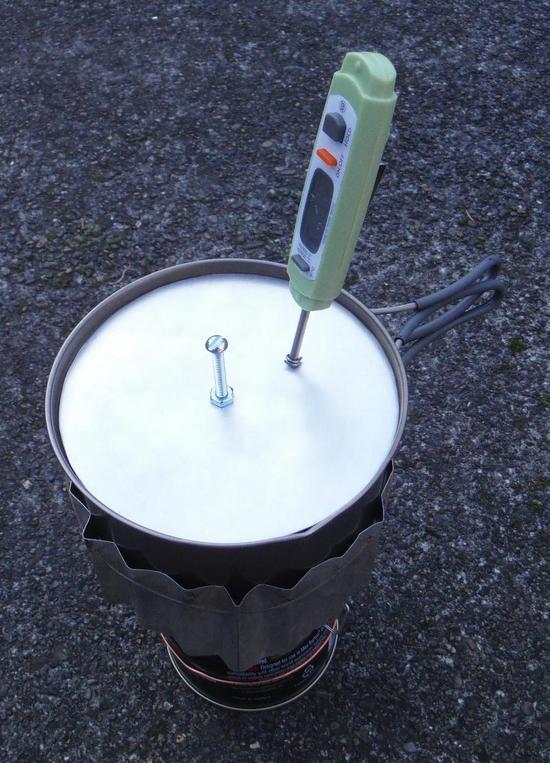
Cheap MYOG version:
windscreenhx

Fits inside pot.

Also acts as windscreen. You need some sort of windscreen with a canister stove. This would be better windscreen if it was a bit lower, but then it wouldn't fit into pot.

Another thing it does is direct exhaust gas next to pot rather than blowing away. If it was lower it would do this better, but then it wouldn't fit into pot.

PostedMar 2, 2015 at 9:08 am

Jerry,

I have to say that unless that heat exchanger of yours contacts the pot much more than I see in the pics, it is doing more as a heat reflector than as a conductive heat exchanger.

Take that same exact pot and set it on a your kitchen range top indoors with no wind . Then ,put a smooth sided version of that windscreen around the pot with about a .5" gap all around. I think you will find the boil times are about 10% faster…

Have you done any experiments with that cannister setup comparing the crinkled vs a smooth windscreen with equal gaps around the pot? That would tell you exactly how much the crinkles are worth..

As it stands, at least they look cool..:)

Just some food for thought.

Jerry Adams BPL Member
PostedMar 2, 2015 at 9:17 am

Yes, that is a compromise both on being a windscreen because it doesn't go far down and as a heat exchanger because the surface area is limited

I haven't done experiment with smooth non contact version

I know it's exchanging some heat because when I cook oatmeal, it scorches right where the herat exchanger contact points are. There are about 20 of them and they're about 1/2 inch long.

PostedMar 2, 2015 at 9:41 am

Well, scortched oatmeal is certainly a telltale sign of hotspots..

The whole interelationship of windscreens, air flow, heat reflection ,pot shape and material along with stove flame pattern and heat output is a very fascinating and at times, confounding one…

I'm starting to see some patterns that affect efficiency/ hotspots in titanium pots with alky burners, though.I've had at least one breakthrough that is counter to conventional wisdom.

Its been an interesting last twelve month with my titanium cookpots and my stove experiments.

Im not ready to cast them aside just yet…:)

Katherine . BPL Member
PostedMar 2, 2015 at 10:22 am

"Open Country has a bailed 2qt aluminum pot that weighs all of 4-5oz and costs $10."

I have that. Functional, and great bang for the buck, but it does get dinged up pretty easily. I'd spring just a bit more, for the HA version (available at trail designs (the caldera cone folks) or four dogs. You can get it w/ or w/o the bail wire.

PostedMar 2, 2015 at 11:34 am

I kinda agree with both sides on this..

The Hard Annodized OC pots are a bit harder and tougher than the plain versions but if the plain lids on my HA set are any indication ,the basic alloy Open Country uses is
pretty darn good. Its way more resistant to corrosion and tougher than the alloy in the IMUSA stuff. Its drawn much smoother as well.

As to cooking for a group, On hunting trips I carry ine Open Country 2 qt pot at 7.5 oz with pot grabber and one Trangia #25 HA 8.75" diameter frying pan at 4 oz. The frying pan has been seasoned with Olive oil and buttered anything slides right off of it.

I can make a full course meal for 2 to 4 people in 30 minutes with Coffee ,Hearty Entree ,Biscuits and desert with just that 12 oz worth of cookware . I carry two burners so I can have each pot/pan going at once.

I get hungry just thinking about it..:)

PostedMar 2, 2015 at 1:28 pm

I guess I'm not fussed about dings. Haven't had a pot become unusable.

I have the same Trangia frying pan — I really think the Trangia UL HA pieces are under-appreciated. They're well made and reasonably priced. Campsaver.com used to sell them at great prices.

PostedMar 2, 2015 at 10:15 pm

Thanks for all the input.

I went ahead a grabbed a couple Primus HX pots. On tacticalwhosalers.com, they about 30 and 35$ for the 1.8l and 3l . I already have a couple of Open Country pots and relatively lightweight pressure cookers.

For base camp use, where cooking mean rice and beans, the pressure cookers are invaluable. I have an optimus HX pot i have used for several years in winter, but I have never calculated the difference in fuel use on long trips. So, maybe on the next trip, I will have to use a HX pot and a non-hx pot and get some data.

Viewing 24 posts - 26 through 49 (of 49 total)
Loading...