

Episode 146 | Dirtbag Rich with Blake Boles
Episode Summary
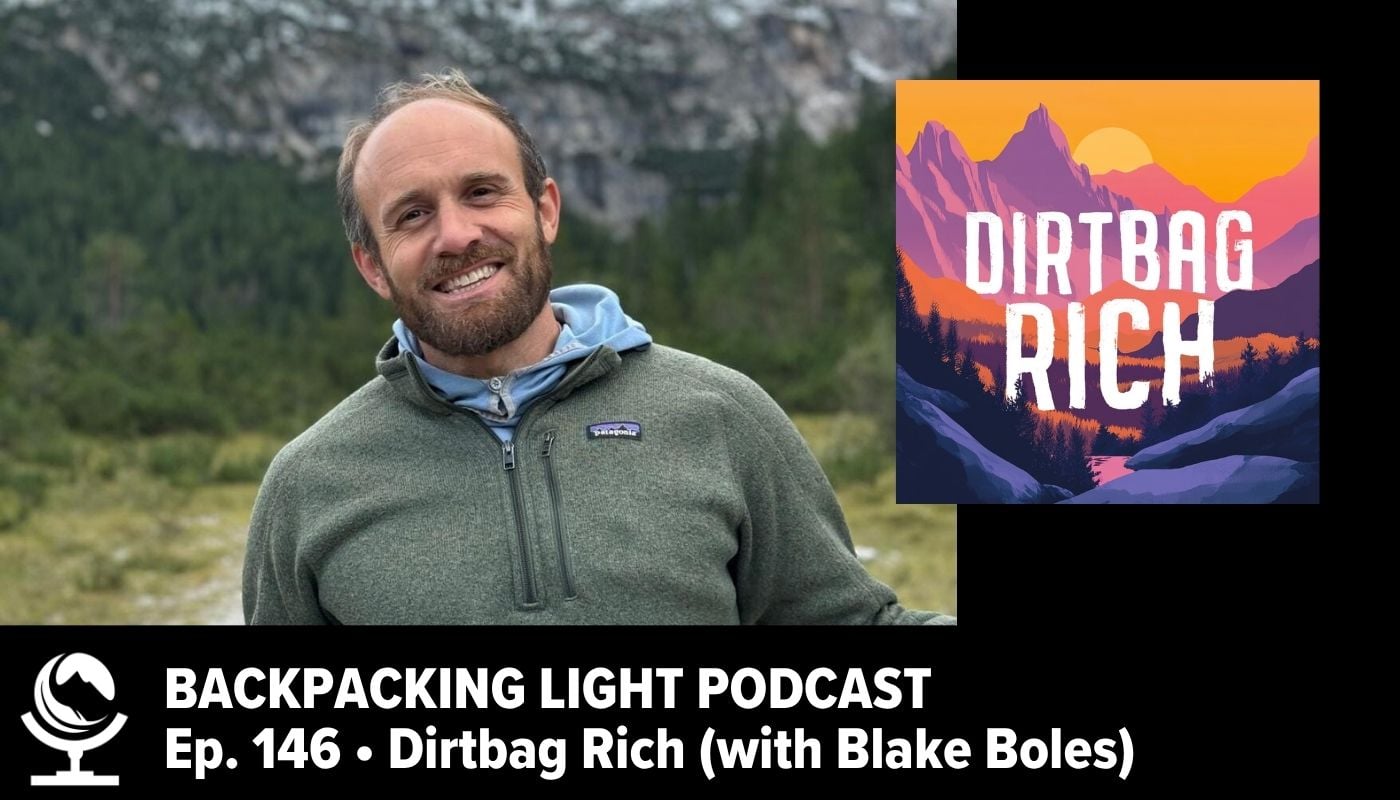
Ryan Jordan interviews Blake Boles, author of Dirtbag Rich, about redefining wealth through time, purpose, flexibility, and outdoor freedom. They explore dirtbag culture, careers, housing, relationships, risk, and the pursuit of a life built around adventure, simplicity, and meaningful time outside before retirement.
Listen Now
Show Notes:
What’s New at Backpacking Light?
- Find information about all of our upcoming Member Q&A’s, Webinars, Live Courses, other live events, and more on our Events Calendar Page.
Featured Brands and Products
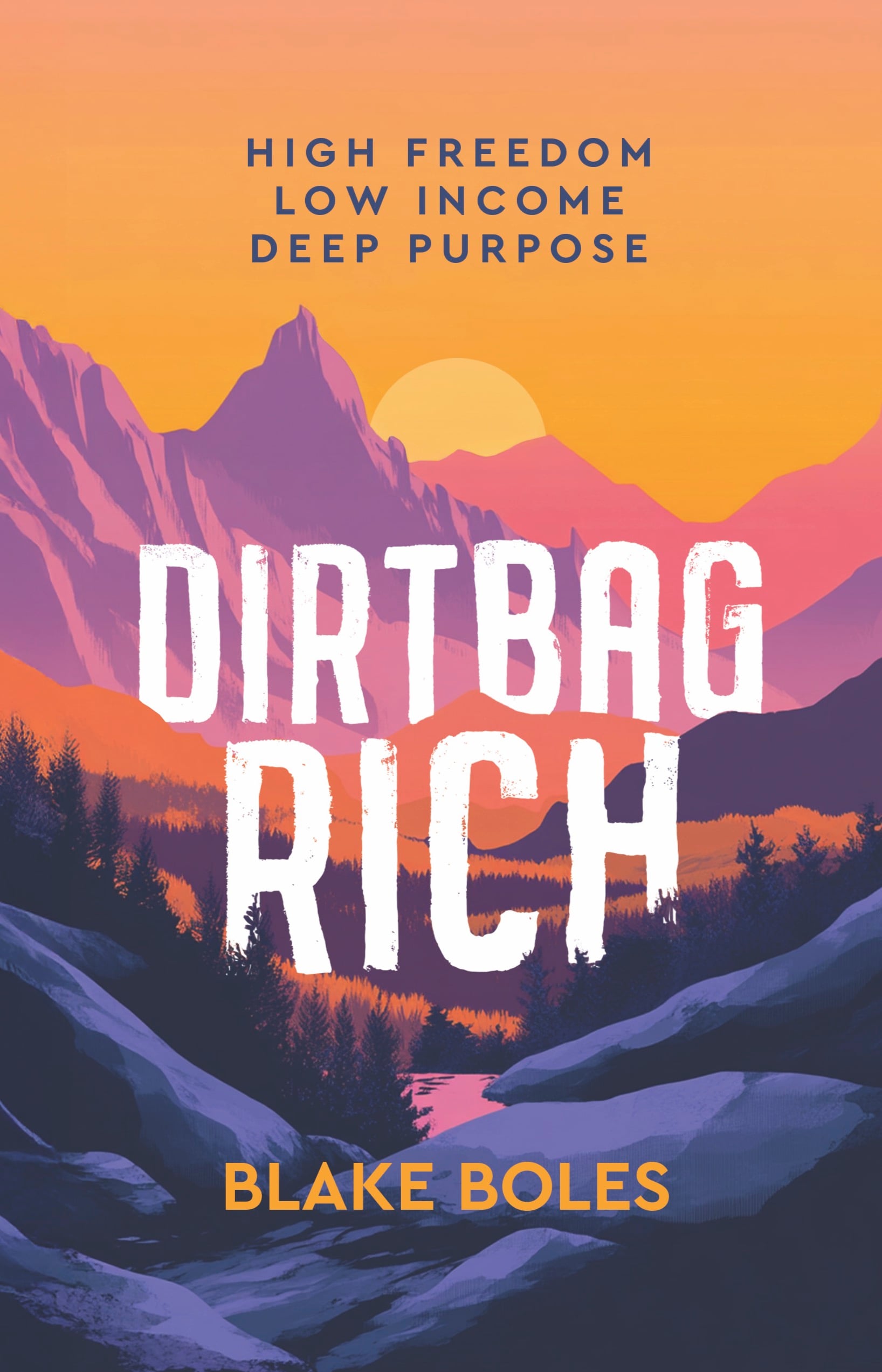
If you crave nature, freedom, adventure, and work that matters—rather than just paying the bills for a life you never chose—then you might be ready to become dirtbag rich.
Drawing from the “dirtbag” tradition of pursuing outdoor bliss through creative self-sufficiency, this book charts an unconventional way of living that includes both security and flexibility, connection and independence, and service and self-actualization.
Whether you’re jettisoning a life that’s not working or just getting started, the message of Dirtbag Rich is clear: You don’t have to play the same game as everyone else. You can have a life where you wake up and decide what you want to do, every day. You really can.
Through personal stories and candid interviews with people who’ve made it work—from nurses and trail runners to graphic designers and relationship coaches—Blake Boles shows how to build a life rich in time, purpose, and freedom.
Main Topic Bullets
- The historical meaning of “dirtbag” in climbing, thru-hiking, and outdoor culture
- How dirtbag culture has traditionally balanced freedom, poverty, adventure, and insecurity
- Blake Boles’ definition of the “Dirtbag Rich” lifestyle
- Why time, money, and purpose should be treated as coequal forms of wealth
- The difference between traditional financial wealth and time wealth
- How outdoor adventure changes the way people think about work, money, and lifestyle design
- Why many people defer freedom, travel, and outdoor experience until retirement
- The role of career flexibility in creating more time for hiking, backpacking, climbing, cycling, and travel
- How living in outdoors-oriented towns can support a lower-overhead, higher-adventure lifestyle
- The risks and trade-offs of choosing flexibility over conventional career advancement
- Housing strategies that support a dirtbag-rich lifestyle, including roommates, small homes, van life, travel, and shared living
- How cultural expectations around home ownership, status, and consumption shape lifestyle decisions
- The relationship between simplicity, minimalism, and freedom in both backpacking and everyday life
- Why relationships, community, and the ability to show up for others may be overlooked forms of wealth
- How to pursue outdoor freedom without romanticizing irresponsibility, poverty, or precarity
Links, Mentions, and Related Content
- Issues: On Wilderness and Flourishing
- Essays: How Much Does Backpacking Really Cost?


Discussion
Become a member to post in the forums.
Companion forum thread to: Episode 146 | Dirtbag Rich with Blake Boles
Ryan Jordan interviews Blake Boles, author of Dirtbag Rich, about redefining wealth through time, purpose, flexibility, and outdoor freedom. They explore dirtbag culture, careers, housing, relationships, risk, and the pursuit of a life built around adventure, simplicity, and meaningful time outside before retirement.
He who spends the most days outdoors wins.
If you’re a trust fund baby who doesn’t have to work, no worries, you can have it all. But for the vast majority of true dirtbag hikers everything’s a tradeoff.
Marriage and children are going to be virtually impossible because of the time, money and stability needed to maintain a solid family. If you’re a male, romance and intimacy are something you’ll probably have to mostly forgo unless you’re a 1 out of 1,000 stunning Giga-Chad. In our society women generally don’t go for broke dirtbaggers who haven’t showered for days. It’s easier for women to find love in the backcountry and please don’t try to give me a PC narrative on why that’s not true.
Dirtbag hikers work just enough to save enough money for the next thru-hike, typically 3 to 6 months, and preferably at a job where the employer matches their 6.2% social security input. Main thing is to have 40 quarters of SS paid in at 65 to get Medicare and at least some SS income later on. The bar is pretty low on getting that done. You’ll need to be on Medicaid before age 65 and income must be kept low enough to qualify….THAT”S HUGE! And stay away from non Medicaid expansion states which are mostly in the Southeast US.
Blake is so right, the rent monster is what enslaves people more than anything, so when it comes time to work again a dirtbag hiker has to find low rent and that can usually be done in most parts of the US. Just go on craigslist and run an ad for “Rooms Wanted” or look for ads saying “rentals to share”. But NEVER sign a lease for an apartment because that will take up 40% plus of your income and you’re committed. When not working there are millions of acres of BLM and National Forest lands in the west where you can camp for up to 2 weeks until you need to move again. Get a 27 dollar a month Planet Fitness black card membership so you can take showers….they are located everywhere.
Food should be number 1 expense. Practice minimalism on all levels. It might be necessary to rent a 5′ X 5′ storage unit to place your worldly possessions (maybe 50 to 70 dollars per month).
Americans are brainwashed into the materialist consumer culture that keeps them on the plantation, a veritable treadmill that makes them working stiffs, slaves if you will. And why are Americans so overweight and unhealthy? I say it’s because they simply don’t walk enough. What did humans do for more than 100,000 years before civilization when they were hunter-gatherers? They walked for about 8 to 12 hours a day. Now when I drive by a fast food restaurant I see cars lined up 10 to 20 deep with motors running and fat a** Americans who are too lazy to park the car and walk inside where there might only be 1 or 2 people in line.
That buddy you may depend on for shelter is now married and has two kids. When you’re gone for a long time, life goes on without you. When you return your head is in a different place from what’s considered normal in structured society. Your values change. It becomes hard to accept the posturing that accompanies emerging yourself totally into a world created by others. You see past the structure, back into the woods where you left reality behind until your next visit.
Actually, I thought it was glossed over quite a bit.
Obviously, I can appreciate the desire to spend more time outdoors. I will probably catch flak for this, but as I listened to this, I couldn’t help thinking how incredibly self-centered it was. It’s all about how you can best live the life you want to live, with little consideration for others. No thought of contributing to a society or to the future. No discussion of service, of helping or supporting other people or a community. I was just trying to listen, and appreciate how people pursuing this lifestyle feel, with an open mind, without judging. But I have to admit that I found the selfishness hard to swallow and I couldn’t get through the entire hour, even at 2x.
Human beings are inherently social creatures, and we live with an implicit or explicit social compact, going back to our earliest roots. The mind-view being glorified here seems to focus almost entirely on what an individual can get from the society, and ignores the flip side. Society, and small communities especially, need everyone (or almost everyone) to contribute in order to survive, never mind thrive.
Society can absorb a certain small number of people pursuing this lifestyle, but in many small mountain towns, where this mind-set is increasingly common, it is demonstrably creating a crisis for the community. I am seeing the longstanding culture of cooperation break down, and people are scapegoating other groups and becoming tribal.
Dirtbag culture, and the desire to avoid long-term commitments, is not entirely to blame. For example, the rise of short-term rentals has created a new culture of greed, which is a major part of the crisis, it’s complicated. But the convergence of these trends is very troubling. And I personally don’t feel that it’s healthy to endorse, or even glorify, such a self-absorbed philosophy of life.
BTW, I have that same Patagucci fleece that the author is wearing. A gift from my wife. 😉
I didn’t find it upsetting. As far as selfishness goes, I know it can be a [silent] motivation for many pursuing a lifestyle of leisure, but that wasn’t what I took away from the episode. Moreso, I felt that the entire episode was moreso a “how to” introduction, a thesis on, how to disengage from the decades long, dogged “grind” of pursuing the “American Dream.”
Near the end, he even highlights how the “Dirtbag Rich” lifestyle allowed someone to, at a moment’s notice, travel to and care for a sick/dying family member. I think that’s a pretty healthy application of a “Dirtbag Rich” lifestyle, and certainly an un-selfish example.
The author even mentioned as well, the different types of people he interviewed for the book – a public-school teacher, some passionate entrepreneurs, etc… These don’t sound like selfish peoples or professions…
I wonder if some of you all maybe missed the grander point of the author’s thesis & book – that making space & time in your life[style] to pursue your “hobbies” can at the same time create space & time for whatever else is important in life.
A lifestyle dependent on selling it to others is not a lifestyle. It’s a business.
In response to Monte’s doozie of a comment… I might suggest that something outdoors-oriented men can do in a time of stability is to attend talk therapy in order to expand their capacity for emotional intimacy. It is in fact possible to adventure with a partner, and it can be frugal too when you split expenses! If you see yourself as a lone man incapable of these things that can be quite the burden. I also find it spiritually unhealthy to denigrate the “masses” who have fallen into a less adventurous lifestyle.
I am sympathetic to Dan’s comment. I feel that Blake’s perspective is Gen X par excellance – the idea that the world is mostly stable and fine, and that the individual’s search for freedom from the cage of normie life is the most virtuous pursuit.
That said, I think it’s fair to acknowledge JAshleys point that Blake doesn’t seem completely unaware of giving back to a community. In fact he seems quite active in various “networked” communities that relate strongly to outdoor adventure, and he references time spent with family as valuable.
In the podcast Ryan hints at the political undercurrent here, that not everyone might be able to freely choose this lifestyle, and that forgoing certain luxuries that previous generations took for granted is not a choice for most. This is very true and quickly might stray a bit too political for BPL if explored fully.
However, I see a great value in this podcast and in Blake’s message, imperfect as it may be, on the topic of embracing values of freedom, of spending time with people, of seeing the world and being outside. Regardless of the political-economic context, I think that those are meaningful values to espouse and embrace.
“I might suggest something that outdoors oriented men can do in a time of stability is attend talk therapy in order to expand their capacity for emotional intimacy”
Yes, perhaps it might serve me well get in touch with my softer side.
In another thread Ryan mentioned stoicism as a good mindset for the backcountry, and even though I personally embrace absurdism, I can see where a stoic approach might work well for a dirtbag hiker due to the depravations, sacrifices and loneliness involved (embrace the suck). It’s all about being in the outdoors day after day, cranking out the miles and staying on the euphoric hypno-high (a kind of runner’s high) while also taking in the awesome scenery. I find good coffee and some things from the dispensary tend to help.
Perhaps the dirtbag lifestyle is selfish, but at the end of the day you only have yourself and no one is coming to save you. At least a dirtbagger doesn’t produce a giant carbon footprint the way most Americans do.
Not selfish at all. Some of the most caring and giving people I’ve ever met. Empathy grows with hardship and going without. Self reliance. Not placing your burdens on others. Sharing the little that you may have. Society calls them dirtbags. I may address myself in such terms. I won’t use it for others. Not unless they truly deserve it, in which case I often throw in a couple more terms. “Dirtbags” hikers are just folks living their lives. Somebody wrote a book. I’m over it.
The podcast rings true, but this isn’t new stuff at all. I’m surprised to hear both the author and Ryan comment that this is something new because of the internet. There have been so many such movements and individuals who have chosen alternative outdoor lifestyles over the last two centuries or even more. Mountain men, Daniel Boone, Thoreau, Nessmuk, John Muir – even Grandma Gatewood! I wouldn’t call them dirtbags though; to me that’s an even more extreme version of choosing life over things, experience over overt wealth, maybe more similar to hermits. But there are plenty of examples of people who didn’t choose a conventional career for their time, in favor of having less wealth and more time outdoors. It’s not a new ideal/fantasy.
When I picture “dirtbags” I see them as freeloaders and leeches, and have met a few that matched that reputation, always wanting others to help them. There are a few who believe when they run out of money to sustain themselves, due to not wanting regular work, that it is somehow someone else’s responsibility to care for them. I realize that isn’t the way they’re using the term here but it’s a fine line.
I feel like my parents created a good balance in life between work and enjoyment. Everyone chooses their path; the important thing is to be satisfied with the path you are on, and satisfied with your contribution to society as well as your lifestyle. Don’t we all want to be good people as well as content in our own choices?
My parents chose a life in teaching both because they were passionate about their subjects (biology and music), and because they could use summers to refresh, explore, and find adventure. They were able to have a modest but comfortable retirement, a life without a lot of material goods but enough to be happy, and have the joy of family relationships.
Because they grew up during the Great Depression, they were more able to appreciate simple joys, and weren’t always questing after the latest greatest thing to buy or have. They made do, they adapted. We had one family car which lasted until it died. We all rode bikes for a lot of our transportation. We never had a clothes dryer, a dishwasher, or many other things that “middle class” people had. And I didn’t really even notice until I was an angsty teenager, comparing my circumstances with others.
My parents were even satisfied with working all week, because many weekends were free for enjoyment; that was not a given for that generation. They liked to work – to paint the house, dig the garden, hang the laundry on the line. If you don’t learn to complain or seek “labor-saving” machines (that require you to work more to afford them), or always wish you were doing something else instead of whatever you are doing, you can find satisfaction in the day to day work and chores; every minute doesn’t always have to be the drama of climbing a peak. But they also spent a very great deal of time outside, day to day, week to week, and all summer long. Find joy in the little adventures as well as the big. Those were great lessons; I sometimes have to remind myself about them.
The true dirtbags are celebrating golden statues of themselves.
Become a member to post in the forums.