


Introduction
I had a small hiccup in the development of the SUL Remote Inverted Canister Winter Stove V7. In brief, at peak power with a cold liquid feed, the vaporisation process inside the Stove Body could fail and the stove could flare, with tall wobbly flames. Shutting off the fuel at the canister when this happens clearly shows blobs of liquid fuel coming through the jet as the stove dies. This is not good enough – it’s not even safe. Much research was done to find out what was going wrong. In hindsight, the problem was fairly simple but had some interesting twists.
What is ‘peak power’? It’s what one gets when the needle valve is opened wide with a liquid feed. There is quite a roar. Signs of flame lift-off may happen, and that can be very dangerous. That said, I never run any stove at peak power: it is very wasteful of fuel as half the flames go up the side of the pot and are wasted.
I only run stoves just up to medium power; dinner gets cooked – or coffee brewed, quite quickly. Because of this, I never tested the V7 at peak power, which was my mistake.
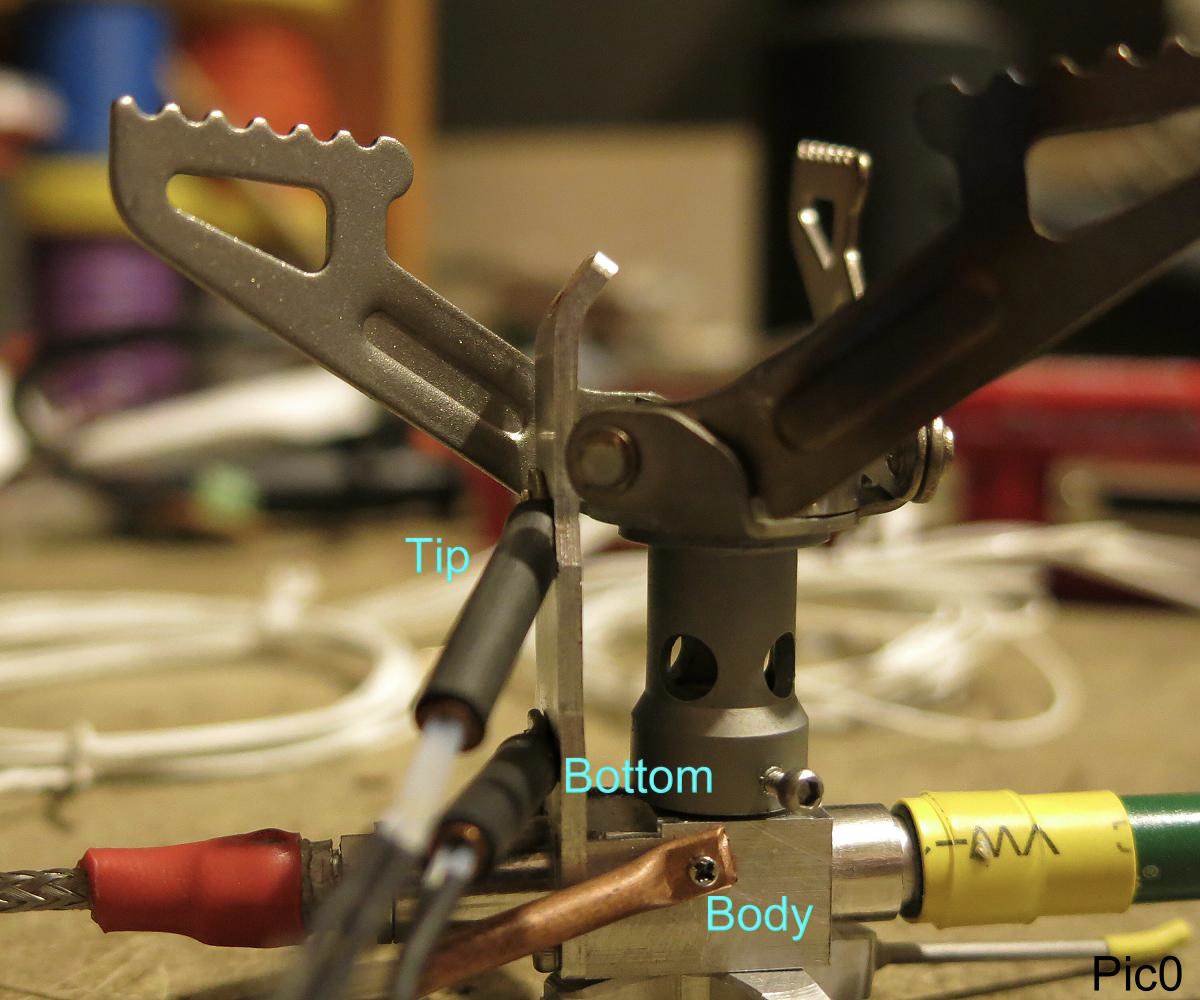
In what follows there will be frequent reference to “Tip”, “Bottom”, “Body”. These are the temperatures as measured near the Tip (top end) of the Heat Shunt (HS), near the Bottom of the HS where it is bolted to the Stove Body, and to the body of the stove itself. They are illustrated above and below. The Heat Exchanger (HX) is a small rod inside the Stove Body which spreads the incoming fuel into a thin film, for vaporisation. Details will follow.
This photo also shows short bits of copper tube attached via M1.2 SS bolts. They hold the temperature-measuring thermistors (in little glass beads) during testing. They also support the leads (they are a little delicate) and they make sure the leads do not cool the glass bead. These copper tubes do not form part of the stove in practice. The locations on the HS are also shown below as the two very small red circles on the central axis.
Later on I made steel clamps to clamp a copper tube to the Stove body, without any bolts. That made testing possible without drilling and tapping holes in either the HS or the Stove Body, which is very convenient.
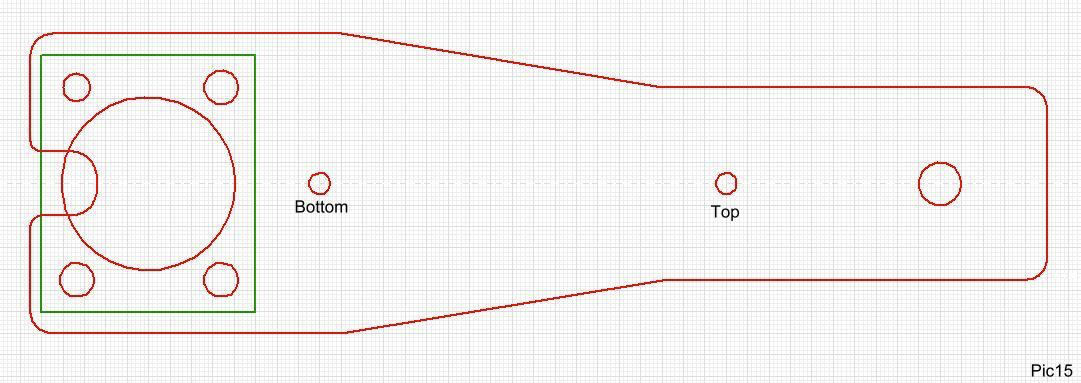
Please Note: My drawings etc are simplified and not very artistic. Sorry about that.
Member Exclusive
A Premium or Unlimited Membership* is required to view the rest of this article.
* A Basic Membership is required to view Member Q&A events


Discussion
Become a member to post in the forums.
Companion forum thread to: MYOG: SUL Remote Inverted Canister Winter Stove Update
Roger Caffin shows how to solve a fuel vaporisation process failure in his SUL remote inverted canister stove.
So, do you have to replace HS on existing stoves?
You could use copper which has twice the conduction as aluminum in the same size?
And maybe if you don’t run flat out don’t worry about it?
Fascinating and excellent work Roger. I had no idea that the heat xfer efficiency varies so much across the various alloys. I think with current research into things such as high entropy alloys, assisted with AI modeling, some day we will see light weigh alloys that approach copper’s HX capabilities.
One thing I wish stove makers would do is limit the max power of these little stoves to prevent melt down. Could be as easy as a stopping tab that prevents the control valve from reaching wasteful and dangerous output levels, especially with the recent prominence of sensitive HX pots.
I also wonder why we went away from graphite valve packing, which has much higher heat resistance. Sometimes ancient tech is the best tech.
One spec some people look at is time to boil an amount of water
If they allow stove to run flat out, it will have a better spec
Hi Jerry
So, do you have to replace HS on existing stoves?
I have sent replacement Heat Shunts to all existing customers.
You could use copper which has twice the conduction as aluminum in the same size?
Yes, but copper has more than twice the density. For the same thermal conductivity, aluminium works out lighter.
And maybe if you don’t run flat out don’t worry about it?
Exactly! And if you are not in perishingly cold weather (eg -20 C?) and you don’t run flat out, even more so.
Cheers
Hi Dirtnap
One thing I wish stove makers would do is limit the max power of these little stoves to prevent melt down.
As Jerry pointed out, marketing spin and claims for faster boil time seem to win out over common sense.
You have spent 8 hours getting there, 1 hour setting up camp: does an extra 1 minute to boil really make that much difference?
Cheers
“You could use copper which has twice the conduction as aluminum in the same size?
Yes, but copper has more than twice the density. For the same thermal conductivity, aluminium works out lighter.”
yes, but the weight savings is insignificant. (We’ve been there before :)
if you didn’t have room to double the width of the aluminum to solve your problem, you could use copper, but I don’t think that’s an issue for your stove
No, not really an issue.
I found that “doubling” size of the bit which intercepts the flame was more significant. Once I have got the energy INTO the HS, then many problems go away.
Cheers
Roger, I admit my knowledge of backpacking stove physics is low BUT… why do you insist on using a heat shunt instead of the commercially common vaporizing fuel tube?
Roger can speak to this much better than I can but frankly I’m shocked more stoves don’t use a heat shunt instead of a vaporizer tube. No chance of fouling, much simpler and more robust design IMHO.
Hi Eric
Fair question. Herewith my thoughts.
First of all, I am not aware of any really small commercially common vaporizing fuel tube on the market. Yes, there are tubes of that description for cars, but they are HUGE compared to my V7 stove. Of course, I may have missed something of the right size: please tell.
Second, there is a manufacturing problem here. A heat shunt is bolted ONTO the stove body, which is very simple (see article). But a vaporising tube will contain extremely inflammable gas under pressure, so it must be hermetically sealed to the stove body to guarantee that you won’t get any fuel leaks in the field.
There are flared fittings as used on copper piping which can do this, but they are a bit large, and they need quite a bit of metal to provide enough strength. That is heavy.
Once you go down that path the stove body has to be a lot larger as well, to provide room for the fitting. That adds even more weight. The same space/volume problems would apply to any joints relying on O-rings. Yes, I am using O-rings, but they don’t get that hot.
You can of course weld or braze such a tube into the stove body: that would be gas-tight – IF this can be done. You can NOT rely on soft solder for this as there is a good chance the solder could melt, with ‘Oh Dear’ results. Even silicone adhesives only get up to (maybe) 250 C, and the stove body could get that hot. Not that there would be much strength left at that temperature.
One could try to weld a small tube into the aluminium stove body, but welding aluminium is a bit esoteric. It gets much worse when you try to weld aluminium to another metal.
Even if you succeed, there is a real problem here with a serious mismatch in thermal expansion rates of aluminium versus any heat-resistant and corrosion-resistent piping. Too much thermal cycling and you will have problems. This would also impact any attempt at a compression fitting. Unreliable.
Suitable piping could be titanium, or maybe brass. The brass would be heavy. Titanium is lighter, but welding Ti usually requires a vacuum chamber. I am a bit short on such things.
Making a flat heat shunt and bolting it on the side was easy.
Cheers
So, pre-heat tubes allow you to operate the stove at cold temperatures by inverting the fuel canister. At above freezing temperatures, the canister can be upright. If I recall correctly, the heat shut must be operated in the inverted mode at all times in order to maintain thermal management of the stove body. for example, at 60 F, if you operated the Winter Stove with the canister upright, the stove body could overheat. This could impact temperature sensitive materials like plastics and O-rings. By following the directions, the winter stove is a brilliant design. My concern with a heat shunt is that people don’t follow directions and the repercussions can be bothersome.
I think that the Winter Stove is a fantastic design for its purpose: winter camping. I would like to see if it would work without the shut for 3 season camping as it is the lightest remote stove around. It surely beats a number of canister topped stoves and the remote allows you to use a simple windscreen for protection. My 2 cents.
Hi Jon
The V7 with an upright burner and a Heat Shunt does require that the canister be inverted , so that a thermal balance is maintained. That is, heat flow down the shunt to the stove body balances the heat needed to vaporise the incoming liquid fuel.
The V6 has a Vortex burner and no obvious Heat Shunt. I strongly recommend that the canister should still be inverted in use, for the same reason of thermal balance. In this case the incoming energy flow is through the base plate to the stove body.
The PFA hose and the Viton O-rings are rated to 250 C. The designs try to limit the temperatures to 120 C with an inverted canister.
Cheers
Become a member to post in the forums.