


Introduction
For much of my backpacking career, I followed the Leave No Trace (LNT) guideline of burying human waste in catholes. Over the last decade, my confidence in catholes as a reliable solution has eroded. This shift has been shaped by two key factors: my own field observations and a growing body of scientific evidence on human waste decomposition in various environments. The result is that I now consider pack-out systems the default in alpine, desert, and other fragile settings. I’ll dive into this topic in more detail during our upcoming livestream, “Leave No Trace: Revisiting Best Practices,” but I’ll summarize some of the key science and best practices here.
Field Observations
The first change came from direct experience. On high routes in the Sierra (CA), the Wind River Range (WY), and the Front Range (Colorado), I began to encounter toilet paper and feces in places that had once felt remote and pristine. These were not popular trails, but rather cross-country routes that required skill and effort to reach (albeit routes that had been heavily publicized on the Internet).
I also experimented with GPS-marked catholes in alpine areas of Montana, Wyoming, and Colorado. When I returned to the same locations several months (and sometimes up to 30 months) later, I found evidence of both human feces and toilet paper in 100% of the catholes. Decomposition occurs painfully slowly in these environments: toilet paper fragments always remained, and fecal material was still recognizable. What I observed in the field was consistent with what the literature reported: soils at high elevations and in arid environments are poor at breaking down organic material. Even Ells and Monz (2011), studying fecal smears in mountain environments, noted “substantial reduction in fecal mass… but extensive reduction in fecal indicator bacteria was observed in only the arid and alpine environments” (Ells & Monz, 2011). None of this bodes well for the long-term health of backcountry soils and water sources.
My Current Practice
Today, I rely on a simple, redundant pack-out system. Toilet paper is always placed in an odor-resistant bag (Smelly Proof). For feces, I use dog-waste bags for pickup, and nest them inside a 5-mil mylar zip bag. My waste bags are then carried in a 3 to 5-liter waterproof roll-top bag stored in the rear pocket of my pack. This keeps it separate from other gear and supplies, providing multiple layers of containment.
This approach gives me flexibility. On multi-day routes that traverse alpine ridges and then descend into forested areas, I pack out waste in sensitive locations. I may transition to catholes only when soils are deep, organic, and have high decomposition potential.
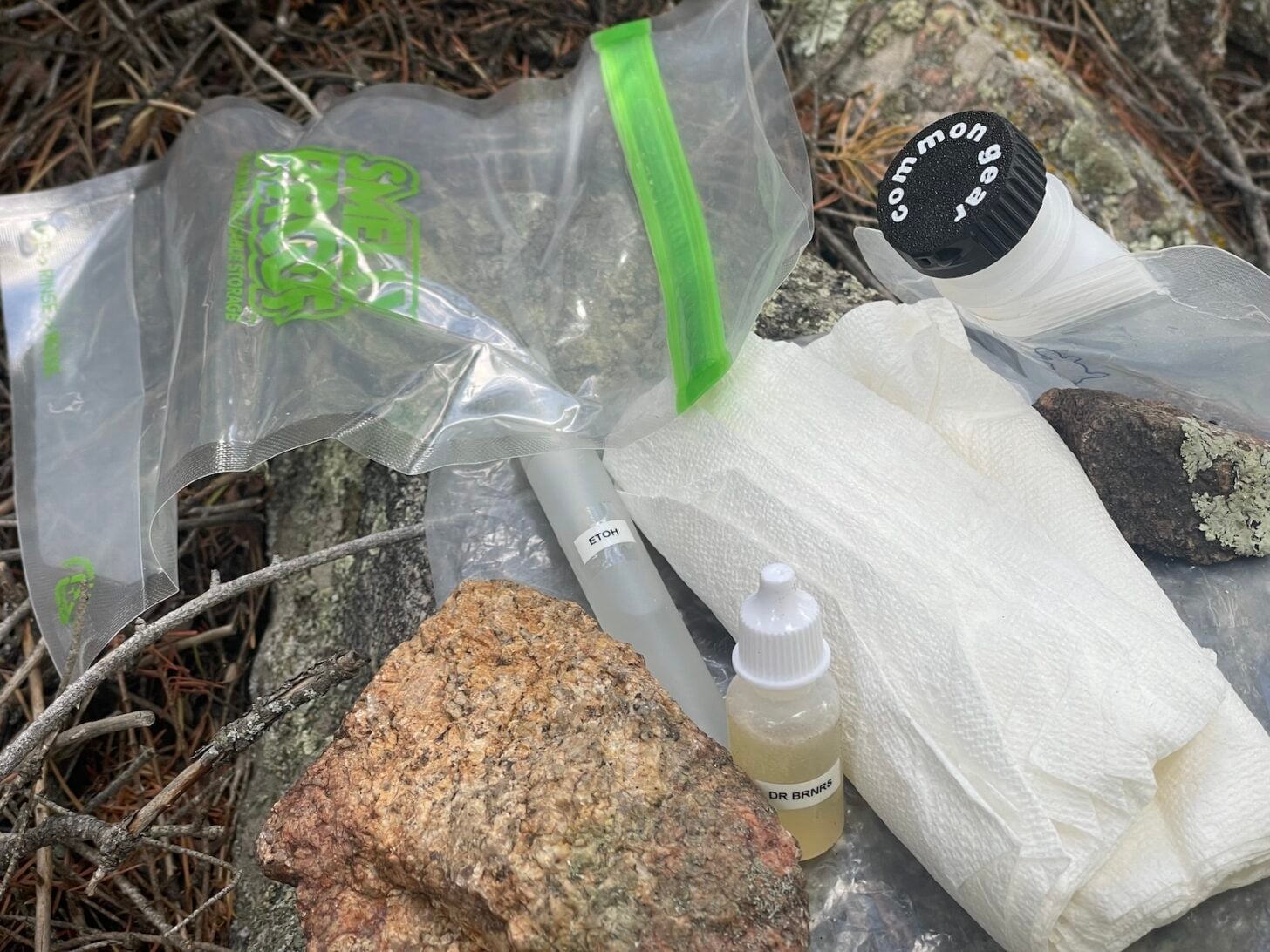
Situations Where I Still Use Catholes
I will still dig a cathole under specific conditions:
- Below treeline
- In organic-rich soils
- In remote areas away from established campsites and trails
Even in those settings, toilet paper is packed out. Catholes have become the exception rather than the rule for many locations during my mountain trips now.
Why I Made the Change
My primary motivation is ecological. Studies have demonstrated that cold, dry, inorganic, and shallow soils limit microbial activity, slowing or halting decomposition. Seastedt et al. (2001) reported that alpine tundra decomposition is primarily constrained by low temperatures and moisture, with microbial activity being uniformly low.
Pathogens can persist in these conditions for long periods (Ells & Monz, 2011). Fecal contamination indicators can remain viable for years in cold and dry soils. Recreation ecologist Jeff Marion has described improperly disposed human waste as a “delivery vehicle for disease” (The Guardian, 2025).
In heavily used areas, the problem is less about decomposition rates and more about accumulation. Many catholes in close proximity exceed the soil’s limited capacity to absorb waste, and casual hikers’ limited motivation to find remote areas to distribute their waste. Land managers report that improperly disposed waste is now one of the most pressing management concerns in U.S. wilderness areas (The Guardian, 2025).
As an educator, I also feel a responsibility to model the practices I recommend. It is difficult to influence behavior if I am not already using and testing the systems myself. In addition, as land management agencies require stricter practices among hikers and backpackers, I’d like to be at the forefront of best practices with well-oiled systems for managing and packing waste.
Research and Management Context
Some lines of evidence to consider:
- Ells & Monz (2011) documented a limited reduction of fecal indicator bacteria in alpine and arid environments (Ells & Monz, 2011).
- Seastedt et al. (2001) confirmed low microbial activity in tundra soils as a primary constraint on decomposition (Seastedt et al., 2001).
- The Bureau of Land Management now requires pack-out in many deserts and alpine zones, and nearly every river canyon where soils cannot effectively process waste (BLM, 2025).
- LNT increasingly emphasizes pack-out as the most appropriate method in fragile and high-use environments (Leave No Trace, 2025).
- A 2024 study of New Zealand mountaineers reported rising adoption of pack-out, with identity and norms as significant predictors (McIntyre et al., 2024).
- The U.S. Forest Service now mandates pack-out in areas such as the Holy Cross Wilderness in Colorado’s White River National Forest (PBS, 2025).
Stabilization, Desiccation, and Volume Reduction
For me, pack-out is now the default in alpine, desert, and high-use environments. Catholes remain an option in specific, low-risk environments. Carrying out waste requires negligible weight for short trips, but the benefits in terms of ecological protection and visitor experience seem significant to me, especially in crowded areas.
My current challenge is managing waste effectively during longer trips, where the accumulated weight becomes significant. I’m studying various methods to manage stabilization and odor control, volume reduction, and possibly dessication.
Human feces are composed of approximately 70–80% water. The bulk of what is carried out in a containment system is therefore moisture, not solids. Without treatment, this water contributes to added weight, bulk, and odor during transport.
From a waste management perspective, three strategies are relevant:
- Stabilization: adding materials (e.g., gelling agents, absorbents, or alkaline powders) that immobilize liquids, reduce odor, and suppress microbial activity. Stabilization improves containment reliability and handling safety, but does not necessarily reduce weight.
- Desiccation: removing water through evaporation (or possibly absorption into some type of disposable desiccant), which decreases both weight and pathogen survival. In the field, proper drying requires specialized material technology that allows vapor to escape while retaining solids.
- Volume reduction: compacting or shrinking the overall waste package to reduce what the backpacker carries. Commercial systems achieve this by immobilizing waste in dense gels; experimental systems, on the other hand, employ membranes or heat-assisted drying to drive off water vapor.
Practical Guidance for Backpackers
- Prioritize containment over treatment. A durable, leakproof bag system remains the most reliable option. Use a commercial kit (e.g., WAG/Restop) or a DIY multi-layer system with odor- and puncture-resistant bags.
- Separate toilet paper from feces. Carry toilet paper in a dedicated odor-resistant bag. This minimizes access to the feces bag, reduces cross-contamination, and makes handling easier.
- Use lightweight absorbents sparingly. A small amount of biochar, sawdust, kitty litter, or commercial gelling powder inside the feces bag can absorb free liquid, reduce odor, and modestly reduce volume (by making everything more compressible with less mess). Carry only what is needed for the number of anticipated uses.
- Recognize the limits of sealed systems. Standard sealed waste bags (DIY or commercial) will not lose water weight in the field. Evaporation requires a vapor-permeable but liquid-tight liner or a vented system with odor molecule (e.g., carbon) filtration, which are not part of current backpacking kits. Exterior storage may help with odor segregation and convenience, but it does not aid in drying.
- Do not expose waste to drying. Leaving feces in the open to air – or to sun-dry – is inconsistent with Leave No Trace principles and creates health risks. Any desiccation efforts must occur within a contained system.
- Keep weight expectations realistic. Full desiccation is impractical in the backcountry with current systems. The most achievable goals are stabilization (to make waste easier and safer to carry) and modest volume reduction through absorbents.
Conclusion
Backcountry evidence and scientific research increasingly show that catholes are unreliable in alpine, desert, and heavily used environments, where decomposition is slow and pathogens persist. Based on both field experiments and the literature, I now consider pack-out as a normalized approach, recognizing that catholes are best limited to less arid environments with deep, organic soils below treeline. My current practice emphasizes the use of redundant containment systems, separation of toilet paper, and the limited use of absorbents for stabilization and odor control. While future innovations may make desiccation and volume reduction more practical, the priority for backpackers today is secure containment and responsible disposal. In short, the ethic of minimum-impact camping is shifting toward packing out waste as the standard practice. Stay ahead of the curve so you’ll be ready when land management agencies impose stricter regulations.


Discussion
Become a member to post in the forums.
Companion forum thread to: Reassessing Backcountry Sanitation: Packing Out Human Waste
Improperly buried waste threatens wilderness soils and water. Catholes have notable limitations in their ability to decompose waste in fragile environments, and are becoming a problematic human waste management tactic in high-traffic areas. See why pack-out systems are increasingly becoming a viable option for backpackers.
I am skeptical that studies show disease is caused by catholes, but willing to consider this
The Ells and Monz study concluded “Although surface smears appear favorable to cathole techniques in terms of indicator bacteria reduction, the application of this method is limited by several other factors common to backcountry sanitation situations. It is therefore likely that surface disposal would only be applicable in very remote, low use, alpine and arid settings where lack of soil development precludes the use of catholes and carry-out techniques are otherwise impractical.”
So it does not say that catholes cause disease, but to use catholes instead of surface smear in some cases. I’ve never heard of the surface smear technique.
In the Seastedt study they say “Despite a longer snow-free season and higher surface temperatures in dry meadows, decay in these areas is substantially lower than in moist meadows. Studies of decay rates of roots within the soil indicate that decay is uniformly low in all habitats and is limited by low temperatures and perhaps by the absence of certain groups of decomposer invertebrates.”
That’s useful information, put your cathole in a moist place. And in alpine areas in general decay is slow.
The other references are about agencies regulating use of catholes.
I wonder if there’s any disease caused by human poop. Maybe it would be difficult to study.
It makes sense to ban catholes on crowded rivers because the use is so concentrated, or in alpine areas with no organic areas.
I need to do my study of checking a cathole later to see how much it’s decayed.
Caused by? No more so than any other pathogen carrier causes it, but being the carrier is the causative factor. That’s why – by way of example – we refer to fecal contamination of water as the cause of cholera, typhoid, lepto, etc. Am I interpreting your wondering correctly, here?
Unhealthy humans leave unhealthy poop. Decomposed or not, nitrification can change the flora and even the fauna. The Colorado trail is said to average around 500 thru hikers a year, plus all the section hikers. 500 poops every 15 to 20 miles. Hopefully away from water sources, though I would gander, not to far away. I have started to carry a couple Smelly Proof bags inside a about a 6 liter DCF bag. One for trash, one for the other. Repurposing my freeze dry meal bags. So far only on short trips. I generally have a dog with me anyway. I’m glad Ryan brought this up. Get past the stigma of carrying a bag of poop.
No, I wonder if there are any studies that show human poop in cat holes causes any disease in other humans or wild animals.
I wouldn’t have a problem carrying my poop out if it prevented some health problem in humans or r wild animals.
I think it’s a great idea that people carry their poop out if they’re boating in a narrow stream corridor or climbing a mountain where there aren’t any good places for poop to decompose
I found three or four such studies with a basic AI-assisted search; seems like there’s research, but not a ton of it.
Beyond that: yes, human waste in any soil setting is a well-documented source for the spread of disease. Take a look at the 5F diagram for disease transmission: fluid, flies, fingers, foods and fields. That last one means soil: various pathogens that are common in human waste can persist for months and years in soil, and that goes for surface and sub-surface contamination. Areas that favor slow decomposition are the simply the most dangerous in regards to pathogen preservation and later transmission, but it’s a potential problem anywhere.
Personally, I have no problem with using the coniferous facilities in areas that see little to no human traffic…but if I’m somewhere populated, then yeah: pack it out. Not gonna be part of that problem.
were there any cases of animals getting sick from catholes
if bacteria persist in the cathole it’s not a big deal.
I would be happy to pack out my poop if it prevented disease in animals
I think the main problem is aesthetic. No one wants to see toilet paper strewn around when they’re in the wilderness. I know I don’t. Whenever I encounter it, I bury it properly. And I take out any trash I see, which is mainly just the corner of a candy bar, rubber band,…
what are the three or four you found with ai assisted search?
I don’t know if it’s possible to accurately document wild animal illnesses in a way that would answer your question…but I disagree that bacteria still existing isn’t a big deal. Any exposure of that still-present pathogen brings it back into play, potentially: that could be accidental human re-excavation, animal digging/ingestion, water washing it out, etc. Is any of that likely? Eh, depends on the usage and overall contamination of the site, probably…but the point is that it’s actually pretty easy for most pathogens to spread: that’s literally what many of them are best at doing.
Aesthetics are definitely a problem, but they’re a tertiary problem to me. The main issue I see is simple overuse and impact, and the secondary issue are the possible health impacts…and yeah, the visual remnants aren’t great, either.
I didn’t write down the studies that I found, but two of them were about waste decomposition in alpine areas, one was focused on heavy site usage in a desert (Escalante?) and I can’t recall the specifics of the last one, but it was also focused on whether or not catholes adequately reduce the possibility of disease transmission. You can likely find them with a quick search…but since there isn’t a great number of them available, I think the direct research is sketchy.
I think the main problem is lack of convenience. It’s accepted pollution designed to bring in tourism.
It’s hypocritical what we do do.
I think that if you’re worried about animal health, you shouldn’t just carry your poop out and call it good
If you’re really worried about this, which I am, you could take grizzly bears as an example.
Biologists determined that to have a long term sustainable population, you need to have enough bears to have enough genetic diversity. In order to do this, the bears need to be able to go between Yellowstone, northern Idaho, and Canada. You need wildlife corridors between them.
Between Yellowstone and Canada/Idaho, there’s a highway and developed valley. There are farms with fences. It’s difficult for the bears to get through this.
If you do things like get the farmers to leave the gates on their farms open when not needed, that will allow the bears to pass. And some other actions. There was a great documentary on PBS about this.
In Canada there are some highways with overpasses for wildlife to pass. This reduces deaths from cars hitting them. They’re making such an overpass over highway 101 in Los Angeles to allow exchange of mountain lion populations. It’s amazing that when you build an overpass, animals will figure it out. They are constantly exploring and will find the safer way to cross the highway.
Or millions of birds are killed flying into windows. People are trying to figure out how to reduce this, like I was just reading about putting a film over the window will let the birds know there’s something there and not fly into it. There’s a skyscraper in Chicago they were experimenting on. There are dead birds on the sidewalk every morning.
That’s the sort of thing you have to do for animal health.
I sort of object to the idea that you can just say that maybe human poop in the woods might hurt animals, so we’ll just regulate that people have to pack out their poop.
We have only so much time, money, and energy to address problems. We should use that in the most productive ways. Having a campaign to get people to carry out their poop doesn’t seem like the most efficient way to improve animal health.
I need to do that experiment of burying my poop and checking it 6 months later to see if it’s decomposed.
In the Eldorado National Forest just west of Desolation Wilderness they closed one area to camping because they found a very high concentration of e. coli bacteria in the streams there–a result of so many people using incorrect poop procedures. They decided the whole area was a health risk.
I avoid areas where packing out your poop is required–not because I find that repellent, but because that’s a clear indication there are way too many people there for my comfort or pleasure.
Meanwhile, as a volunteer, we are instructed to bury any human poop we find, and to do so more than 200 feet from water. We pack out all TP that we find, because despite what some believe, it gets dug up by rodents and reappears all too often.
“In the Eldorado National Forest just west of Desolation Wilderness they closed one area to camping because they found a very high concentration of e. coli bacteria in the streams there–a result of so many people using incorrect poop procedures. They decided the whole area was a health risk.”
That makes sense, good policy, in my opinion
I really appreciate people that help maintain trails by carrying out trash. Also cutting trees across trails. Also talking to people on the trail about LNT.
I have seen TP dug up by rodents. It’s pretty easy to carry it out. low weight.
It isn’t necessarily the most efficient, but it’s one of the easiest aspects of overall health to address. We know for a fact that various mammals can pick up and transmit both giardia and crypto, and carnivorous animals that can (and do) scavenge feces are easily infected by e. coli, salmonella, etc. The same goes for norovirus, Hep A, etc…and also possibly parasites. The incidence from this happening in catholes specifically is very tenuously known, but the basic transmission vectors are not really up for debate. Poo is an issue, period.
I won’t argue that larger infrastructure changes – i.e. overpasses to allow wildlife population movement – are effective, but improvements to basic sanitation practices on the individual level definitely have a place at the table. In this case, the blanket “pack it out” rules are aimed at:
This certainly doesn’t cover everyone, because not everyone is part of the problem. Consider yourself, for example: you’re willing to understand a 6-month study just to see if your poo-disposal methods pass muster…so you’re not really the guy that’s causing the issue in the first place.
link posted this on another thread https://www.youtube.com/watch?v=HR3qsS7s7w0
In that case they were carrying out garbage bags of trash
They don’t allow catholes there, you have to use these boxes that you sit on, and when they’re full, they carry them out. For some reason, there were many full boxes. I wonder if it’s because they don’t have the money to remove them. Do they use a helicopter? or carry on pack animals? Or maybe it’s because the area is flooded with people.
They said there are many tiktok videos of people going there. It appears Colchuck Lake in particular has gone viral.
They definitely need to do something. On the video, the sheriff said they might have to close the road a few miles back to reduce the number of people.
That all makes sense, although I didn’t read anything about animals being harmed, I think it’s just aesthetic. But it’s so extreme I think they need to do something. Closing the road a few miles back seems like an easy solution.
I am meticulous about burying my poop and everyone else should be too. That one study that Ryan posted said that it has to be moist soil – I will now look for moist soil to use, great idea.
If the rules say that you have to use proper cathole technique but some people are ignoring this, then changing the rule to carry out your poop won’t be effective – the people that are ignoring the cathole rule will ignore the carry your poop out rule.
When I have encountered toilet paper flowers, it seemed like people were marking where they pooped so someone else could avoid it. Just a guess on my part. If that’s true, then there should be a sign at the trailhead saying not to leave toilet paper flowers, don’t worry, if you properly dig a cathole no one will accidentally get into it, it will decompose fairly quickly. Do it far enough away from a campsite at a place people are unlikely to walk.
It seems like that would be a better strategy to improve back country aesthetics.
Much depends on the trail population. Go off on a side trail. The same side trail that everybody else takes. Find the same perfect spot that 100 fellow hikers found. Dig up the same cathole. Up in a small drainage 200′ from the water, hoping it never rains. You don’t have to dig holes. Don’t have to carry a trowel. Plop, pick up, and go It’s a luxury item.
Question about using a dedicated odor-resistant bag. Does that make the bag single-use or is there a way to sanitize it at home and re-use it?
Soap and water. Your own poop won’t hurt you. If available , recycled bags, coffee bean bags, freeze dry food bags, doggie bags.
Become a member to post in the forums.