


Bill Budney’s recent post Not all rain jackets are completely waterproof (and why that may be OK) led to a discussion of Polartec Aircore – a new fabric that has just come to market by bikewear maker Castelli. They describe this product as a cool-weather, all-around jacket that is weather-resistant yet breathable. The jacket utilizes a polyurethane electrospun membrane between the knit polyester face and liner fabrics. They claimed excellent breathability and enough water resistance to meet the needs of most bicycle riders.
The forces that a rain jacket must withstand are described in my Paramo article. In that article, I found that indeed, the force of falling raindrops is far, far below the hydrostatic head claimed by many outdoor jackets. Therefore, I was willing to accept their premise that a high hydrostatic head is not necessary to stay dry in many, possibly most, circumstances. This is especially true because the jacket is designed explicitly for road bikers. They don’t have to worry about straps and pack surfaces pushing water through a fabric. However, they do “push” through the rain at higher speeds than hikers, so that a little more rain resistance might be needed for a bicycle jacket.
Unfortunately, the MVTR and water resistance testing provided by Polartec in their online presentations and in their product fact sheets suggested to me that this jacket might not perform as well as claimed. In their fact sheets, they published performance ranges that the fabric was expected to meet. They generally lacked specific test results. So, can this new fabric live up to Polartec’s claims? I decided to purchase one and make some measurements. If someone were to make a hiking/backpacking jacket from this fabric, we could get a better idea of whether we might want one.
Here is what I learned.
Fabric construction
Unlike most membrane jackets that have a woven face fabric, both the face and liner fabrics are knit. The face fabric is fairly dense, providing the membrane with the required protection. The liner fabric is a very loose knit. The membrane is protected, but the liner helps moisture vapor migrate outward.
The following image shows the face and liner fabrics:
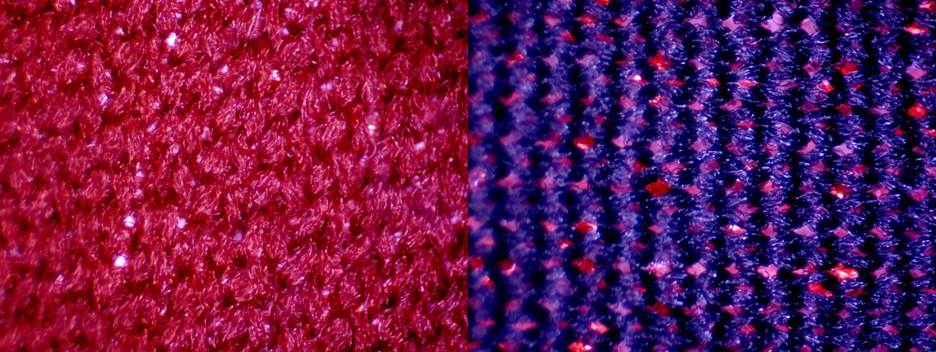
The left side of the image is the fabric. The membrane seems to be highly transparent. We see perhaps a hint of it in the backlit liner image.
Comfort and feel
This is a bicycle jacket, so it has a remarkably slim cut. However, the fabric is very stretchy, so although the fit is tight, it yields to all your movements. To check the stretch, I held the bottom hem in my hands. My hands were 22” apart. I then stretched the jacket fully. My hands were then 32” apart. Nevertheless, the size large recommended by the website was too small for my taste. In fact, at 5’10” tall and 175 pounds, I decided an XXL fits me best. I must not be built like a Tour de France racer!
Wearing the jacket is like wearing a base layer. It is soft and comfortable against bare skin.
Membrane
The jacket uses a proprietary polyurethane electrospun membrane. Polartec has substantial experience with electrospun membranes through its Neoshell product. In this iteration, they have eliminated all PFAS chemicals from the membrane, face, and liner fabrics.
DWR Coating
The DWR coating is Zelan r3, manufactured by Archroma. The coating contains no fluorinated chemicals. The company claims its treatment is effective for at least 30 wash cycles. Unfortunately, I have no information on what happens after that.
Jacket features
I won’t discuss the jacket’s features since this is a biking jacket, and we are backpackers. If you’d like to learn more about the jacket and its features, I recommend this podcast. There are also several reviews of pre-release jackets online.
Measured performance values
Hydrostatic head
I conducted a hydrostatic head test to check for water resistance. This fabric is extremely stretchy, so during the test, the water pressure caused substantial expansion of the fabric. There was so much expansion, I feared the fabric might burst. I ran the test to 2,800 mmWC and stopped it. I think 2,800 mm of water column resistance will be plenty for a bicycle jacket. According to their Technical Information Sheet, they conducted a hydrostatic head test on three samples. Their spec calls for an acceptable range of 4,000 to 20,000 mmwc. However, they indicate that the fabric is tested with restraint. This means a wire or other mesh is placed over the fabric to prevent it from bursting. Comparing my own tests on different fabrics with and without restraint reveals that the restrained result is unrelated to the non-restrained result. So, when they claim 4,000 mmwc or higher, I would take that with a grain of salt. You would think Polartec could spare a sample of fabric and get an unrestrained value.
Air permeability
Some proponents of electrospun membranes believe that their small air permeability helps with ventilation. I don’t buy it. I think MVTR is a more direct indicator of the membrane’s ability to pass vapor. I measured .8 CFM/Ft² at .5” wc of air pressure. They claim an air permeability of 0.4 to 1 CFM/Ft².
MVTR
Polartec’s specified acceptable range for this test is 25,000 to 99,000 grams/m²/24 hours. That is a pretty wide range. They use JIS L 1099, B1, like most manufacturers. In my test, which produces a different scale of MVTR values than the B1 test, I measured 2,880 grams/m²/24 hours. This is not a bad result. It could be the highest MVTR in a bicycle jacket, but I have only tested a few of these. I prefer jackets that are at the high end of the 3,000s.
In comparison, I have tested 9 electrospun jackets or fabrics (all with PFAS). The MVTRs ranged from 2,780 to 3,893 grams/m²/24 hours. So, this is near the bottom of the barrel. But, in general, the barrel performs at a pretty high level. Aircore should outperform non-porous urethane or EPDM membranes, which are often used in bicycle rain jackets. I have a conversion equation I produced by testing Montbell rain jackets, for which they publish their JIS L 1099 B1 performance. Using that equation, I calculate a B1 equivalent of 62,934 grams/m²/24 hours.
Conclusion
Now, you can all decide if this is a fabric of interest when it shows in a backpacking or hiking jacket. I expect it will.


Discussion
Become a member to post in the forums.
Companion forum thread to: Polartec Aircore – a brief review
This article presents an independent evaluation of Polartec’s new electrospun membrane fabric, originally developed for cycling jackets. Performance data on hydrostatic head, moisture vapor transmission (MVTR), air permeability, and fabric construction are reported and analyzed.
Encouraging. Thanks. Can you estimate the weight of the fabric?
It will be interesting to see how Aircore works out in other garments.
from your dispatch “However, they indicate that the fabric is tested with restraint. This means a wire or other mesh is placed over the fabric to prevent it from bursting.”
somewhere, you said that the HH test stretches the fabric a little including the pores. So the results might be worse than when you’re wearing it and being rained on
does a wire mesh over the fabric stop the stretching of the fabric and increasing of pore size?
then wouldn’t this be a better test?
Hi Jerry: The normal test can stretch the fabric and open the pores. Not a little bit. A lot. That I why I stopped the test when I did. I feared the very stretchy fabric would burst. This makes a mess and leaves a hole in the garment. I agree with you. The use of a well-specified restraint could make the test more useful. Unfortunately, we can’t order the industry to change its test procedure and we cannot order marketers to use one standard or the other. We cannot even order marketers to clearly tell us when a restraint was used and at what pressure a non-restrained sample burst.
There are several standards for hydrostatic head testing. Iso 811 calls for device that measure up to either 1000 mm wc or 2000 mm wc. Clearly, this standard was not designed for fabrics produced today, which can achieve far greater hydrostatic heads. AATC 127-2018 imposes no qualifications on the limits of the test instrument. AATC 208-2017 allows for the use of restraints with the same instrument described in 127-2018. The purpose of the restraint is “to prevent fabric deformation”. The restraint is specified as follows: Restraint: 200 × 200 ± 10 mm, made of 6.0 ± 0.5 mm thick clear cast
acrylic. Other restraint materials may be used with the agreement of all parties. The test works by placing the fabric on the clamping surface of the tester. A paper towel is placed on the fabric to be tested. The restraint is placed on the paper towel. The clamp applies pressure to the fabric, paper towel, and restraint.
As you can see this method allows no expansion to the fabric. Therefore, it can withstand far higher pressures before leaks occur in the test fabric. The standard states the following: The results obtained by this method may not be the same as those obtained by the AATCC methods for resistance to rain or water spray. Results may not be the same as those obtained by hydrostatic water resistance testing without a restraint.
As permitted by the standard, I use a restraint that is a metal grid. This permits greater fabric deformation. It is not something I often use because the results will vary substantially from a test conducted without restraint.
Here is the problem: For years, there has been discussion about the amount of hydrostatic pressure required for waterproofness. This discussion refers to values generated without restraint and the fabric permitted to expand without limit. It is therefore very confusing when a manufacturer, like Polartec, quotes the results from a restrained test without stating that the test is performed with restraint. In the podcast, there is no mention that the test was restrained. Yet, they claim the result, as I recall, is 5,000 mmwc. Maybe it would survive an unrestrained test to reach 5000. Maybe it would burst. We don’t know. So, we cannot really compare the test results quoted here with our expected performance for a fabric that passes at a similar pressure, but without restraint.
We can’t change the test procedure. We must be aware of the test’s shortcomings. That is our responsibility. We can expect the test method to be accurately disclosed. We can expect a manufacturer to identify when a restrained test result is provided and state that this value has little relationship to that of a non-restrained test.
I would like to see a shower test, such as the one I created for the Paramo article, used in conjunction with a hydrostatic head test. Then, we would know if a fabric could withstand heavy rain, and we would know how much pressure a fabric would resist when in direct contact with water, such as sitting in water or kneeling on a tent fabric.
Hi Bill: There are two versions of the fabric. The one used in the garment I tested is 155 gsm. The other is 298 gsm. I don’t have access to the heavier fabric.
thanks Stephen, that makes a lot of sense
maybe the HH test is just too far away from reality to be useful
plus, you’re experiments showed the actual HH in your simulated rain is much smaller
if one could define a shower test maybe that would be better. You’d have to include size of droplets, speed, number, temperature. Find a worst case that was at the top end of what you’d see in reality.
You could put a piece of absorbent material underneath. Weigh it before the test. Weigh it after to see how much water leaked through.
I’m thinking abstractly, not taking into account what any manufacturer would actually do.
If the current flawed HH test produces useful results – fabric that has HH > 2000 or whatever is actually waterproof – then maybe it doesn’t matter. If they made fabric that had a much lower HH test result but was water proof enough and more breathable, then it would matter, it could be actually drier in real life.
Thanks again, Stephen. We’ll see what happens with it.
Agreed about a shower test being more relevant to garments (or both shower and HH). I use the towel weight method to get a sense of what is happening underneath.
I am not certain that is the end of it, though. We might need further refinement, but it would be a step forward.
Hi Jerry: What you describe is how I created my rain test. It is described in the Paramo article. I think it is helpful to know how a fabric responds to actual pressure when in contact with water. What happens when you slide down snow or kneel on your tent floor could be determined with a restrained HH test. How readily can a pack strap push water through your jacket? I don’t recall the specifics of what I learned when I explored this topic a few years ago. I was trying to verify a high HH value on a 7 or 10 denier rain paint. I then proceeded to blow a hole in some Montbell waterproof pants. I found the specified restraint to be unworkable, so I opted for a wire grid. This doesn’t come up much for me but I have put holes in other fabrics. I am very careful with complete garments.
Thanks for the great write-up. Given the extremely snug sounding tailoring on this jacket, there is no way in Hades that I would feel comfortable wearing it. (I’m a bigger guy). I get it though – most serious cyclists are built like greyhounds.
My XXL is reasonably snug. When I was doing the testing, I also purchased another Castelli jacket that used a different Polartec fabric that was lighter with less bulk than the Aircore with all kinds of confident claims about great breathability. I purchased an XL in that. I had to muster a fair amount of force just to get the sleeves on. They make a XXXL in that jacket. That might have fit. It was 4 or 5 ounces and folded small enough to fit into a bike jersey back pocket. Holy grail stuff! Unfortunately, its MVTR was quite a bit less. It came out at 2160 g/M2/24hr. So, I rejected it.
What I wonder about now is the following: Would the MVTR of a tight jacket be higher than a looser jacket? My thinking is maybe. The vapor pressure difference that drives the moisture away from the skin would be at its absolute maximum without the dilution of air circulating between the skin and the membrane, especially if you wore it with a mesh right below the jacket.
Stephen, thanks for testing.
It doesn’t sound like this new membrane offers much improvement over Neoshell or Powershield.
I thought I remember seeing some Neoshell measurements from you that had a higher MVTR?
And there are stretch version of Neoshell available as well, so that’s not a USP.
And yes, Castelli is know for running small in their sizing, even for road cycling apparel, where you expect/want a skin tight fit.
Even stranger, I recently had to go up a 1 or 2 sizes in a Sportfull (owned by the same company as Castelli) jacket, compared to several jackets and jerseys from them I allready own. So maybe they are regrading their sizing, and perhaps Castelli is as well.
Hi Tijaard: The only benefit the new membrane offers over Neoshell is no PFAS chemicals. I guess that is an accomplishment. As it happens, Pearl Izumi has its 2024 Neoshell cycling rain jacket on sale (I think all US Neoshell jackets will soon be on sale). I purchased one. Its MVTR is 3360 vs 2880 for Aircore. Not a big difference, but not progress. It is an XL, but a more generous cut than the Aircore. It too has stretch, but not as much as Aircore. It does not need as much. The Neoshell jacket weighs 1 oz more. However, the Neoshell jacket has a more water-resistant main zip. All seams are sealed. Only the shoulder seams are sealed on the Aircore jacket. I have not measured its HH, but I have never tested an electrospun with HH less than 9800. So, the Neoshell is built as a real waterproof rain jacket. It may delaminate in a few years, but, of course, we don’t yet know how well the new shell fabric will hold up.
The real problem with these jackets is that they are used for cycling. Cycling is a high-aerobic, high-MET activity. If the temperature is above 45F it is too warm for a training effort in the Aircore jacket. I have not ridden in the Neoshell jacket yet, but I doubt it will be very different. Using this in the rain, where it may be impractical to open the zips, means you will be soaked from sweat. If the temperature is above 55F and it is raining, I am more comfortable just getting wet. The MVTR for this type of jacket probably makes little difference unless you slow way down in the rain (which is probably not a bad idea). Fortunately, in Colorado, a biking rain jacket is seldom needed. Whichever jacket I decide to use, along with the OR jacket I use for skinning, will be taken to the local gear repair shop, where I will have forearm-to-bicep 2-way Aquaguard zips added to eliminate the issue of soaked base-layer sleeves and soaked backer fabric in the jacket sleeves. High MVTR is nice to have, but for high MET activities, ventilation trumps all other solutions.
Thanks Stephen.
I have 2 Polartec Neoshell jackets from Sportful (same ownsership as Castelli, btw, and they sell Ski touring gear under the Karpos brand. Worth keeping an eye on).
I also have a Neoshell jackets from Made Apperal.
The Made jacket is an allround parka, with a lot of venting. The Sportful are cycling ones, without any venting. They also have stretch fabric. So, very similar to the Castelli Aircore jackets. One has a fleece backer and one has a regular thin (tricot?) backer.I have been very happy with the breathability of all of them.
i was contemplating getting one of the new Aircore bike jackets, to go more towards breathability and give up some waterproof, but it really doesn’t seem like it will improve much on the breathability (or might in fact decrease), so I’ll stick with the Neoshell versions I have.
I will give the Ristretto fabric options a try, since those are truly designed to just be wind resistant.
Become a member to post in the forums.