


Not all waterproof-breathable (WPB) jackets are fully waterproof – by design. Let’s explore why, and how you can deal with that in extremely wet conditions.
Marketing and test standards lead us to think that a “rain jacket” should be waterproof under all conditions. However, even high Hydrostatic Head (HH) scores don’t guarantee that you will stay 100% dry. Instead, there is a spectrum of water resistance, from windshirts with DWR to highly breathable electrospuns, to a variety of other membrane types.
Some of the issues:
Mismatched Expectations, a.k.a. “Leaks”: Backpackers commonly choose not-entirely-waterproof WPBs in search of improved breathability. It works, but people complain of wet out, leaking, and other water ingress in some of their more breathable layers. I originally thought they must be wrong — that users were mis-reporting condensation.
Condensation: Some of it really is condensation. Most DWR fails in half an hour of hard rain (even when new). A wet out face fabric prevents vapor transmission, is cold, and rainy air may be humid. The combination encourages condensation inside the jacket. But there is more to it than that…
Hydrostatic Head: This standard test works well for fully waterproof shelter fabrics. It involves measuring a column of water suspended by the fabric. A taller column applies more pressure to the fabric, simulating the impact pressure of a raindrop, or the pressure of a shoulder strap on a shoulder, or a knee against a tent floor.
Wicking: However, WPB membranes may have other characteristics that the HH test does not measure. It turns out that some membranes are designed to pass moisture as liquid. In the past, this was advertised as a feature: the membrane can pass sweat even when the face fabric is wet out. But the fine print is that the membrane may also pass a small amount of water from the outside to the inside of the membrane. It is a slow process, over time, so the wearer continues to benefit from partial resistance to rain. This ingress can happen with negligible hydrostatic head pressure.
(Note that keeping the jacket zipped up may cause more vapor pressure inside the jacket than outside, which would encourage moisture movement toward the outside. However, wearing a zipped up jacket in humid weather can be unpleasant.)
Stretching, Wear and Tear: Well-worn membranes are especially vulnerable, which can lead to pinholes and/or stretching of the membrane, which increases some of the gaps that allow air to pass. If those gaps become large enough, then liquid water can pass through the membrane. Of course, a new membrane with effective DWR and intact membrane will allow less penetration.
Field Reports of Wetness: People report this phenomenon in many popular rain jackets such as the Outdoor Research Helium (and other jackets made with the Pertex Shield fabric), Polartec NeoShell and PowerShield Pro, TNF FutureLight, Outdoor Research AscentShell, ZPacks Vertice, and other electrospun membranes. I do NOT see those reports for Gore-Tex and other, heavier, less breathable, membranes.
For example, Columbia Outdry (heavier membrane-on-the-outside) has a modest but useful amount of MVTR, while being apparently 100% waterproof in my field testing. It is not as pleasant to wear while active as my Outdoor Research Motive AscentShell (electrospun), which has a very high MVTR. However, the AscentShell leaves me slightly damp in extended or heavy rain. I feel safe in Outdry in a cold storm, but I would be concerned about the AscentShell in heavy and prolonged cold rain.
Summary: So don’t dismiss reports of “leaky” WPBs. Instead, recognize that they may be working exactly as intended. The disconnect is that the marketers never fully explained the intent, which was to improve breathability in light or intermittent weather conditions. That is exactly when a WPB jacket is most helpful.
A practical strategy is to pair a more-breathable-less-waterproof WPB jacket with a fully waterproof layer as backup in case of heavy or prolonged cold rain. Some UL examples might be:
ZPacks Vertice, Outdoor Research Helium, Rab Phantom, or even some windshirts for light weather.
Frogg Toggs Emergency Poncho (3.5 oz), Coghlan’s or Ozark Trails Emergency Poncho (1.5 oz), Timmermade Megazip, RockFront Rain Hoody, LightheartGear or Anti-Gravity Gear or other sil jacket as backup.
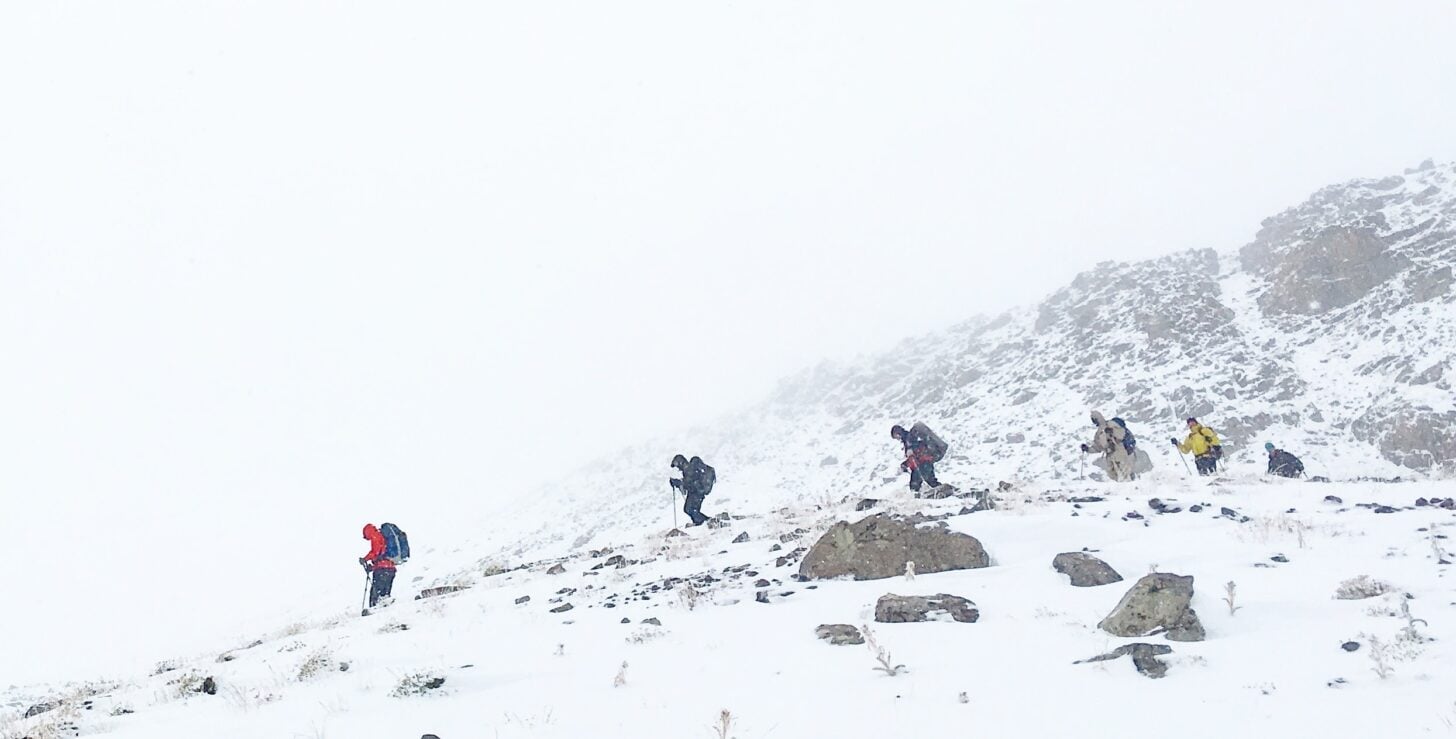
Above: High-exertion trekking in raingear during a Backpacking Light guided expedition in the Absaroka-Beartooth Wilderness, Montana (Ryan Jordan photo).


Discussion
Become a member to post in the forums.
Companion forum thread to: Not all rain jackets are completely waterproof (and why that may be OK)
Not all waterproof-breathable jackets are truly waterproof. Learn why some WPB rain jackets leak by design, how Hydrostatic Head and breathability trade-offs work, and practical strategies for staying dry in heavy rain.
well written, concise. You have don’t have to say “If I Had More Time, I Would Have Written a Shorter Letter”
I wonder if vapor can go through the fabric and then condense on the inside surface of a wetted out layer on the outside of the fabric. I have wondered as I walked through the rain with a wetted out jacket.
I have been wondering if the water inside my rain jacket is from condensation or it leaked through
I know, I could put some dye on the outside surface and see if it leaks through to the inside.
Thanks, Jerry.
Vapor doesn’t have to go through the membrane. The air often has plenty of humidity to condense. Moisture from sweat and cooling of the wet out fabric can increase the effect.
Concise and to the point. Explanatory.
Great article! Helps a lot with understanding something I’ve been wondering about for a while now.
Is it really true though that there are tradeoffs between hydrostatic head and breathability, as the title suggests? I understand there are tradeoffs between silicon coated fabrics and Outdry, on the one hand, and some (all?) other PU and spun membranes on the other. (And Outdry would also be my top choice for very wet conditions (from what I’ve heard).) But need there be tradeoffs between Gore-Tex and other ePTFE membranes and the PU/spun membranes? As far as I can tell, whether based on manufacturer claims or Steven Sorber’s tests, the best ePTFE membranes (even ignoring the super-breathable, but discontinued Shakedry) are more breathable than at least most of the PU/spun membranes mentioned. As an example, my highly breathable Gore Infinium jacket (Montbell Versalite) recently performed flawlessly in 5+ hours of rain, sometimes near-horizontal driving rain. Well, the fabric performed flawlessly. The jacket openings less so, partly or entirely because the user did not perform flawlessly :-( .
I did not mean to say anything like that. Just that some membranes have characteristics that are not fully measured by the hydrostatic head test. Is that required to achieve greater breathability? I don’t know… I only know that some fabrics that breathe better can allow small amounts of water ingress under some conditions. Electrospuns often have high hydrostatic head scores, so that doesn’t explain the phenomenon.
The membranes are all changing this year anyway, and we don’t have much data or field reports for them. That includes the Versalite (which has a new membrane this year) and ShakeDry (which is no longer made).
@Terran: Thanks. We try. :)
Interesting concept
To think I didn’t buy the OR helium for mountain biking as monsoonal moisture rolled in this summer because of all the poor reviews…..
Exactly!
At least it now makes sense why Heliums are so popular among thru-hikers. I bought this year’s updated model with NikWax DWR. I haven’t had it out in the rain yet, but it is tolerable as a windshirt. Not as nice as a real windshirt, but not as awful as I thought it would be. Part of that is probably because it is such a light jacket that it doesn’t hold much heat by itself (which increases its versatility).
Interesting discussion
Polartec AirCore is a new fabric that they’ve developed with Castelli and seems to be offered so far only by them in cycling jackets.
It looks like it has really good properties, the kind I’d love in a hiking jacket personally.
They mention that in really wet and cold conditions (for cycling) you might want a “rain cape” ie a completely waterproof but light (essentially plastic) layer either over the top or instead. I think this is where really light and smaller coverage DCF ponchos could play a key role in the backpacking scenario; you probably don’t need perfect coverage, certainly not normal poncho coverage, you just need something to take the edge off particularly from the hardest rain hitting you on a more vertical plane. Eg, hood, shoulders, dorsal sides of arms, etc. Such a poncho could probably weigh less than 2oz easily out of a lower weight DCF (and rarely need to be used).
Worth watching this video:
https://www.youtube.com/watch?v=-EFOAr534V4
AirCore™ Fabric | Polartec®
Yes, it was the AirCore announcement that prompted this dispatch. AirCore appears to be an evolution of NeoShell and Power Shield Pro, and shares most of their qualities, including the not-fully-waterproofness that they occasionally mention (although rarely). Even the numbers are similar. I suspect that any performance gain is more qualitative than quantitative, but we’re going to need real-world and long-term testing before we will know much about it. The Castelli people are enthusiastic, but don’t add much detail to the discussion.
The music in the Polartec videos is great, though. :)
Agreed about possible hybrid layers for heavier rain, specifically on horizontal surfaces (heady/shoulders/tops of arms). The LHG Hoodie Pack Cover has always struck me as a great idea in that category.
I listened to the podcast. I agree with their assessment of the waterproofness issue, which aligns with my conclusion in the article about Paramo. However, I don’t buy their claims about the breathability of this jacket. Not just because the air permeability is so low and the MVTR is mediocre, but because the bicycle jacket is cut to be tight and will not even support pumping. I don’t see how there is a ventilation mechanism here. Nevertheless, I have ordered one, just in case I am wrong about this. It will arrive on Monday and I will take a look at this. If I am wrong, it will be on a week-long bike trip I have scheduled. If not, it will go back.
Yes, it’s basically the same story that the Polartec Product Manager described better several years ago, when discussing NeoShell and Power Shield Pro.
If AirCore turns out to be an incremental improvement over those membranes (or even similarly competent) then it is not nothing in this year of changing away from PFAS.
But, also yes, it doesn’t appear to be anything revolutionary, either.
Will be interesting to hear your experiences with it, Stephen.
I would like to see more mechanical ventilation. Front flaps are hard to find. I like to wear a rain hat instead of a hood. It improves my peripheral vision and hearing. I feel more aware of my surroundings, and I like it. It also allows me to regulate airflow around my neck better, a key spot to cool off. With sufficient mechanical ventilation I am willing to accept a fabric without much breathability.
Rather than carrying a separate rain hat, I would be interested to try a full brim hat with rain cover which can be put on when needed. If it didn’t make me look like a dork that would be nice, but seems near impossible. I’ve seen troopers use a setup like this, but that’s not the look I am after.
Thanks for the article, Bill. Very helpful and easy to understand.
I wasn’t sure if this has been shared yet but I found this recent interview about Aircore quite interesting.
While I totally agree with your practical approaches to the problem, I believe that companies should be required to be far more transparent about real-world performance and stop allowing their marketing departments to run lip service.
The reality is that outdoor companies continue to market “waterproof breathable” garments—often costing hundreds of dollars—to consumers who may not fully understand their limitations. After just a few hours in the rain, these jackets often wet out, leaving users cold and clammy, only to be told afterward that it’s not a leak—just condensation—and they should accept the discomfort.
In my profession, if an architect specified painted wood siding and the paint mysteriously disintegrated after the first rainstorm, their liability insurer would be the first call—because failure like that isn’t just inconvenient, it’s unacceptable and could become a life-safety issue. The same could potentially be said about a wetted out rain jacket.
After spending many years in my young adulthood working in outdoor retail, I’ve grown very weary of what marketing departments can claim—often at the expense of customer trust and product transparency.
Regardless, I really appreciate you and the BPL team for your commitment to digging into the real data and helping people make informed decisions.
Matt:
Wouldn’t that be nice?! The good news is that we occasionally see acknowledgement of the limitations from Polartec, in both the Castelli and the Blister podcasts linked above. It doesn’t happen often, but it does happen.
Tim: Agreed about mechanical ventilation. Timmermade’s MegaZip Poncho, Rock Front’s Rain Hoody, the LHG Hoodie Pack Cover, and The Packa are all steps in the right direction.
I know that I have seen an add-on brim for a rain hat, I just don’t recall where. It seems like an easy MYOG item, although an addon might not weigh much less than a rain hat.
The MontBell Rain Umbrero might be the most ventilated hat. Only some guyline cord touches the head — the rest is suspended by the cord.
The AirCore jacket arrived and I took a look at it. I posted the results as a Dispatch here. I think it does better than Polartec’s limited data suggest.
from your dispatch “However, they indicate that the fabric is tested with restraint. This means a wire or other mesh is placed over the fabric to prevent it from bursting.”
somewhere, you said that the HH test stretches the fabric a little including the pores. So the results might be worse than when you’re wearing it and being rained on
does a wire mesh over the fabric stop the stretching of the fabric and increasing of pore size?
then wouldn’t this be a better test?
Hi Jerry: The normal test can stretch the fabric and open the pores. Not a little bit. A lot. That I why I stopped the test when I did. I feared the very stretchy fabric would burst. This makes a mess and leaves a hole in the garment. I agree with you. The use of a well-specified restraint could make the test more useful. Unfortunately, we can’t order the industry to change its test procedure and we cannot order marketers to use one standard or the other. We cannot even order marketers to clearly tell us when a restraint was used and at what pressure a non-restrained sample burst.
There are several standards for hydrostatic head testing. Iso 811 calls for device that measure up to either 1000 mm wc or 2000 mm wc. Clearly, this standard was not designed for fabrics produced today, which can achieve far greater hydrostatic heads. AATC 127-2018 imposes no qualifications on the limits of the test instrument. AATC 208-2017 allows for the use of restraints with the same instrument described in 127-2018. The purpose of the restraint is “to prevent fabric deformation”. The restraint is specified as follows: Restraint: 200 × 200 ± 10 mm, made of 6.0 ± 0.5 mm thick clear cast
acrylic. Other restraint materials may be used with the agreement of all parties. The test works by placing the fabric on the clamping surface of the tester. A paper towel is placed on the fabric to be tested. The restraint is placed on the paper towel. The clamp applies pressure to the fabric, paper towel, and restraint.
As you can see this method allows no expansion to the fabric. Therefore, it can withstand far higher pressures before leaks occur in the test fabric. The standard states the following: The results obtained by this method may not be the same as those obtained by the AATCC methods for resistance to rain or water spray. Results may not be the same as those obtained by hydrostatic water resistance testing without a restraint.
As permitted by the standard, I use a restraint that is a metal grid. This permits greater fabric deformation. It is not something I often use because the results will vary substantially from a test conducted without restraint.
Here is the problem: For years, there has been discussion about the amount of hydrostatic pressure required for waterproofness. This discussion refers to values generated without restraint and the fabric permitted to expand without limit. It is therefore very confusing when a manufacturer, like Polartec, quotes the results from a restrained test without stating that the test is performed with restraint. In the podcast, there is no mention that the test was restrained. Yet, they claim the result, as I recall, is 5,000 mmwc. Maybe it would survive an unrestrained test to reach 5000. Maybe it would burst. We don’t know. So, we cannot really compare the test results quoted here with our expected performance for a fabric that passes at a similar pressure, but without restraint.
We can’t change the test procedure. We must be aware of the test’s shortcomings. That is our responsibility. We can expect the test method to be accurately disclosed. We can expect a manufacturer to identify when a restrained test result is provided and state that this value has little relationship to that of a non-restrained test.
I would like to see a shower test, such as the one I created for the Paramo article, used in conjunction with a hydrostatic head test. Then, we would know if a fabric could withstand heavy rain, and we would know how much pressure a fabric would resist when in direct contact with water, such as sitting in water or kneeling on a tent fabric.
Well put Stephen. Very well put.
There are lies, damn lies, and there is marketing spin.
Cheers
Become a member to post in the forums.