

Introduction
In 1996, while hiking through a wildfire burn area north of Yellowstone’s northern boundary, a summer thunderstorm began swirling around us, its winds toppling trees in the distance as we hiked a remote, unmaintained route. As we hiked, a loud crack rang in our eardrums, and a large, burned lodgepole crashed less than 20 feet behind me – and less than 20 feet in front of my hiking partner. It was a jarring, terrifying experience.
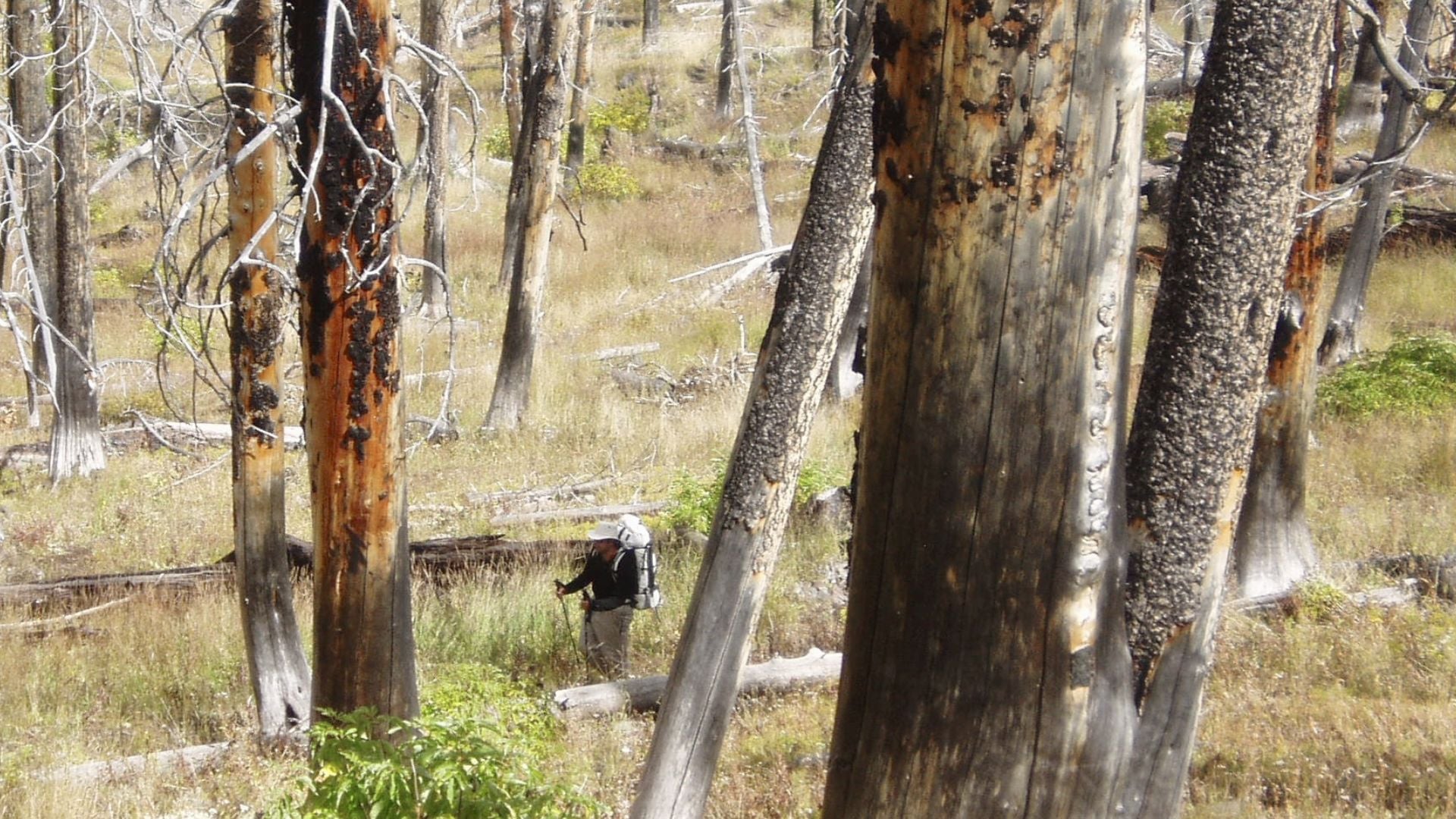
In 1988, wildfires burned nearly 1.4 million acres in Yellowstone National Park and the surrounding ecosystem, leaving behind standing matchstick forests – and dead trees – for decades.
Since then, I’ve experienced dead trees toppling in the wind throughout the mountain west, whether hiking in a storm or camping in the backcountry. The feeling of fear never leaves you when you’ve been close enough to a falling tree that could have killed you.
Falling trees are not among the most common causes of death in the backcountry. They do not occupy the same risk category as drowning, falls from cliffs, hypothermia, heat illness, lightning, avalanches, or cardiac events. Many of us have slept under trees hundreds of times without incident. That familiarity can breed complacency, dulling our awareness of one of the few hazards that’s all around us, all the time, that can have fatal consequences even when we’re doing everything else right.
In August 2022, a visitor at Olympic National Park’s remote Elk Lake wilderness campsite was killed when a tree fell on his occupied tent (August 2022). The National Park Service reached the site by helicopter the next morning. In the White Mountain National Forest, a backpacker sleeping in a hammock was killed when the tree attached to his hammock fell and struck him (May 2021). On the Colorado Trail, a backpacker was killed when a tree fell onto her tent (August 2019). On the Pacific Crest Trail, a thru-hiker was killed by a falling tree while moving along the trail (August 2019). More recently, hikers have been killed or seriously injured by falling trees or branches on popular trails, including maintained routes in national parks and national forests.
These incidents are uncommon, but they occur often enough to be more than figments of our imagination when hiking through dead-tree forests. They occur in wilderness campsites, long-distance trail corridors, dispersed camping areas, developed campgrounds, river camps, hammock sites, and on trails frequented by day hikers. Tree failure is a low-frequency, high-consequence hazard, and backpackers seem to be most exposed when they stop beneath trees for extended periods. That’s certainly when I’m most aware of the risk – especially in the wind.
We don’t commonly ask ourselves, “Are trees dangerous?” Instead, consider this question: “Am I about to spend the next several hours near trees or limbs that could fall?”
In this article, we explore the causes of hazard trees and how to identify them, how to assess their risk in various environmental scenarios and contexts, and how to manage that risk while hiking and camping.
Member Exclusive
A Premium or Unlimited Membership* is required to view the rest of this article.
* A Basic Membership is required to view Member Q&A events


Discussion
Become a member to post in the forums.
Companion forum thread to: Camping Under Trees: Hazard-Tree Awareness and Campsite Selection for Backpackers
Falling trees pose a fatal risk to backpackers, especially when camping. Learn to identify hazard trees and choose a safe campsite by scanning the fall zone.
scary. We were hiking on trail, on a beautiful sunny afternoon, mid way between top and bottom of a small mountain. Heard something fierce cracking.. I froze in my steps and thought that an 18 wheeler had veered off the road up top and was crashing down the side of the mountain from above. Turns out a tremendous size tree had fallen and in its path crashed down about 3 or 4 other big trees.. snapping each one like dominos falling. Who knows how many smaller trees were also taken out by this slide, but it was loud and scary. I much prefer sleeping in the open then under trees, especially in winter during a storm. Unless of course we have hammocks, then its very cautious and aware of surroundings.
“Summer Branch Drop”. Hot. Trees take up too much water. And a large heavy limbs fall. Postmortem? Perfectly healthy large branch. Perfectly deadly. Redwood and Spruce branches 2 ft plus in diameter. We are watchful year round.
I would emphasize extra campsite inspection at night. Many times I have woken up, to seeing a widow maker in my campsite after I have made camp after dark. It is easier said than done, because you are usually stopping at night to make camp because you are tired. Any additional suggestions for avoiding tree risk when making camp at night?
I do not have any real good suggestions for the occasional tree with bark beetle damage? Maybe just assume if you seem some trees with beetle damage your campsite could have trees with beetle damage.
Only once I have witnessed a tree falling in forest. It was a cotton wood tree that fell when I was eating lunch. The tree was approximately 30 yards away. It was extremely loud when it fell over. I learned the real meaning of “jump out of your skin!” idiom.
Yay or nay?
^^ Throw a tarp over it and call it good! ;>)
As a hammock camper, I don’t have the option of making camp in a clearing. Sometimes the hardest part about finding a campsite is avoiding widowmakers. More than once, I have set everything up, gotten into the hammock, looked up, and seen something that causes me to move. If a tree or limb is suspicious, even the slightest breeze will keep me awake.
Late September 1983. My buddy DogTired and I stepped out of the car at the Fern L TH in RMNP and began xc-ing toward Forest Canyon which was (and is) trailless. It started raining as soon as we began walking. The rain turned to snow as we made our way over a ridge and down into the canyon proper.
Our goal was Forest L or maybe Arrowhead L at the upper end of the valley, about 5 miles. But the deadfall in the canyon was thick and we were not even half way there as the light began to fail. We changed our target to Raspberry Park, which our 7.5′ topo showed as a clear area.
The map was (and is) out of date. There is no park there, just slightly less dense forest. But it was sufficiently less dense that we could find a spot to pitch our tent, eat dinner in the dark and turn in.
Then the wind came up. I have no idea what the local windspeeds were, but Boulder’s Table Mesa NCAR station recorded its highest gust ever, 186 mph IIRC. Due to the density of the forest, windspeed at tent level was not too bad, maybe 20-30 mph. But all that wind energy being absorbed by the forest was causing a major blowdown event. We could hear trees breaking and crashing every 30s or so. It went on for hours.
We were pretty well trapped. There were no open spaces to move to and retreating back to the TH bushwhacking in the night would have been more dangerous than staying put. All we could do was shut our eyes, cross our fingers and hope for the best.
Somewhat to our surprise, we woke up alive. There were 6 inches of snow on the ground. We decided we had had sufficient adventure and headed back to the car. The forest, needless to say, was a disaster area. But we were alive and unharmed, even though we had no right to be. Funny how life works out that way sometimes.
It’s pretty common for me to find dead standing trees within 100 ft of my campsite. If I’m carrying my saw, they are also a good source of dry firewood. I can often push them over with a fairly modest effort.
What’s harder to avoid is thick falling branches that are way too high above to test for how close they are to breaking. If it’s summer, and you notice a big high branch without leaves near your tent – it might be wise to relocate.
Great article. Widowmakers are no joke. 3 years ago, after a brutal full day of walking in cold rain, we had no choice but to camp in a burned area in the Wind Rivers in a section that had experienced a legendary blow down event the year before. We got through it but never again.
Every time I see a discussion about this, I think of this article:
https://www.nytimes.com/interactive/2019/03/20/magazine/kayaking-trip-alaska.html
Become a member to post in the forums.