


Introduction
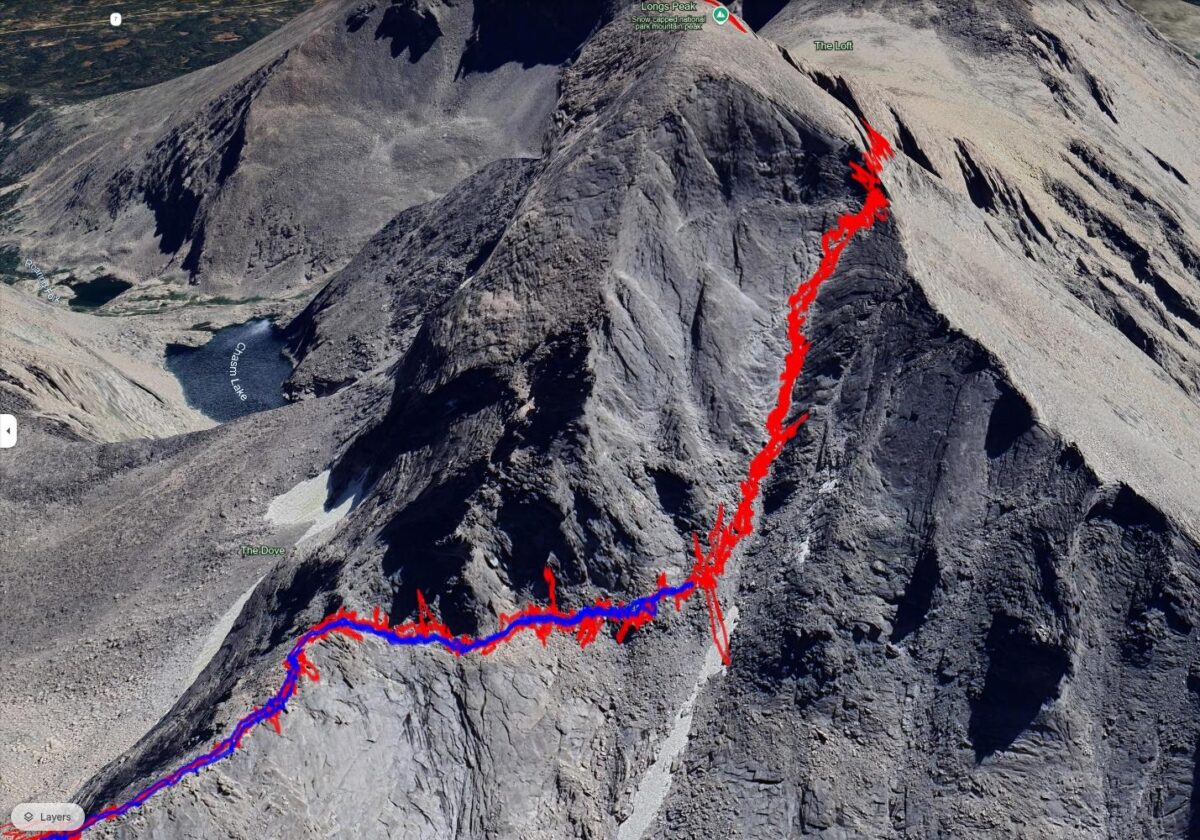
Imagine you are hiking on a sunny day to the summit of Longs Peak in Rocky Mountain National Park (RMNP), the only 14,000-foot peak in RMNP. After passing through the Keyhole, you are above the treeline, navigating steep, rugged terrain along a narrow, often loose route marked with painted Colorado emblems. Wandering a few feet from the path can result in a plunge of thousands of feet.
As you reach the summit, a storm suddenly hits. High winds, sleet, and snow drastically reduce visibility, making your descent perilous as the markers become invisible. Can you rely on your GPS device to guide you safely back down?
Obviously, you’d never want to place yourself in this situation. But, if you did, the latest GPS technology will improve the odds of following your recorded track back down the mountain. So far this year, my two attempts to summit Longs have been thwarted by unexpected changes in the weather. On the second attempt, well before the storms hit, I could follow my recorded track back down, which was not previously feasible.
Below, we will discuss what has changed in GPS devices to make this possible.
Member Exclusive
A Premium or Unlimited Membership* is required to view the rest of this article.
* A Basic Membership is required to view Member Q&A events


Discussion
Become a member to post in the forums.
Companion forum thread to: By the Numbers: Can New GPS Technology Save Your Life? Under the Right Conditions, it just Might
Stephen Seeber compares iPhone and Garmin Fenix GPS tracks for accuracy and reliability.
This is cool. I’ve never given a second thought to jamming or multipath interference in my watch. Next time I shop for one, they will be at the top of my list!
Thanks for the detailed explanation! My partner (with fenix 7) and I (with epix) had noticed significant differences in our gps output on recent hikes through the Sandias, with the fenix 7 track showing multipath interference and a much longer hike just as you described. Looks like we need to dive into the settings before our next outing to make sure the fenix is accessing the L5 band!
Hi Tyler: On the Fenix 7 (and probably the expix), when you are in Hike mode, Hold the left center button to get to the settings menu. Scroll down to system. Select system. Scroll down to Satellites and select. I like to use Auto Select. If you select GPS only, you will not receive L5. If you select All +Multiband you will get everything and suffer a noticeable reduction in battery life. Auto seems to identify multipath and adds L5 when needed.
It would be interesting to see the battery life for the current different modes. The early multiband GPS had reduced battery life with multi-band turned on. I only turned on multiband in steep terrain or canyons.
tkkn c….you can pull up battery life chart for the Fenix 7 with the Rainmaker review.. Long article, suggest doing a search on “L5”, the 2nd hit will take you near the chart.
Thanks NoCO-Jim, still a significant increase in power consumption for multi-band. I guess the upside is that the run time has increased, so the multi-band reduction still allows you to run all day without recharging midday.
Thanks!
As I recall, I got 2 days and a few hours of battery life when using all bands. Auto seems like the sweet spot unless you are in rugged terrain and don’t want to take a chance on the Garmin deciding what to use.
Interesting comparisons. I have to check my owner’s manual to see if my 67i accepts the new signal. Howsomever… GPS watches are not for my needs.
I’m currently using a Garmin 67i B/C I like the larger screen, the emergency beacon and limited texting WITHOUT carrying a damned smart phone. Yeah, heavier but all-in-one features I want.
Become a member to post in the forums.