


Bikepacking Curious
As someone who enjoys both bicycling and backpacking, the opportunity to blend the two – “bikepacking” in the modern outdoor recreation lexicon – has provided me with some of my most memorable trips in recent years. Although I’m fortunate enough to be able to easily bike to several trailheads that access the third largest wilderness area in the Lower 48 (Selway-Bitterroot Wilderness), I’ve found myself becoming more interested in doing trips where the bike is part of the on-trail journey, rather than just part of the commute. Given the restrictions on mechanized travel in wilderness areas, this meant that I’d have to look for other nearby areas that allowed bicycle travel, but ideally were otherwise non-motorized. My past experience with mountain biking on mixed-use trails that allow dirt bikes and all-terrain vehicles was underwhelming, to say the least – the trails usually proved to be cobbly, steep, and generally unpleasant. Simply touring on gravel roads, especially those blocked by gates or snowdrifts, proved to be far more enjoyable than pushing my bike up a rocky and rutted path that was most definitely designed for the enjoyment of those with motors attached to their bikes.
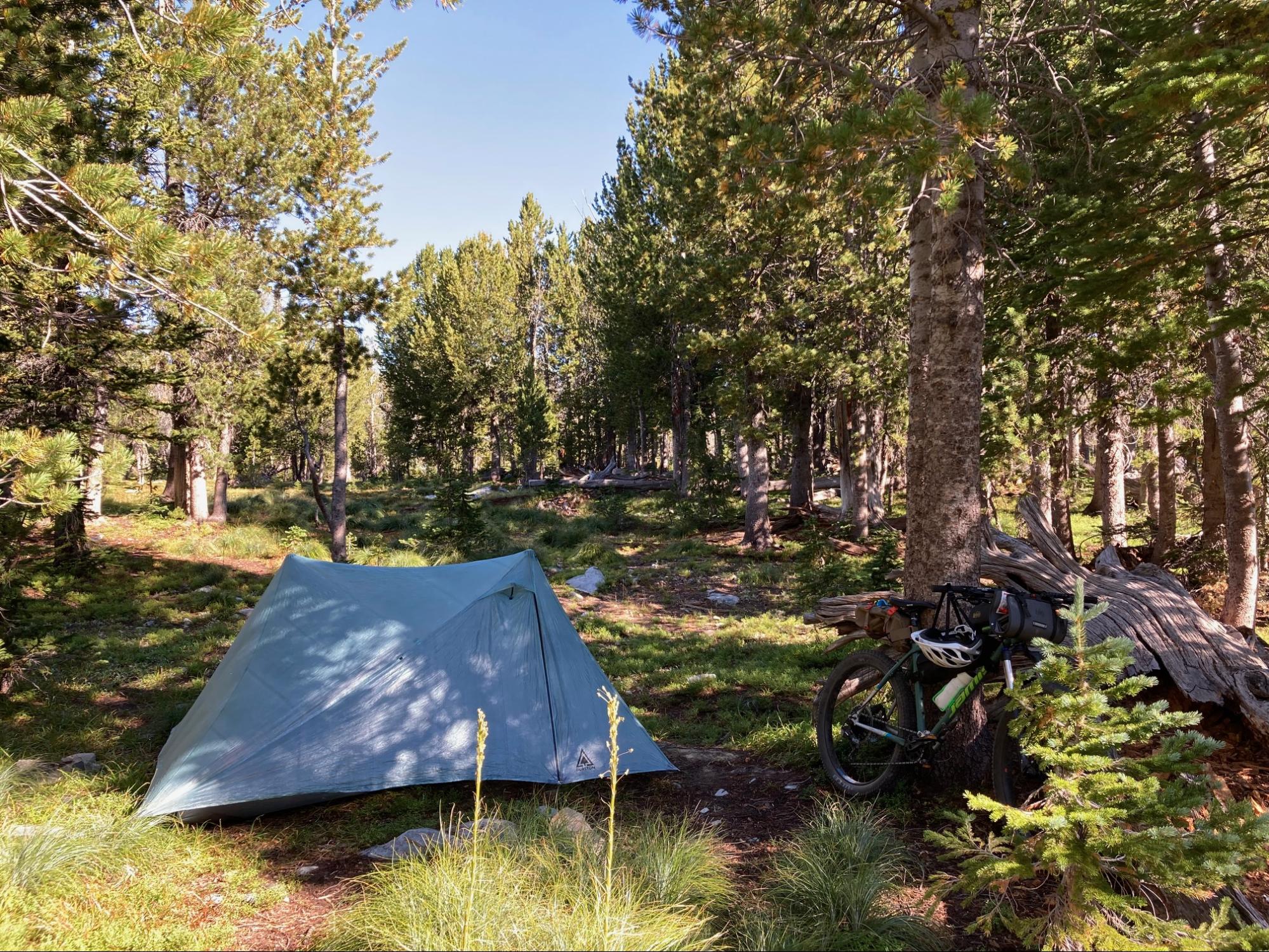
But the allure of biking along a single-track trail to an awesome campsite kept calling out to me, so I committed to leaving the roads behind and planning out trips that would take me – and my bicycle – to more remote corners of the Northern Rockies. I remembered from past backpacking trips that several nearby mountain ranges had trails that had no restrictions on mechanized travel but did limit motorized travel. Those seemed like ideal areas to try out this new-to-me activity, so I set about planning a trip that would allow me to use a mountain bike to cover more ground than I could hope to on foot and thus pack more into a five-night trip than would usually be possible.
However, my enthusiasm for bikepacking was tempered by the fact that I wasn’t a particularly skilled or experienced mountain biker. Although I’ve pedaled thousands of miles in urban areas as a bike commuter for nearly the entirety of my adult life, plus a few thousand more on rural roads for recreation and transportation to trailheads, I only had two hundred mountain biking miles to my name when I began to plan out my first multi-day bikepacking trips. While the consequences of being a novice bikepacker probably weren’t particularly great when compared to other outdoor pursuits, I thought it best to treat it with the same mix of preparation and trepidation that I treated my first foray into backcountry skiing. With it being too late in the season to execute the route I’d drafted up, I decided to use the shoulder season to hone my skills on less committing trips.
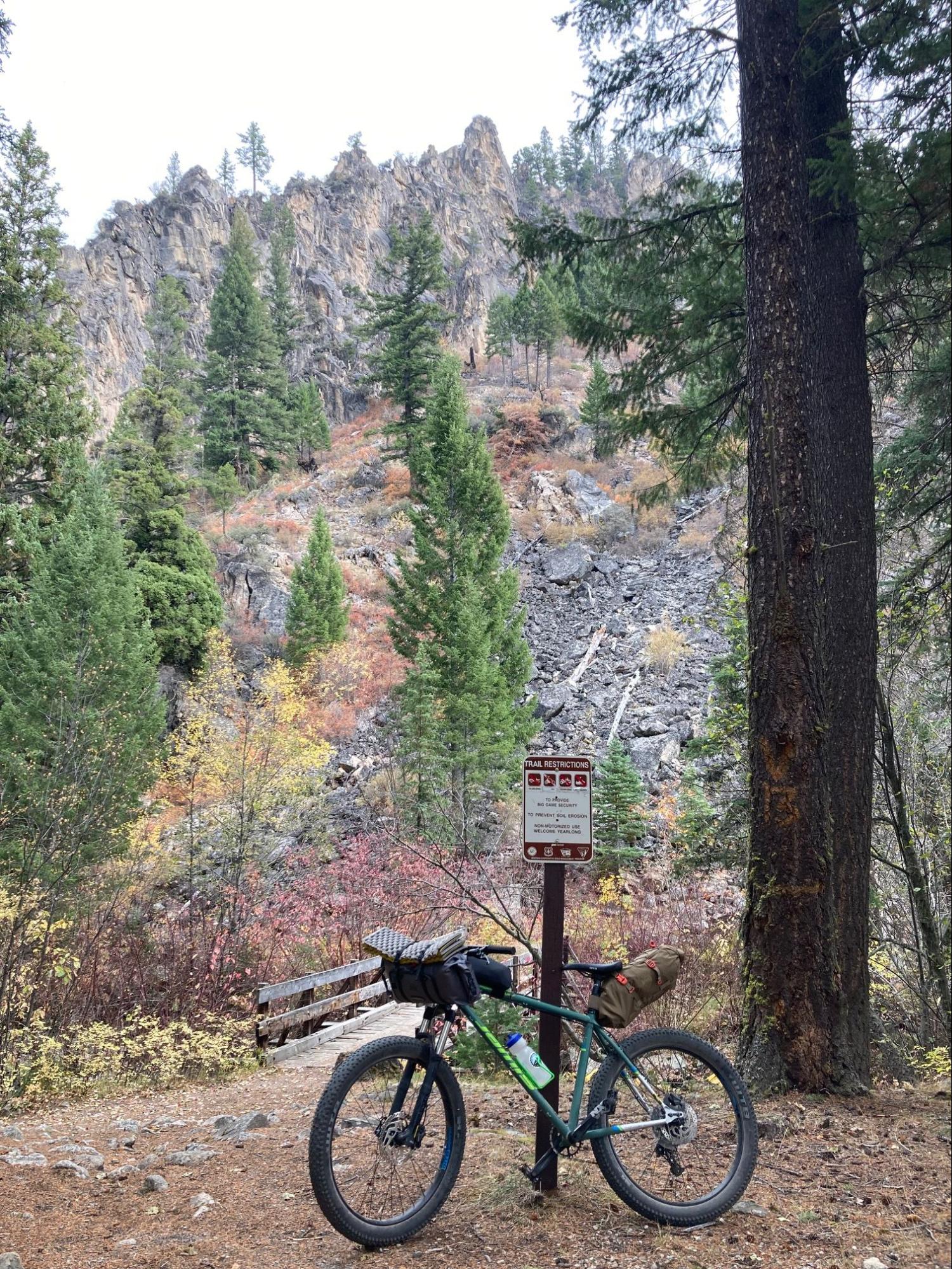
Rather than starting off with a multi-night trip carrying the same kit I would when backpacking, I decided to warm up with a trip into a Forest Service rental cabin. I’d hiked the trail several times over the years and was familiar with its conditions, its gentle gradient, and the amenities of the quaint, creekside cabin. This allowed me to have a “soft launch” into the bikepacking realm. I didn’t need to carry a sleeping pad, shelter, stove, or heavy insulating layers. This allowed me to cut down on the weight and bulk of my gear considerably and made the bike much more forgiving of my limited skills, particularly when negotiating the few rocky sections of trail. It was a six-mile (10 km) ride into the cabin with a laughably modest elevation gain. This took me just over an hour, which was slightly less than half the time it usually took me to hike in. Although I certainly didn’t feel like a master mountain biker on the way to the cabin, I was able to enjoy most sections of the trail and was especially enamored with the efficiency of rolling through terrain at twice the speed of hiking. Plus, it seemed like I was having at least three times the fun pedaling along the trail compared to merely hiking it.
Member Exclusive
A Premium or Unlimited Membership* is required to view the rest of this article.
* A Basic Membership is required to view Member Q&A events


Discussion
Become a member to post in the forums.
Companion forum thread to: Bikepacking: More miles, more smile
Mark Wetherington tries his hand at ultralight bikepacking and hiking to remote places along the CDT in Montana.
I am SAO glad you are finally paying attention to bikepacking! I’ve been a backpacker, backcountry skier, sea kayaker and predominantly an untramarathon cyclist (Randonneur). I had ridden trails like the Kettle Valley Railtrail and others in BC and WA starting 20 years ago. I was hooked. Just before Covid I bought a gravel bike and did a few trips but not much since. I have in mind the Tree to Sea’ route from Bikepacking dot com in the Spring. Alternatively, I also have a folding bike, folding kayak and folding trailer and may do some multi-modal remote tours since BC is a paddling paradise. 90% of content here is relevant to bikepacking. The bike technology is not that important. I just wish someone would make a backpack convertible to panniers, and some hiking/peddling boots. Options are always good.
Thanks, Barry. I was really excited to write this piece for Backpacking Light and was glad they were interested in publishing it.
I also hope there are some gear innovations that can make crossing over from pedaling to hiking easier. The mountain bike shoes I have weren’t suitable for the type of terrain and mileage I did on the side-trips during this outing, so I ended up bringing a pair of trail runners to switch into. This added weight, which wasn’t a big deal, but it was just another thing to deal with and keep track of. Although it was nice to change into a fresh pair of shoes when I was done riding for the day!
Pleasant read. Thanks Mark.
Thanks Mark. This article has given me some inspiration for future adventures. The idea of bikepacking hasn’t resonated with me, but the idea of a hybrid trip seems really interesting.
Hi Barry. A backpack pannier can be had at prioritybicycles.com; Look for the 174 Hudson pannier/backpack, $79. Capacity is only 20 L, but I’ve found that adequate for an overnighter. Check it out.
That’s not bad. I have one like that designed for students, mainly as a book/laptop bag. But it is too heavy and has too many compartments and zippers. I would prefer something light with just one big space and a roll top. The design I saw once decades ago was two panniers that stacked up on, I think, a two-part external frame. Very versatile, but not cheap. I think it was French. Someone should make an external frame with horizontal bars you could attach ANY pair or panniers to, one over the other. But that frame should be collapsible for storage. I’ll have to experiment.
Thanks.
Become a member to post in the forums.