


Introduction
Vargo’s new V3 Pocket Cleats cut more than half the weight off the leading lightweight traction devices, Kahtoola Microspikes. But how well do they hold up on the trail for running and backpacking?
That was the question that weighed on my mind as I prepared for a February backpacking trip on what’s reported to be the most treacherous winter trail descending the walls of the Grand Canyon. The backcountry office informed me that the north-facing, higher elevation Grandview Trail, “more than any other, tends to turn around unprepared hikers due to the combination of narrow sections of trail, exposure, and ice.” I’ve heard others talk about one tight section in particular where the snow and ice pile up alongside a sheer drop that can feel life-threatening.
Back home in Michigan’s icy winters, I also hoped Vargo’s Cleats could help me get in more trail running days. And if they proved effective, I figured they could also seriously lighten my load on future shoulder season backpacking trips in the mountains.
I reviewed Vargo’s Titanium Cleats, but the Stainless Steel version is nearly identical.
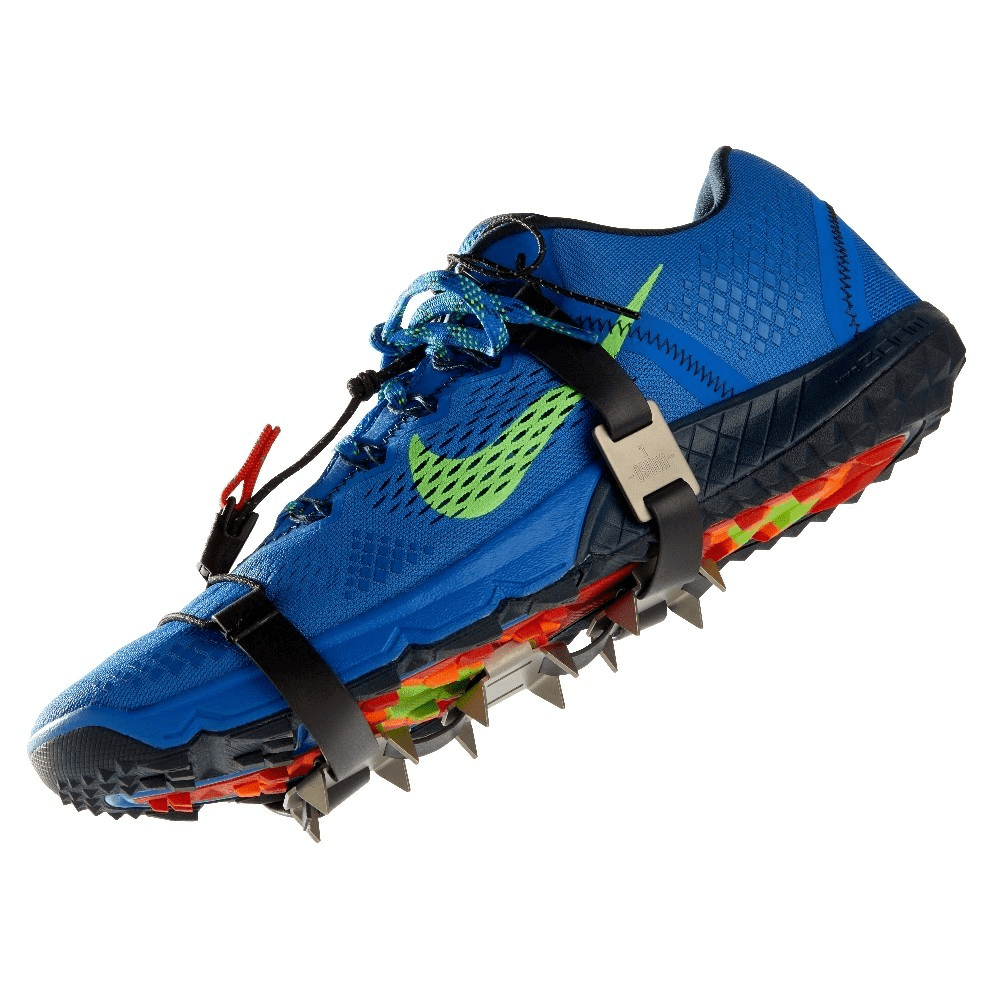 Photo: Vargo Outdoors
Features
- Strong, durable ultralight titanium cleats: 12 spikes per shoe.
- TPU coated nylon webbing
- Duraflex™ quick release cord locks
- 12 mm reflective nylon cord
- Unique “tie-in” design
- Lateral stability brackets and reverse cleats to prevent side-to-side movement
- Fit into included nylon stuff sack
Specifications
- Sizes: One size fits all
- Spike length: 1/2 inch (13 mm)
- Weight (each): 2.4 ounces (69 g). 4.8 ounces for both shoes.
- Pack size: 5 x 4 x 3 inches (127 x 102 x 76 mm)
Context
Lighter and more nimble than heavy-duty mountaineering crampons, traction gear serves a critical safety role for backpacking in winter and at higher elevations much of the year. It can also be used for trail running and just getting around town when needed. Key features that lightweight backpackers look for include:
- Solid traction for safety and speed.
- Low weight to reduce fatigue.
- Durability to ensure your plans won’t be thrown off by gear failure.
- Ease of use to get a solid fit and save time and hassle when taking them on and off.
- Flexibility to work with different footwear and conditions.
Field Testing
Before reaching the Grand Canyon for my February descent, I had plenty of opportunities to test Vargo’s Cleats in a variety of Michigan’s ice and snow conditions which changed from day to day. I also tested Vargo’s V3 Pocket Cleats on different footwear: Altra Lone Peak 2.5 trail runners, Altra Instinct 2 running shoes and Merrell Mid Moab Gore-Tex hiking boots.
They say the Inuit people of Alaska have more than 50 words for snow. While our vocabulary may be less comprehensive, our experience with different types of snow here in Michigan is nearly as wide. From the icy-snow that crusts up after sunny days to the snowy-ice that hides super slick surfaces under a dusting of new snow – I took Vargo’s cleats on daily trail runs and hikes to see what they could handle for more than a month. I also tried them out on city street runs to see how they would handle the variation as I passed from snow to ice to abusively long stretches of bare pavement and salt.
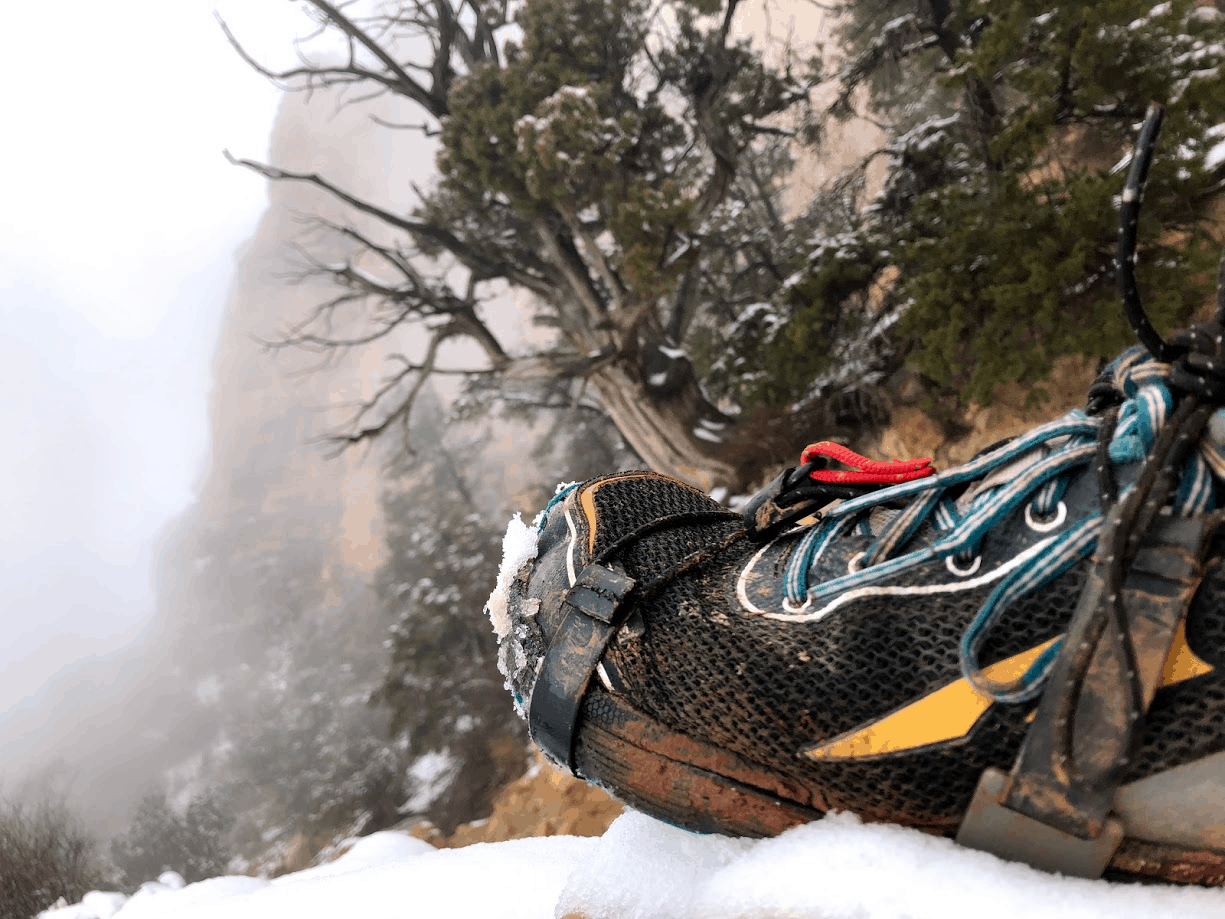
And then there was the Grand Canyon, which held its own surprises. In the days before my descent, the canyon had unseasonably warm weather that melted most of the snow. Because of its northern exposure and narrow shaded sections just below the rim, the Grandview Trail still held small sections of snow, though I felt like the cleats had gotten off too easy. But five days later, when the weather greeted me with freezing rain, sleet and snow as I climbed out of the canyon, I was glad I had the Cleats handy.
Performance
Member Exclusive
A Premium or Unlimited Membership* is required to view the rest of this article.
* A Basic Membership is required to view Member Q&A events


Discussion
Become a member to post in the forums.
Companion forum thread to: Vargo V3 Titanium Pocket Cleats Review
Vargo V3 Titanium Pocket Cleats are half the weight of leading lightweight traction devices, but do they perform for running and backpacking?
A lot of the time, choosing lighter gear for BPL just means needing to take better care of it. With foot traction devices, one could bite the the dust if a failure occurred. This is what makes it so hard to choose something lighter than the Microspikes. If it is not rugged enough, it can be lethal. I’ve really beat the heck out of the Micros for years, and they have never failed.
But I eventually bought a pair of Snowline’s Chainsen Lights (large), which had spikes as large as the Micros, and are just over 3 oz lighter for the pair. They go on much like the Micros, and use a similar rubbery material to hold them onto the footgear. The spikes look just as durable, but the rubbery stuff is visibly lighter, and there is no way to know how durable it will be with rough use. So they are used with care.
Both devices have straps, albeit elastic, around the heels, and there are points under the heels as well. Posts on BPL have drawn attention to several lighter devices that do not have points under the heels, and I’ve passed them up because I want traction under the heel, especially when descending. And I’m not sure if any such device can be securely attached without a heel strap of some kind.
Both devices are also a PITA for me to put on, but their utility outweighs that concern. Still, after using Ramer ski bindings for years, it would be nice to see a traction device come along that mounts with just a retainer or strap over the toe and a cam connector at the heel. It probably wouldn’t work on trail shoes, but it certainly was effortless to put on.
I can applaud Vargo for trying to push the envelope for lightweight traction devices, and these look like an improvement over earlier designs. Like Sam, I want something for my heels as well. I am a heel striker, particularly when descending – I try to be consonant about not heel striking on slick surfaces, as I have busted a few times because of it, but habits are hard to break. I have been using my Microspikes for going on 11 years now and I think I will offset their additional weight by taking Gatoraide bottles instead of the Hyperlight Aluminum bottle :)
I made something like those a few years ago (2014). Titanium 6Al4V alloy left over from my stoves.

Very bitey teeth. Nuts and long screws replaced with nylocs after the photo.
Took a fair bit of heat and hammering to get the bends as the alloy is one of the harder ones available. But it is possible to MYOG.
Cheers
Roger
Vargo is apparently fixing some subpar stitching on these according to MattShafter (see description “EDIT 2“):
https://www.youtube.com/watch?v=J-tBaLN1rHM
My conundrum: Where the heck do I find traction for my 8-year-old daughter?
The V3 pocket cleats attach to size one shoes! I can fit them with two of the three cleat pieces per foot. Hooray. I’ll feel much better taking her out on snowfields. (Yeah, “Pacific Northwest Problems”)
Vargo also totally rocks on CS for sending me extra webbing so I can upsize her as she grows! (I offered to pay, but they just went ahead and mailed it.)
Asides from the lower weight consider the competition:
A long-loved brand has pretty damning reviews recent reviews—recurring theme of the plastic breaking. I’d love a pair manufactured eleven years ago! Eleven months ago? Not so much.
A well-regarded competitor only fits down to women’s size 9. Really? Really?
Hi Kat
One of the problems with 8-year olds is that they are growing FAST. Anything which fits her today won’t tomorrow.
Have a look at the Ti version I made a few postngs back. Could you make something similar using sheet aluminium – about 1 mm. Tinsnips and a drill and a file. You would need the tabs going upwards for webbing attachments. For downwards spikes, fit 8+ screws (6 – 8 mm) through the Al sheet, threaded ends pointed downwards, and locked in placed with Nyloc nuts. Sure, the whole thing will get a bit bent and worn after a season or two – but her feet will have grown so much in that time anyhow.
Our ancestors did not have the extreme technology which we have today, but they still got around.
Cheers
Hmm. The weight sure is tempting, but I really wouldn’t fancy that lacing procedure in a blizzard with cold fingers…
Maybe best used in situations where you can be confident you won’t have to don them in severe weather?
What do people think?
As mentioned, the lack of traction under the heels is a serious shortcoming when going down hill, even slightly, unless you are willing to walk down with a mid-foot strike.
Become a member to post in the forums.