

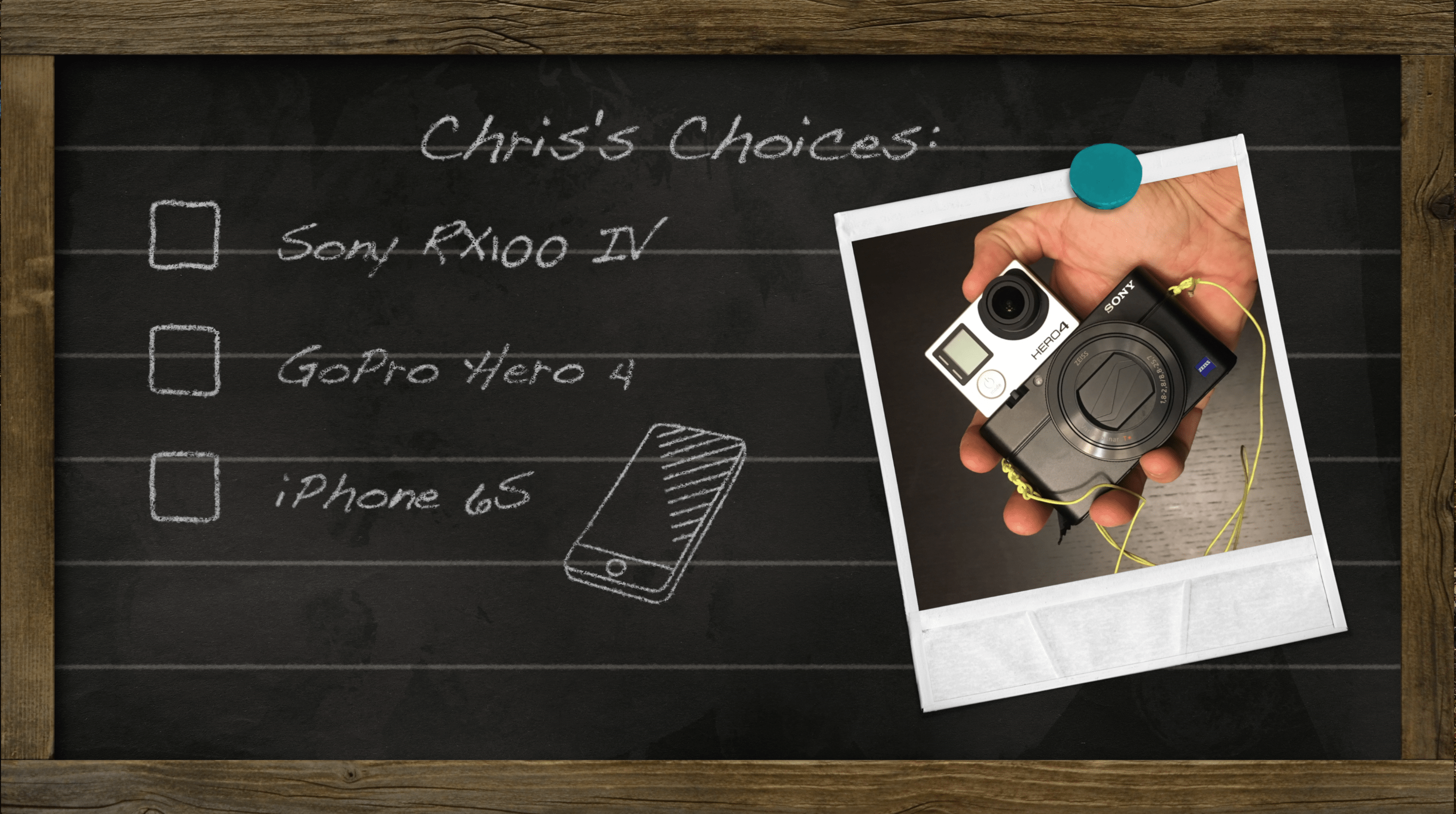

Join Chris, a BPL member and Amateur Film Maker, as he walks us through this 10-minute video on the ultralight video gear he uses to capture his backpacking adventures. From gear (and how to carry it) to video editing software, Chris talks about what he considers to be the best ultralight video gear. He also shares valuable lessons learned and how to make the most of the images you capture while backpacking. Stay tuned for more “According to Chris” film series here on Backpackinglight.com throughout the year.
View the According to Chris video series here at backpackinglight.com.


Discussion
Become a member to post in the forums.
Companion forum thread to: Ultralight Video Gear (According To Chris)
Chris Smead, who produces Backpackinglight.com’s “According to Chris” video series, goes through his ultralight video gear.
Hi, Chris,
thanks for posting this video. You certainly aren’t going light with your new setup. Another way to go would be the Sony RX100IV or RX100V for stills and 4K video, using a lightweight tripod when necessary. And a Sony FDR-X3000 which is a 4K action cam with internal B.O.S.S. stabilization for wide angle stabilized video. The RX100s and X3000 also share the same battery, so that can shave some weight.
If you plan on shooting 4K video in FF mode with the A7RII, I think you will get worse video quality than with the RX100IV or RX100V. Do some research online to see why. If you shoot 4K video with the cropped mode of the A7RII, the quality will be similar to the RX100. I think if you really want stable looking 4K video at anything other than the widest focal lengths, you will need to use a tripod (I know, as I’ve tried for some time to get around this) or some sort of gimbal if you want camera movement. The RX100 can be used successfully with a small and lightweight tripod, like the Sirui T-025X, or a small gimbal, but the A7RII will need a much bigger and heavier tripod and/or gimbal.
There is no doubt that for stills, with a good prime or primes, shooting full frame, the A7RII will be superior to the RX100 in terms of resolution, control of DOF, and dynamic range. But the real question is, do you need all of that for your planned use? If you are posting images on the web, viewing images on an UHDTV or HDTV and maybe doing prints up to 16X24, I really don’t think you will see a difference. If you are doing extreme cropping, professional paid jobs and huge prints, then the extra cost and weight and size would be worth it.
Going back to video, if you want quality video from the A7RII, you will shoot cropped, or essentially APS-C size sensor, so you will lose some of the light collecting advantage of the full frame sensor. You are suggesting using a 16-35 f/4 zoom, which in the 4K crop mode will be equivalent to 24-50 or so, but at f/4. The RX100IV and RX100V are f/1.8 at 24 mm. So that means that the RX100 at f/1.8 will let in about 4.9X as much light as an f/4 lens. But the APS-C size sensor has about 3.2X the area of the 1″ sensor in the RX100. Overall, the RX100 would collect about 4.9/3.2 or about 1.5 times more light per area, and would have better low light performance. Of course if you put the f/2 prime on the A7RII and shot stills FF, then of course that setup would collect far more light.
I think that the RX100IV or RX100V is a great camera for lightweight backpacking, combining great still and 4K video image quality in a small and lightweight package. For 4K shooting, I don’t think that the A7RII setup will be better, but it certainly can be better for stills. I just think “better” won’t matter for most uses. And this is coming from a gear head with a big GAS (Gear Acquisition Syndrome) problem. I just sold 5 cameras recently on eBay, and currently have 10 cameras that I use, and multiple lenses. I’ll be selling some of them. My largest sensor camera right now is an A6500, but I might consider purchasing or renting an A7SII with a fast lens if I go on a specific far north aurora trip, in order to shoot real time video of aurora (not time-lapse). But for general use, the A7SII would be overkill.
Hey there David, thanks for the insights! Do you have any links to articles about the FF quality issue you mentioned? I’ve heard of people shooting in APS-C mode to avoid pixel binning. But I need to learn more about that.
As for the rx100 vs the A7rii: To my untrained non-professional rookie eye, there’s a HUGE quality improvement. Here my take on why, but take it with a grain of salt:
And yes the weight…ouch. 7lbs! I’m trying to go more SUL in other places to make up for it… guess I’m in the right place. :)
I’m in the planning stages for a new trip/video project that will be shot almost entirely on the A7rii, so I’ll let you judge for yourself. If ya have any pointers let me know. I’ve still got lots to learn.
PS: This new video project will feature a surprise guest. Let’s just say you’ll recognize this individual. :)
Hi, Chris,
look at the A7RII reviews on Cameralabs, Dpreview and the Youtube video on the A7RII video features from TheCameraStoreTV. In addition, google a phrase such as “4K video on A7RII FF versus super35”, and you will see numerous video posts and forum posts comparing super35 versus FF with the A7RII.
Several other comments. If shallow DOF is paramount to all of your video work, then shooting 4K video with a FF sensor camera and a fast lens makes perfect sense, but such a setup can not really be considered ultralight. Of course with careful work with an RX100, such as zooming with your feet, it is possible to get some shallow depth of field, but nowhere near what you can achieve with a FF sensor camera and a fast lens. So, if your comments and choice of the A7RII and heavy lenses are viewed as, “This is what I use to achieve my artistic vision while backpacking.”, then they are entirely appropriate, but if they are viewed as “This is an appropriate setup for most people shooting video while ultralight backpacking.”, then I would disagree. Also, your comments show that you view shallow DOF as “quality”, but it is really more about a technique or a specific look. For dramatic work, it can be very effective for isolating a person from a background, but for the type of films you are shooting, in general your audience isn’t going to care about this.
You mention that you wished that the RX100 supported Slog, but both the RX100IV and RX100V do support S-Log2 gamma, and I believe that the RX100V adds Gamma Display Assist which allows you to view a normal contrast image while shooting S-Log2. I don’t shoot S-Log2, but since you do, you might be interested in this.
As for stabilization, I have not shot with an A7RII, but I have shot with an A6500 which has IBIS and can use OSS lenses together with the IBIS. I’m not overly impressed with the IBIS in the A6500 for 4K video. Maybe the A7rII does better. Panasonic’s recent micro 4/3 cameras with IBIS and Dual IS compatible lenses do an excellent job of IS when shooting 4K, compared to Sony. I think that Panasonic’s technology is better than Sony’s, but even so, Panasonic has the advantage here for IS, since it is much easier to stabilize a micro 4/3 sensor as compared to a full frame sensor.
Certainly with a fast lens, the A7RII is very good with low light performance. But I would argue that if your main focus is video, and not stills (except for use within some videos), and if you want the FF sensor DOF control, and the very best low light performance, then the A7SII is the better choice for video, and is more video oriented.
Before composing this post, I watched both your JMT video and your more recent Yosemite Snowshoe video, and I have to say, “WOW.” Excellent use of video, stills, motion, graphics, animation, music you created, narration, titles and editing to showcase your artistic vision and create a certain “look”. You really are ready to enter film festivals with the right content. You really captured the feeling and look of the JMT – My wife and I hiked it in 2014, but we are much older than you, with two grandchildren substantially older than your children, and we had much worse conditions – multiple forest fires which were brought under control but numerous storms, and five days of hailstorms at least once a day. We did re-supply at Mammoth Lakes, MTR and also backpacked out to Onion Valley to pick up a food cache. I hope that people watching your JMT video have some understanding of how much effort, mental and physical went into your numerous time lapses, etc. To be honest, I didn’t have the energy to do a huge amount of daily filming at my age. I was just happy to get up early, pack up and hike all day. We did however, climb Caltech Peak on the same day after going over Forester Pass, as I am an alumnus and I was probably never going to be close to it again. When I signed the summit register, I knew about 1/3 to 1/2 of the names in it, either as Caltech friends or fellow peak baggers.
I could see your improved camera work comparing your JMT footage to your Yosemite Snowshoe footage. I did note that your Yosemite Snowshoe footage was shot with the GoPro and the RX100IV, and I don’t really see how the edited film would really be substantially better if you had shot it with the A7RII. The night time lapses were gorgeous.
My big suggestion to you is that you need to be careful about obsessing over gear and the incremental improvements that new gear brings. The vast majority of your audience at a film festival or your audience online isn’t going to care that your shots were done with a more shallow depth of field. They will expect focused shots, reasonably well done white balance, no bad shaky cam footage, etc., but they won’t care if the night time lapse isn’t quite as noise free and perfect as you would like it to be. But ultimately they won’t want to watch your video if the content and story doesn’t interest them, and that is the most important thing. Content is king.
You are probably your own toughest critic, but you need to balance doing very good to excellent work versus trying to do perfect work, unless that in itself is your goal. When I get a new camera and/or lens, I spend a bunch of time shooting test charts and real world stills and video shooting, often pixel peeping at 100%, but eventually, unless the camera or lens is a dog, I come to the conclusion that I am wasting my time, as the video and stills under whatever normal usage that I would make of it is more than good enough for my needs. But I still enjoy doing the tests.
Anyway, you have an artistic eye and ear and heart, and are able to tell an interesting story with video, and you are completely ready to enter material into a contest or festival. I look forward to your further work.
Thanks David for all the valuable info and advice! Sounds like I need to do some testing in super35 mode.
My next project I’m going in a totally different direction. It’s an experiment/exersize really. Very few effects, and mainly a focus on good cinematography. It’s my way of forcing myself to be a better camera person! ;) And like you said content is king, so this should help me focus on that.
Wow the rx100 can do slog?!! I’ve checked everywhere in the settings…maybe I need a firmware update. Or maybe I’m just missing it. The backcountry is full of crazy contrast I’m learning. Seems you have to blow out the sky to properly expose the mountains so slog would be helpful for that.
I think that the RX100V had S-Log2 when it was released, but the RX100IV had it added with a firmware upgrade, which is why it might not have been in your camera.
OLYMPUS TG 4 – Best backpacking camera I’ve found.
F2 lens
video capable (1080p)
audio (decent)
GPS
many picture mode options (soft focus, macro, micro, etc.
attachable tele and wide angle lenses (yep)
“dropproof” to 7 ft.
waterproof to 60 ft.(W/warning buzzer t 50 ft.)
about $400.
Interesting. Looks like a cool option. I’ll check that out!A gear review article/video on Alcove is coming out soon with some camera discussion, but I’ll probably do another deep dive video later on sharing some lessons I’ve learned.
2 other cameras I’ve been loving are the A6500, and the AX53 handicam. Neither are super light. But the quality/weight ratio of the A6500 is amazing. The AX53 is bulky, but the internal gimbal stabilizer works so well you can get smooth footage of gliding through trails. I’m curious to see how the Olympus stabilizer stacks up.
I’m noticing a lot of people favor the Panasonic GH4. I don’t get it…tiny sensor in a big package…but I should try it before judging I suppose.
In the end my favorite is still the Sony A7rii, but it’s far from UL. But I love it so much it’s almost weird… ;)
Eric, the TG-5 is out now.
Become a member to post in the forums.