

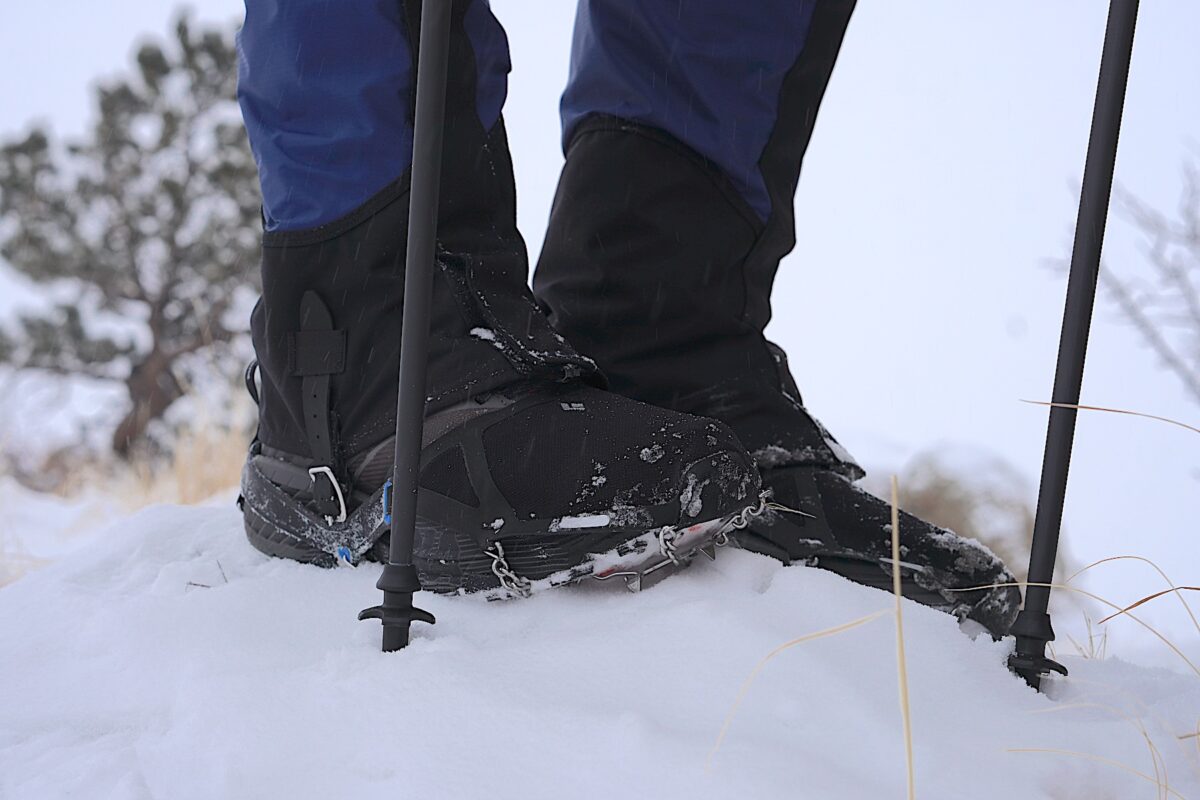

Introduction
My first experience with traction devices was back in the 1980s while backpacking in Olympic National Park. Back then, traction spikes as we know them today didn’t exist. We relied on mountaineering crampons, which were necessary for the steep off-trail terrain we often traversed to reach technical mountaineering routes. Walking in crampons on non-technical trails was cumbersome, but they were the only option. By 1990, I took a grinder to a pair of Salewa steel crampons, filed the front points off, filed the rest of them down to about 15 mm, replaced the leather straps with a DIY 10 mm nylon webbing harness, replaced the metal connecting bar with steel wire, and I was off to the races with something that was (almost) manageable with lightweight hiking shoes. I managed several ultralight-style objectives in that combo, including Mts. Rainier, Shuksan, and Hood, and a wintry (November) thru-hike of the Wonderland Trail.
Fast forward to the early 2000s, and traction technology had evolved. In 2007, Kahtoola released the first iteration of traction spikes, the Kahtoola Microspikes. Now, there was an option that could be used with lightweight hiking and trail running shoes. For me, this opened up a whole new realm of winter backcountry travel. I could now move quickly over hard-packed snow or icy trails without committing to heavy mountaineering boots or cumbersome crampons.
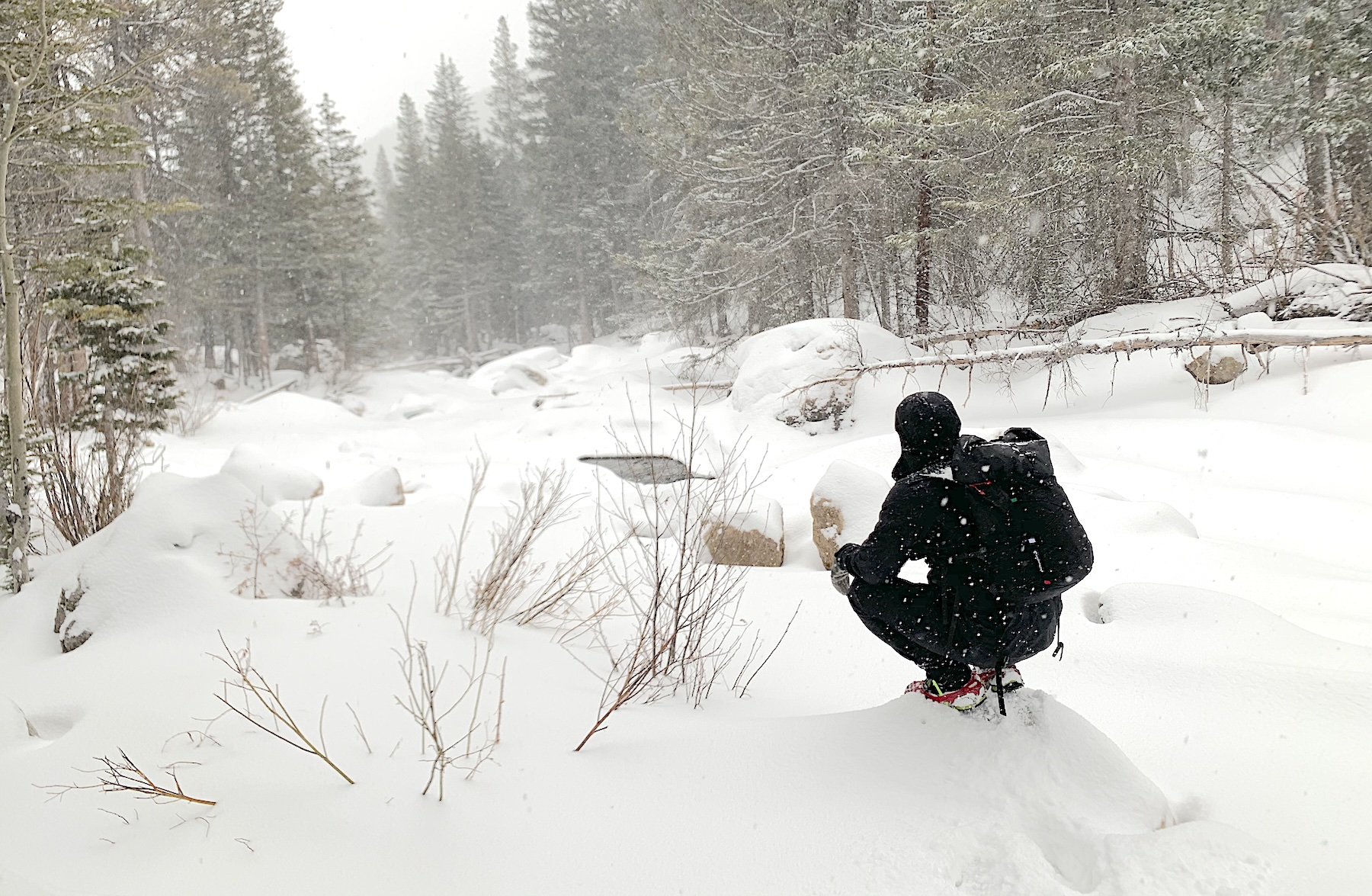
Over the years, I’ve tested nearly every type of traction device available, and I’ve learned a few lessons along the way. In this guide, I’ll break down the different types, their strengths and weaknesses, and share stories from the field that illustrate when and why you need them – and when you don’t. Additionally, I’ll provide a comparison of today’s market offerings, breaking down how different products perform based on key attributes and my experience with them in the field.
This guide will focus on traction spikes, which I distinguish from chains, coils, studs, and traditional crampons.
The following models are reviewed in this gear guide:
- Black Diamond Access
- Black Diamond Distance Spike
- Camp Ice Master
- Grivel Explorer
- Grivel Explorer Light
- Hillsound Cypress6
- Hillsound Flexsteps
- Hillsound Freesteps 6
- Hillsound Trail Crampon
- Hillsound Trail Crampon Pro
- Hillsound Trail Crampon Ultra
- Kahtoola Ghost Microspikes
- Kahtoola Microspikes
- Montbell Chain Spike
- Nortec Alp 2.0
- Nortec Nordic
- Snowline Chainsen Trail Light
- Vargo Titanium Pocket Cleats Solo
- Vargo Titanium Pocket Cleats VTRAC
- Yaktrax Ascent
- Yaktrax Summit
- Yaktrax Traverse
I realize that as this product category evolves, so too do the lines that distinguish its product subcategories of products. So, we’ll start with a discussion of where traction spikes fit in the context of the broader market category of footwear traction devices.
Types of Footwear Traction Devices
Traction devices come in several distinct categories, each designed for specific terrain, activity types, and performance needs. Choosing the right traction device is based on use case and desired performance outcomes. Those outcomes most often balance weight, flexibility and comfort on the shoe, and traction performance.
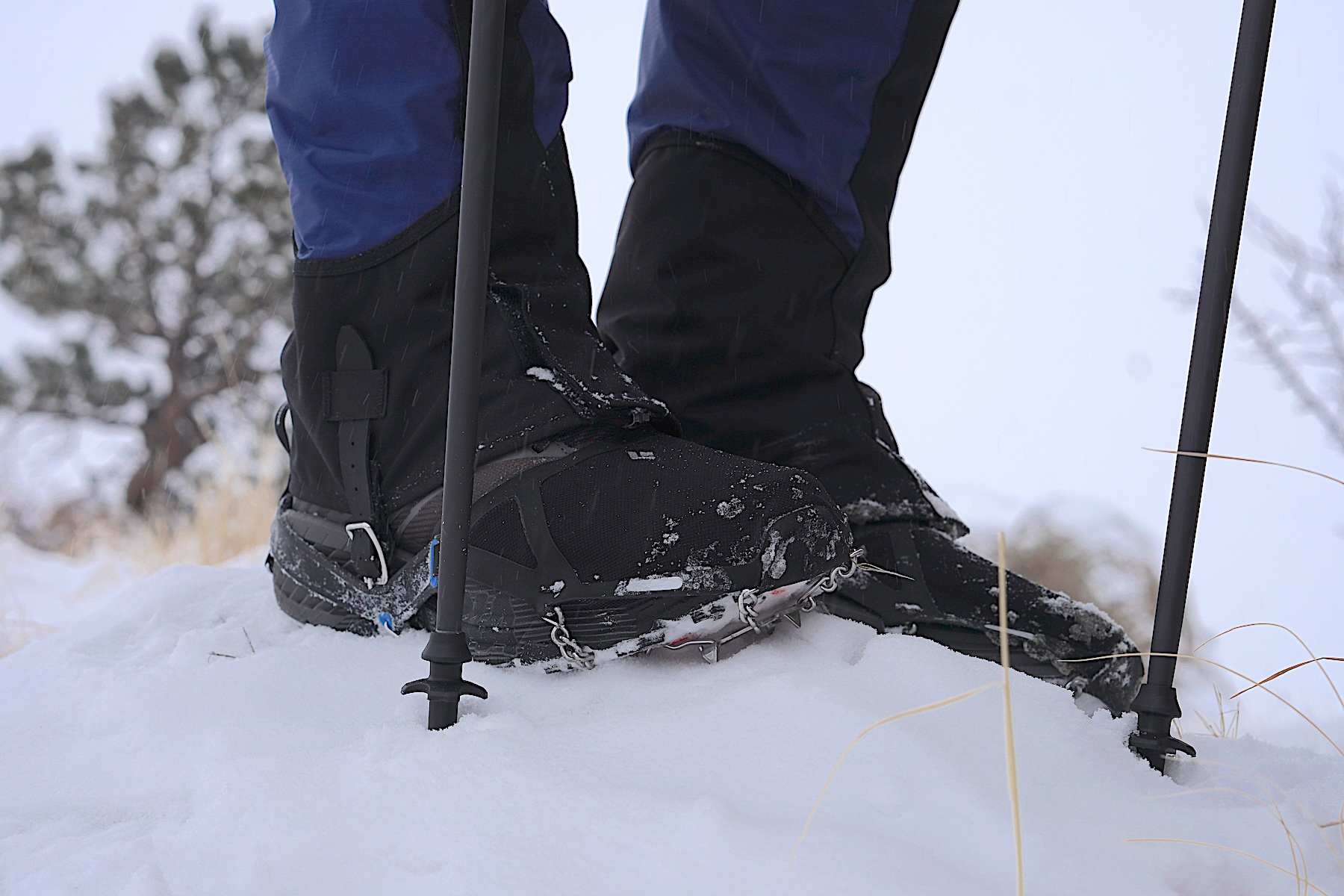
Traction spikes are the most versatile and widely used traction devices for hikers and trail runners navigating icy and hard-packed snow trails. They most often consist of a flexible elastomer harness with short, evenly distributed stainless-steel spikes connected by chains or links. This design allows for secure grip on slick terrain while maintaining flexibility at a weight that’s lighter than crampons.
Traction spikes excel in non-technical environments where a balance between weight, packability, flexibility, and traction is needed. They are ideal for well-traveled trails, moderate inclines, and environments where crampons would be excessive. However, they are not suitable for steep ice climbs or mixed snow-and-rock terrain where longer spikes or rigid crampons would be required to mitigate fall risk.
Crampons
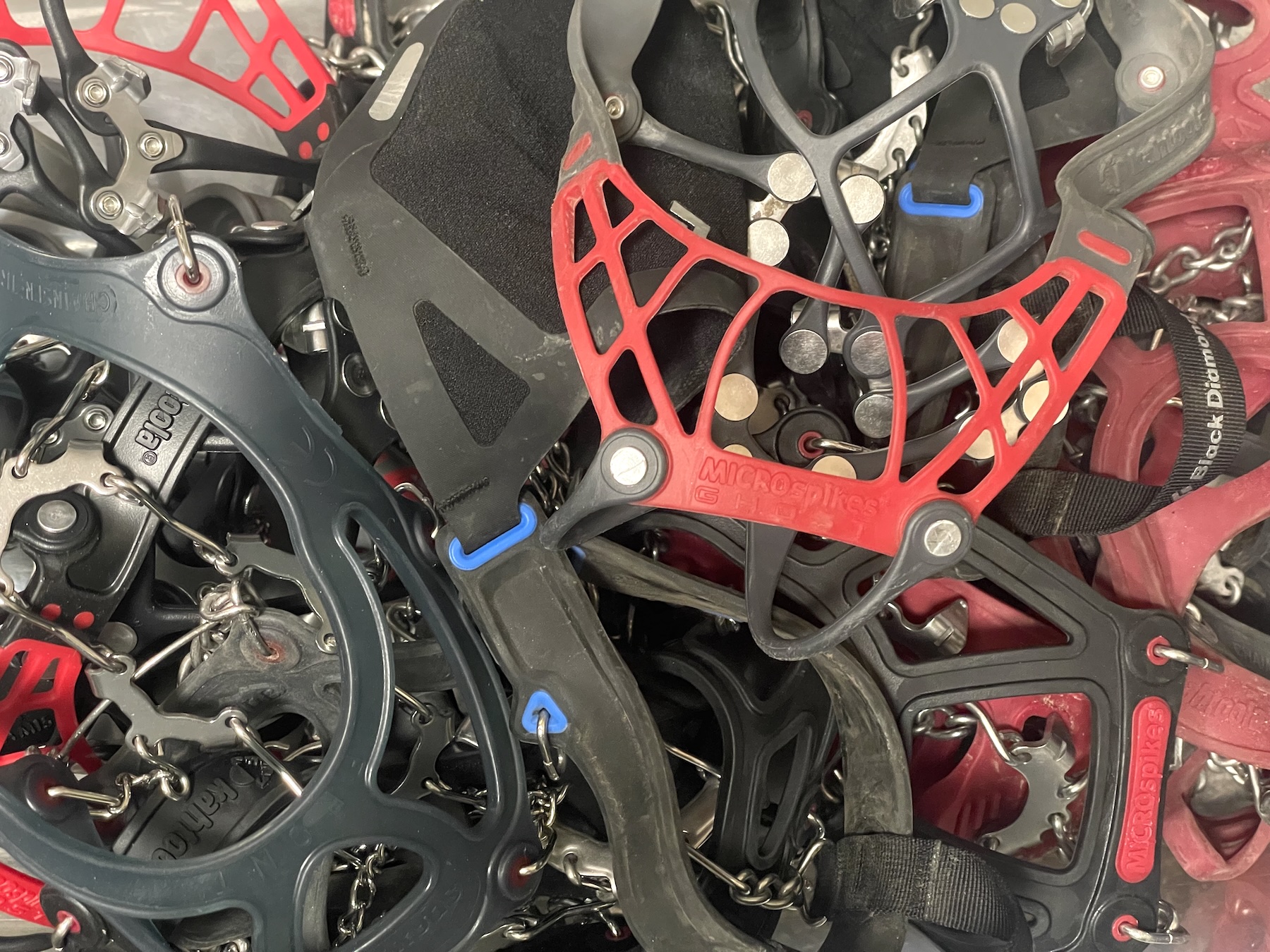
Crampons are a more aggressive traction solution intended for mountaineering, ice climbing, and more technical winter terrain. They feature rigid or semi-rigid frames with long, sharp spikes designed to penetrate ice and compact snow effectively. Crampons attach securely to mountaineering boots via strap-on, hybrid, or automatic binding systems, ensuring a stable platform on steep, frozen slopes. Some mountaineering crampons can be affixed to more flexible footwear with so-called universal bindings. Mountaineering crampons made with carbon steel frames and spikes are the most common, and weigh 24 ounces (680 g) or more. Others use aluminum and can weigh as little as 15 ounces (425 g), but provide less traction and durability on hard ice.
While crampons provide unmatched grip on extreme terrain, their rigidity makes them impractical for long-distance hiking on mixed terrain. They are best suited for technical climbs where weight and mobility are secondary concerns to safety and stability.
Chains, Coils, and Studs
Chain-, coil-, and stud-based traction devices represent the minimalist approach to winter traction. These devices typically consist of small metal coils or studs affixed to a rubber or elastomer harness that slips over the shoe, or chain links underfoot. They are primarily used for walking on icy sidewalks, roads, and gently-graded trails.
While chains, coils, and studs offer some level of slip resistance, they lack the deep penetration of traction spikes or crampons. Their grip is often insufficient for backcountry conditions, making them a better choice for urban environments or low-angle, icy trails where hard snow is not a factor.
Hybrid Traction Devices
Other categories of traction devices have emerged to bridge the gap between spikeless (e.g., chain / coil / stud) devices, traction spikes and crampons. Hybrid models combine elements of spikeless, spikes and crampons. Hybrid devices may offer spikes of varying lengths, combinations of spikes and studs, or harness elements of different designs.
For example, the line between traction spikes and crampons is blurred when a crampon doesn’t have front points (which are mandatory for climbing steep terrain). Generally, crampons have longer spikes (up to 1 inch / 25 mm or so), while traction spikes have shorter spikes (down to about 0.25 inches / 6 mm).
Member Exclusive
A Premium or Unlimited Membership* is required to view the rest of this article.
* A Basic Membership is required to view Member Q&A events


Discussion
Become a member to post in the forums.
Companion forum thread to: Traction Spikes
An in-depth guide to traction spikes for hiking, backpacking and running in all seasons. Compare models, materials, and performance attributes with insights from field testing to find performant options for different use cases.
great writeup! i found a few more options to check out when my kahtoola microspikes (which have been stellar in a variety of situations) bite the dust.
I lived on Oahu for a few years and was really surprised when the veteran hikers pulled on microspikes for the descent. The trails are often steep, wet, and slippery. The spikes were for traction descending the sloppy mud! There was often a frayed waterski rope tied to a shrub to help you. I rarely slip and fall on the Western mainland, but it was a regular experience on the island. Microspikes to the rescue!
I use Kahtoola microspikes in New Hampshire mountains although one of our SAR teams that I work with strongly suggests the Hillsound equivalent instead.
Until we start getting significant snow, which lately hasn’t started until late December, the Kahtoola exospikes did well on mixed terrain or hard packed snow, thin ice, and rock. Has reduced falls going downhill on rock covered with black ice or slick lichen.
After decades of carrying way too heavy packs recreationally and professionally, my feet have some problems including hammertoes. The bindings of the Kahtoolas tend to press down on my Topo boots in ways that are painful to the hammertoes. So I switched recently to BD distance spikes- an advantage not mentioned is that the soft shell top eliminates pressure points by distributing the pressure across the top of the foot. A huge relief for my feet.
In subzero full-on conditions I switch to La Sportiva G2 or G5 boots, both not deformable like the Topos I use in warmer winter weather. The G5 accepts the more rugged Kahtoola or Hillsounds (and full crampons when needed) without pressure on my feet. I sometimes use the BD distance spikes on those boots too, when just a little added grip is called for.
One problem with the BD distance spikes- there are some weak points so I’ve had a few break in various places. (The fit has to be near perfect to reduce the chance of that happening.) So I carry an extra pair- they are so light that I can do that easily.
I couldn’t get the largest Kahtoolas to fit my 12W boots. Hillsounds work great. The rubber is just slightly more stretchy — enough that they succeed where the Kahtoolas did not.
Vargo VTRACs are perfect to keep in the pack when you don’t expect to need them (much). They are super-duper lightweight, and add enough traction to a shoe to be useful. They’re a heckuvalot better than nothing when you encounter unexpected snow, ice, or mud.
This list is a great resource. Thank you, Ryan.
Great info.
I saw a picture somewhere of a guy who hiked up a ridiculously steep Alaska mountain in Xtuff rubber boots. He shot a bear than used micro spikes on the boots for the hike down with a heavy load of bear meat. To put the steepness of the Kenai mountains in perspective, I watched kids basically sled down a grassy mountain on their rears. Not as fast as on snow but moving fast enough they had to be careful not to lose control. I think I’ll try spikes this summer for off trail hikes there.
Another thing people from warm areas don’t realize is that a popular trail may get beaten down to the point where you don’t need snow shoes or skis even if there is 3 feet of snow. But… those trails can get icey. I’ve gotten a lot of use out of spikes lately. It’s been a low snow year but lots of slippery ice.
Become a member to post in the forums.