

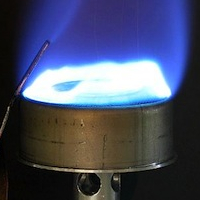

A number of recent stove models feature a pressure regulator in place of a needle valve, and the marketing spin and claims for the virtues of the pressure regulator border on the absurd. In Part 1 of this series we examined the claims and debunked them using basic physics and some testing. Despite this, some manufacturers and some users claim improved performance in the cold for their particular stove, relative to a 'conventional upright stove'. We believe some of this improvement is possible, so in this Part 2 we examine just what is going on here in both upright and remote canister stoves. Needless to say, it has nothing to do with the pressure regulator.
We will start with some history about stove design and different fuels, because looking at that sheds a lot of light on why many stoves have been made the way they are. We will especially look at remote canister stoves and other liquid fuel stoves, because they shed a lot of light on this. We will also look at recent developments in stove design, with a lot of data coming from experimental work done over the last few years by the author. Then we will put it all together and offer a suggestion as to what is really happening, and how better stoves could be made in the future.
ARTICLE OUTLINE
- Introduction
- Technical History
- Kerosene
- Petrol or White Gas
- Propane and Butane
- The Big Difference between Fuels
- Conventional Winter Remote Canister Stoves
- Second Generation Remote Canister Stoves
- Epiphany
- Upright Canister Stoves for Winter Use?
# WORDS: 3860
# PHOTOS: 8
Member Exclusive
A Premium or Unlimited Membership* is required to view the rest of this article.
* A Basic Membership is required to view Member Q&A events


Discussion
Become a member to post in the forums.
Companion forum thread to:
Thermal Feedback in Upright Canister Stoves
not sure if they could be made to work in this application, but bi-metal coils are at the heart of most house thermostats, and there's probably a mature technological base that knows how to manipulate their properties.
Bi-metal sounds very interesting and it should not be hard or expansive to source.
Picture: http://www.google.se/imgres?imgurl=http://www.hilli1.de/Physik/Folien/Waerme1/Bimetall.gif&imgrefurl=http://www.hilli1.de/Physik/Folien/Waerme1/Bimetall.htm&h=660&w=514&sz=23&tbnid=oZjbVetxRYXVOM:&tbnh=89&tbnw=69&zoom=1&usg=__IAb2lOT2K7tr0ORmGJq8mXWP4rc=&docid=1VfhP_GJPe_5DM&hl=sv&sa=X&ei=FkY4Uf6QO4vesgbykYCYBA&ved=0CEAQ9QEwBQ&dur=670
It doesn't even have to be bimtallic in the traditional sense of two alloys continuously bonded to each other. Simply two metal rods triangulated with a narrow base would, if allowed to pivot, bend away from the hot side. The hot rod could be either a conductor of heat to a vaporizer or the vaporizer tube itself. The cold rod could be a turnbuckle to field tune it for ambient temps or different fuel types ( butane, white gas, diesel, yak's milk, etc).
So, what is the heat of vaporization of yak's milk?
–B.G.–
>Novel! I imagine it could work.
>But sourcing the material …
I don't usually give novel ideas away. If you make it big in the stove industry, you owe me some CNC play time…
Here's some useful info on bimetals. These guys would probably send you some samples if you tell them you are developing a product.
http://www.cladit.com/tech.html
> http://www.cladit.com/tech.html
f a s c i n a t i n g…
Cheers
Roger,
Very interesting what you’ve learned by experimentation (and frustration at times, no doubt). Sounds like it’s all about the heat and consequent pressure within the canister although I still wonder some about the Jetboil Sol (although I suppose if I’m really curious I can do a bit of experimentation).
Interesting bit about the difficulty of sealing a pre-heat loop. The FMS-118 Volcano at least has the sealing right (although it seems they’ve got the diameter a bit too big).
I do notice the Kovea Moonwalker uses a shunt instead of a pre-heat loop. The one thing I don’t like about this arrangement is that the whole stove gets quite hot and takes a while before I can reasonably pack it away, but the Moonwalker has a lot of metal. Smaller, UL style stoves will likely not have this problem.
It’s late, and I don’t have any particularly brilliant insight to add (would that I did), but I thank you for writing yet another article that very few people are in a position to write. It is such articles that make BPL such a great place to be a part of (well, and the people too of course).
HJ
Adventures In Stoving
E-gads! Is that old thing still out there? That was B.T. (before tripod). I hope you take motion sickness meds before viewing.
The idea of priming a remote canister stove with alcohol has merit, particularly one that is designed for it. For example, the WindPro is really a white gas stove (the Simmerlite) that has been repurposed for use with canister gas (and it outlived its parent, the Simmerlite, which alas has been discontinued). The WindPro’s head will hold alcohol and it has a small priming cup. Very interesting. Suppose one filled the head with alcohol and ignited it. The edge of a cold canister could be held into the flame. The flame would a) heat the canister and b) heat the pre-heat loop. One would then open the valve, and voila! no-flare inverted start ups with plenty of pressure. Conceivably, one could operate in very low temperatures this way. Adding a bit of fiberglass wick, as on a Whisperlite Internationale, would increase the vaporization of the alcohol which could be quite balky in cold weather. Hmm. Interesting.
HJ
Adventures In Stoving
Roger,
I just noticed this elsewhere on BPL regarding your MYOG canister remote stove:
I noticed the PowerMax canister in the photo here in your article (of which I have laid in a goodly supply), but your stove also works with standard threaded and Camping Gaz? Now, that’s nice.
How did you do it? Do you have a connector that fits over the rim around the valve, something along the lines of how an MSR SuperFly connector works? Is the pin any different between a PowerMax, Camping Gaz, or standard threaded stove?
HJ
Adventures In Stoving
Hi Jim
All the details, in great and gory (or glorious) depth, will be revealed soon. The connector is more like the French Campingaz one than the Superfly. I tried the Superfly and was, frankly, a bit scared of the way MSR had done it. Things flexed … It was not an option for me.
The pin – you would not believe how much trouble that gave me! The Lindal valves are all different. Yes, a solution was found, and yes, it will be in the article to come.
Fwiiw: I have been using my winter stove for 6 – 9 months now.
Cheers
(Yes, I know I'm mean not giving all the details now …)
IANASG (I am not a stove geek), so maybe this is a dumb question:
Given all the troubles vaporizing butane, why not make light canisters with 100% propane specifically for winter use?
Why are Coleman-style propane steel canisters the only ones on the market anywhere close to backpacking size?
(Edit) And to answer my own question:
http://www.backpackinglight.com/cgi-bin/backpackinglight/canister_stove_faq
As the link you added explains, pure propane is so high pressure, it requires thicker steel. About exactly the weight of the propane regardless of size (14 oz. 16 oz, 20-pound/4.5-gallon, 80-pound, etc).
There are about three people on this very gear-heady site that I'd trust to load their own lighter canisters for winter-only use and be damn sure they never got above room temperature during transit and use. Those safety margins are used for good reason as HikinJim, RogerC, and I have all proved at times.
Now if someone offered a refillable 200-gram fuel weight aluminum or titanium propane canister, I'd order a handful.
I own a Chevy Siverado that I had converted to Run on Natural Gas. It has a polymer tank that is wrapped in fiberglass and carbon fiber.
It has a fill pressure of 3600 PSI.
I just use public fill stations but there are several types of home filling stations.
It would be nice to just have a small refillable bottle to use with my stove! No more issue with low temps and no more canisters in landfills.
Maybe 3M or GE see an ultralight mini tank in there future?
> It has a polymer tank that is wrapped in fiberglass and carbon fiber.
Bring it on!!!!!
But the cost of production would likely be swamped by the cost of development and insurance and safety testing and getting approvals and …
Sigh.
Cheers
Roger that is most definitely the problem!
It is amazing what is out there just waiting
Well my son can look forward to such high tech gear!
In 25 years who knows what possible
Ah. Interesting. And it works with threaded too. Fascinating.
Actually, having tried my hand at canister refilling, I very much would believe it.
I will look forward to the article,
HJ
Adventures in Stoving
Propane’s a frisky critter, and it’s tough to keep him caged.
Even so, there was a light weight canister out there, but it was for torches, it was a specialty item, and it didn’t stay on shelves long. It may have had approval problems or maybe there just wasn’t demand for it; I really don’t know. I have two such canisters in my collection.

More info on said canisters: 100% Propane for Backpacking
HJ
Adventures in Stoving
Well, the one pictured above is 226g, and while not officially rated for refills, yes you can refill them with 100% propane. Problem is they’re hard to find. Supposedly there were still some available in Boise, ID, last I heard.
HJ
Adventures in Stoving
Hi Jim
> there was a light weight canister out there, but it was for torches, it was a specialty item,
Sigh. Never in Oz. SIGH!
Cheers
Sigh. Never in Oz. SIGH!
Actually Bunnings (Melbourne) had them but for a very short time.
By the time I realised their potential they had disappeared from the shelves…
Does exist, altho I have yet to see one in a shop

It even says "Manufactured by Primus" on that link.
Why cant they get it going? They're already set up with the proper segment of retail/ distribution.
must be a safety issue. only welders and people who are 'trained' with compressed gases?
–ironically I was typing "distribution" and accidentally typed "disastrbution" (disaster) maybe that was The Big Bang telling me why they DON'T make em. lol
> Why cant they get it going? They're already set up with the proper segment of
> retail/ distribution.
To import these into a country I believe they have to get safety approval in that country, and they have to use approved shipping methods. They can't use air-freight, so it has to go by sea. That normally means waiting for a cargo to be ready, unless they make up a special sea-mail parcel. This is only worth doing if they think the sales volume will be big enough.
I have argued the point at some length with both the Sievert people in Europe and the Primus people in Australia, and it seems they are just not interested in bothering to do the paper work. If only I could get some of the empties, before they were filled! Certify them as clean (no fuel) and airfreight.
SIGH. IF ONLY!
Cheers
The aluminum in that can is probably a lot thicker than aluminum used in the old Power Max butane canisters. The empty can probably weighs significantly more and it may not be easy to crush.
The problem getting a new fuel can in the market dominated by 7/16" NCEF threaded lindal valve canisters is getting enough market to justify the product. And people might not buy the product because it would require a different stove or because the stove would be rendered useless if the canister is removed from the market.
However if a company brought a aluminum canister to the market with a 7/16" threaded lindal valve that is recessed a 1/2". remote canister stoves with a compatible fitting could use the new canister as well as the current butane cans. The new aluminum can with have a weighted hose on the inside so that liquid fuel would be supplied to the stove without the need to invert the canister. Regular stove that are not compatible with liquid fuel would not fit the recessed valve which would help prevent accidents.
The new aluminum can could be filled with the current butane/propane fuel mix, pure propane (if thicker aluminum walls are used) or any mixture in-between. And if a long distance hiker stopped in a town to get extra supplies he would have to worry about not finding the new aluminum canisters. He could use standard butane canister instead.
Become a member to post in the forums.