


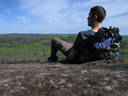
The summer of 1999, after my freshman year of college, I ventured on my first backpacking trip with two friends in the Canadian Rockies of Jasper National Park. I had yet to consider the very concept of weighing my pack, let alone each item within it. A rough guess as to our individual pack weights is somewhere in the range of forty to forty-five pounds, and this is after emptying eight liters of water out of the dromedary I had hanging from my backpack, which I carried for the first few uphill miles! Even though we had a water filter, I thought carrying water would be easier. Hah! From perusing old photos, I can see that we were wearing cotton t-shirts and jeans! Three days later, basking in the after-trip glory at a local pub, we bragged to the cute young waitress about our trip on Jasper's thirty-kilometer Skyline trail. She smiled and listened to our story, and then slammed our egos by mentioning that she ran the same trail the previous Saturday for fun.
My next trip was rather miserable. It was closer to home in Minnesota on the Lake Superior Hiking trail with my brother Ben. We certainly weren't in good shape, and I'm guessing our packs weighed in the range of forty to forty-five pounds again. We assembled our gear from my dad's and cousin John's extensive collection of old camping stuff. Our cooking pot was actually one inch thick along the sides, which I'm sure weighed several pounds. Ironically a normal kitchen pot would have been much lighter, but we brought this one along since it was a "camping pot." We considered ourselves lucky to have my dad's 1970s-era one-burner stove, which was roughly equivalent in size to four Mac Mini computers. That was lucky because our alternative was a two burner Coleman camp stove. I had recently purchased a brand new Granite Gear Stratus Access pack, which weighed seven pounds. We also had my dad's external-frame elk hunting pack, also from the seventies. The external frame pack dug into our backs and was horribly uncomfortable, so we carried considerably more weight in the Granite Gear internal frame pack. And in the sense of fairness, we swapped packs back and forth throughout the day. It rained constantly the entire three days, and one mile from the end of the trip my left knee popped under the strain of the heavy load. For the next several years, pain in my knee reminded me of this trip anytime I went for a run.
I continued backpacking despite this miserable experience. Pack weight lessened as I replaced the 1970s equipment with more standard backpacking gear, until I was down to a thirty- to thirty-five-pound pack. My wife Becca and I did a four-day, thirty-mile trip on Isle Royale in the summer of 2003. This was Becca's first backpacking trip, and she was carrying about twenty-five pounds, which was a decent amount for her smaller build. I wore a knee brace for my bad knee. On the second day Becca's feet were in considerable pain, and we realized that she has over-pronating arches. Her feet were in pain the remainder of the trip, and combining this with the typical rigors of backpacking produced a poor first backpacking experience for Becca. This was the point I realized something had to change if I was to continue backpacking.
ARTICLE OUTLINE
- The Beginning
- The Transition
- The Reality Check
# WORDS: 2240
# PHOTOS: 6
Member Exclusive
A Premium or Unlimited Membership* is required to view the rest of this article.
* A Basic Membership is required to view Member Q&A events


Discussion
Become a member to post in the forums.
Companion forum thread to:
Every Ounce Counts
Good story Luke
Agree that is it fun to go as minimum as you can and then, when you want, to add back a "luxury" or two. The experience of actually going as light as you can (whatever that weight is to each individual) is life changing IMO.
Great story, Luke. My pack weight is dropping from 35ish pounds of 2 years ago to under 15 right now, and I'm planning on a Skyline trail hike this summer. I will show your story to my buddies that think that more is better, and give me a hard time for my 1 oz stove and 2 pound tent. If people realized that less weight means faster and/or farther and/or easier, instead of just doing without, maybe they would appreciate lightweight a little bit more.
Once a customer at my store told me about their up coming skyline trip taking 4 days for 44km. I asked why so long and they said they were doing it fast. I then told them I was doing the North boundary in jasper (179KM) in 7 days, and they thought I was nuts and thought that it wasn't possible. then I gave them this website.
my approach is get everything as light as i can but not sacrifice comfort. That means repackaging everything, dehydrating, cutting straps, etc. Summer Full SO is about 20-23lbs (which is light in my book and including hammock setup, gps, extra socks), winter full so 27lbs. Again no problem to carry, lots of luxury. I could immediately cut a lb with a switch to a different pack from my aarn FF(aoubt 2.3lbs), but why? The Aarn ff is the most comfortable pack i've ever used, no need to. I still make huge miles with my current weight. There are some changes i would like to make though, replace spinn hammock tarp with cuben one, make a cuben hammock w/ bugnet instead of a sil hammock. This would probably cut me another lb, and would be amazing. Anyway enough rambling.
So Luke what do your weights look like now? I mean your full so weight, when your at the trailhead taking your first step, whats your pack weight? I don't care about what clothes your wearing, just your pack.
Great article. I have been doing the same thing. Did a few crazy light trips but now slowly the comfort items are creeping back in.
10km a day is fast? We've done 25km days and that's still not as quick as I'd like. My first trip with 35lbs to Mystery Lake by Jasper was 12km each way and I'm told I flew for my 4 hours in, 3.5 out. I said I was slowed by retying my shoes every other step. I will have to return with my new pack, see if I can be in and out between breakfast and lunch.
Isaac – I just got back from a 3 day trip in Itasca State Park and my pack weighed 14 pounds 3 oz, with a base weight of 9 pounds 5 ounces. If you count my camera (37 oz) which I carry slung over my shoulder, not in my pack, then my weight was closer to 16 pounds 8 oz.
Thanks for sharing your experience Luke. It's a bit embarrassing to admit how much stuff we carried in our packs before lightening up. You bring up an important topic in your choice to bring back some luxury to your hike. It's easy to get in the tunnel of mileage and weight, one must go up and the other down. Rather than treat base weight/mileage as a cause/effect relationship, we need to remember that lightening up also instills confidence, provides less distraction when we stop for the night and have to sort through a locker full of gadgets, and simplifies the overall experience. Some will declare heresy as I say this, but looking at the gross number of things vs. the weight of things is the best means of lightening up for myself. For example: I'm sure I could put together a multi-piece foam pad for less weight than a full length ridge rest, but I prefer the one stop shop that allows me to roll it up and strap it and go, opposed to fiddling w/ 2 pieces of foam and finding a place for each. Less gear means more than less weight. It means more focus on the hike; more focus on the surroundings. A seamless interaction with one's natural surroundings.
Excellent testimony Luke! From one extreme to another and back a little. I'm still working on reducing my pack weight but like you I need the comfort of shelter with the ability to keep out mosquitoes. As most of my hiking is in the south and bugs can be a real problem at night, my Tarptent Rainbow at 34 oz. is tough to beat.
Nice Luke—Deja Vu and comfort counts.
Glad to hear of others who don't sacrifice everything to minimize weight.
I never "overshot" on the weight thing because I'm so cheap, and I seem to have settled into the 10-14 lb baseweight range, depending on conditions, at least for a while. As equipment wears out I will replace it with lighter equivalents (as long as it doesn't bust the bank), and I'm currently sewing synthetic insulated jackets to replace my heavier fleece stuff.
I would also add that I don't overdo it on the mileage, either. At my age (mid-50's) my feet and bones just can't take too many hours on the trail.
Thanks for your insights.
>> Elliott said: At my age (mid-50's) my feet and bones just can't take too many hours on the trail.
Amen, my Brother! : )
The parallels with my own experience are notable but, I suspect, not extraordinary. I'm English & often, from my perusal of BPL, different situations apply. For me, height as well as distance are fundamental, climbing hills & wild camping high for an amazing morning view. When I, 12 years ago, first started a multiple-day trek in the Lake District, 10-12 miles a day with a heavy pack, 5 cotton t-shirts, jeans and other insane packing decisions, I was astonished that others would do a similar hike in a 35 litre pack rather than 60! Bless the Aussies!! Now, some years on, I'm hillwalking with a base weight of 4.5kg but I could possibly get that down to 4kg – any lower & it would not be fun for me. Summer tarp camping seems like a feasible option in valleys but camping above 800m in the UK under a tarp, even in Summer, carries the risk of such inclement weather as to make the whole proposition potentially very unpleasant. I think that may be why some US manufacturers are not as popular in the UK & vice versa. I've read numerous critical reviews of one of the most popular 1 man tents in the UK, the Terra Nova Laser Comp being too warm in the US. Conversely, in anything other than 2 season use, I find the Big Agnes Seedhouse SL1 rather draughty above 800m. There is a balance to be struck between terrain, season, personal comfort & what you seek to achieve but there are constants in your seasonal kit lists, no matter where you are & what you want to do. Sites like this & stories like Lukes keep us informed to make decisions about what we want carry.
Just enjoyed looking through the photos on your Web site, Luke. They bring back some memories as you and I have visited quite a few of the same places.
Great article! I really enjoyed it. :)
Good article…..when walking in aussie often come across other walkers struggling with heavy packs…of 25kg plus
lightweight is the only way to go…..the article refreshed memories of adventure walks when a teenager with friends
we carried everything in heavy canvas packs, leadweight sleeping bags, 2 burner gas stoves and yes the….cast iron camp pot….
thesedays my pack with all food and water weighs less than 10 kgs…for a 4-5 day walk
I too have come a long way in lightening my load, from an 8lb eureka to a 3 1/2 lb spitfire to a 1 1/2 lb Tarptent Contrail! Lighter bag and pad etc. Don't want to be uncomfortable though. One hike I took a 3/4 length z rest and used it for seating and sleeping. Found I really missed my crazy creek chair and not enough padding at night. But what about food? I can get my pack weight with out food and water to about 18 lbs and then when i add about 4 days of food and a liter of water I'm up to 29lb. Which is still much light than I was at 42lbs!
Rhonda, if I did my math correctly, that is 11 pounds of food for 4 days. Doesn't that seem a little heavy? With careful planning and repackaging, you ought to be able to get that under 2 pounds per day. However, getting it much under 1.5 pounds per day will have compromises. My low limit is 1.3 or 1.4 pounds per day.
You can get away with some nutrition compromises for just a few days like that. Hey, you may drop a couple of pounds of body weight. No big deal. In the long term, you may want to pay closer attention to balanced nutrition.
I've found that I can go a long way on a little food weight as long as I have a few snacks and plenty of water during the day. For hot meals, I have lots of rehydrated soups. After a week, though, I will crave solid food.
–B.G.–
I'm still working on lowering my pack weight, so I don't qualify as a lightweight, let alone ultralight, backpacker yet. Your experience sounds quite a bit like mine. I went from a 65 pound starting weight to around a 40 pound starting weight so far (I'm targeting a starting trip weight of around 40 pounds), and even that much has made things much easier.
The biggest change I've made was to leave my digital SLR at home (that dropped close to 10 pounds from my pack), travelling only with a point and shoot (Canon s90) and my Arca-Swiss monorail. Other things are less redundancy and a lighter stove (saved a pound on the stove alone). Up next are a lighter shelter… after that, a quilt, which will lower my pack weight by another 2.5 pounds or so in total.
Even though I'm not there yet, and my total pack weight will always be non-trivially higher than that of a true ultralighter, I'm a convert. And most of the reason for the higher pack weight is the 4×5 camera, film, changing bag, lenses, filters, and tripod. And the extension rail.
I'm really looking forward to doing a lot more backpacking this summer… more backpacking means… well, more backpacking, which is enough of a victory by itself, but it also means more photography, which will in turn lead to yet more backpacking.
I'm still working on lowering my pack weight, so I don't qualify as a lightweight, let alone ultralight, backpacker yet. Your experience sounds quite a bit like mine. I went from a 65 pound starting weight to around a 40 pound starting weight so far (I'm targeting a starting trip weight of around 40 pounds), and even that much has made things much easier.
The biggest change I've made was to leave my digital SLR at home (that dropped close to 10 pounds from my pack), travelling only with a point and shoot (Canon s90) and my Arca-Swiss monorail. Other things are less redundancy and a lighter stove (saved a pound on the stove alone). Up next are a lighter shelter… after that, a quilt, which will lower my pack weight by another 2.5 pounds or so in total.
Even though I'm not there yet, and my total pack weight will always be non-trivially higher than that of a true ultralighter, I'm a convert. And most of the reason for the higher pack weight is the 4×5 camera, film, changing bag, lenses, filters, and tripod. And the extension rail.
I'm really looking forward to doing a lot more backpacking this summer… more backpacking means… well, more backpacking, which is enough of a victory by itself, but it also means more photography, which will in turn lead to yet more backpacking.
Thanks for the inspiration. I'm just starting the journey to lighter packs. Like you, I started out with just the gear I could scrounge, and now hope to invest in things that are lighter.
And thanks everyone on this forum for all your helpful and patient advice.
What a great article. I felt like I was reading my hiking life story!
Great article with a nice variety of pictures.
I think the one piece of advice I would give to a newcomer, who is trying to lighten up, would be to purchase an electronic postal scale that will measure to the gram or 0.1 oz. I believe it will be the best $30 invested.
One really doesn't appreciate what "Every Ounce Counts" means, until you put it on a scale and add it all up! My eyes were opened.
Coming from a "different" backpacking background (Light Infantry), I was quite proud to get my pack down to 60 lbs including 6 days rations (no water). Guess I could do better!
My mindset was that 15 years ago, I could hump a 77 lb ruck (yeah that be military speak), and a 14 lb "LCE" (the combat suspenders that hold the canteens, ammo pouches, etc). So 50 to 60 lbs was light to my mind…. Then started "humping" it 15 years later with no real recent training!!!! yeah… no fun!
Learned ALOT from your article Luke, and hope to get it down in the 30's for a base weight… It's a start!
BTW it sounds like we are from the same neck of the woods, I live close to Aurora MN and am going to do a portion of the Superior Trail in about 2 weeks.
Take care and thanks
Become a member to post in the forums.