



Introduction
Páramo is an English outdoor clothing manufacturer in business for over 30 years. Their clothing claims to be waterproof and highly breathable without using membranes. Páramo gear has been a source of curiosity and possibly skepticism for years. If you search Páramo on Backpackinglight.com, more than 350 results spring up.
Conventional waterproof-breathable fabrics often trap condensation during exertion, leading to discomfort and compromised thermal regulation in cold or wet environments. Páramo addresses this by using directional fabric systems, which actively transport liquid water - not just vapor - away from the body. This approach is designed to maintain a dry microclimate next to skin during high-output activity and persistent precipitation, potentially outperforming traditional membrane-based systems across a wider variety of environmental conditions.
I, too, have shared that curiosity, but until recently, I had never seen one.
A few months ago, I received a PM from a member who owned a heavily used Páramo Analogy jacket that he no longer needed and asked if I would test it. He had some specific questions he wanted answered, and I wanted to know if it worked as claimed, so I agreed.
I received the jacket, and it was genuinely well and heavily used. It had some stains, some holes, and tears. I patched the tears. I then washed the jacket in Nikwax Techwash and treated it with Nikwax TX Direct, following the manufacturer’s instructions.
I then proceeded with my usual battery of tests, followed by some tests I created to evaluate its waterproof performance.
What did I find?
The performance of this jacket demonstrates that Analogy’s two-layer construction provides nearly waterproof performance in conditions that substantially exceed Páramo’s test procedure. The tests conducted here concentrated on the fabric’s performance and did not include jacket details such as zippers and the hood. The test did not evaluate how wearing a backpack over the jacket might impact its waterproof performance. Based on the test results, I expect that if one follows Páramo’s recommendations for washing and reproofing, the Analogy jacket will keep you dry through a wide range of conditions. Although I have never worn one of these jackets, I expect it to do as well or better at moisture management than many membrane jackets.
The performance of this jacket raises questions about our reliance on Hydrostatic Head testing to measure garment water resistance. Using both Rain tests and Hydrostatic Head tests can provide a more comprehensive and nuanced understanding of garment performance in wet conditions.
Jacket Description and Standard Test Performance
The Fabrics
Analogy fabrics were developed by Nikwax and are used to create Páramo’s waterproof jackets.
The Analogy jackets are two-layer garments.
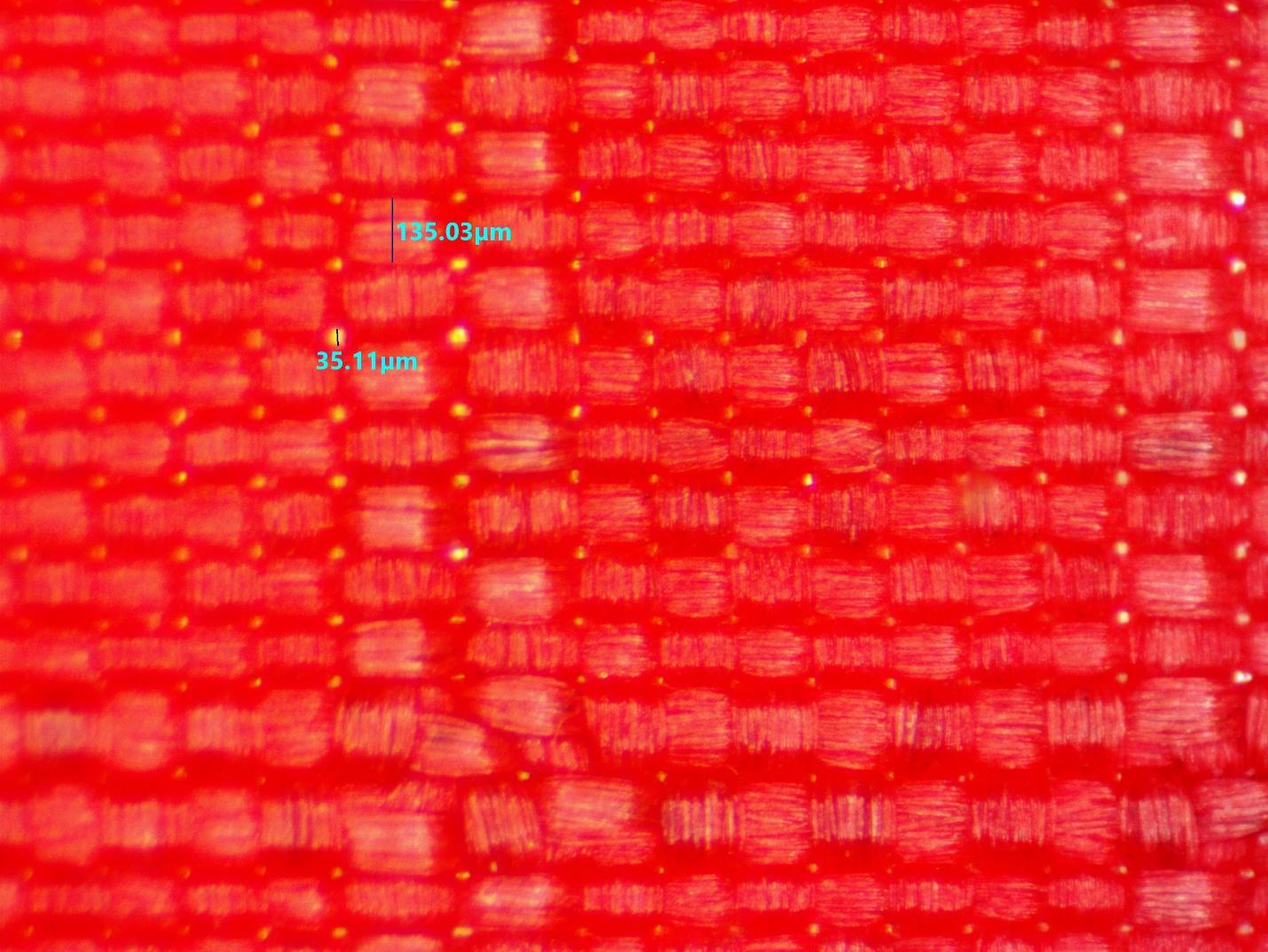
The outer shell is a very tightly woven nylon microfiber with tiny voids at the crossings of the weave. This construction will permit reasonable vapor transfer while providing an effective wind barrier. Figure 1 illustrates the construction.
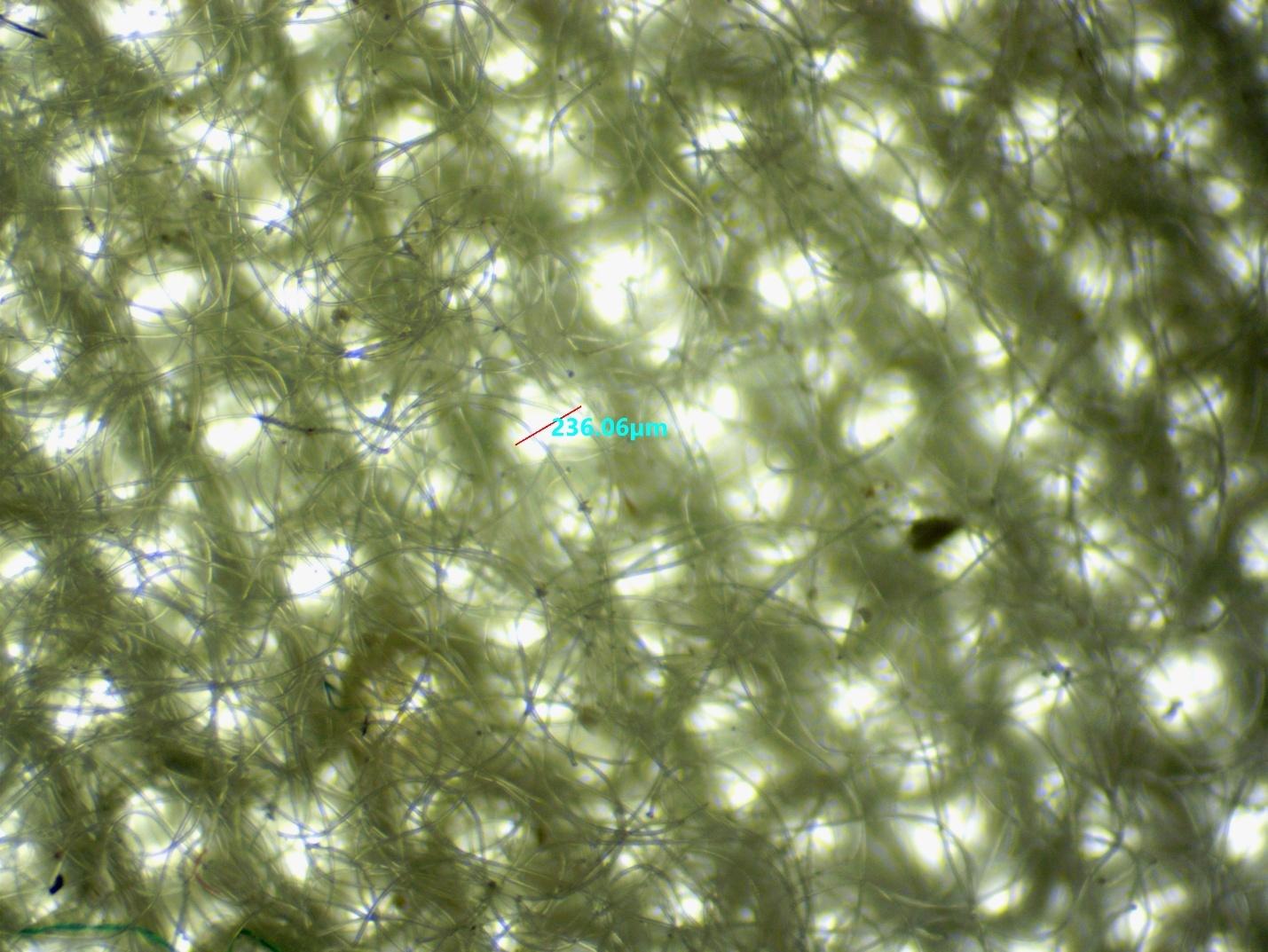
The inner layer is a polyester knit called the “Pump Liner.” The Pump Liner is a thin fabric with a very loose, airy knit that provides some warmth and minimal resistance to vapor transfer. The inner face is lightly napped, providing a little fleece. The construction is seen in Figure 2.
Both layers are treated with Nikwax DWR to provide very hydrophobic performance. The Nikwax DWR and two-layer construction are critical to the functioning of this garment.
Jacket Standard Measurements
- Model: Unknown, it is labeled as 618142
- Size: Women’s Medium
- Weight: 16.8 oz (473 g)
- Air Permeability (Two Layers): 5.6 CFM/ft2
- Hydrostatic Head (Two Layers): 210 mm H2O
- MVTR: 2720 g/m2/24 hours
According to the test results, the jacket’s performance is similar to that of many wind shells. However, owing to the pump liner, robust fabrics, and extensive feature set, it tends to be heavier and bulkier than most wind shells. It has a far lower hydrostatic head than garments typically expected to be waterproof.
What is Waterproof?
Waterproof performance is ill-defined. EN343, a European Standard for Waterproof and Breathable Protective Clothing, provides a definition. EN343 offers two classes of waterproof performance: “Intermediate” at a hydrostatic head greater than 815 mm H2O and “Highest” at a hydrostatic head greater than 1325 mm H2O.
These ratings are highly dependent on usage. If you sit in a puddle or slide down wet snow with clothing rated at 1325 mm H2O, water penetration of the garment will likely occur.
The performance of the Páramo jacket would not be considered waterproof by the EN343 definition because its hydrostatic head is far below the standard’s requirements. This begs the question, does the EN343 definition apply to a jacket with the construction and anticipated utilization of a Páramo Analogy jacket?
How Much Pressure Is Exerted on a Jacket by Falling Rain?
Hydrostatic Head (HH) testing is the primary measure of water resistance for a garment or a tent. HH testing measures the force of a water column pushing against a fabric. The HH test measures static force. The force of an increasing column of water expands the spacing between yarns until the spaces become large enough to let three drops of water pass through.
Figure 3 illustrates the extent of fabric expansion produced by the hydrostatic head test:
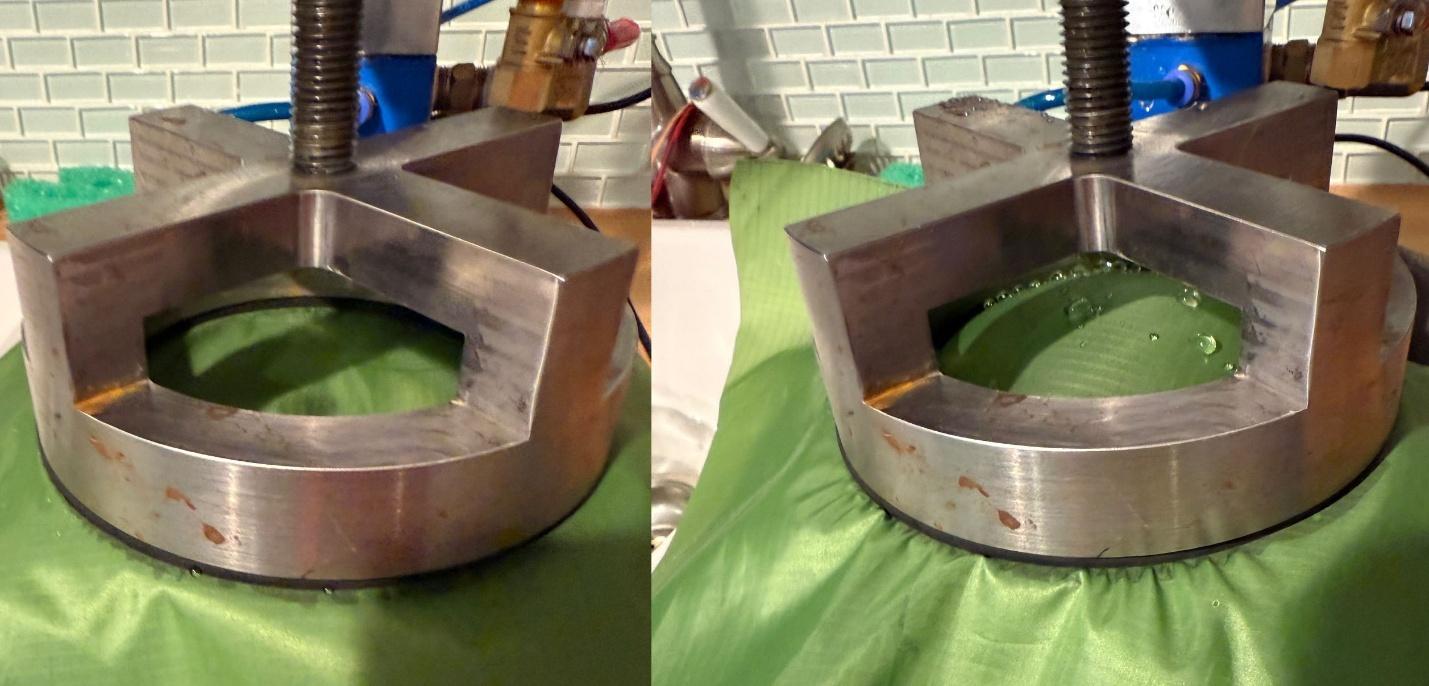
In the right image of the HH test, we see that the test fabric is greatly deformed under the test pressure. This expands the spacing between the yarns, forcing water drops through the newly enlarged spaces.
This is not what happens to a jacket in the rain since the occupant of the jacket limits the expansion of jacket fibers. It is unclear how well the hydrostatic test can mimic the forces withstood by a fabric, except to say that a higher test result means it will be harder for water to penetrate. We can estimate how much HH is required for a given pressure, such as kneeling on a tent floor pitched on wet ground, but how do we estimate how much HH is necessary to resist a raindrop?
The force of a raindrop hitting fabric is very different from kneeling in a puddle of water. A falling drop of water, 0.5mm to 5mm in diameter and traveling at a terminal velocity of 2-9 m/s (4.5-20 mph), comes to a virtually instantaneous halt when it hits the fabric surface. The drop then changes dramatically as it deforms and distributes its force over an increasingly large fabric area.
This dynamic force of a raindrop striking a garment differs greatly from the static force of a water column measured by the HH test.
In writing this article, I made a considerable effort to quantify the force of falling rain on a garment. Using ChatGPT-4o and several academic sources, I relied on an iterative process to understand the issue and provide a range of expected values. As part of this process, I developed a pressure measurement technique as part of performing a rain simulation test.
Member Exclusive
A Premium or Unlimited Membership* is required to view the rest of this article.
* A Basic Membership is required to view Member Q&A events


Discussion
Become a member to post in the forums.
I’m using a Páramo Velez jacket in winter. It’s a good warmth from 10 C to -20c. I’ve goten wet with it on a bike ride in heavy rain but mostly around the zippers.
I don’t use it much for backpacking but for cool/ cold overnighters it’s very comfortable. Works best if you stoll procduce warmth and dry it out.
I remember sitting on my pull in wet snow/ cold rain around freezing and feeling ok warm with a thick fleece under. better than pulling out the puffy and getting that wet.
in ski touring I use a Buffalo pile pertex garment which combines very well around freezing and under.
Two separat garments woul be more flexible and finding a good wind shirt and fleece, maybe Alfa, should be comparable. That’s what I use in summer. And a WPB shell.
Great work!
1. How does this jacket compare in MVTR to a Polartec layer combined with a Shakedry shell?
2. I recall a forum discussion mentioning that aged Shakedry jackets, while still repelling water on the surface, tend to develop a damp inner lining. This study made me wonder: could applying a DWR treatment to the inner surface of an aged Shakedry shell help restore its performance?
Hi ZY. Thanks for reading. I took a brief look at your first question here. I used two combinations of off-the-shelf “jackets” placed under a Shake Dry jacket. RAB made Alpha Flash. It used 120 GSM Alpha Direct. I use mine all the time around the house. The Patagonia Nano Air has gone through a number of iterations. The one I used, perhaps circa early 2020s, has Air Permeability of 41 CFM/Ft2. I don’t use it any more, since a high MVTR shell with good ventilation and an appropriate Alpha Direct layer is more versatile. Here are the results.
So, the Paramo jacket actually performs better than the “combo” tests. This result might change with an Alpha Direct 60 gsm shirt, but you raise a very good point! The MVTR comparison with other garments probably should be based on “like” layering structures. The Paramo jacket liner has air permeability of 289 CFM/Ft2. This is higher than a lot of base layers. In contrast, the Alpha Flash air permeability is 626 CFM/Ft2. So, the answer here is unclear but perhaps worth a closer look. It wouldn’t surprise me if the MVTR of the test jacket is higher than the Shake Dry. Also, bear in mind, that I have no idea how the membrane and pump liner in my jacket compare with current models. I have never seen a current model.
Regarding your second question. My experience with Shake Dry as it ages is that it develops tiny holes in the membrane and eventually permits some water penetration. I rarely had moisture accumulate on the inner surface, but I had pit zips installed on all of mine to avoid that problem. I think if you experience moisture accumulation on the interior you are sweating too much and have overwhelmed the MVTR of the material. If you coat it with DWR under those conditions, I expect vapor would condense in the jacket and eventually drip down the fabric. So, I don’t think you would accomplish much. I have put away my Shake Dry jackets. I will use them in the winter, mainly as a wind layer. However, I have replaced Shake Dry with the Fine Track Photon, for which I published a review here.
Small correction. Above, I stated that it wouldn’t surprise me if the MVTR of the test jacket is higher than that of the Shake Dry. That statement applies only to the outer shell of the test jacket. Not the combination of the two layers, which is what I tested.
Hi Stephen, outstanding article as always. Thank you for shedding light on the “lab” hydrostatic head test vs the “real world” shower test. IR imaging, wow! Hats off to you.
Do the findings of this test imply that a single-layer nylon weave with gaps around the same size (~35nm), paired with a hydrophobic mesh/loft (like alpha direct as you commented above) is a sufficient “cool rain” clothing system? Seems like the pump liner might as well be standalone, since both layers are treated with Nikwax and meant to be hydrophobic? A base + octa/alpha + single-layer nylon weave?
Separately, I recently purchased a discounted Rab Phantom CNDR and it’s a 7d, 2.5 layer Pertex. Though I still lean toward packing my heavier old north face rain jacket / Frogg Togg poncho due to the mechanical ventilation. Hard to live without that.
Hi Max: Thanks for reading and your kind words. First, the shell is polyester, not nylon. My mistake. Second, to your second paragraph, I think that is right. Third, I looked up the jacket. It has very poor MVTR, assuming they are using the JIS L 1099 b1 test method. You are definitely going to want mechanical ventilation with that jacket. I wonder why so many brands, if they list test numbers, list 20K HH and 20K MVTR? What are the odds they will both come out the same during testing? Vanishing, I would say. Now, 20K for HH is great (although possibly unnecessary). On the other hand, 20K MVTR is miserable. But kudos to Rab for listing something. You will have a pretty good idea of what you are buying.
Thank you for the detailed and insightful response! It’s very helpful.
Stephen, I think you and I talked about this years ago, not sure, but given that the inner pump liner of the Paramo system is a constraint on usability of the system because it is provides too much insulation for most rainy conditions in the US, I puzzled long on how to replicate the function of the pump liner with less insulation.
One idea that I had was layering a Finetrack elemental layer over a thin base layer to replace the pump liner. The hydrophobic elemental layer would provide the hydrophobicity, and the standard thin baselayer (or Brynje) would provide a gap between that layer and the skin. I think a thin base, already assumed worn, would not be made appreciably warmer by the additino of the super thin Elemental layer mesh fabric, but would provide much the same hydrophobic function of shedding any moisture that got through. But I’ve never extensively tested this combo.
I did do quite a bit of testing of “roll your own” Paramo using various windshirts paired with either a furry fleece that I treated with Nikwax, or with a bespoke shirt made of Paramo Pump Liner fabric, or with Paramo’s Enduro Fleece stand-alone product.
The windshirt chosen was the critical piece, and DWR failure usually resulted in water ingress, as did typical windhirt vulnerabilities – cuffs not sealable, hoods don’t shed water that great, etc. But otherwise, these roll your own combos work pretty well, and I did some long hikes in steady rain using these with only minimal ingress. In general, an ultralight full-feature windshirt + pump liner shirt came in about half as heavy as the lighter Paramo one-piece, off the rack options. But none of these combos worked as well as the Paramo one-piece jacket systems, which are fairly refined for this function, although sadly too darn heavy for ultralight backpacking unless it is in sustained, cold rain, which is not as common in the States as in UK.
I think I must have forgotten to check back on this thread.
While I trust the findings you’re referring to, finding actual garments with these wpb membranes seems a lot harder. But you make a point, since finding Paramo has proven to not be so easy either :)
I looked at a few different companies making Analogy products, and while I no longer remember my reasoning, I kept coming back to Paramo as my preferred route.
And so it went. I while back I needed to have a package shipped from the US, so as I had to pay for shipping and import processing anyways, I did the perfectly rational thing and ordered clothes from a UK based brand, produced in South American, from their North American store. It’s not unlikely my Paramo’s have crossed the Atlantic 3 times before they were ever used.
Sizing was maybe not quite as expected. I ordered a Velez jacket in Medium and Cascada II pants in Small-tall.
I went a little back and forth before settling on medium for the jacket. I have quite a few jackets that are sized for summer use, i.e. not a lot of excess room for layering.
With the Analogy clothes being quite warm, I moved away from my initial plan to use it as a commute jacket and rather a cold season outdoor jacket. It also made it less likely that I’d end up with a jacket that I couldn’t use due to short size.
Judging by how generous the arm- and body length proved to be on the Medium Velez, I’m quite sure a Velez in small would have worked fine for my initial use case.
The pants were a bit strange. I don’t think I’ll get as much use from them as I had hoped.
Maybe if I had bought them in medium-regular, they’d be more suited for winter use together with the jacket, but even in small the legs are annoyingly wide, so I’m not sure how that would have panned out.
Both the pants and jacket are VERY static. I’ve never had any outdoor clothing that feels so electrically charged (surface tension) and that attracts so much to other surfaces. Maybe surface tension is part of what makes it resist water?
Thanks for your recommendation Tjaard.
I must have forgot to check back here, and in the meantime I went ahead and ordered a Paramo Velez. Although I changed direction somewhat and decided to test it in a different type of use than I initially intended. I actually needed a non WPB winter jacket with a roomier fit to allow for more layering, so it felt like a safer starting point for a jacket known to be inherently warm and a brand known to be on the roomy side.
On the bright side, it seems like the rumors of Paramo being for short people were quite exaggerated, at least in case of the Velez. The arm length is generous and I believe I’d have no issues using a Velez in small, if I’d ever want one more optimized for my original use case. If it comes to that, I’ll make sure to consider Cioch Direct as well.
“the inner pump liner of the Paramo system is a constraint on usability of the system because it is provides too much insulation for most rainy conditions in the US”
that seems like a major factor in “waterproofness”
it’s not the MVTR or whatever, it’s that you can get too much insulation so you start sweating excessively. Then, no matter how breathable the jacket is, it will become overwhelmed. If you sweat a lot, you’ll get wet even if wearing nothing which is the most breathable.
So, a strategy would be to have your base layer be the pump liner and just the paramo outer layer as your jacket
I’m not going to look back and see that I’ve said the same thing before, because that would be embarrassing : )
Jerry,
One benefit of Paramo is that the liner makes it comfortable against the skin. So I impinge if you get the pump liner separate (which they did sell at one time) you could wear that as base layers , with a windshell on top.
Become a member to post in the forums.