



Introduction
This article features lightweight down parkas (usually, full-zip jackets with hoods, a longer hem, and box-baffled construction) appropriate for winter backpacking, snowshoeing, backcountry skiing, mountaineering, and other cold-temperature activities.
What is the best down parka? The answer: it depends, of course.
I researched over 50 models and selected 12 to use over two years of outdoor activities that including lightweight backpacking, alpine climbing, mountaineering, backcountry skiing, and multi-sport expeditions.
The objective of this article is to give you some education about down parka design and performance that will help guide your decision-making process when selecting a winter-worthy parka.
Summary of Products Featured in this Review
Patagonia Grade VII Down Parka – $900/24.1 oz
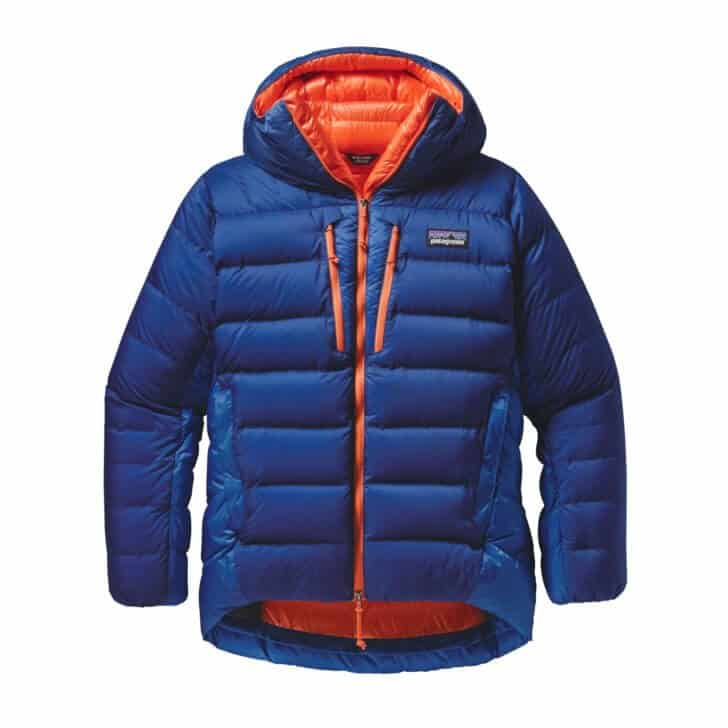
The Patagonia Grade VII Down Parka is the highest performing parka in this review. Its unique for its attention to detail, exhaustive feature set, durability, baffle design, and unmatched warmth-to-weight ratio. This parka earns our Highly Recommended rating for expedition use in extreme cold.
Buy Now at Patagonia or Backcountry
Nunatak Kobuk – $575/19.8 oz

Known for its customizability, the Nunatak Kobuk has a high warmth-to-weight ratio that will appeal to those who want to save weight and don’t need a parka as warm the others in this review. This parka earns our Recommended rating for mild winter use.
- Learn more at Nunatak USA.
Patagonia Fitz Roy Down Parka – $450/21.6 oz
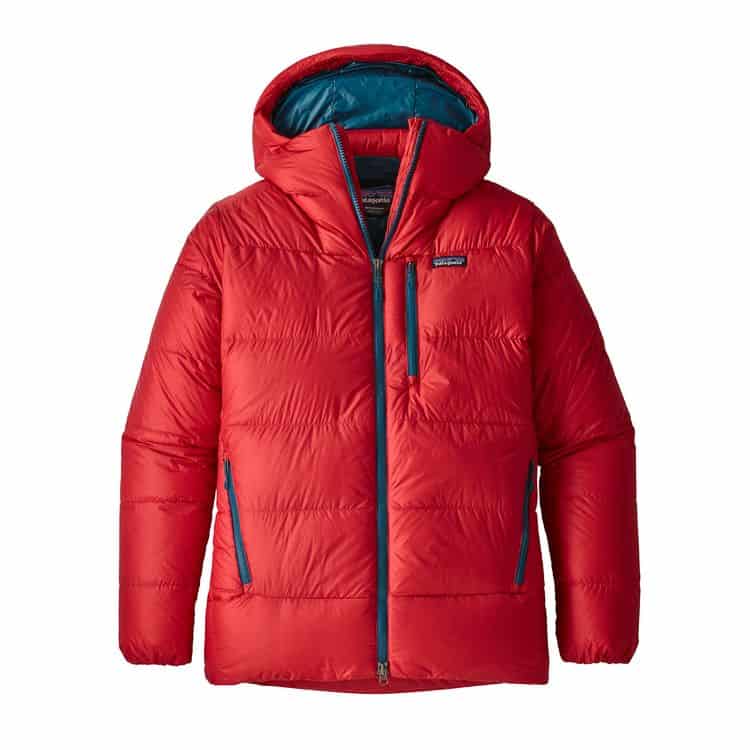

Probably the best all-purpose parka in this review, the Patagonia Fitz Roy Down Parka is warm for its weight, feature-rich, and a great value at this price. This is the parka I wear most often. This parka earns our Recommended rating for all-around versatility.
Montbell Frost Line – $289/20.4 oz
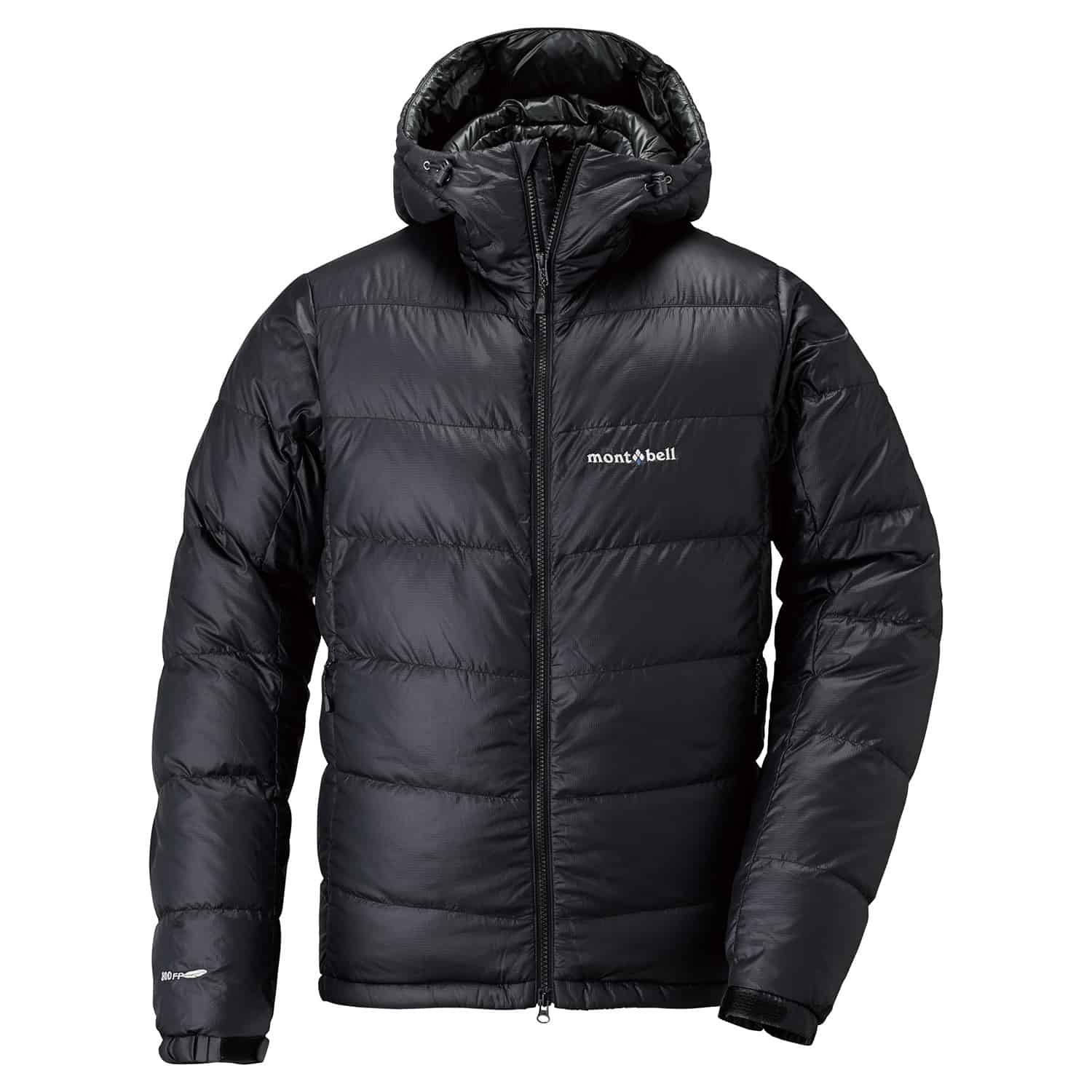
The Montbell Frost Line is my recommendation if you’re on a budget. It’s not the warmest parka at this weight, but it’s by far the best value here. This parka earns our Recommended rating for its value.
- Learn more at Montbell USA
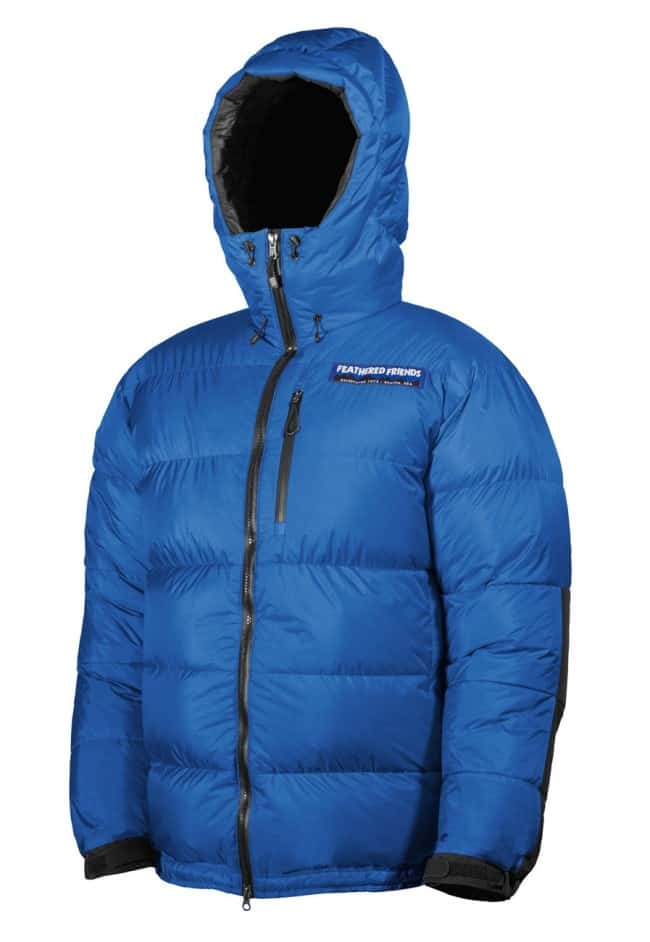
Feathered Friends Hooded Helios Jacket – $359/17.1 oz
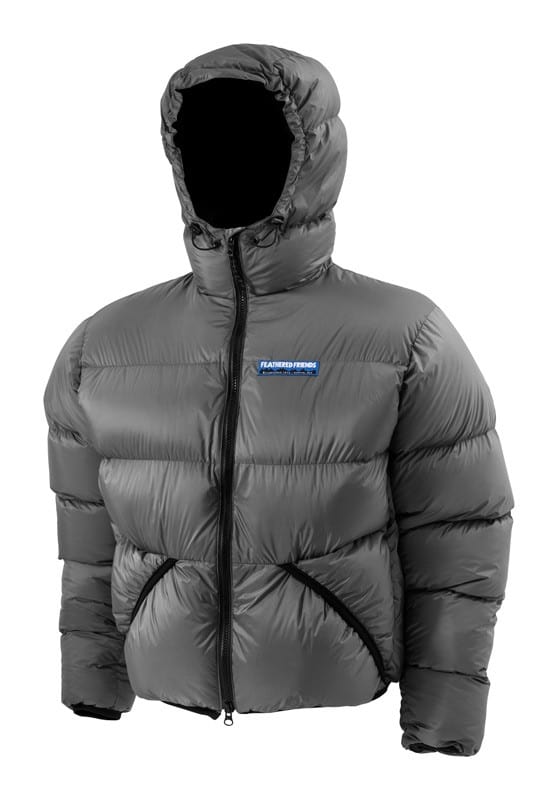
The Feathered Friends Hooded Helios Jacket is probably the warmest down parka on the market that uses sewn-through baffles. Warmth is going to be very difficult to beat at this weight, but the parka has a short length, so it’s best for users with shorter torsos. This parka earns our Recommended rating for winter backpackers with shorter torso lengths.
Feathered Friends Khumbu Down Parka – $599/34.6 oz
If absolute warmth, a voluminous expedition cut, and durable waterproof fabrics are required for you to stay comfortable while stationary for long periods of time in frigid conditions (mountain guides and people who work outside come to mind), then the Feathered Friends Khumbu may be for you. This parka earns our Recommended rating for professionals who work outside in extremely cold conditions.
Other Jackets Featured in this Review
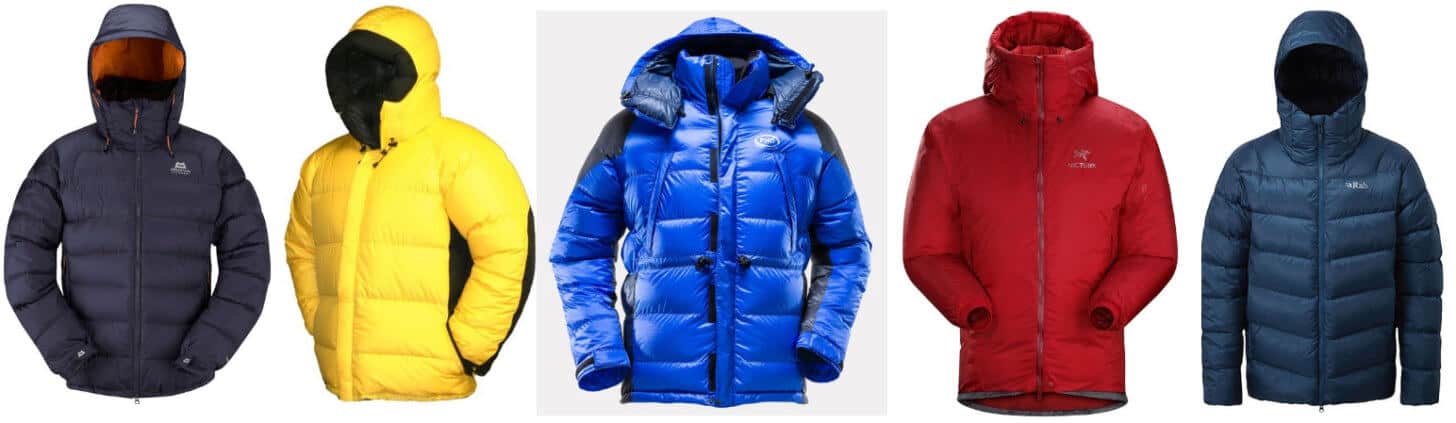
- Mountain Equipment Lightline – $250/26.0 oz – the lowest price option in this review.
- Western Mountaineering Snojack – $825/28.8 oz – Similar to the Feathered Friends Khumbu, but shorter.
- PHD Hispar K – $875/22.6 oz – Very high-quality materials from a UK-based premium manufacturer.
- Arc’teryx Firebee AR – $950/23.4 oz – Impeccable attention to detail and construction quality, and the most durable parka in this review.
- Rab Neutrino Pro – $375/21.1 oz – Sewn-through like the Feathered Friends Helios, but with a longer cut and more durable fabric.
- Goosefeet Custom – $560/21.2 oz – Smaller cottage brand manufacturer offers custom fit and feature set (build to order), high-quality ultralight materials.
Review Context
Down Parka Definition
Member Exclusive
A Premium or Unlimited Membership* is required to view the rest of this article.
* A Basic Membership is required to view Member Q&A events


Discussion
Become a member to post in the forums.
Finally, my big question: Can anyone confirm whether the Fitz Roy’s arms are sewn through, as they appeared to Winston W above, or box baffled???
(I’ve heard the sleeves have as much loft as the chest. If so they’d probably usually be warm enough even if sewn through. But if sewn through, then I’d expect the jacket to be less warm versus some of the other box baffle jackets than the fill weight and fill power imply. I understand even the Frost Line has box baffle sleeves.)
“Hi Jean,
I checked the Fall 2017 version (the year we had the orange color) and this version has 331 g of down, the Fall 2018 version was listed as 299 grams and the Fall 2019 version was listed as 331 g. There weren’t any revisions listed for the Fall 2018 version, so I checked with someone in my Product Team on this just in case there was an error on my end. They confirmed it was a typo and the Fall 2018 version does indeed have 331 g of down – not 299 g. We appreciate you bringing this to our attention, so that we can correct our page with the correct down weight.
Christine
Patagonia Customer Service “
Why manufacturers don’t list down-fill weight is beyond me. Rab and Feathered Friends always come through and provide this information without customers having to send needless emails. Sorry, pet-peeve of mine, haha. Thanks for sharing!
I may be able to answer my question about how the Patagonia Grade VII can have 3.7 oz more fill than the Patagonia Fitz Roy and multiple weight-adding features, dimensions, etc. and still weigh only 2.5 oz more: It seems that in addition to the Grade VII’s interior and two exterior fabrics mentioned in the article, there is a third exterior fabric which is lighter than the exterior fabric of the Fitz Roy. I’m still not convinced this is enough to explain it though. Maybe … .
After reading this article, I had high expectations of the Fitz Roy. And having now taken delivery of one, it has met or exceeded my expectations is almost all ways – which makes the exception even more surprising.
The exception is the hood. And while they got the tough parts right (it’s well baffled and they didn’t skimp on fill, resulting in a lot of loft everywhere), they missed the easy one – the face opening is simply too large. It does come down nice and low over my forehead (an area that I’ve found loses a lot of heat) without restricting my vision. But it does not come up over my mouth, no matter how I adjust it. Indeed, unless I lean my head down, it barely reaches my chin.
Furthermore, the opening is too wide, leaving the side of the face more exposed than necessary. And the more you tighten the hood (necessary to bring it down low over the forehead), the wider it gets. This is the result of the strange single adjustment mechanism. (There is just one draw cord at the back of the hood.) Though if you pull the sides of the hood forward after tightening it, it helps a bit.
Compared to my only other big, warm down parka, an ancient Marmot Warm II, it leaves about twice as much of my face uncovered. I am surprised by this weakness, because I would expect it’s something Patagonia would prioritize avoiding. For leaving half the face uncovered must surely lose a lot more heat than, for instance, a poorly designed shoulder baffle, or zipper baffle, etc. We all know a huge amount of heat is lost by an uninsulated head. I don’t know how much is lost by the part that does the thinking, which this hood covers, versus the part that does the talking, breathing, and seeing, which this hood doesn’t. Maybe most. But I do know that when cold sets in, just battening down the hatches over my face when wearing a Gore-Tax parka with a very good hood makes a big difference. And when it’s cold and windy, I want my face covered as much as it can be.
I guess the reason it’s not so good is that they didn’t want the collar to be too high when not wearing the hood. I would have hoped that they would have simply gone with a higher collar anyway, as I now see the Grade VII has.
But there is an even better solution. Something that, unfortunately, has almost disappeared from technical clothing: I’ll call it a wrap-around hood. In other words, a hood with a face closure that is separate from the neck closure. That’s how my Marmot jacket works – the big bottom hood flap on the wearer’s left closes with Velcro over the flap on the right. This makes it easy to adjust the extent to which it closes, and whether the hood accommodates a helmet or fits tightly on a head, even with mitts on. More importantly, it facilitates an opening that is wide enough for your eyes without being too long and not covering your mouth or forehead. It also seems to help with making the hood turn with the head (which the Fitz Roy’s hood doesn’t). And the neck closure being separate means it can be tighter.
Of course, such a hood isn’t ultralight. Except that actually, it is. Because nothing is heavier than a jacket that requires an additional piece of gear to keep warm. Indeed, I’ve now twice seen promotional materials for down jackets showing wearers also wearing a separate neck/face thingy to cover what the jackets don’t. If everything we wear other than base layers should have a good warmth to weight ratio and allow easy adaptability to conditions, is there anything worse than a neck gator/thingy?
The Fitz Roy is not alone in such weaknesses. I’ve recently tried a lot of lighter down jackets and all but one had hoods that were even worse. The exception was the Montane Anti-Freeze, which was quite acceptable. Maybe as good as my Marmot down jacket – I can’t clearly recall. Which does show that a wrap-around hood is not 100% essential. On the other hand though, while my Marmot down jacket has a good hood, it is hardly best in class (it also doesn’t turn with the wearer’s head). Neither it nor the Montane hood are anywhere near as good as the wrap-around hood on my even more ancient Marmot Powder Jacket (a Gore-Tex parka). I’ve wanted to replace it with a newer Gore-Tex or similar jacket for skiing for decades now, but I simply can’t find one with a hood that is nearly as good.)
Other reviews I’ve read also suggest that the Montane Frost Line’s hood may be good at both covering most of the face (it certainly looked that way in a photo) and turning with the user’s head.
Back to the Fitz Roy. I am also a bit concerned about how helmet compatible the hood is. I haven’t had a chance to try it, but the hood does not look huge enough to fit a big helmet, like a modern ski helmet (and I can imagine that having just a single adjustment may have necessitated limiting the size). As noted, a wrap around hood also helps with this. With a bit helmet, you wrap it a little. With a bare head, you wrap it a lot.
One neat feature is the baffle at the back of the neck to seal the cold out. I haven’t tested this in a cold wind yet (kind of hard, this time of year), but it feels like it should work. (This does solve one of the problems with the neck closure and the face closure being the same – a wide neck oppening.) However, it also feels like it comes with a disadvantage – when you unzip and want to vent heat, your back won’t vent as much.
Finally, I don’t much like the position of the inside pockets. Seems to me that if a jacket has hand warmer pockets, then if you want to add more pockets, you should put them at the chest level, not right behind the hand warmer pockets at belly level. If you put them there, as Patagonia has done, you have pockets on top of pockets. So if you need to put things in your pockets (which is why you have them after all), you get swollen lumps of stuff over and around your belly, which is neither comfortable nor attractive. And it’s worse still if you put your hands in your hand warmer pockets only to clod into whatever lumps lie below.
So I’ll return it then? Well … other than the hood and the interior pocket position, I really, really like the Fitz Roy. I like the fit. I like the fabric. I love the loft, and the baffles do a great job of avoiding cold spots. It compresses amazingly. And looks great too. I would prefer something designed for thinner people. (For which reason I went a size down, and I think it was the right choice, though I do wish the arms were one or two centimeters longer.) I can live with the pockets, so the only real reason to return it would be the hood.
The logical alternative for me is the Frost Line. I had planned to buy one before reading here that it is so much shorter and less warm. But if I don’t need to go a size down (TBD), will I really lose more heat from my butt with the Frost Line than from my face with the Fitz Roy? If not, then while it does have less down, I can probably live with that, and it has the advantages of being lighter, having sturdier fabric, better interior pockets (probably), and adjustable cuffs. And if the hood does cover my mouth, I may appreciate the micro-fleece I understand the Frost Line has there.
But I really like the Fitz Roy … .
P.S. I can answer a question from one of my recent posts. The Fitz Roy’s arms have box baffles, not sewn through construction. I’m sure about that in the upper arms. I didn’t inspect the lower arms as closely, but they don’t feel different. Furthermore, contrary to what I had read elsewhere, it does not seem that the Fitz Roy has as much loft in the arms as in the chest, which is good.
Ah, but have you tried eating a sloppy stew when the front of the hood tries to come over your mouth? Definitely Yuk. Have a separate chin/mouth cover.
Cheers
Now how were you able to get that quote of my text at the beginning of your post??? I am a regular user of other forums, so of course I regularly quote other’s text in just the same way. But I just can’t figure out how to do it here. :-(
Anyway, no, I’ve never tried that, and I never will. I will never need the maximum warmth of my down parka in a situation where I am eating anything other than dry snacks. Of course, that’s just me, and I can imagine that sometimes others will, even if not often. But then you can simply zip your hood open a bit more. (Or better yet, unwrap it a bit.) If you might need to eat stew in the coldest conditions you might encounter, then you need a parka that is warm enough in such conditions when the hood is not 100% shut. Which has the added bonus that when you are not eating, you will have some extra warmth.
No need for a separate chin/mouth cover. No need for constantly having to remove your hood/beanie/helmet/headlamp to yank it off every time you start overheating. No need to do the whole process in reverse every time you cool down. No need for having a big lump stuffed in your pocket when you don’t need it (or having to take your pack off to take it away, and having to set aside valuable quick-access space in your pack for it). No need for the snow and ice often retained by the fabrics typically used for such things, like fleece, when they are an outer layer. No need for something that is either too tight for your mouth, or too loose for your neck, or both. And no need for all the extra weight.
Yes, I used to use such things. They were always the first and often only part of my gear to get sweaty. And after going back and forth, it eventually became 100% clear that when I had a good hood, they were never part of the optimal attire for me, in any condition.
Whereas a hood that can cover the mouth does not mean a hood that will cover the mouth when you don’t want it to. You can always unzip/unwrap a bit. So a good hood will usually help, and never hurt.
B-Quote, in the bar above the Edit region
Happens all the time when XC ski touring. Well, every night, anyhow.

Trouble is, in my experience, when the hood is not 100% shut the corners still flap around and can get dirty when I am eating, specially if the corners come up too far. I have tried tucking them inside to keep them out of the way, but the corners don’t stay there.
Rule #1 for traveling in sub-zero conditions: don’t get sweaty!
There is (usually) a transition from working hard while traveling to sitting in the tent in the evening. Our down gear ONLY comes out when we are inside the tent and sheltered. It does not get snow on it.
But, each to his own, especially as people travel in a wide range of different conditions. What suits one may not suit another.
Cheers
Strange, I can’t even find anything that says edit, much less B-quote. But if I post this post, at least the edit button will appear. Let’s see what happens then … .
Nope, no B-quote. Maybe it doesn’t work with certain browsers, like Firefox?
This is what I get with W7 and Firefox 75.0

Green line points to the EDIT option on YOUR postings.
Red line points to B-QUOTE in posting screen.
Cheers
Thanks for the quick and helpful response! For whatever reason, that’s not what I’m seeing. And I started to write more details, but maybe it would become too much of a tangent to this thread, so I sent you a message instead. Thanks again!
Anyway, back to parkas and hoods.
OK, it starts to make sense to me now – I see you have solved the stew issue by not wearing any hood and wearing a hat instead. I assume though that if it’s cold enough to need the hat in the tent, then if you need to go out, e.g. to pee, it’s good to pull up a hood. And surely it’s best to have a hood that can give you as much warmth as possible from a given amount of down (especially when it’s windy) by enabling you to make the face opening as small as possible, no?
And then, here’s an opportunity for an entrepreneurial parka maker, why not design the hood so that the flaps can be held securely out of the way, so you can have your cake (or stew?) and eat it too? One way would be little Velcro tabs on the outside of the flaps that connect somewhere further back on the hood or the shoulder.
Or you could just use what I called a wrap-around hood. I just tried my Marmot down parka and it is quite easy to wrap the flaps securely under the chin. And while it does require tightening up the face opening with the draw cords, this would not be necessary if the velco were a bit wider, or if instead of a single strip on each of the right and left flaps, there were multiple parallel strips of horizontal velcro with some space between them, like on my old Marmot Gore-Tex shell. You could safely eat with the face opening tight or wide open. Indeed, with my Marmot Gore-Tex shell, it is very easy to switch between mouth perfectly covered and hood perfectly protected from stew, all while the hood perfectly rotates with the head.
In any case, I’m with you about to each his own. So while I wish the Fitz Roy’s hood was more like the Grade VII’s, which the author praises for covering more of the mouth, and even if I think most people would agree with me, I am simultaneously glad that not all parkas have the same hood.
Except that in some ways they do. Which too often means to each someone else’s. I’m again thinking about the disappearance of the wrap-around hood – and maybe 10 other bits of outdoor gear I’ve wanted to buy but which seemingly no one makes (anymore). Someone in the outdoor gear industry is not getting one of the most fundamental rules of business: You don’t make money by making the same thing as everyone else. Which is ironic, because I first heard this rule in an interview of Yvon Choinard, the founder of Patagonia.
What is to be done? Not much, I suppose. But for readers of this thread who don’t need a hood that can’t cover the mouth – and I’m sure that’s not too small a portion of us – when you’re trying on parkas (or hard shells, or whatever) in the shop, pay attention to how well the hood covers your face! (And also to whether it fits securely and turns with your head with and without a helmet.) And if it doesn’t cover your face well, tell the retailer “hey, this thing is no good”, and maybe the manufacturer will eventually get the message. (Ideally, you might also suggest that what they really need is a hood that wraps around the lower face. :-)
@Andrew
>> What is to be done?
Well, my wife and I don’t buy much gear these days. We get sent some for review of course, but otherwise, I make our own (MYOG). I draw the line at trying to make joggers and Ti pots: too hard.
>> You don’t make money by making the same thing as everyone else.
Good point. Finding an empty niche can be difficult of course.
Cheers
Testing …
And testing again …
(Sorry everyone, trying to figure out this B-Post thing, and screen shots of new posts were requested (and it doesn’t seem possible for me to delete them).)
Forwarding to Web Support.
Cheers
Thank you Nick.
Cheers
Let’s try again:
That looks better!
Thanks from me too!!
Become a member to post in the forums.