

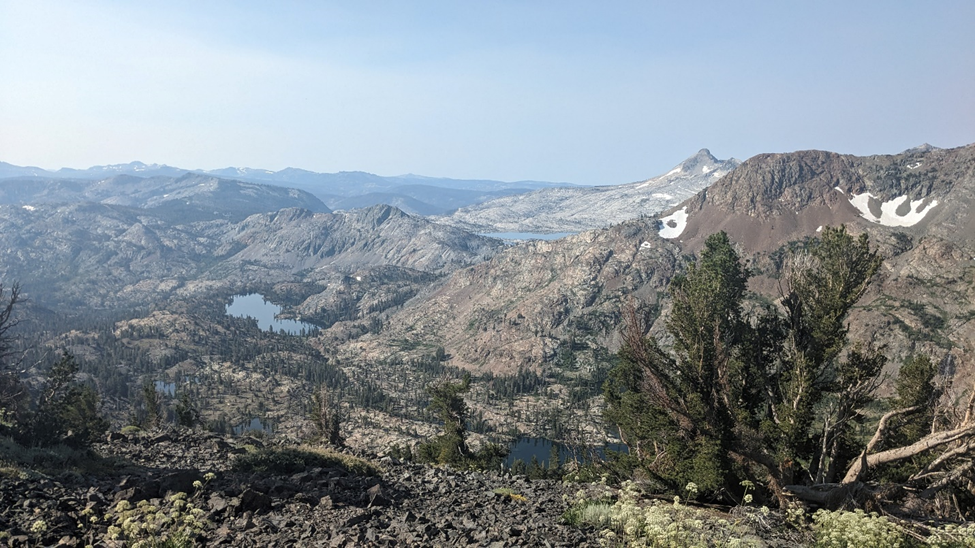

The only forests are the ones that have burned, the ones that are burning, and the ones that haven’t burned yet. – Far Out Guides Comment, Tahoe Rim Trail
Introduction
This fire starts in a canyon, ten miles southwest of Donner Pass, on a day with high winds and even higher temperatures. There is no rain in the forecast — there rarely is. Ground personnel say the likely cause is an abandoned campfire, discovered by a hiker. The rugged terrain makes the blaze near impossible to put out, even with air and ground resources deployed. Thirteen teen backpackers are evacuated from the forest, and the weekend brings storms which are full of lightning and no rain.
And then the fire stalls. The firefighters manage to keep it in the canyon. I refresh Inciweb each day and watch the containment percentage creep up. The news sources reassure Independence Day travelers that the Royal Fire is not a threat to Tahoe City, despite describing the area around it as a tinderbox. Please, they seem to say. Please come and enjoy your vacation even as the world is burning.
Our First Day Out
On our first day out, I encounter the largest juniper I have ever seen. I run my hands up and down the trunk, the wood like hardened, ancient sinew underneath my fingers. I cannot imagine how long this tree has lived on this ridgeline, but by its girth — the trunk is large enough that it would take several people holding hands to encircle it — I would estimate hundreds, if not thousands, of years.
Behind me Big Mama Tahoe, as Sundae and I have taken to calling the lake, glistens in the distance. The deep blue waters look frigid, and even though there is barely any snow on the surrounding ridgelines, the landscape has a glacial feel, as if we are walking on the shores of a polar sea. It is the first day of our thruhike on the Tahoe Rim Trail (TRT), a 165 mile circumnavigational journey that will take us around North America’s largest alpine lake. The water seems like a gift. So do the small whorled leaves that crown the juniper, so high above me. I live in the Sonoran Desert, a place of needles, and a landscape shaped by drying winds. The mountains and ridgelines here and the fact that you can look at all that water, makes this place seem soft, welcoming, and watery in comparison. Even though I know how dry it is. The Royal Fire was a warning that this journey might not have been. I still cannot believe that we are here.
The first days come with all of the physical reminders that we haven’t backpacked in some time. The altitude tugs at our lungs. We can feel our packs shifting into place along our hipbones, as our gaits adjust to the weight. I cannot remember how big my tent footprint is, so I often select a site, get halfway set up, and have to move and repitch.
Campsite selection is tricky. The ground is often rocky and the nights bring wind. And then there are the trees.
Sundae, my hiking companion, is a hammocker at heart. Though she sleeps in a tent on our high altitude trips, her hammocker’s intuition, as I call it, hasn’t left her. Every night she scrutinizes our campsites, unhappy about the large number of standing dead trees, their dehydrated branches and leaves the same rust red as dried blood. She paces out how far a tree is likely to reach if it falls, and then we do a series of calculations together to see if we can sleep there without a risk of being crushed. Sometimes there is. Sometimes there isn’t. On nights there isn’t, I go to sleep wondering if there is a patron saint of tree branches, who can hold the forest upright for a little while longer. The sunrise the next day feels like more of a blessing than usual.
“I don’t understand how anyone would mark this as a safe campsite,” Sundae says as we pack up. “Aren’t people paying attention?”
Though we never camp in designated burn areas, there are so many standing dead trees along the trail that it is nearly impossible to avoid camping near one. Oftentimes we have to just settle for no widowmakers, but this caveat would do nothing in case of a lightning strike. Sundae is from Florida and is terrified of lightning. I am from Colorado and my relationship with fire is a more grim, if practical one. I am used to places I know burning.

Member Exclusive
A Premium or Unlimited Membership* is required to view the rest of this article.
* A Basic Membership is required to view Member Q&A events


Discussion
Become a member to post in the forums.
here’s one review of Koonin’s book among many by reputable people in reputable publications. this took all of two minutes to find.
https://www.scientificamerican.com/article/a-new-book-manages-to-get-climate-science-badly-wrong/
I suppose Koonin and his supporters will claim this merely proves that “the elite” have it in for global warming deniers. But any contrarian could claim the same thing, and often does, when consensus science disagrees with them and shows how their analysis is wrong.
in the end, I trust my own eyes. Lyell glacier was the largest glacier in the Sierra and had been when I began backpacking. There are two photos at the head of this article. it’s exactly what i’ve seen. And everyone knows this process has continued worldwide.
https://story.californiasunday.com/lyell-glacier-yosemite/
Switzerland, today and 10 – 20 years ago.

(I cannot remember the source – sorry.)
Cheers
I’ve read koonin’s book. And that review of koonin’s book.
His conclusion at the end is pretty good i think. He says that global warming is happening, but any changes we’ve seen so far are subtle. Like, it’s difficult to see any changes in hurricanes because of global warming. Or droughts. Or sea level has only risen an insignificant amount…
He didn’t mention the arctic though. As I remember. Thats where there is the most change due to climate change. Maybe he doesn’t mention this because it contradicts his argument.
He says increasing co2 won’t make any difference because all the co2 is already blocked. Its like a window that’s painted black won’t let and less light through it if you put more black paint on it. Except if you put more co2 in the atmosphere, the IR will be absorbed at a lower altitude, so it’ll get warmer lower in the atmosphere, which will probably make a bigger change to the climate.
Towards the end of his book, koonin says that he acknowledges global warming is happening, but we don’t know if it’s going to be that bad. Therefore, we should do more research to figure this out, and in the mean time, we should at least make easy changes.
I kind of agree with that but I think I would consider more things easy enough we should do. Solar and wind is cheaper than fossil fuels so we should definitely max out on those, for example.
I kind of disagree with koonins concept that you should only do things when you’re sure this is a crisis. Just the opposite, if you’re not sure, you should take more action.
We only have limited resources so we do the most important things first. And there are a lot of other problems besides global warming we also have to work on.
there are a lot of other problems besides global warming we also have to work on.
Like maybe how to reduce Musk’s IRS bill to zero?
Cheers
Hi Jerry Adams,
Thank you for your very thoughtful views on the book “Unsettled” by Koonin. All the best.
I interpret that as you disagree with me : )
Become a member to post in the forums.