


Introduction
There are several different sorts of gas canisters on the market: in the traditional walking/camping area, we have screw-thread, Campingaz, and Powermax (discontinued). In the hardware store or BBQ area, we have cheap spray-pack cans, which hold about the same amount of fuel (220 g) as a mid-sized screw-thread canister (230 g). And we also have various refill cans used for refilling cigarette lighters and so on; they usually come with a whole range of little plastic adapters in the cap. Most of the camping style canisters are expensive: close to $8 for a 230 g of butane/propane, at least here in Australia. But I can buy four of the spray cans, each holding 220 g (~400 mL) of “butane” for just $8 total at the local hardware store. That is so much cheaper!
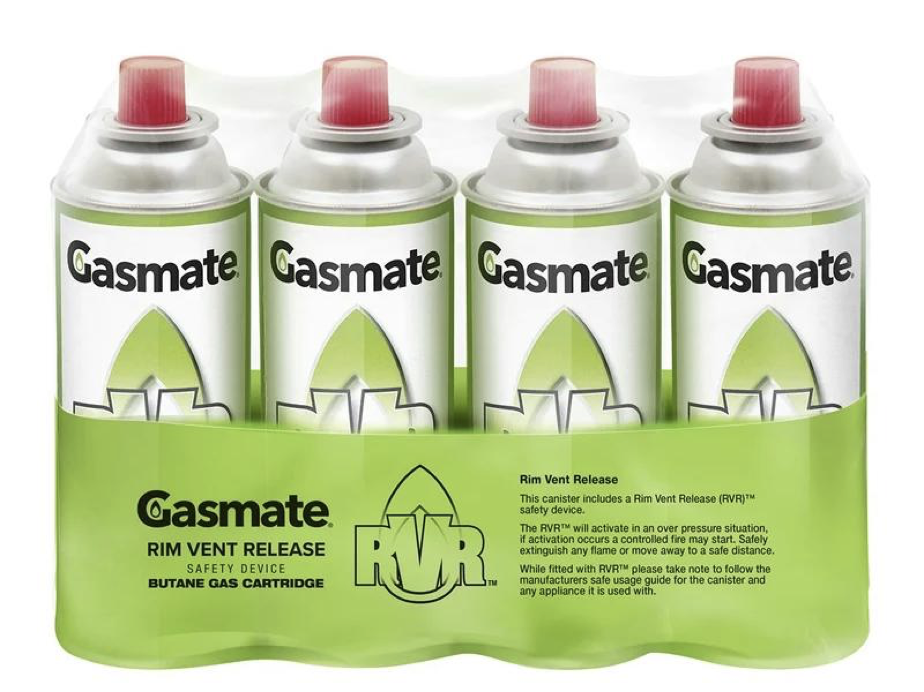
The “butane” in these spray cans is unspecified, but it is most likely a mix of n-butane (boiling point ~32 F / 0 C) and iso-butane (boiling point 11 F / -12 C), possibly roughly in equal parts. It is doubtful whether the vendors even know what is in the cans with any accuracy. To be sure, that is not good enough for winter use in the snow, but indeed it is usable in 3-season conditions with the ambient temperature above 40 F / 5 C?
Granted, propane bought in any decent-sized container (say 5 kg and up) is even cheaper than the ~$8/kg for the butane in these cans, but just maybe the further cost savings are not nearly as significant. Added to this is the worry about putting straight propane in a canister rated only for a 30%/70% mix: if it gets warm, the canister might be approaching its burst pressure. You just don’t know in advance, and if it goes bang, then it is too late.
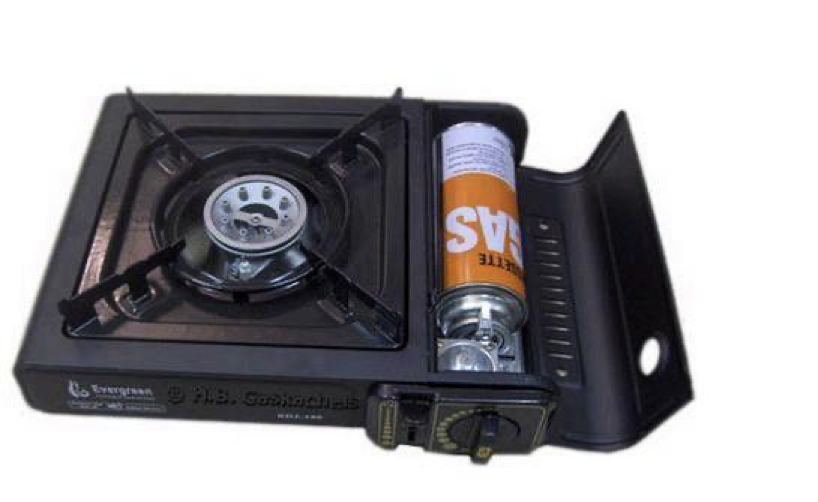
These butane cans have a special fitting designed for little table-top stoves, sometimes called “wok stoves”. Unfortunately, the fitting is not directly compatible with our little canister stoves.

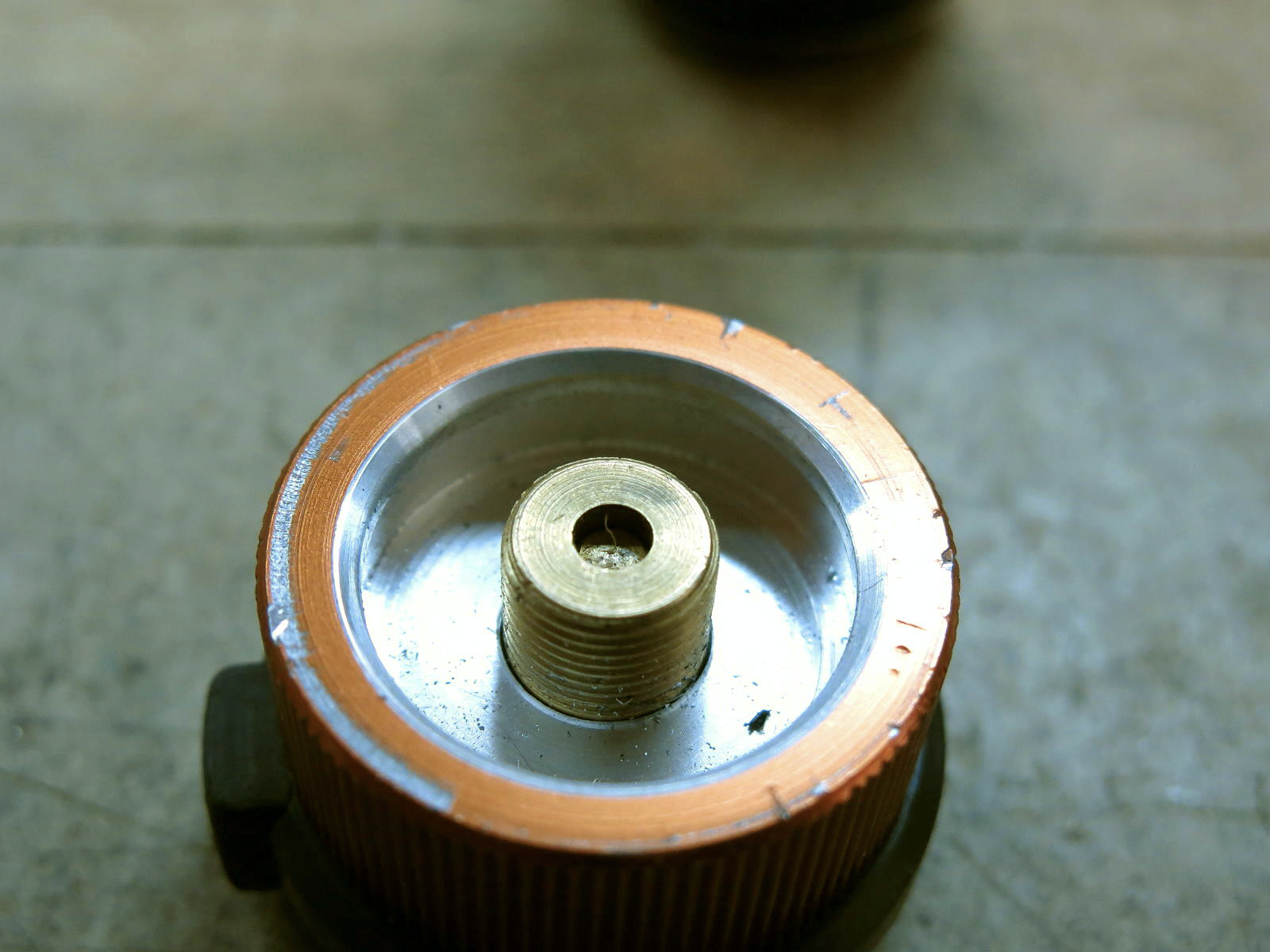
The rim around the outside of the Lindal valve and the notch in the rim is extra to what we find with our ordinary fuel canisters, but they do not get in the way. However, the metal tube up the middle above the nipple is “impossible”.
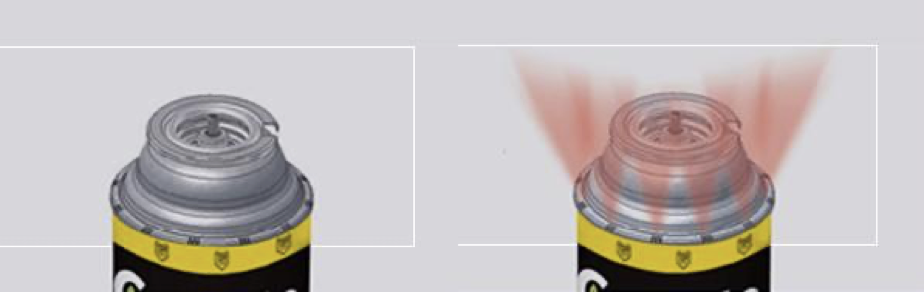
I have seen many cans advertise a thing called Rim Vent Release (RVR), which is supposed to be a safety feature. As far as I can see, the top rim has sets of three tiny slits around the rim. They are the dark marks on the rim in the left-hand photo. After examining them closely, I think these were added after the cans had been made, in a sort of retro-fit. Anyhow, if the internal pressure gets too high, first the top rim deforms, exposing lots of little leaks at those sets of slits, as shown at the left, then the overpressure is released through those leaks, as shown at the right.
You are most likely to have this problem only when running a stove with an exposed flame. So now you have a huge leak of butane next to a flame. The label on one package says “if activation occurs a controlled fire may start”.
“Controlled,” eh? Would you prefer a large ball of flame from the vents or an explosion? Hummmm: frankly, I would prefer neither.
Information on the web implies that there may also be a thermally-activated Temperature Sensing shut-off Valve (TSV) inside some butane cans, which also provides some safety. I know nothing about this, and I don’t think it is globally available. It seems to me that it could lead to an explosion.
The bottom line here seems to be that no matter what you do to make something safe, there will always be a bigger fool. Be warned and take care.
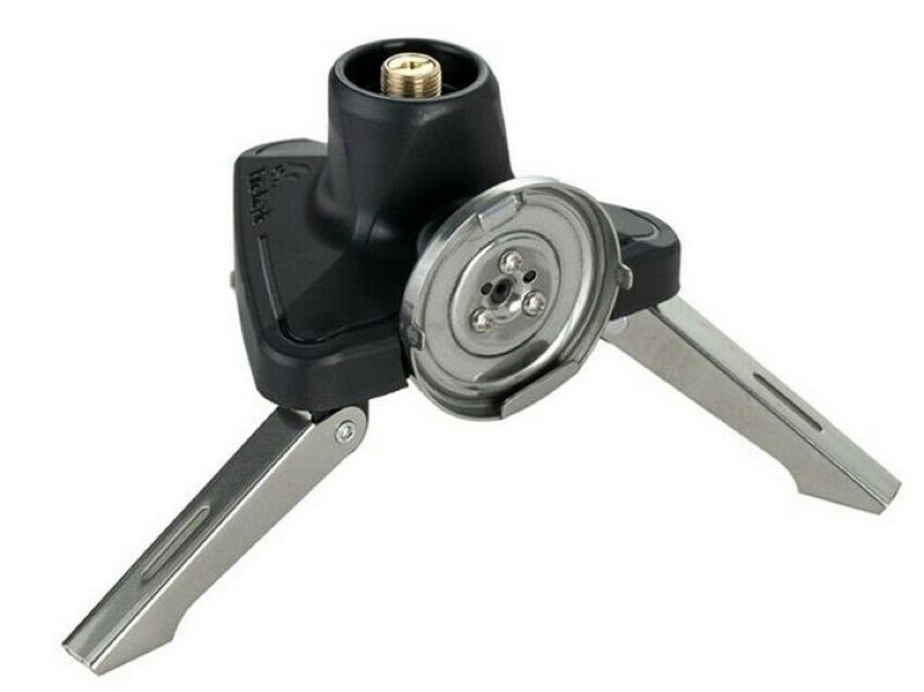
Just because the standard fitting on one of these butane cans is incompatible with our stoves is not the end of the story. There are a several adapters on eBay that could allow a butane can to drive a small stove while lying sideways in its “correct” position; one of these is shown here. This correct position is how the can is mounted in a wok stove, and it has the black tab and the fuel delivery tube pointing upwards. In this position, the canister delivers a gas feed.
Member Exclusive
A Premium or Unlimited Membership* is required to view the rest of this article.
* A Basic Membership is required to view Member Q&A events


Discussion
Become a member to post in the forums.
I meant to add ‘is the tegstoves use of an upright A4 canister reassuring at all about such usage’ to the above post but couldn’t find sn edit button .
You can buy an adapter for the A4 canister from ebay for a few dollars. It converts a tilted canister to an upright stove. Why pay anything more?
Note that it is butane: summer only, but there’s plenty of that.
Note also that I found the adapters rather tricky to fit to the can. You need to fit them while outside as some gas leaks out while fitting.
Cheers
Yeah, I had one of those adapters lodge onto the horizontal canister and I couldn’t remove it. Definitely an outdoor activity.
I suggest trying it at home first, before relying on it while beach camping on Kauai (a tough island to find fuel on if Walmart is out of stock).
at 4:49 pm#3754909Reply
Roger CaffinBPL MEMBER
You can buy an adapter for the A4 canister from ebay for a few dollars. It converts a tilted canister to an upright stove. Why pay anything more?
….
I only mentioned the previously commercially available upright (but very expensive) teg stove because the article expressed doubt on the suitability of the A4 canisters for upright use.
Maybe just easier to use those little adapters to transfer butane from A4 cartridge to a regular canister.
There are so many stoves and canisters used that they’re pretty reliable
If you know the cans hold 220g of butane (which the article says is 400ml volume), and you know the cylinders external diameter (knowing can thickness means you could know internal diameter), then can you work out how much pickup tube is above liquid when can is vertical?
Eg assuming can wall is 0.5mm thick r is (65-1)/2=32
Vol=pi.r^2 x h
So h=vol/(r^2 x pi)
Giving h=400/(32^2)3.14
=12.4339cm but that ignores the concave base, so assume 13cm..
doesnt that leave a fair bit of gas space when upright (assuming my maths is ok…….).
The intended application for those cartridges is like in the stove pictured above.
The outlet tube opens up on the top of the cartridge as positioned above
When you stand the cartridge up it’s like this:
The outlet tube looks like this:
So the outlet tube would be pretty close to the top of the volume. They always have some air space so if you stand the cartridge up, you should get gas and not liquid.
(stole those pictures from adventures in stoving)
another application for those cartridges is:
They use those like for cooking. You can brown the top of some food.
In this case, the outlet tube should be at the top so it delivers gas, not liquid.
I think there are a lot more users that do this, than ultra light backpackers that want to adapt a stove not intended for cartridges
Thanks, thats reassuring.
hmmm… I have one of those torches
I should try turning it on, then turning it upside down and see what happens
If there are no more posts from me you will know why
However, to return to the original question:
You can buy tiny adapters on ebay which will let you transfer the fuel from the A4 bayonet fitting to a standard screw thread canister. Very simple to do, and you can have full 230 g screw-thread canisters for summer use for about $1.25 each. (4 bayonet cans for $5.)
That has got to be the most ‘UL’ solution imho.
Cheers
yeah, I’ve been doing that for years
That one is $8. I have noticed different manufacturers, but after a while they discontinue but another manufacturer then has one.
As has been exhaustively discussed in previous threads, if the temperature gets below about 40 F, the cheap butane doesn’t work very good but there are techniques to get them to work at colder temps.
Kovea, the respected brand make/sell-on the style of adaptor favoured by Roger Caffin in this article: perhaps they could be persuaded to supply them already cut out, as in this articles mod, to save ULers spending time with a lathe/ CNC machine.
The big problem is that we are talking about an extremely small part of the market. Not economic to consider.
I find refilling a conventional canister with one of those tiny adapters as the quickest and simplest way.
Cheers
After reading the article I’m still a bit lost: can I use these Butane Gas cartridges with adapter in vertical position with a Soto Windmaster?
All examples seem to use remote stove with a hose?
All examples seem to use remote stove with a hose?
Yeah, well, I have a thing about remote inverted canister stoves :)
can I use these Butane Gas cartridges with adapter in vertical position with a Soto Windmaster?
The answer is a definite maybe.
Sorry about that. There is a reason.
The gas intake on one of those butane canisters looks like pic 7 in the article, or like this:

The problem is that a full butane canister may have liquid butane covering the inlet to the pipe, in which case there could be a ball of flame instead of a nice gentle flame as wanted. This would not be good.
However, as Jerry points out in preceding postings, you can buy commercial things (torches) which use the stock butane can in an upright position. He suggested that the inlet would be in the vapour space above the fuel, so that you don’t get balls of flame. This is very possible as these cans are not filled to the brim (by law); instead they do have vapour at the top.
I am not going to say yes or no. Instead I suggest that you try it at home (outdoors!) first. Once you have burnt a little fuel out of the canister, the liquid level should (hopefully) be below the intake anyhow.
Mind you, such an arrangement would be very slim and tall and not very stable. Care!
Cheers
The cheap cartridges are tall and have a narrow base, compared to regular canisters, so using your soto windmaster or any other regular stove screwed on top would be sort of tippy. It would probably be okay if you were careful, especially if you used it on a flat surface like a table.
I’ve never tried it though. I just transfer fuel to a regular canister. Just enough for the trip I’m on (plus some extra just in case).
If you don‘t mind the weight – I‘ve used such a folding stand successfully with those tall canisters. Still tippy but stable enough if you‘re careful.
Takes some practice mating the canister to the stand properly, without losing a lot of gas, but these might be the shot.

Get them from ebay.
Cheers
On a kind of related note.
I was very surprised to walk in to my local REI here in SE Michigan the other day and see bins of butane canisters being sold next to the standard IsoButane and Propane/IsoButane canisters for backpackers. They are asking $3.50 per 8oz butane canister. Home Depot’s website says I can buy 12 canisters of butane for $35, or $2.92 per.
I asked one of the REI guys about it, whom I’m friends with. He said it’s to accompany the new butane stoves they are selling for car campers and “van life” people. His personal opinion is that this stuff is taking up a lot of floor real-estate that he feels could be better allocated to backpacking stuff. Our REI store in Troy is small. The other two (Northville, Ann Arbor) are larger than this one.
REI also now sells a 5LB propane tank called a “Growler” that you fill at your local U-Haul and then use to power your 2-burner propane camping stoves instead of using the expensive green 1LB propane cylinders. Upon reflection, the refillable 5LB growler seems to make sense if you’re looking to move away from using disposable 1LB propane tanks. My understanding is that the disposable 1lb tanks is becoming a problem in the National Parks as there’s no established process to safely recycle them.
The 8oz butane cylinders, however, seem to fly in the face of the “refillable” movement.
“I just transfer fuel to a regular canister. Just enough for the trip I’m on (plus some extra just in case).”
Jerry’s solution is the one that makes the most sense, no extra contraptions to carry and fiddle with. Using a canister that the stove is created to use seems by far the better option.
I now use one of those “FlipFuel” style adapters to either consolidate two small IsoPro canisters into one, or to transfer fuel from one of the jumbo (16oz) IsoPro canisters into a small one to top it off.
I’m curious about getting the adapter for the butane canisters and then using it to transfer fuel into a standard stove canister. However, it sounds like the butane canister should be horizontal for optimum use? Transferring fuel from a butane canister into a stove canister would require orienting the butane canister upside down, and mating it to the receiving canister through the adapter coupled to the “FlipFuel” device. With the orientation of the tube inside the butane canister, it sounds like it would be impossible to get 100% of the butane to transfer, correct?
I understand that butane also has a higher boiling point and in some conditions I’d have to use a “Mulder strip” to make it work optimally, as has been discussed on here in the previous threads.
However, it sounds like the butane canister should be horizontal for optimum use?
Yes, see post 3754977 for pic of the internals. Note that the inlet points towards the notch in the rim, which is normally positioned on top to get a gas feed. But you will need to have the notch at the bottom to transfer liquid fuel.
No, you can’t quite get 100% of the butane transferred. There will be a tiny bit left behind. Chill the receiver and warm the butane (gently) can might get a bit more.
Butane BP is 0 C; propane BP is -42 C. Big difference. I don’t mind walking and camping at 0 C, but not at -40 C!
Cheers
I instill N-Butane from a cheap tall butane canister into an empty green Coleman 1-pounder, and then add some propane to that same 1-pounder, to get my desired mix stored in a canister that is over-rated (originally comes filled with 100% propane) for the mix I blend.
Last time I did this I was able to empty =ALMOST= (but not quite) of the full 8 oz of butane from the cheap tall can into the green coleman bottle. I got 7.8 oz. moved. So: “close enough.” (I have adapters that let me consolidate partial cheap tall B cans as well and I either do that, or boil eggs with the remainder).
I then added 4.2 oz of propane to the green mix bottle, resulting in 12 oz. of a 35%P/65%B mix. Cheap stuff: maybe $2-$2.50 per 8 oz can ($4-$5/lb) for the cheap B cans, and about $1/lb for bulk propane at my local U-Haul ($3.95 per 4.2 lb. gallon). So: $2.46 for those 12 oz.; 20.5 cents per oz. About 72 cents to refill a 100/110 gram canister; less than a buck-fifty to fill a 230/8 oz. canister.
I most recently moved this mix into a coleman ISO-Butane can that originally came filled with 40%P/60%B.
I do this all outside, with safety glasses on, wearing gloves, and underfill the target canister slightly which ends up with a little less fuel at a little lower propane ratio. Works for me. YMMV.
Become a member to post in the forums.