


Companion forum thread to: Winter Backpacking Trailhead
A curated guide to winter backpacking gear, strategies, skills, podcasts, forums, research, education, product recommendations, and more.
Topic
Become a member to post in the forums.
 .
.
Companion forum thread to: Winter Backpacking Trailhead
A curated guide to winter backpacking gear, strategies, skills, podcasts, forums, research, education, product recommendations, and more.
I saw what looked like a snow-collapsed Hilleberg AKTO tent in this section. I have a very similar Tarptent Moment DW, mainly for winter. In winter I carry the optional Crossing Pole which I have shortened 5″ to run under the fly for more snow load support.
I did the same with our SCARP 2 and its two Xing Poles. Both tents have short, double-sided Velcro cable ties sewn under the fly (at reinforced points) to capture the poles and hold them in place in high winds and snow load.
TIP: In winter never camp under trees which can dump their snow on your tent. Rather dangerous.
I’m not disputing the idea that water in a bottle freezes top down, but I’m trying to understand the physics. We know that cold water is denser than warm water and, therefore, sinks in open water environments, lakes, seas and oceans. We also know that air is a better insulator than water. So, in a bottle, with or without any air in it, why doesn’t freezing occur at the bottom where the coldest water is supposed to be? What am I missing?

why doesn’t freezing occur at the bottom where the coldest water is supposed to be? What am I missing?
Ice floats to the top.
A peculiarity of water is that it reaches its maximum density at 4°C, slightly above its freezing point. As it cools further it expands, so the cooler water rises to the top. Odd? Yes!
As ice forms, it expands more, so that’s why ice floats. All is explained in Wikipedia under ‘Properties of water’.
Become a member to post in the forums.
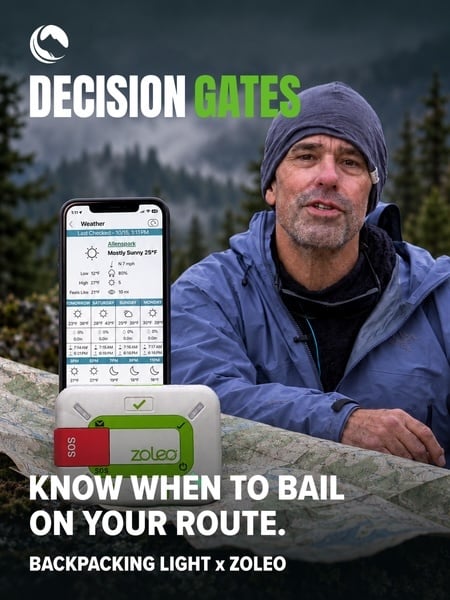 How to Plan with Decision GatesKeep going, change your route, or turn back? Watch how decision gates help structure these choices in our YouTube video.
 © Beartooth Media Group Inc.
 Loading...