First, please note: I don’t use non-woven fabrics for packs because have not been satisfied with their fitness for this purpose.
For the pack bottoms use 6 oz coated nylon that resists abrasion, and add a layer of 30D silnylon inside the pack bottom to increase WP, as the coatings on heavier nylons, including the 6 oz, often do not adhere well. Note that the only gear that rests on the inside of the pack bottom is the sleeping bag, which does not threaten the thin silnylon.
My packs all have suspended mesh back panels, so an inner panel must be added to keep water out. Use silnylon for that, and because there can be more abrasion from the contents further up the inside of the pack, use 70D silnylon further up the inner back panel .
The rest of the pack outer fabric is a problem. Have been using a 3 oz coated double ripstop nylon bought from Rockywoods, but am just about out of it. The double ripstop adds greatly to abrasion resistance. Unfortunately, they no longer have it, unless you want black, which I don’t. Only make one pack at a time, and replace it when it wears out, so maybe in a few years there will be comparable fabric on the market when it’s time for yet another pack. RBTR often adds new fabrics, so check their site regularly.
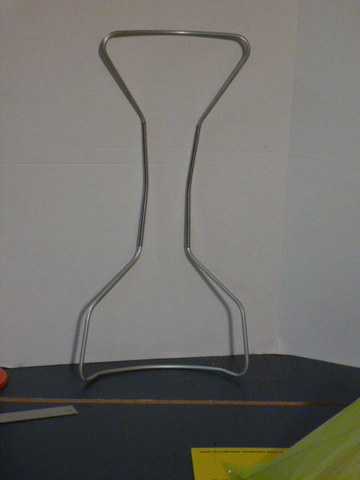
My packs have inner frames, but they are very light. The current project has a frame made of Easton tent pole tube, .340″ in diameter, prebent with the help of Roger Caffin to make a frame with a butterfly, or hourglass shape. Here is a photo of a such a frame used on a Bean’s pack:

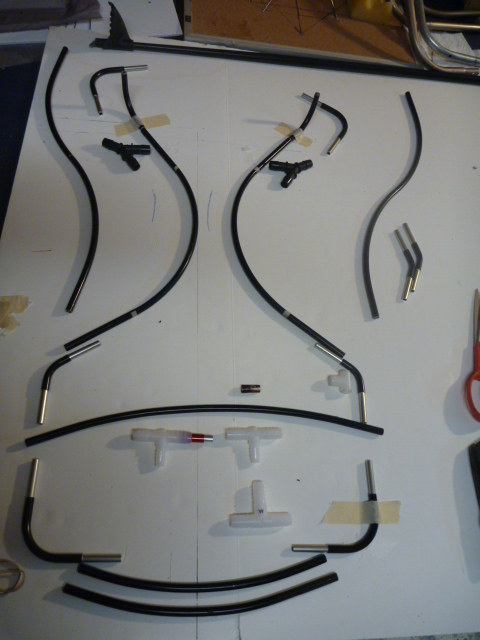
Here is another photo of parts of a butterfly frame laid out:
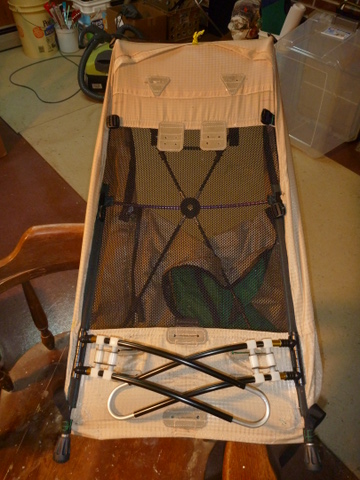
And here is a photo of a the backside of a previous prototype with the straps removed. Plan to rebuild this pack to take the butterfly frame:
Also integrated on both the old and new frame are carbon fiber cross bars that hold the shoulder and lift straps in place. The webbing from the straps runs through the pack to connect to the cross bars. Reinforcement patches are sewn on the pack with slits to accept the webbing. The patches are small, so thin leather can be used for them without adding much weight. So most of the pulling force from the straps is directed to the cross bars. Not shown are double pull ladderlock buckles that are connected to the cross bars on one side of the buckles, and snug right up to the back of the pack. The other side of the buckles accepts the webbing from the pack and lift straps, and is adjusted as needed.
In line with Scott’s cautions, the outside of the top of the pack is reinforced at points most subject to abrasion, like the top sides of the pack, as is the inside at points where the inner frame rubs against the fabric. Without this inner reinforcement, the inner fabric coating would rub off, and the WP would be lost.
Expect this approach will yield a total weight under 2 lbs, but not sure by how much until the whole thing is put together. Hope that this approach will be of some interest.