Topic

What Makes For A Good Hydration and Electrolyte Strategy?

Viewing 23 posts - 1 through 23 (of 23 total)
Lowell k BPL Member
PostedSep 3, 2025 at 6:32 am

My hikes tend to be moderate to high intensity. I use a formula of I need to replace about a half liter per hour. I don’t usually replace electrolytes but I eat some dried fruit and plain nuts. I am starting to rethink this strategy and experimenting with adding electrolytes because I don’t like salty snacks. Also, I can lose a couple of pounds after each 3-4 hour training hike so I think I must be way under-hydrating.

Curious how people are approaching this.

Thanks,

Lowell

Bob Shuff BPL Member
PostedSep 3, 2025 at 7:49 am

I’ve used LMNT mixed into a 700 ml bottle at the start of a hike or training walk, especially an early morning start. On the trail I’ve tried the flavored Saltstick chews or Nuun tablets when refilling that water bottle, but usually not until later in the day and if I’m slumping

in between it’s usually water and snack foods or something prepared like a PBJ or other sandwich. I think variety is key. I hear Tailwind is good if you want to refuel on the go and need the calorie replacement. Lately I’ve been bringing dried mango, a PBJ and whatever bar I have, like a Cliff, Bobo’s or fig bars. Something salty with lunch is good to balance the otherwise mostly sweets – maybe some jerky, or sausage and cheese if I’m going gourmet.  I don’t typically use gels or the small performance foods, because I’m usually eating during a break or just don’t need the concentrated calories. I do usually have one just in case I bonk.

Paul Wagner BPL Member
PostedSep 3, 2025 at 8:12 am

I had an exciting and unpleasant experience last year after starting a new blood pressure medication. That’s now been changed, but I start every hike by drinking up to a half liter of water. And I often hike in areas/conditions where it is a couple of hours between water sources.

Given that, I start these hikes with a full liter of water, plus another half-lited of electrolytes, which I tend to drink first. And I need them both. For more than two hours, I’ll another liter of water and some electrolytes.

Over the course of a day doing trail work in the Sierra, I will drink three to four liters of water, plus a liter of electrolytes, and then still need to drink at least another liter at dinner.

Being dehydrated is no fun..and potentially dangerous.  YMMV.

Jerry Adams BPL Member
PostedSep 3, 2025 at 8:53 am

I’ve noticed for years if it’s hot, after a few hours I’ll hit a wall and really slow down.  I thought it was just that I’m getting old.  Also, at night I’ll get leg cramps – I have to carefully stretch my leg before I can get up.

Then I started taking a diuretic (hydrochlorothiazide) and it was much worse.

I took my blood pressure meter on a couple trips and noticed my systolic blood pressure got down to 90 when I was hitting a wall.  The diuretic causes the kidneys to remove sodium from blood, which lowers BP – that’s how it works.  When I sweat a lot on top of that, it removes more sodium from blood which lowes BP more – that’s the problem.

The solution I found is to half my dose of the diuretic for days I hike a lot and it’s warm.  My BP might be a little high initially, like 125.  I try to keep it below 120.

If I exert a lot and it’s hot then I’ll take electrolytes.  1/4 teaspoon of lite salt which has 300 mg of sodium and potassium.  In a pint of water.  Maybe repeat with a second dose.  Over the day.

Also, when I’m backpacking, I tend not to eat that much salt, so I add about 1/4 teaspoon each to my breakfast, lunch and dinner.  That along with nuts and stuff will give me my nominal 2000 mg of daily sodium.

That has worked pretty good to avoid that low BP and hitting the wall.  And severe leg cramps.

If I don’t take enough electrolytes and get severe leg cramps at night, I’ll skip the diuretic the next day.

I could just take the normal does of diuretic and take a little more electrolyte during the day – I think that would be equivalent.

I’ve had leg cramps at night forever – for decades.  I thought it was just that I was over exerting my muscles or something.  Not that bad so I didn’t worry about it.  I could have been taking electrolytes.  I try to get up to pee, but it is too painful, but if I relax and stretch for about a minute then it’s okay.  Once I get up and walk around, no problem.

Murali C BPL Member
PostedSep 3, 2025 at 9:05 am

I always take 4 to 5 NUUN tablets which I use in the morning – each Nuun tablet for half a liter for water. In the afternoon, I will use Gatorate packets for each half liter. If I know it is going to be very hot in the afternoon – then I will take 2 Gatorate packets or more. On the PCT desert section, I took 4 Gatorade packets for the afternoon.

I rarely have cramps even on consecutive >25 mile days in the desert. I guess everybody’s body is very different.

Packaged food has lots of sodium – so my almonds, cashews are usually unsalted.

AK Granola BPL Member
PostedSep 3, 2025 at 9:42 am

I have found electrolytes to be helpful, however they also tend to give me the runs if I overdo them. I prefer just salty snacks but if it’s really hot or I’m working really hard I’ll sip some electrolytes too, in moderation. I like Fizz, which doesn’t have sugar. I’d rather eat sugar than drink it, not a dietary requirement, just a preference.

Jerry Adams BPL Member
PostedSep 3, 2025 at 10:01 am

I think that if you don’t have leg cramps at night, you’re taking enough electrolytes

Mark Verber BPL Member
PostedSep 3, 2025 at 7:27 pm

I ran a number of experiments to see how much water I lost at different activity levels / conditions. [My numbers similar to Ryan’s found in  should-i-pack-water-or-tank-up article. I take little sips as I go, a good drink when I am thirsty, and when I do my 5 minute break I will drink til I have replaced what I expect I have lost if I haven’t been drinking enough (which is common).

When I started backpacking in the 70s my dad had us use salt tablets but didn’t do anything until a few years ago when I was heavily sweating.  Lots a lot of electrolytes… and from Ryan’s article I realize I likely most more that 2% of my body weight… I thought I was drinking enough.

On “normal” days I think my food has enough electrolytes AND carry a couple of LMNT or Nuun electrolyte supplements.   When I expect heavy sweat I will take one packet of LMNT mid morning, and sometimes another mid-afternoon.  Since doing this I haven’t experienced any cramping.

Bonzo BPL Member
PostedSep 3, 2025 at 11:48 pm

I work on staying hydrated as best possible at all times; I just feel better when I’m on my game with it.  So, even at home, I try to supplement my daily water with at least one liter that has a touch of electrolyte powder in it, because electrolytes are what Bonzos crave.  Staying hydrated long-term has really improved my fitness, sleep and recovery, in addition to my overall performance.

When I’m out hiking, I carry a couple of small tubes of a dry powder mix that I make, and I add that to my water when needed…or – again – at least once per day.   I start with something like orange-flavored Skratch, cut it with powdered beet and some dextrin for added fiber, and pack that in small reusable tubes.  It makes for a fruit-punch-like substance that also helps with satiety and regularity, both of which suffer big-time with decreased fluid intake.

Drinking: on the move, I basically drink when thirsty and not sweating, or at least once every other hour.  When I’m sweating, I drink every hour, or even sooner if I start feeling questionable or dehydrated.  If I don’t rapidly start feeling better, I basically stop and make sure I get some fluids in me, stat.

Marcus BPL Member
PostedSep 4, 2025 at 12:31 am

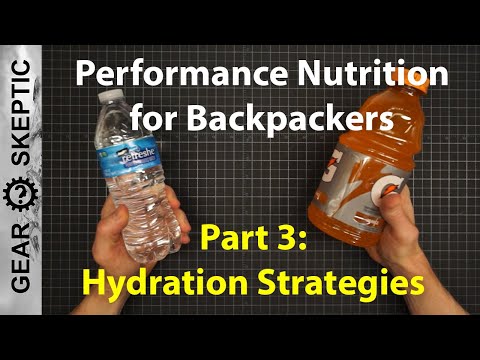
Essential viewing on the subject from one of my favorites, Gear Skeptic

Youtube video

Youtube video

Youtube video

Bill Budney BPL Member
PostedSep 4, 2025 at 3:26 am

Gear Skeptic is awesome, but he only considered sweat. When you take into account daily requirements, things change a little:

  • Calcium should come from your diet. Whey/casein are great sources and UL. Cheese works, as well.
  • For most people, magnesium should be supplemented separately, at much larger doses than the tiny amounts in electrolyte mixes.
  • Chloride comes free with sodium and potassium, phosphate and carbonate come from food, so you can ignore those three.
  • That leaves sodium and potassium for your electrolyte mix. Lite Salt is 50% sodium chloride and 50% potassium chloride. That’s very close to an ideal mix that you can get for pennies per liter at any grocery store. 
  • If you mix Lite Salt with your favorite regular salt in equal quantities, then you will have 75%/25% sodium/potassium, which is a ratio that has tested well in longevity studies. Some people may prefer the flavor of this ratio.
  • Salty snacks and Mountain House meals are part of your electrolyte plan.

TLDR: 1/4 teaspoon (1.5g) of Lite Salt per liter of water. 


Jerry Adams BPL Member
PostedSep 4, 2025 at 7:41 am

I use 1/4 teaspoon of lite salt per pint of water, but it does taste quite salty

I’ve read that 50% sodium, 50% potassium has a metallic taste.  I don’t notice that.  My wife does.  If you have 75% sodium 25% potassium it avoids this.

Those are great gear skeptic videos.  There was a thread about that a couple years ago.

Bonzo BPL Member
PostedSep 4, 2025 at 9:40 am

Agreed on most of your points, Bill.  That’s good nutritional info that I don’t often seen posted.

Salty snacks and Mountain House meals are part of your electrolyte plan.

Unless you can’t eat most of them because of other food additives, à la my partner.  We work around “salty snacks” by finding or making our own, but 90% of the packaged snacks and meals on the market are a no-go for her, and it’s because of the additives.  I have trouble with them, myself, for different reasons: my daily fiber intake is approximately “all of it” and that can be hard to find in a pre-made meal.  The good news is that we can use whatever we want for flavoring and/or salt/fiber addition if we make our own food…so, your point still stands.

TLDR: 1/4 teaspoon (1.5g) of Lite Salt per liter of water.

I would love to find an easily-available and clean orange/lemon/lime flavoring, so that I could ditch my Skratch powder and just mix that flavor with Lite Salt (or similar) and my other stuff, and call it good.  It would probably be much cheaper…but most everything I’ve found is either non-powdered, not available in less than 5-lb. containers, or not very good.  I have one or two brands left to try, but I’m not hopeful.

I think that in most dehydration cases I’ve seen, the culprit honestly hasn’t been electrolytes [hand gesture].  Mostly, it’s been sheer lack of water.  I can’t even begin to count the number of times I’ve been a couple of miles into a popular trail on a hot day and seen someone walking by with a 12-oz. water bottle from a vending machine and literally nothing else.  No pack, even…just carrying a water bottle in one hand, likely empty.  I now carry extra extra water during the warm months, exactly for that reason.

Don Montierth BPL Member
PostedSep 4, 2025 at 8:22 pm

I never paid much attention to this until the last few years, when about the third day into a backpacking trip, two years in a row, I really hit a wall. I mean really hit a wall. I chalked it up to the effects of age and perhaps a lower ability to both absorb and store electrolytes.  This year I took a much more measured approach to it, adding electrolytes, and I did far better. On my typical hikes, hiking many hours a day, if I’m sweating a lot, pushing up over high passes, I will supplement electrolytes several times a day.  And if I’m going to supplement, I use something with a significant amount of electrolytes. This year I really came to like Saltt, though I also used LMNT, FitAid, Salt Stick caplets, and Nuun, among others.  Saltt has a good amount of electrolytes in a good ratio with flavors I like.

I also added up how much sodium, potassium, and magnesium I am consuming in my normal day to day diet.  I found that I am far below the USDA Acceptable Daily Intake for all of them.  Interestingly, though, blood tests have shown that my electrolyte levels are in normal ranges. Curious.  Maybe it’s because I’m not normally sweating that much, or perhaps because blood tests have been done when I hadn’t been working hard.

Bill Budney BPL Member
PostedSep 4, 2025 at 8:36 pm

Your body is very good at keeping blood levels of electrolytes steady because you need them for important things like heartbeats. It will steal calcium and magnesium from your bones if necessary.

Useful testing is difficult. Simple plasma levels don’t tell you much.

Better to be aware of getting enough in your food and water.

Bonzo BPL Member
PostedSep 4, 2025 at 11:35 pm

Better to be aware of getting enough in your food and water.

This.  Keeping on top of it as a daily habit makes life a lot easier both in and out of doors.

Jerry Adams BPL Member
PostedSep 5, 2025 at 7:43 am

I think the USDA 2300 mg of sodium is an upper limit.  You don’t want to go above that.

Cardiologists love the DASH diet which is much less.  Because it will lower your blood pressure.  (if you lower your sodium enough)

Don Montierth BPL Member
PostedSep 5, 2025 at 8:11 am

The USDA limit for sodium is based on studies with people who have hypertension. Studies of people that do not have hypertension do not support the argument that sodium intake causes high blood pressure.

Plus, if I am sweating a lot, more sodium is needed to compensate for what is lost, which could easily exceed 1 gram/liter of sweat.

Jerry Adams BPL Member
PostedSep 5, 2025 at 9:45 am

let me say that better, the 2300 mg is an upper limit.  The FDA recommends you don’t go above that.

I think for most people it doesn’t matter.

I think this is a problem with FDA and other groups recommendations.  If everyone in the population lowered their sodium to 2300 mg, for some people, their blood pressure would be lowered.  If you average over the entire population, the average blood pressure would go down.

Epidemiologically, you have improved the over-all health, but a lot of people lowered their sodium for no reason.  Although it doesn’t hurt for people to lower their sodium, so maybe that’s okay.  It seems like it must be possible for such recommendations to be personalized, but that’s more complicated, so difficult to accomplish.

AK Granola BPL Member
PostedSep 5, 2025 at 10:09 am

Heaven knows what kinds of recommendations will come at us now that science is no longer a criteria – ivermectin everyone? Some oregano oil? Call the witch doctor, quick!

I have low blood pressure, always. I have had to do jumping jacks to get my blood pressure high enough to donate blood; they give you two chances to get the systolic above 90. I never worry about my salt intake, except for getting enough while hiking hard in hot weather. So people do need to individualize/personalize their system.

Don Montierth BPL Member
PostedSep 5, 2025 at 10:11 am

Moderation in all things applies here. Though there is evidence to suggest that 2,300 mg/day is too low for many.

Unfortunately, our government is not a very good example of moderation and sane advice, they have to cater to the worst cases. Years ago when the USDA went on the attack against fats, there was a big push to go low fat in everything. Because fat is bad, right? Well it turns out that was very misguided. Fat isn’t bad, at least not all of it. But the result was that foods we find in the grocery store now may have lower fat, but food manufacturers added a lot of sugar to make it palatable. And in the end, the higher sugar content is worse than the fat.

Bonzo BPL Member
PostedSep 5, 2025 at 12:43 pm

I have a couple of thoughts on these latest posts.

National nutrition guidelines are designed to address the average needs of a population, and a lot goes into creating them…but one of the things that doesn’t go into them are the individualized deviations from this average that best contribute to ideal nutrition in any given person.  Rather: the guidelines are a starting point that should keep most people mostly healthy…but “most people” and “mostly healthy” are not what we’re talking about, here.

Backpackers that are concerned with optimizing nutrition, hydration and any of the other factors that contribute to better athletic performance – training, gym sessions, sleep, etc. – are a small subset of an already-small subset of a minority within the greater population.  In the US, only about 19% of the population regularly goes hiking, and the portion of that 19% that stays outside overnight and over multiple days is small enough that we don’t actually have a reliable percentage for it.  The fraction of that second population – multi-overnighters – that’s concerned with their hydration and nutrition strategies enough to debate and improve them…well, you’re probably looking at most of us, right here. 🤣

What I’m saying is this: national nutrition guidelines aren’t really applicable in this situation because their answers are too generic and too coarse for our current purposes.  One can debate the politics of said guidelines until everyone is equally blue in the face, but the original question – “What makes for a good hydration and electrolyte strategy?” – will remain almost entirely unanswered.

On that note: originally, I wanted to one-liner my answer by posting “have a chat with your doctor” because Snarky Bonzo was having a day…but upon reflection, maybe I should’ve said exactly that.  There’s really no substitute for gathering personal performance data, handing that data to someone that can correctly interpret it within the framework of your existing health and condition, and then acting upon their recommendations and/or following up as needed.  In my case, I was told to literally not worry about electrolytes or salts beyond making sure that I got the majority of them from food sources, drank plenty of fluids in pair, and drank a balanced electrolyte mix once a day in liquid form…and that latter point was more for the sake of gut motility than anything else.  I was also told to get a lot more sleep than I normally get, but that’s a discussion for another time.

Anyway, tl;dr: have a chat with your doctor.

Steve Thompson BPL Member
PostedSep 6, 2025 at 10:02 pm

I’ve started taking one salt stick capsule with every liter of water I drink.  Seems okay, at the least it has eliminated cramping.

I never paid much attention to this until a friend I took hiking mentioned lightheadedness and then turned and broke his ankle.  Tests showed his sodium levels were low.

I related this to a Sierra backpacking trip a few years earlier, hotter than normal temps and my own lightheadedness. So I tried the salt lick caps on a R2R2R dayhike and had no cramps during or after the hike. In fact, I had my fastest recovery. I also just completed 10 days in the Sierra following the one per liter regimen. Again, no cramps which historically have been an evening or middle night wakening event.

So 2 consecutive data points to the good.

Viewing 23 posts - 1 through 23 (of 23 total)
Loading...