Topic

Weather station temps always higher than observed (not even an elevation thing)

Viewing 12 posts - 1 through 12 (of 12 total)
PostedFeb 21, 2016 at 6:06 am

Coming from the summer car camping world, I’m starting to ease into shoulder seasons and backpacking.  I’ve been observing that nearby weather stations consistently seem to report a much higher temperature than what I end up seeing on the ground.  For example, I slept outside in my suburban back yard last night with a forecasted overnight low of 41f – woke up and took a reading on our house outdoor thermometer and it registered 28f.  That’s 13f off.  Now maybe my house thermometer that I took off the wall of the porch and laid outside my tent could be off by a few degrees but even so the posted weather was probably off 7f from what I was feeling.

Is it common that the weather stations in suburban areas are just totally untrustworthy?

Side-topic – what are people taking out in the field to register temperature accurately?  I’ll pay for quality and lightweight if there is something that is actually accurate that I can take.


Thanks!

PostedFeb 21, 2016 at 7:42 am

“Is it common that the weather stations in suburban areas are just totally untrustworthy?”

Absolutely. It’s part of the global warming conspiracy.  Everything you need to know is over in Chaff in The Carbon Flame War thread.  Calibrate your own thermometer with boiling water for 100* and freezing water for 0*, then trust no one else. (Adjust for elevation relative to sea level, of course.)

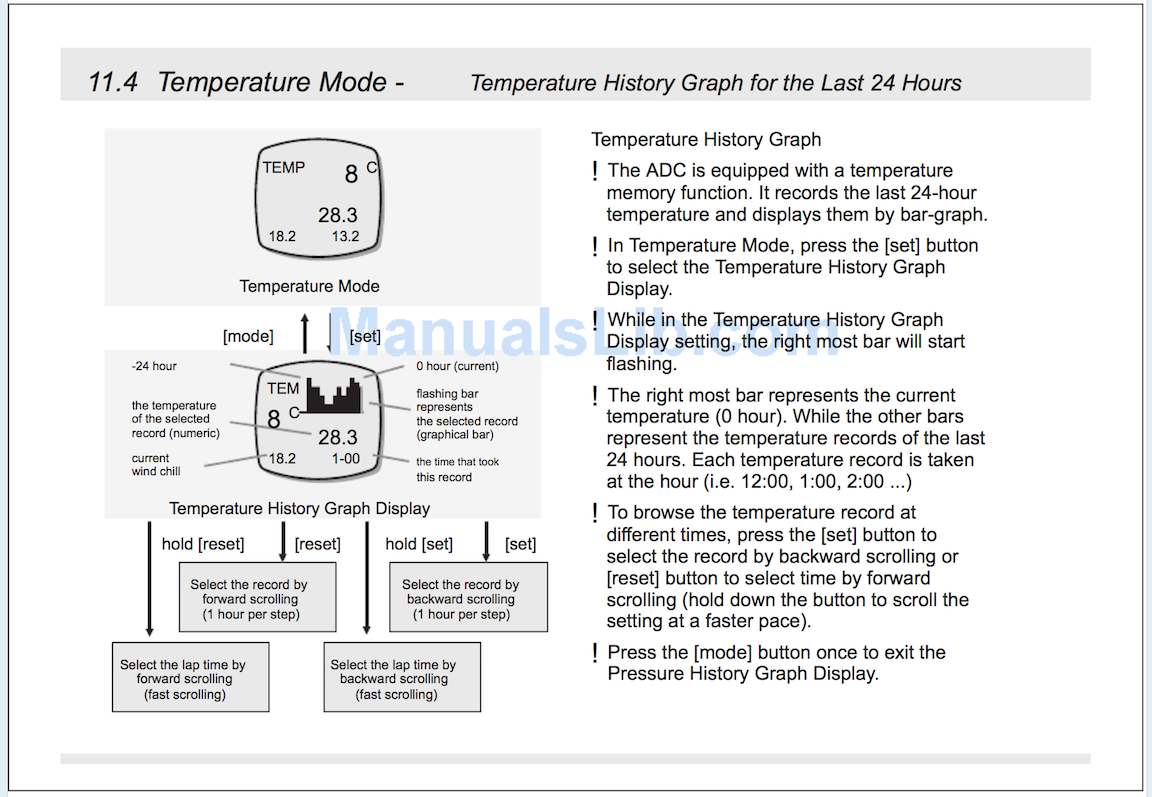
To monitor and record temperature over the past 24 hours I use a Brunton ADC Wind

Richard May BPL Member
PostedFeb 21, 2016 at 9:41 am

A lot depends on where you are in relation to the weather station. The Urban Heat Island phenomena is one thing to consider. The other is that thermometers will try to read the temperature of the sky if they’re left in the open.

Ralph Burgess BPL Member
PostedFeb 21, 2016 at 10:15 am

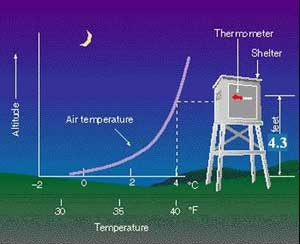
http://about.metservice.com/our-company/learning-centre/frost/

A typical MetService forecast as seen on TV, heard on the radio or read in the paper will tell you about the overnight low. This is the lowest that the air temperature is expected to get at about shoulder height. This air temperature is measured in a special screen (called a Stevenson screen) and at a specific height (1.3 metres or 4.3 feet) above ground level. The screen is designed to allow the temperature probe to reach equilibrium with air temperature inside – it shields against rain and warming /cooling by radiation and allows free air flow….Note that the OVERNIGHT LOW is for an AIR temperature and not a ground temperature….This diagram of a Stevenson screen shows that temperature near the ground may be as much as four degrees Celsius cooler than the overnight low.

PostedFeb 21, 2016 at 10:17 am

THANK YOU for that pic and summary – I never knew that.  And to think I got out of hammocking in no small part to feeling like it was harder to stay warm in the air!  (much more likely I failed to underquilt enough.)

PostedFeb 21, 2016 at 10:21 am

I found another BPL thread on measuring temps while camping and it looks like this thermometer was settled on as being pretty darn reputable and only 0.6oz!

($20 @Amazon) – might have to order one right quick


Alex H BPL Member
PostedFeb 21, 2016 at 10:52 am

Kodiak, that thermometer doesn’t record constantly, only the low or high when it was on.  Get this one from Accurite, many of us here use them and they are pretty accurate and cheap and record.

PostedFeb 21, 2016 at 10:59 am

Hrm – they don’t post a weight – do you know the weight of yours by chance?

Mostly I like being able to take a spot temp – while knowing the overnight minimal low might be nice, I’m not sold on buying a probably heavier thermometer that likely wasn’t built with accuracy held in high regard.  Getting a food thermometer like the one I linked IMO is likely to be very accurate out of the box.

Ralph Burgess BPL Member
PostedFeb 21, 2016 at 11:25 am

Yes, a probe thermometer like that one on Amazon is designed to equilibrate with a solid or liquid.   I don’t know how reliable or stable an exposed probe would be to measure air temperature — and, of course, you’re carrying the unnecessary weight of the probe (unless you actually want to stick it into a lake, or into the ground or something).

The Accurite one that Alex posted is the kind of thing you want.   Designed to measure air temperature – I presume that they have an opening somewhere that allows air to pass freely, but encloses the sensor so that it’s not in contact with anything but air, and protected from radiation.

Alex H BPL Member
PostedFeb 21, 2016 at 11:35 am

I believe the Accurite is .9 oz.(25 gms).  They are slow to register the current temp but not too bad.  The most important thing to me is recording the overnight low.  I am a farmer and have about 6 of them that I will use around the farm to check overnight lows in  spring and fall, they are all with in 1 degree of each other when lined up next to one another.

My usual camping set up is to hang it from one of my poles near the head of my sleeping bag so I can glance at it at night and it is 12-18″ above the ground.

PostedFeb 21, 2016 at 11:44 am

Ralph – I would not agree that all probe thermometers are calibrated strictly for immersion.  Many, if not all probe digital thermometers work fine in air – I oversaw an office building for a while and no matter what HVAC person would come by, one of their main tools was a pocket probe thermometer that they could stick into vents.  Some were $150 Flukes, others were little off-brand dealies.  I think ExTech is a pretty decent maker and I’m tempted to get one just to test it and post results :)


Alex – thanks for the reply!  I’ll probably get one of the ones you mention as well and see how it does.

Dean F. BPL Member
PostedFeb 21, 2016 at 4:43 pm

Your house thermometer is probably at least partially exposed to the sky, right?  So it’s not measuring air temperature very accurately because it is radiating IR energy into the night sky.  Among other standardization methods, temperature stations are covered so that they measure air temperature more reliably.

Viewing 12 posts - 1 through 12 (of 12 total)
Loading...