Topic

Water filter trade-offs (and is there a larger version of the Sawyer Squeeze?)

Viewing 25 posts - 1 through 25 (of 28 total)
Ryan P BPL Member
PostedSep 16, 2025 at 12:50 pm

My understanding of mainstream/popular modern water filters is as follows:  you apply force to the water (by manually squeezing a bag, or letting gravity do the work, etc) to push it through tiny holes in the filter.  There are two basic trade-offs involved:

  1. Trade-off #1:  Filter effectiveness (pathogen reduction) vs flow rate (for the same size of filter):  If the filter has smaller holes, then it will more effectively filter out the germs, but it will have a worse flow rate.  For example, the Sawyer Squeeze filters out more germs than the Katadyn BeFree, but has a worse flow rate.  My understanding is that this is because the filter has smaller holes, which means fewer germs can pass through, but also means more resistance to water flowing through.
  2. Trade-off #2:  Filter size (volume/weight) vs flow rate (for the same filter effectiveness):  If the filter itself is larger, it will have more holes, and will thus have better flow rate (for the same filtration effectiveness).  For example, both the standard Sawyer Squeeze and the Sawyer Mini have tiny holes and equal effectiveness against germs, but the Sawyer Squeeze is larger so it has more holes and thus a better flow rate.  For this reason, many backpackers seem to go back to the standard Squeeze after getting frustrated with the poor flow rate of the Mini.

It seems that many backpackers value flow rate more than weight/volume, since they choose the standard Squeeze over the Mini.  Since this is the case, why doesn’t Sawyer offer a larger version of the Squeeze?  (I don’t think they do, do they?)  Are there any filters like this on the market?  (most stringent log reduction rates like the Sawyer filters, but better flow rate by making the filter larger/heavier).  I would personally prefer it if my filter weighed an extra ounce or two (and was slightly larger in volume) if that meant it had a much better flow rate, while maintaining the same effectiveness at pathogen removal.  After watching the gearskeptic video on the topic, I don’t think I want to sacrifice the filter effectiveness (although I understand why others would be willing to).

Terran BPL Member
PostedSep 17, 2025 at 4:22 am

The Sawyer is a nice compromise at a good price. You can spend more and buy bigger and faster filters, spend 5 minutes filtering instead of 6. I guess you could get two Sawyers. Double your time. Redundancy in case one fails. Or look at the Grayl.

Ryan P BPL Member
PostedSep 17, 2025 at 11:14 am

Yeah, I agree that the standard Sawyer is a good compromise overall.  I was just wondering if there is a version (perhaps from a different brand) that is basically the same as the standard Sawyer only a little larger/heavier (and perhaps a little more expensive) but with better flow rate, while maintaining the same effectiveness.  I’m content with the standard Sawyer, but in my mind the perfect filter would be a little bigger but with better flow rate.  When you say, “you can spend more and buy bigger and faster filters”, did you have any specific filters in mind (that are basically like the Sawyer but maybe an ounce or two bigger)?

Brad W BPL Member
PostedSep 17, 2025 at 4:03 pm

I don’t see a need to make a bigger Squeeze. The flow rate is good, size is good.

dirtbag BPL Member
PostedSep 17, 2025 at 6:01 pm

If you want more/better flow.. try the Hydrapak filter. Same idea as sawyer.. maybe smaller thoough? But better flow.

Steve Thompson BPL Member
PostedSep 18, 2025 at 7:45 am

The biggest drawback with the Squeeze is the gasket. I’ve given up on them because the gasket eventually falls out and I don’t care to keep track of it. On the plus, if you carry the backwash plunger they can maintain flow over a longer hike. The platy Quick Draw is the same basic concept with no gasket.

The Hydrapak and BeFree are similar in concept, both are “in bottle” and have high flow rates. They don’t have an option for high pressure backwashing. Where the water generally runs clear I prefer these, but where the water has high turbidity I prefer a backwashable filter so the no-gasket platy wins for me.

As to the question of there being a larger version, I am not aware, but the flowrate of all these is fast enough for my purposes. If I were filtering for a large group I’d probably look for a different solution.

Terran BPL Member
PostedSep 18, 2025 at 8:24 am

It’s the same filter they use for supplying villagers with. They just use a bucket. If you want greater flow, get two of them. If you want a better filter for viruses, look for smaller pores, they’re out there. Larger pores for greater flow. There’s really not much need for smaller pores in most situations. It’s not like a lot of folks getting sick on trail from their use. Primarily, I’d add a activated carbon filter for cytotoxins and flavor.

Brad W BPL Member
PostedSep 18, 2025 at 9:20 am

As you said, better flow means significantly less filtering ability. Befree and similar offer only a 3 log reduction for protozoa, Sawyer offers 6. No free rides here. I own both and use both. I take the Squeeze when the source is even slightly suspect, Befree when the water source likely decent. I do like the in bottle design of the Befree. Would be nice is Sawyer had something similar. The wide mouth bags of the Befree are also very easy to fill and use.

dirtbag BPL Member
PostedSep 18, 2025 at 10:05 am

with some modifications you can adapt the sawyer to wide mouth bags

Erik G BPL Member
PostedSep 18, 2025 at 10:25 am

Sawyer does make an in-bottle filter – the SP-140. It has nipples on both ends rather than a threaded connection on one end, which works well for the in-bottle configuration as well as for gravity filter setups. I’ve been using them for years and really like the design vs the standard Squeeze. Gotta purchase the whole kit with the 32oz bottle though.

Sawyer SP-140

Ryan P BPL Member
PostedSep 18, 2025 at 12:29 pm

Brad–you said, “better flow means significantly less filtering ability. Befree and similar offer only a 3 log reduction for protozoa, Sawyer offers 6. No free rides here.”  I 100% agree that there are no free rides (that was the main point of my post), and that most people who want better pathogen removal put up with the worse flow rate of the Sawyer.  However, there is another way to increase the flow rate (while maintaining the effective pathogen removal)–and that is to make the filter larger (more holes).  It’s not a free ride; the cost is increased weight and volume.  That’s the basic tradeoff between the standard Squeeze and the Mini.  Apparently a lot of people are willing to take on the extra volume/weight in order to get better flow rate (all while maintaining the same log reduction rates), because a lot of people prefer the standard Squeeze over the Mini.  That leads to the question of why Sawyer doesn’t move even further in that direction with a “Jumbo” Squeeze.  Although, like you said, the standard Squeeze does indeed strike a pretty good balance, and I’ve been happy with it overall.

Thanks all; I’ll look into the suggestions that have been made.  I suspect I’ll stick with my standard Squeeze though.

JCH BPL Member
PostedSep 19, 2025 at 6:00 am

+1 for the in-bottle filter that comes with the Sawyer SP-140…makes a great DIY dedicated gravity system. Bummer that you have to buy the bottle to get the filter…never found a use for it.

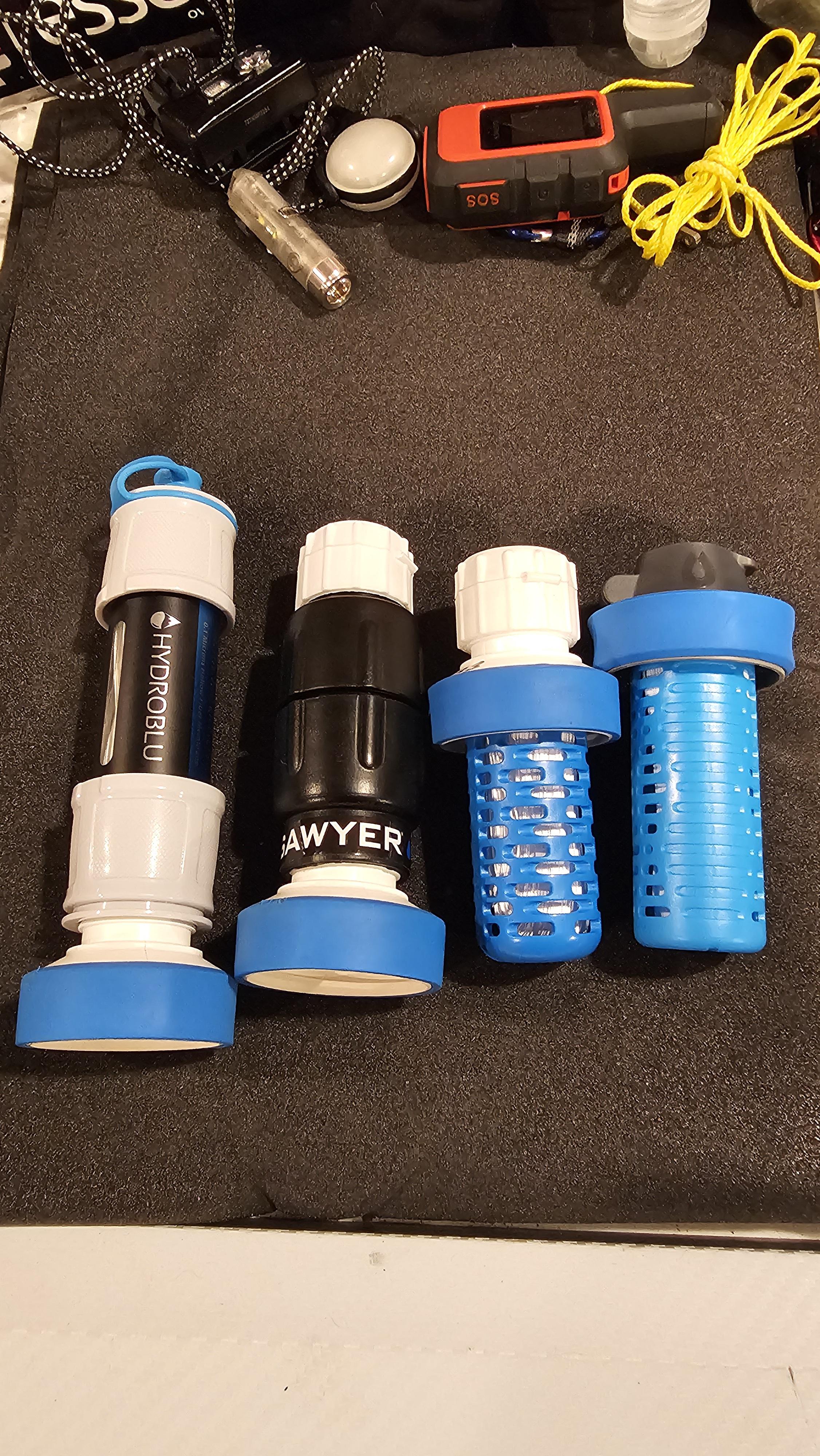
Also +1 for a carbon filter add on. Platypus makes a good one.  Also love the Hydroblu Versaflow with carbon filter…really nice integration of the two units.

I likely have 5 of the Sawyer back-flow syringes. I wonder how many people are in the same situation?  I’ve used them, but luckily never had to carry one.

Don Montierth BPL Member
PostedSep 19, 2025 at 3:44 pm

I carry an adapter to use a standard 28mm soda bottle for back flushing.  The bottle serves double duty as a clean water receptacle.

Mart BPL Member
PostedSep 20, 2025 at 11:33 am

The posts in this forum outline many of the DIS-advantages of various water filters. Why not avoid the filter conundrum altogether by using Chlorine Dioxide drops or tables (Aqua Mira or Micropur MP1 tablets). A 4-hour contact results in PURIFIED water. One can simply mass treat a sufficient quantity for your next day after supper and let it “perk” all night long. Nothing is lighter. Nor more effective.

Don Montierth BPL Member
PostedSep 20, 2025 at 6:15 pm

A 4 hour contact time means carrying more water, negating the lighter weight of the tablets. A filter allows treating water on demand, less water to carry.

David D BPL Member
PostedSep 20, 2025 at 7:35 pm

Pre-scout the water, if no crypto use pills needing 30 minute contact time. Just did that today, do it often.

JCH BPL Member
PostedSep 21, 2025 at 6:32 am

Why not AC/Tabs?  One word: Taste. If I want to drink chlorinated water I’ll stay home and drink from the municipal supply (I filter my water at home with ZeroWater).  Nothing tastes better than a clean mountain stream. If the source has a taste issue the carbon element addresses that.

And as Don said, I don’t want to carry an entire days water.

Jerry Adams BPL Member
PostedSep 21, 2025 at 7:48 am

The last couple trips in the Cascades at elevation I didn’t bother treating the water.  Too lazy to get my Squeeze out.

David D BPL Member
PostedSep 21, 2025 at 8:45 am

The taste isn’t for everyone, true.  But with 30 min contact time, I find I’m not carrying more water

Brad W BPL Member
PostedSep 22, 2025 at 11:41 am

Why not pills? Taste, Time, gut biome impact. Filter can scoop it up, drink nice cold spring water with no chemicals.

David D BPL Member
PostedSep 22, 2025 at 12:10 pm

All legitimate pluses for filter over pills.

Otoh, with pills water breaks are much shorter which I highly value.  If water sources aren’t scarce I carry less water using pills because the overhead of using a filter for me encourages filtering more water at a stop so to have to stop less.

If I know the water is low in organic material and crypto free, and water isn’t scarce, for me the benefits of pills outweigh the disadvantage.  But I’ll never cook or hydrate food with that water because of the taste.  So if the situation allows (which is very often) I use pills while moving, and a platy filter when in camp.  It does require prior in depth scoping of water sources but I consider this mandatory even for an extended day hike.

I’ve often wondered about the gut biome impact but have never come across any legitimate science on the topic.  If anyone has any to share, please do, that would be appreciated.

John Vance BPL Member
PostedSep 22, 2025 at 2:58 pm

I used pills, UV, and filters depending on water sources.   I haven’t ever treated water for cooking but get the sense that many do.  I also just bring it to a boil and let it sit for a bit – no extended boil. I often drink water straight from the source when it seems prudent and drink melted snow when available.

I am taking a break from hollow fiber filters and going back to my Steripen Adventure for speed of use, dependability, and the compact size.  Back up will still be pills.

Jerry Adams BPL Member
PostedSep 22, 2025 at 3:01 pm

the gear skeptic says that all you have to do is bring the temp to 165F to kill bugs.  Based on papers about pasteurization.

That’s when the noise level increases and you can see bubbles form on the bottom and start to rise.

Don Montierth BPL Member
PostedSep 22, 2025 at 6:01 pm

Tablets require extended contact time for giardia and crypto.  Even then they may not be entirely effective against crypto.

https://www.cdc.gov/healthywater/pdf/drinking/backcountry_water_treatment-508.pdf

The last 5 trips to Sierra high country (SEKI and Mono Divide, the shortest being 6 days) I have not treated water.  In areas with noticeable human presence (I’m talking about you, Whitney zone) I am selective in where I get water. Historically water samples from the backcountry have been biologically safer than most municipal water supply systems.

I hike a lot in the Smokies, and samples from many spring sources at shelters show pathogenic bacteria. There are also wild hogs that get into surface sources. I filter water in the Smokies. A friend of mine got confirmed giardia from a 5 day trip south of the Smokies in Citico Creek/Joyce Kilmer/Slickrock despite filtering. It was a trip with a bunch of teenagers who also used his filter. I suspect they were not careful and there was cross contamination. There was plenty of sign of wild hogs. I may have let my son use my filter, but I did not loan my filter to anyone else.

Viewing 25 posts - 1 through 25 (of 28 total)
Loading...