Topic

Wall Charger Wattage

Viewing 15 posts - 1 through 15 (of 15 total)
John Papini BPL Member
PostedSep 20, 2018 at 3:52 pm

I’m trying to figure out my backup power for 2019 thru hike and spent far too long today looking at wall chargers. I’ve also spent a fair amount of time trying to frame my question — the state of power banks and wall chargers is incredibly confusing.

My main question is this: for the purposes of a thru hike, what wattage wall charger should I be considering? The only thing I need to charge is a ~10,000 MaH battery pack (yet to be chosen), which will in turn be used to charge two iPhones. In 2016 I had a RavPower Savior 9000 that included a foldable wall plug and built in lightning connector for around 8.5 oz. I carried no other cables or chargers. I would plug the battery in the outlet in town, and sometimes plug my phone into the battery’s lightning cable. Usually I’d have charged my phone the night before off of the battery, so this was just to top it off. Often I only charged the battery (and not my phone) while in town.

Now, 8.5 oz isn’t bad. So either I’d like to achieve a lighter setup using a battery/charger/cable combo, or else I’d like to – for approximately the same weight – have the battery pack itself charge faster in town (I’ll be hiking with my S.O. in 2019, so the battery is likely to be lower when I get into town).

Consider five different wall chargers I found:

  1. 60W, one port USB-C, 5.5 oz (output is 5V=3A / 9V=3A / 15V=3A / 20V=3A)
  2. 56.5W, two port USB-C / USB-A, 4.8 oz (output is 5V=3A, 9V=3A, 12V=3A, 15V=3A, 20V=2.3A; for USBA, it’s 5V=2.1A)
  3. 27W, single port USB-C, 2.5 oz (output is 5V=3A / 9V=3A / 12V=2.25A / 15V=1.8A / 20V=1.35A)
  4. 24W, dual port USB-A (with PowerIQ), 2.9 oz (output is max 2.4A per port, I assume at 5V)
  5. 18W, single port USB-A (Quick Charge 3.0), 2.5 oz (output is 3.6-6.5V=3A / 6.5-9V=2A / 9-12V=1.5A)

Obviously I’m trying to figure out which products to buy, but if anybody cares to give a quick lesson on how to interpret these output numbers, I’d appreciate it. Here are a few things I’m trying to work out:

  1. Assuming I get a 10,000 MaH battery with USB-C input, can it take full advantage of the 60W (#1 above)? If so, how much faster will it charge using the 60W single (#1) vs. the 27W single (#3)?
  2. If I don’t get a battery with a USB-C input (maybe they are heavier?), but I get a battery with QuickCharge 3.0 technology, how much slower will it charge using the 18W single USB-A with quick charge (#5) than if I had gotten a USB-C battery and used the 27W USB-C (#3)? Both of these chargers weigh the same 2.5 oz.
  3. Obviously charging my phone in parallel (i.e. plugged into the battery) will slow the charge speed, but help me put this into context. For example, would it be faster charging to plug my battery into the 60W (#1) and my phone into the battery, or would it be faster to plug both my phone and battery into the dual port 56.5W (#2)? Presumably the former, because I’m getting 60W instead of 56.5, correct?
  4. Should I just get the 24W dual port USB-A (max 2.4A per) at 2.9 oz and call it a day? With a ~5 oz battery and the lightning cable, this will be similar to my RAV set up but will give me an extra port for my extra lady. I assume charge time for the battery would be around 5 hours, as it was with my RAV.
  5. Not to complicate things too much, but should I consider getting two ~6,000 MaH packs that can charge at the same time? I just assumed that it would be lighter having one battery than two, assuming similar MaH totals. This obviously has benefits in terms of gear failure, but I’m asking here about overall weight and charge efficiency.

Thanks for your help, folks who are smarter than me.

Woodstock
Bruce Tolley BPL Member
PostedSep 20, 2018 at 4:22 pm

Woodstock

I look forward to the answer to your questions. When I did some admittedly brief research on this issue a year ago, my conclusion was that all the various quick-charge options were to quick-charge phones directly, not the batteries. And some devices like GPSes do not support the higher wattages.

In reference to greater redundancy with two batteries, I would also think that if you buy one high-quality battery, your cable with its mechanical connectors would be more likely to fail in the field than the internal electronics and Lithium cells.

Ben H. BPL Member
PostedSep 20, 2018 at 6:05 pm

According to Wikipedia: https://en.wikipedia.org/wiki/USB-C

All USB-C cables must be able to carry a minimum of 3 A current (at 20<span class=”nowrap”> </span>V, 60<span class=”nowrap”> </span>W) but can also carry high-power 5 A current (at 20<span class=”nowrap”> </span>V, 100<span class=”nowrap”> </span>W).

So it sounds like if you get a USB-C capable battery pack it would use the full 60W.  I’m not sure what that additional comment about 5A/20V/100W capability means… Since this is talking about cables perhaps it is a buffer in capability USB-C capable devices could need.


Bob Shuff BPL Member
PostedSep 20, 2018 at 7:42 pm

Woodstock,

I feel your pain.  I’m a EE and dabble in battery electronics because I have a homemade ebike.  Sad story is the specs available are incomplete and often misleading.  As you say, the “charge” specs often refer to the battery charging the phone, not how much current the battery will accept from the wall outlet.

Short answer from my perspective is to wait as long as you can and buy the latest battery and wall charger from a reputable brand like RavPower or Anker (or a couple others) with support for the same charge standard.  Battery technology is changing so much, a couple of months makes a difference.  Look for quick charge input (or USB-C) and try to match the charger and battery (quick charge 3 or …).  The battery pack decides how much voltage/current it will accept from the AC Charger, and negotiates this with the charger.  How that works is not well documented.

If the vendor specs input charge voltage/current you can multiply that to get the power in Watts it will accept.  In general I would have a separate charger for your phone in town.  Its gives you a backup in case one charger craps out, and will give you the shortest possible charge time.

Get a battery that is more than you need.  They will charge to 80% quickly – the remaining 20% takes a lot longer due to the charge curves to keep the battery healthy.  If you get impatient or just don’t have enough time, you can still get a good portion of the charge quickly.

I hope that helps.

PostedSep 20, 2018 at 7:53 pm

I didn’t read your entire post – my attention span it to short – and you may already know this, but 2 things to be aware of:

1) Delivered capacity to a 5 volt device (phone, beacon, etc) is 65% to 75% of the rated capacity, e.g. a 10,000mAh battery will deliver between 7,500 mAh and 6,500 mAh.  And, you probably won’t take your device to zero charge so you should account for the number of  ~ 80% charges you anticipate. Size accordingly.

2) Some battery banks charge faster than others.  Anker has a couple of fast charging battery banks. The charge time on “not fast” battery banks can run many hours.

Renais A BPL Member
PostedSep 21, 2018 at 1:25 pm

For the AT I liked having a transformer with two inputs. That way I could charge both electronics and a battery pack when I made a town stop. The Anker transformer had two 2.4 A outputs and functioned well.  I also used a battery pack with two full power inputs.  Having the two inputs really cut down on the recharging time of the pack.  Once my electronics were charged, I’d put both transformer inputs on the battery pack and try to get as much of a charge as time would allow.  I used a Samsung S7 for pictures all day long, took it off airplane mode once or twice a day, and used an InReach at night.  I never had a problem with everything being discharged and no reserve power using a 14000mAh battery pack.  If doing the PCT, I’d consider something like the RAVPower 26000 mAh packs with two charging inputs since you may be in less contact with recharging opportunities, and you’ll have two people using the pack.  https://www.amazon.com/Portable-RAVPower-26800mAh-Double-Speed-Recharging/dp/B07793KSV4

Renais

Jerry Adams BPL Member
PostedSep 21, 2018 at 1:55 pm

It seems like companies are more into fast charging of devices, not fast charging of the battery bank

For fast charging of the battery bank, look at the input spec – voltage and current

Most of them are 2A.  Since they don’t mention voltage it must be 5 V.  2 A * 5 V = 10 W input power

Anker Power IQ 2.0 says 5-9 V, 2 A.  9 V would be 2 A * 9 V = 18 W – almost twice as fast.  You’d need the right wall charger that would produce 9 V since 5 V is normal.  Maybe ask Anker.

Anker PowerCore Speed 20000 PD says 5V=3A, 9V=3A, 15V=2A, 20V=1.5A.  20 V * 1.5 A = 30 W.  15 V * 2 A = 30 W also. which would be 3 times faster.  Again, you’d need the right wall charger to produce 15 or 20 V.

Of course maybe the spec would be misleading, it might consume that spec’d current at the beginning but then start slowing down.

I plugged a device into a wall charger that produced 9 V and it fried the device, so you have to be careful with that.  If you get a wall charger that produces more than 5 V it can be dangerous.  But that would be USB C only, which has a different plug, so regular devices should not be able to plug into it.

Jerry Adams BPL Member
PostedSep 21, 2018 at 2:29 pm

Quick Charge 3.0 AUKEY 18W USB Wall Charger

says output 9 V 2 A so that might work to charge one of those anker power banks faster

David Thomas BPL Member
PostedSep 21, 2018 at 3:40 pm

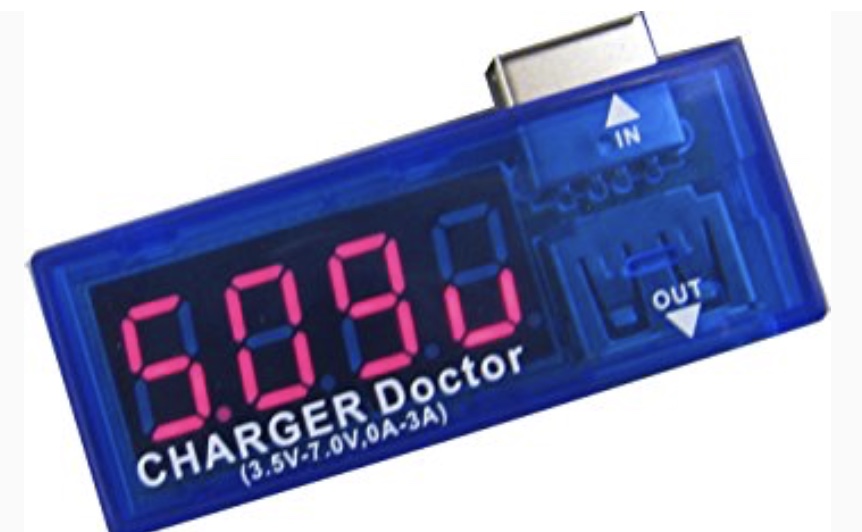
I’ve found it very helpful to use an in-line, USB ammeter/voltmeter ($1-$2) on eBay out of China.

Then I compare different chargers charging the same device with the same cable and compare different cables while using the same charger and device. Some results were so striking (0.87-0.95 amps on various chargers but 0.17-0.25 on a few) that I’d throw away the most horrible chargers and cables.

David Thomas BPL Member
PostedSep 21, 2018 at 3:50 pm

They can be hard to find, but I’ve really appreciated a few short, multi-outlet charging cables. I’ve got one that is micro-USB, old-style iPad and new-style iPhone all from one USB port, letting me charge three devices at once (if speed doesn’t matter or they are small amp draws like LED headlamps and Bluetooth ear buds). And at only 9 inches long (each of the three wires), it’s about as light as possible.

If you have a ton of devices to charge (phone, camera, inTeach, GoPro, Drone, battery banks), bring an extension cord sold for Xmas-lights. They’re light gauge with 9-12 110-volt outlets. That way, in a coffee shop or hostel, (1) you’re not using all the outlets and (2) if all the outlets are already in use, you can insert the cord between the wall and an existing user and create more outlets for everyone.

I travel with one while overseas because then I only need one Europe-US adaptor and the extension cord gives me 10 more US outlets. For backpacking, I’d cut the cord shorter to 4-6 outlets.

PostedSep 21, 2018 at 5:45 pm

After thru-hiking the PCT in ’14 and just finishing a thru of the CDT, I’ve found that the fast chargers are not needed and only add weight to your pack because they are heavier, add bulk and will save you about 30 minutes on average. I am very satisfied using the 5w plug and lightning cable  that came with my phone and using a second 5w plug to charge my 10,000 mAh battery that was seldom drained below 50%. I always had more than enough time to charge the battery, phone, Inreach Explorer and MP3 player while in town with what I carried. Unless you are trying to set a FKT for the trail, in my opinion, you are over thinking a simple problem that doesn’t need solving. Far better to keep things as simple as possible for a thru-hike, you’ll be happier for it.

Bob Shuff BPL Member
PostedSep 22, 2018 at 1:47 am

+1 testing the entire set with a current meter.  Especially if you are expecting the higher voltage and current.  A cable can make a difference when the battery is negotiating the max power transfer

Bruce Tolley BPL Member
PostedSep 22, 2018 at 2:42 am

Both the Anker Powercore 10000 and the Anker Powercore Speed 10000 have rated inputs of 5V 2 Amps. The high-speed charging supported by Anker is between the battery back and the phones that support the high-speed charging. Even the USB -C input on the Powercore Lite 20000 is rated at 5V 2 Amps.

Jerry Adams BPL Member
PostedSep 22, 2018 at 2:52 am

“Diymore USB Charger Doctor Current Voltage Charging Detector Battery Voltmeter Ammeter”

from amazon $8.99

I got something similar that they don’t have anymore

you can test charger before you plug your expensive electronic device into it, check voltage and current

Viewing 15 posts - 1 through 15 (of 15 total)
Loading...