So I am doing my first long distance hike this summer with a fellow BPL’er in the Sawtooth wilderness in Idaho in mid July. We are covering 60-65 miles over 5 days and a significant elevation change. 5k-8k of elevation change a day. I am fit but not in fantastic shape. For the last two months I have been doing training hikes 3-4 times a week consisting of carrying my fully loaded pack for 6 mile hikes. The first two months were on a flat urban trail. Now I am training on actual trails. The trail I am currently doing is 6 miles round trip with a nice ridge right through the middle (400 ft of elevation change in about 1/8 of a mile) with a total of 1200 ft of elevation change in 6 miles. Which makes for a fun up and down. I am looking to add an additional 10-12 miles a week now. Also now that the high country in Arizona is defrosting I am planning on adding one long hike once a month doing 10-15 miles above 9K ft. I am also beginning a kettle bell workout program 2-3 times a week. My calves are stiff/sore the after my hikes but with stretching that goes away and I feel fine so I don’t know if I need to work harder. I am wondering if this is sufficient training for the 3 months I have left? I could hike 18-20 miles right now a day without a problem on a trail without the elevation change we expect to see but the elevation change and altitude of this trip is where I am most concerned as I have never encountered this much change in such a brief period of time. Can anyone offer any advice on how they have trained in the past for such a trip? Thanks!
Topic
Training for first long distance hike
Become a member to post in the forums.
- This topic has 44 replies, 17 voices, and was last updated 10 years ago by .
Depending on how heavy your pack will be, you can get away with cardio (6mi runs) and upper body workouts (pull-ups)
Your training seems like more than enough to me. I think you’ll be fine for 13 miles per day with elevation change. Just be sure to drink water when you get out on the hike and the altitude shouldn’t be too bad. Baby aspirin helps me when I first start to get acclimated to high elevation. Especially if I haven’t given myself time to acclimate before exerting myself.
if you are doing 13 miles a day on your trip, I don’t think you need to do longer than that on your training hikes. lots of 6-10 mile hikes with a 13-15 miler every 3rd week or so.
if you are in good enough shape, I would focus exclusively on the climbing and descending and skip the hiking on flat terrain. this is what will really get you prepared. hiking with a pack is good. But I would mix the weight up a bit, some days with a lighter weight pack, like half of trip weight, and some days with full weight. this should help teach your legs differing cadence rhythms and give you some variety.
what is the highest and average elevation of your trip ? if these are above 8,000 ft you may want to do as many elevation hikes as possible the last month before your trip.
Total pack weight fully loaded with all consumables, gear, water, food, fuel, etc… is 24 lbs. I am trying to get in as much ascending/descending as possible but I live in the burbs of Phoenix and there isn’t a lot of that nearby that is easily accessible for me and fits in to my work/family schedule. The trail I am doing at the moment is about 6 miles round trip and the total elevation gain/loss is 1,400 ft. I would have to drive 1-4 hrs to get to a trail with some good vert and I now drive a Honda fit as I have a long commute to work everyday so I can’t get to the trails I used to when I owned a Jeep. The trails near Flagstaff I can hit here at the end of this month are easily accessible via a car and have some good distance/climbing/ascending. The loop we are doing in the Sawtooth will be 90% above 8,000 ft with the highest elevation being 10,715 ft. After 20 years of long distance running I can no longer run as there is too much scarring and damage to my plantar fascias and Achilles. If I kept running I would have to have had major surgery that might cause me to lose 30-40% functionality in my Achilles afterwards so no running for me.Thankfully I can still hike.
My plan right now is to go once a month to Kendrick Peak here in AZ it is 10,423 ft and the trail is 9 miles round trip. There are tougher trails like Humphrey’s but they are super crowded with people and I generally try and avoid crowds. I will probably just day trip it once a month in April, May then in June I am planning on doing it twice and probably staying overnight those times at altitude. A doctor I know who researches AMS where I work said that the effects of being at altitude stay in your blood for 6 months so I am hoping that 3 months of trips to altitude will help me when I get to Idaho in July. I will have about 1 day to acclimate upon arrival. I do not leave things to chance and I have acetazolamide and dexamethasone if needed.
Thanks for the link Link… lol that article has a ton of good information.
your trip does not sound super high altitude but could cause issues depending on you. if you may have issues of sickness I’d recommend Diamox 2 days before your trip and continuing thru out your trip, or at least 2-3 days into your trip. don’t wait until you are sick to take the drugs.
even if you don’t get sick, exercise at altitude will be an issue, so some altitude training for this would be a help.
your training plan sounds decent given your situation. I was going to recommend some pack free power walks up hill, but if you have plantar and Achilles problems this may not be good. at any rate, you probably don’t need to wear a pack more than 2-3 days a week at most in your training.
It is not super high altitude but I do live at 1,200ft now and altitude does effect me. I have been using the Diamox for 2 years since I got AMS in May of 2014. I do as you said, take it 2-3 days before I get at altitude. The only side effect I have noticed besides the deep breathing is having to urinate a lot more frequently so you definitely need to pay attention to hydration.
If this trip was at sea level – 8,000 ft I don’t think I would be worried but since it is at altitude this is one of my greatest concerns as my body is not used to it any longer (I grew up in the mountains) but have lived at/near sea level for the last 18 years. I am hoping 3.5 months of monthly hikes at altitude will help. I am probably going to spend the weekend before my trip hiking at altitude as well then rest for the 4-5 days before my trip.
The side effects of Diamox can be as bad as the AMS. Best of all is a slow acclimatization. If you can give yourself two or three days to get to 10,000 feet, it will make a BIG difference.
Paul I agree a slow acclimatization is best but I do not have the time for that on this trip. I have been using diamox for 2 years with little side effects other than peeing a lot. It affects everyone differently. As planned we will not hit Cramer divide (9,500ft) or Mt Cramer (10,715) until day 3. My plan is taper the diamox to none by this point (hopefully). I am more hopeful that 3.5 months of hiking at altitude does the trick beforehand.
I’ve never heard any mountain sickness doctor say the side effects were worse than AMS.
there can be a minor tingling/buzziness in the first couple days that scares hypersensitive people, but its not dangerous.
I would find a steep hill nearby (South Mountains Park?) and considering doing hill repeats once a week added into your regime
if you want to train for vert, hill repeats will yield the very best bang for your buck
Mike,
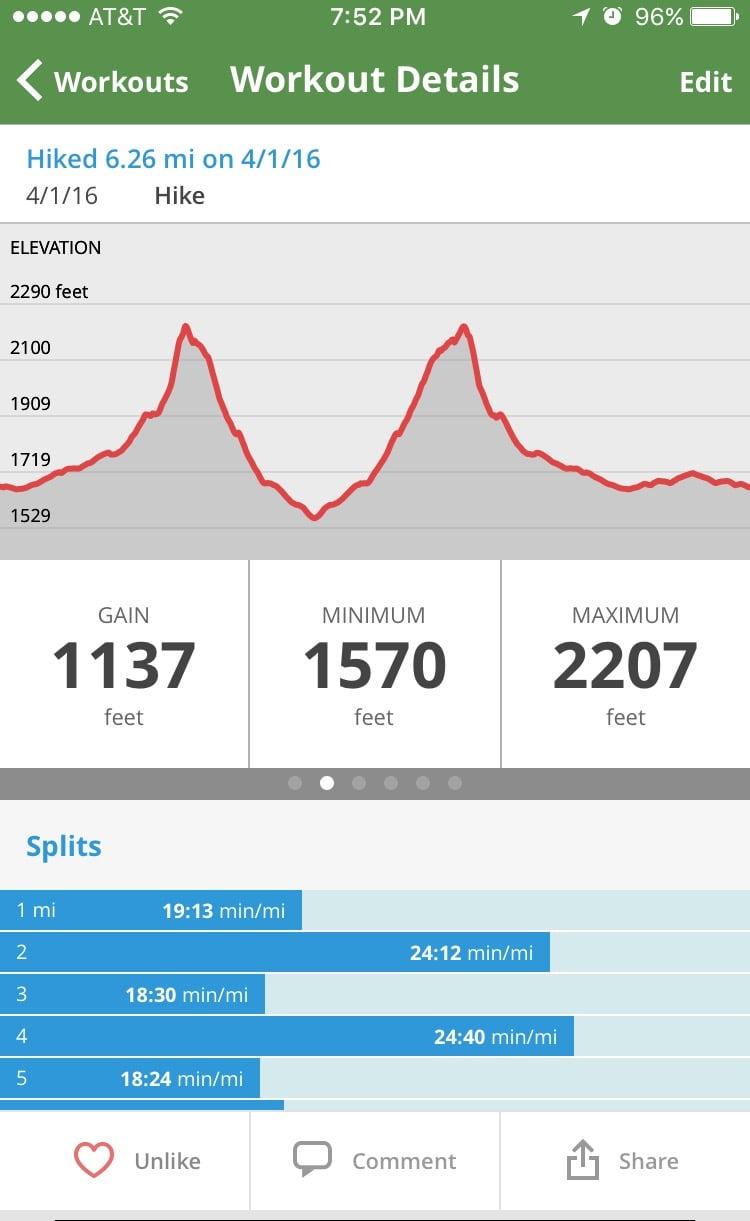
I could do hill repeats at San Tan Mountain park on the Goldmine trail near me (Pretty much what I’ve been doing is 6 mile hill repeats). I am going to start hikes on trails like Barnhardt trail, Reavis Falls, etc… that are roughly 12-14 miles long roundtrip with 3-4K of elevation change on the weekends with the one trip a month up to Flagstaff for the at altitude hikes. Attached is a pic of the distance and elevation change of that Goldmine trail. 
yup those look good :); if you can find steeper even better
I have a brutal hill nearby that is just over a 1000′ in ~ .7 miles- I try to get three of them in a session, they are tough enough I only do them once a week, but they have paid off handsomely
This is, by far, the best, most comprehensive training guide for long-distance backpacking. And I say this as a professional (PT that is…)
Jennifer,
lol.
Mike,
I am definitely on the lookout for a hill like that but am trying to not spend 2 hours just getting there and back on weekdays. I already spend 2 hours a day in traffic commuting to and from work.
Art,
I agree. The doctor that prescribed me the meds does research on altitude sickness for Nasa and the Airforce. He is kind of an expert on it and he made it clear that the symptoms of AMS (which can lead to death) are far worse than the symptoms of Diamox.
Heath- one other thought; I’m not much on exercising indoors, but if you can find one of those old stair machines, not stair stepper, they are big and have an escalator like setup- often referred to as the stairs of death :). These are a very effective machine, most gyms have gotten rid of them , if not they tend to be covered in dust. I don’t have experience with Vera Climbers, but have heard good things (well bad like the stairs of death) about them. They might be a useful supplement to your regular training.
Mike,
Yeah not a big fan of exercising indoors either. I grew up in the boonies where there were no gyms and find gyms weird. As a kid I took care of horses, cows, chickens, a large garden, building barns, bailing hay, swapping engines, working on cattle ranches, hiking, hunting, skateboarding, etc.. doing physical things that built muscle and endurance. I’d rather hike/climb/skate/surf/kayak/swim, etc… as an adult than step foot in a gym as I find the whole stand in a big stinky room full of strangers and pick up and put down heavy things or run in place watching tv very strange.
Art and Heath
Point well taken. AMS can kill you. Diamox can make you feel uncomfortable. But my wife found that Diamox made her feel lousy enough that she didn’t feel hiking…which is pretty much a problem.
Don’t forget that if you are flying to your destination, that time in the airplane counts as acclimatizing at about 6,000 feet, depending on the plane.
And yes to hydration. Absolutely critical, particularly if you are hiking long days. Keep drinking and peeing!
Art,
I totally forgot that airplane cabins are pressurized to the equivalent of 6,000 ft elevation That will help a bit!
For a big hike, I have a 5 week training plan. We probably need to keep in mind that each of us is different. Sometimes I think we over analyze training for backpacking or even confuse backpacking with what might be considered the extreme of the sport such as Chenault’s annual Bob Wilderness Classic or the Alaska Mountains Wilderness Classic, which are adventure races, not backpacking.
As I am prone to say, backpacking is just walking. The best training program for backpacking is to simply go backpacking often. Unfortunately for most backpackers, this isn’t something they can’t do often enough.
I walk every day and most years I hike or backpack every weekend, plus do several longer backpack trips every year. It is rare for me to actually “train” for a hike. I should note that I am probably blessed with a healthy physiology, or perhaps live a fairly healthy lifestyle. I do run occasionally, but it is more for fun than training, something I have been doing for decades as I was a fairly successful high school distance runner — but I should point out that as a kid I had severe asthma and we had no money for medical treatment, so I started running as my self-help cure. I had read that this might help me “out grow” my asthma, which apparently worked. So I started out as a very sickly and frail kid.
Except for a couple of years as a young adult, I have lived my entire life at or below 400′ elevation. High elevations have never bothered me, but perhaps this is because I often hike in mountains, or perhaps I am just lucky? I have never hiked anything higher than Mt. Whitney.
5 week training plan.
Anyway, here is my training routine for a big hike. An example is when Craig Wisner and I did a 3 day, 60+ miles, 20K foot elevation gain/loss trip. Since I was 60 at the time and nearly twice Craig’s age, I needed to up my game so I wouldn’t hold him back too much. Also, I live at the base of Mt San Jacinto, which gives me easy access to trails and elevation gains. My main training trail is the Desert Skyline Trail, often known as the Cactus to Clouds Trail. The first 11 miles has an 8,000 foot elevation gain, the next 5.5 miles a gain of 2,500 feet. Each week I do one strenuous hike and only carry the gear, food, and water needed for the hike, not simulate my actual trip gear. In between each training hike, I would do my normal daily walk of 1-2 hours around town.
Week 1: Includes 6 miles of flat walking to and from the trailhead from my house. Hike up Skyline 3,000′ feet and return. Total mileage around 10-12 miles.
Week 2: Includes 6 miles of flat walking to and from the trailhead from my house. Hike up Skyline 5,000′ and return. Total mileage around 14-16 miles.
Week 3: Walk from house to Skyline (3 miles), hike to Palm Springs Tram (11 miles, 8,000′ elevation gain). Take tram down and walk home (5 miles and 3,000 elevation loss). Total mileage around 19 miles.
Week 4: This is a two day overnight trip. Day 1. Walk from house to trail (3 miles). Hike to the peak of Mt. San Jacinto (16.5 miles, 10,500′ elevation gain). Hike 1 mile to Little Round Valley Camp. Total Day 1 = 20.5 miles. Day 2: Hike to tram, take tram down and walk home. Total Day 2 = 11.5 miles 5,500′ elevation loss. Total trip mileage is 32 miles.
Week 5: Same as week 3, but do the Skyline trail to the tram in under 6 hours. A few years ago it was under 5 hours.
This 5 week training plan prepares me for a big hike.
This was also my training plan a few years ago when I hiked up California’s White Mountains from the base to the peak at age 61. Most years I don’t “train” for backpacking trips, but I am slowing down a little each year. YMMV.
Sounds like a good plan. I am not in good enough shape currently for my trip to only do a 5 week plan. I am hoping that after this training to maintain a high fitness level so I can do a lot more 65/75/100 mile trips like this. There are tons of tall peaks in AZ but nothing near enough to me that it wouldn’t cut in to my family/work responsibilities for me to hike more than once a month.
Heath- if you don’t have tall close by, how about steep? It doesn’t have to be overly tall- steep will work, just more repeats. Good effort up, slight recovery down, repeat as necessary, get ego crushed :)
I think Heath said earlier in this thread he had some Achilles and Plantar issues.
lets not cripple him before his adventure begins. he’s not going for an FKT record on his route, so general back packing conditioning should be fine.
the idea of training hikes with a pack is to get the upper body in shape, probably even more than the leg workout a pack provides.
Mike,
There are two other trails near me (Peralta trail and Picketpost Mountain) that have good gains but I am unsure if my car can make it down the roads to them.
I concur that you’re on track to do just fine, conditioning-wise. You’re doing so much more than most people do before a trip. One thing about these “training for a hike” posts: post your age. I can do anything in my 50s I did in my 20s, but it sure does take more conditioning, for longer in advance, than it used to!
The single biggest return-on-investment of time I’ve ever done before a trip is just walking up and down real stairs (not a Stairmaster in the gym). Few hilly trails will require quite that much lift with each step and the damn Stairmaster just has you moving your legs, not lifting your body up against gravity. The bigger issue is that you never go DOWN on a Stairmaster, treadmill or elliptical and that is how you end up sore and in pain on the trail – from the downhill. Just 10 minutes most mornings going up and down the single flight of stairs in my house for a few weeks in advance (I’m 54) makes a huge difference on the trail because our immediately area is pretty flat, otherwise.
Become a member to post in the forums.