Topic

Tieout attachments for Tent / Tarp

Viewing 15 posts - 1 through 15 (of 15 total)
Frank BPL Member
PostedJan 4, 2026 at 1:22 pm

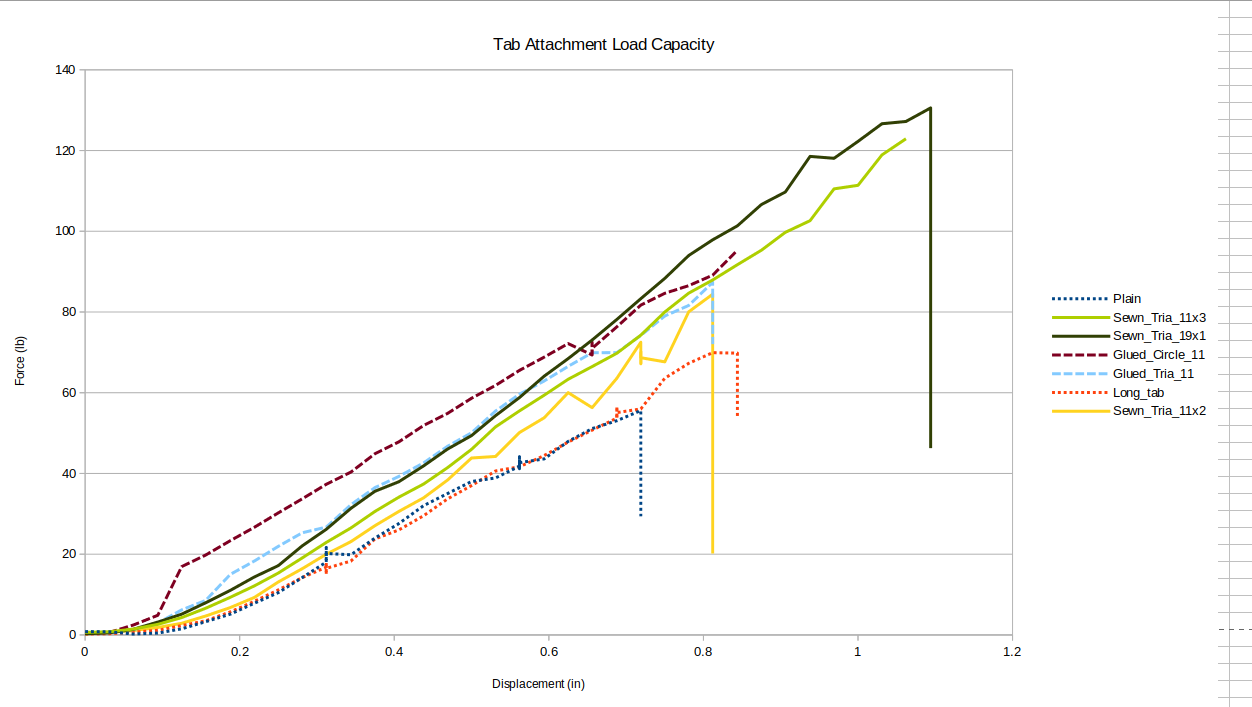
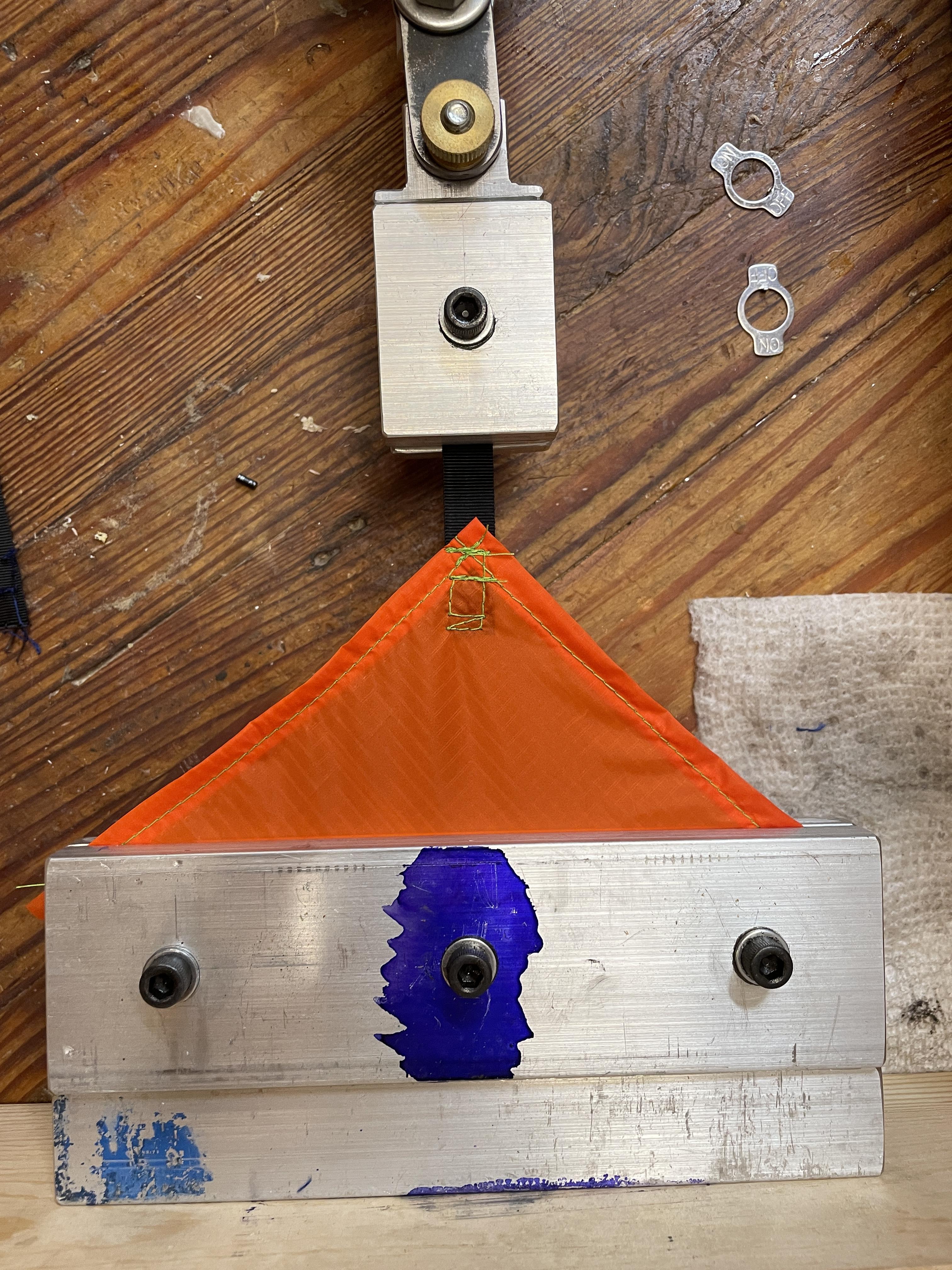
I am planning to make a tarp (cooking shelter, not sleeping shelter), and if the 1.1oz sil fabric leaves me sane maybe I will try for a tent.  Not finding much about how to attach the stake / tie / guy outs to the fabric, I tested some samples with sewn in or glued in reinforcements.  All samples are 1.1oz Silpoly with a 5/16ish rolled hem along the sides.  Reinforcements are either 1.1oz silpoly (x1 or x2 for 1 or 2 layers) or 1.9oz silnylon.  A 1/2″ wide mil spec grosgrain ribbon was sewn to the silpoly with Mara 70 thread.  Thinking the silpoly to be the obvious weak spot, I did not pay particular attention to sewing a consistent attachment.  Results below.
Results

I was rather amazed at just how strong the wispy 1.1oz silpoly is.  Certainly stronger than any tent stake.  The samples without reinforcements showed visible elongation of the thread holes by 20lb, and about 1/8″ long holes by 40lb, for both the 1″ and 2″ long sewn tab.

For the glued samples, the weak link was the thread (to my surprise), so the later sewn in triangles got triple stitching.

The glued in patches were a bit of a pain to make – spread the silnet, stick the pieces together and clamp between thick plywood blocks overnight.  I do have concerns abut long term delamination as well.  The quarter circle patch had significant delamination at the end of the test, more than what is shown in the picture.

Since the sewn in patches did far better than needed, I don’t plan to glue reinforcements on my tarp…


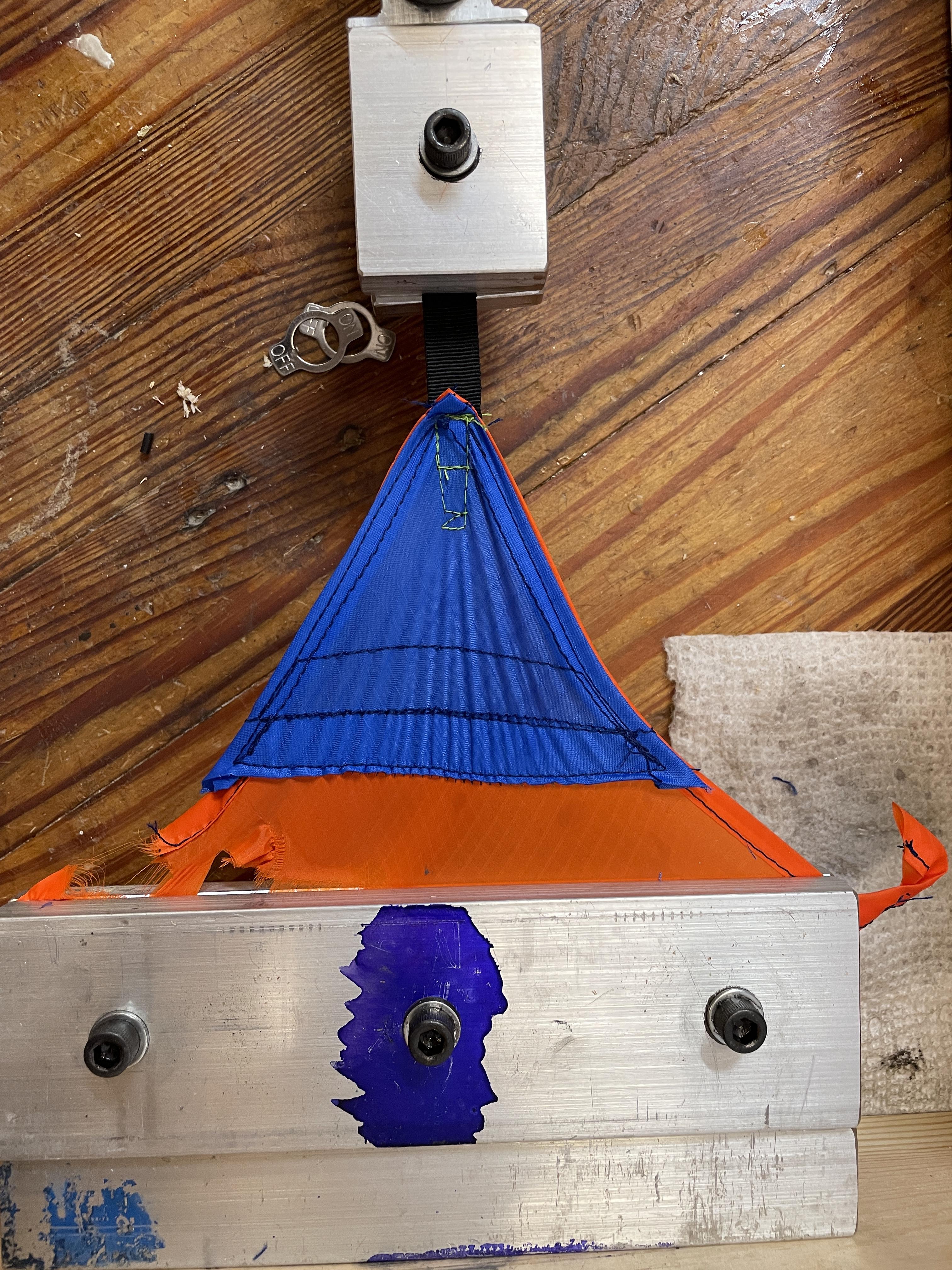
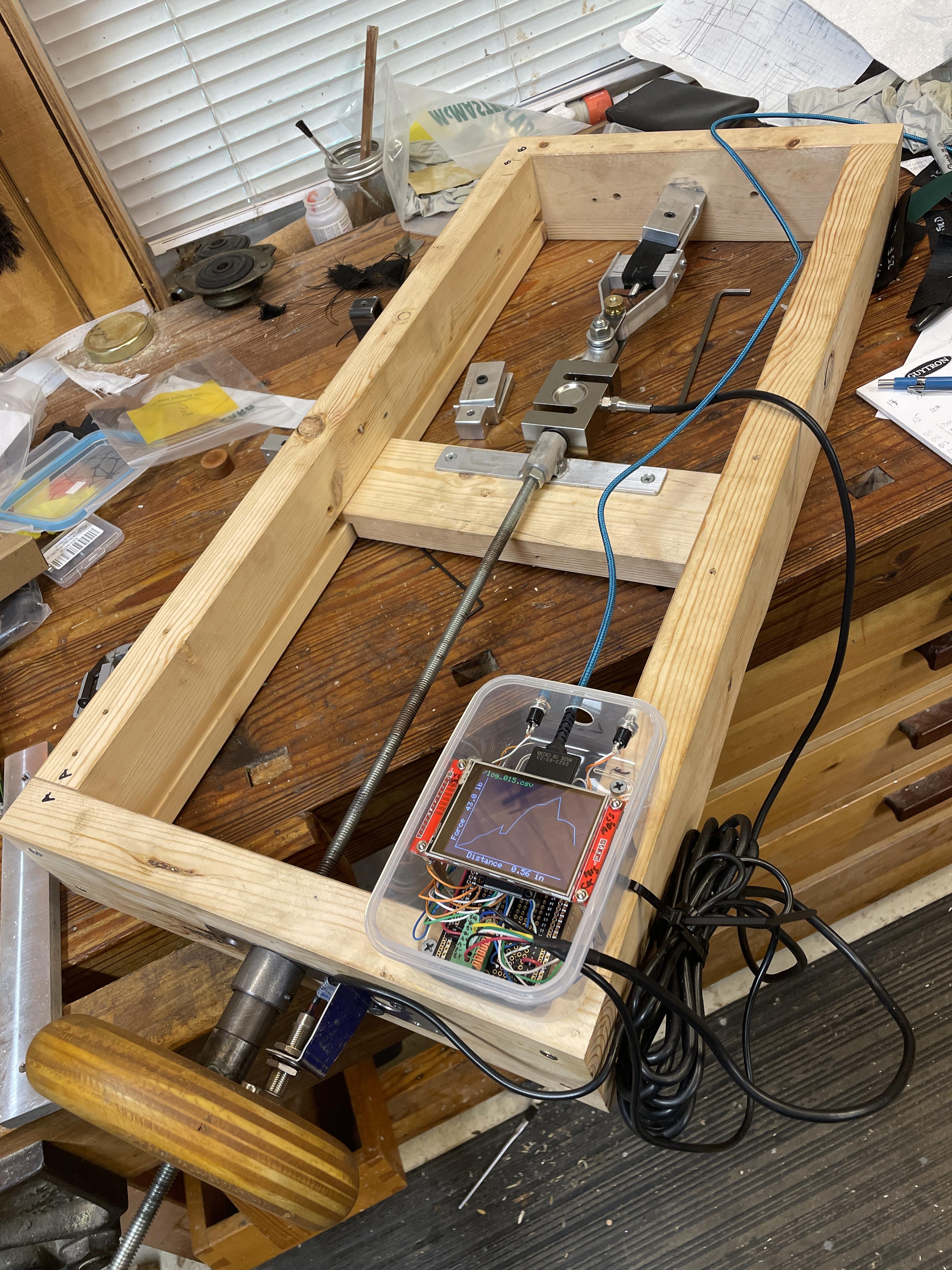
Test Setup (more or less, though this was a different experiment)
 

No reinforcements (same failure mode as the long attachment below):
Long Attachment, no reinforcement (same failure mode as the short attachment)
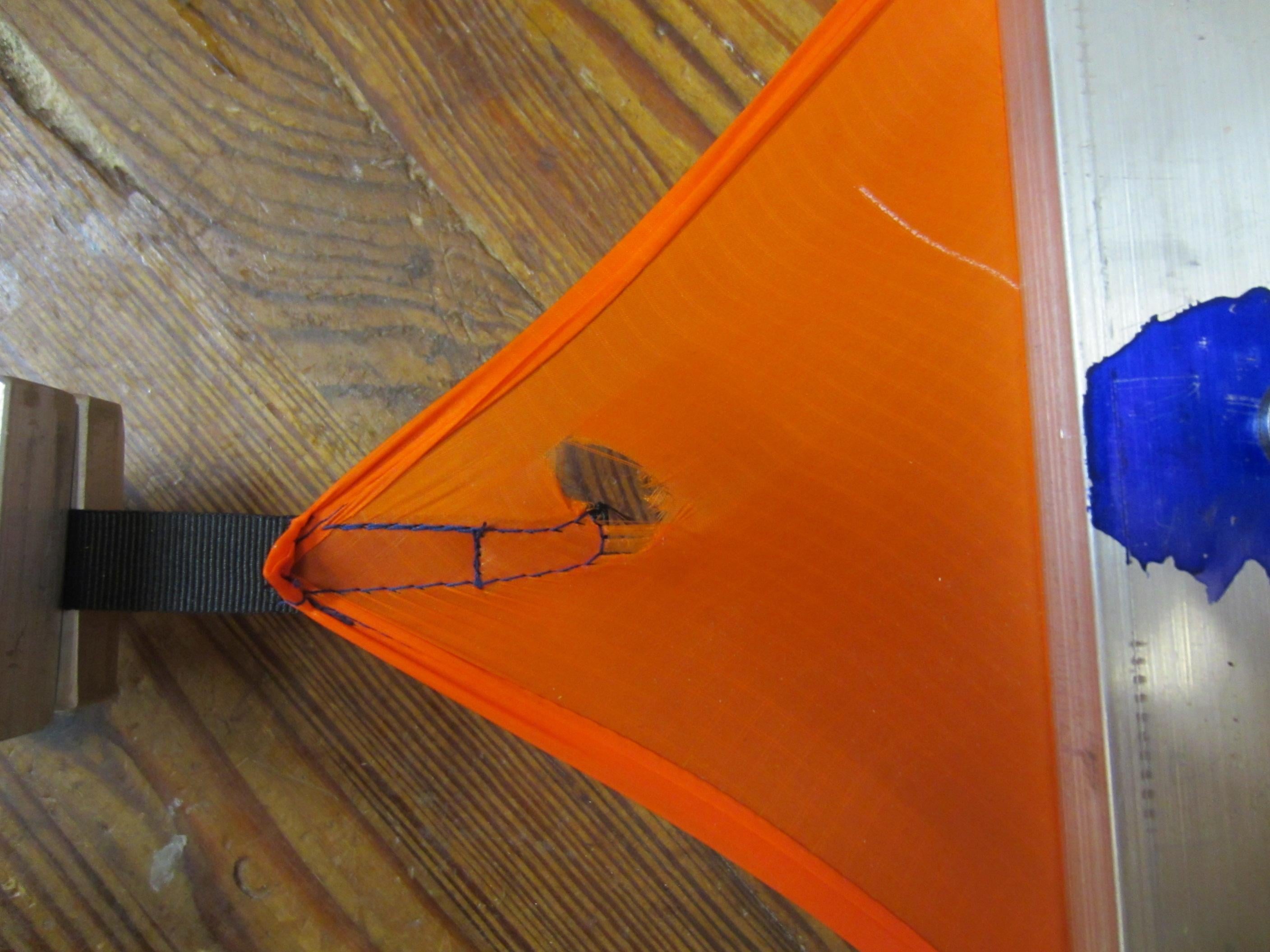
 

Glued 1.1oz triangle (silnet); note delamination.  Thread was the weak link!
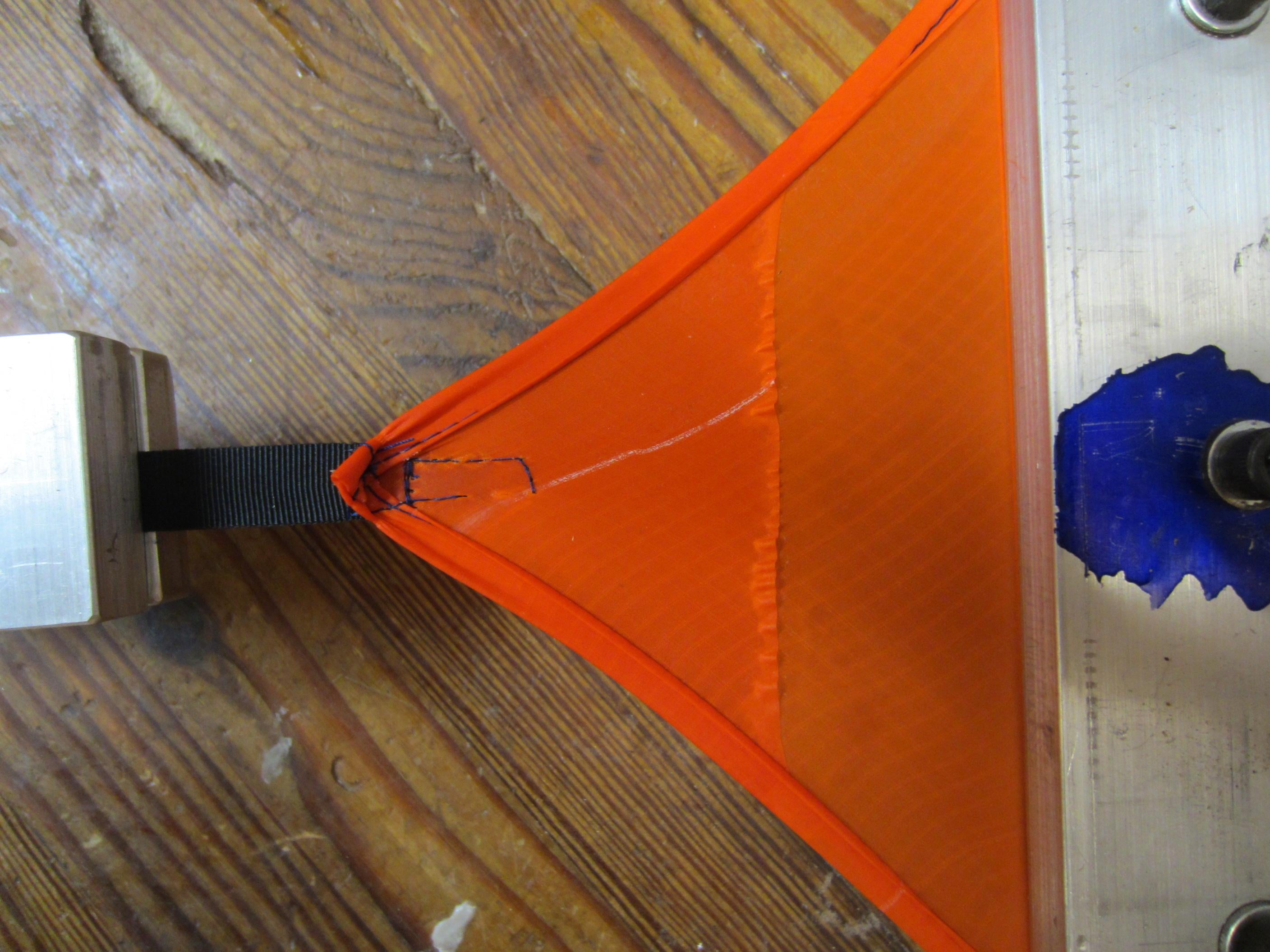
 

Glued 1.1oz quarter circle (silnet); note delamination.  Thread was the weak link!
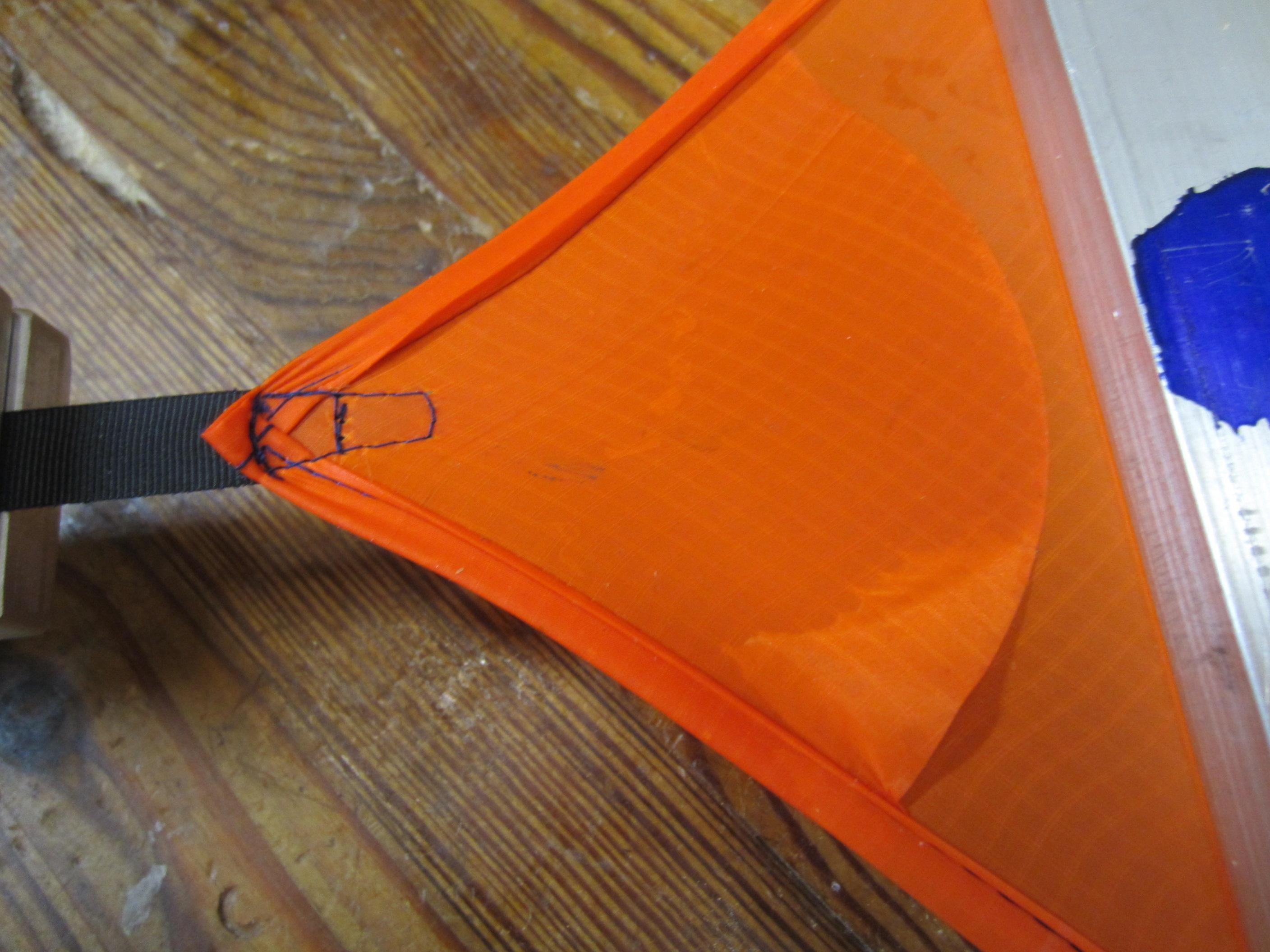
 

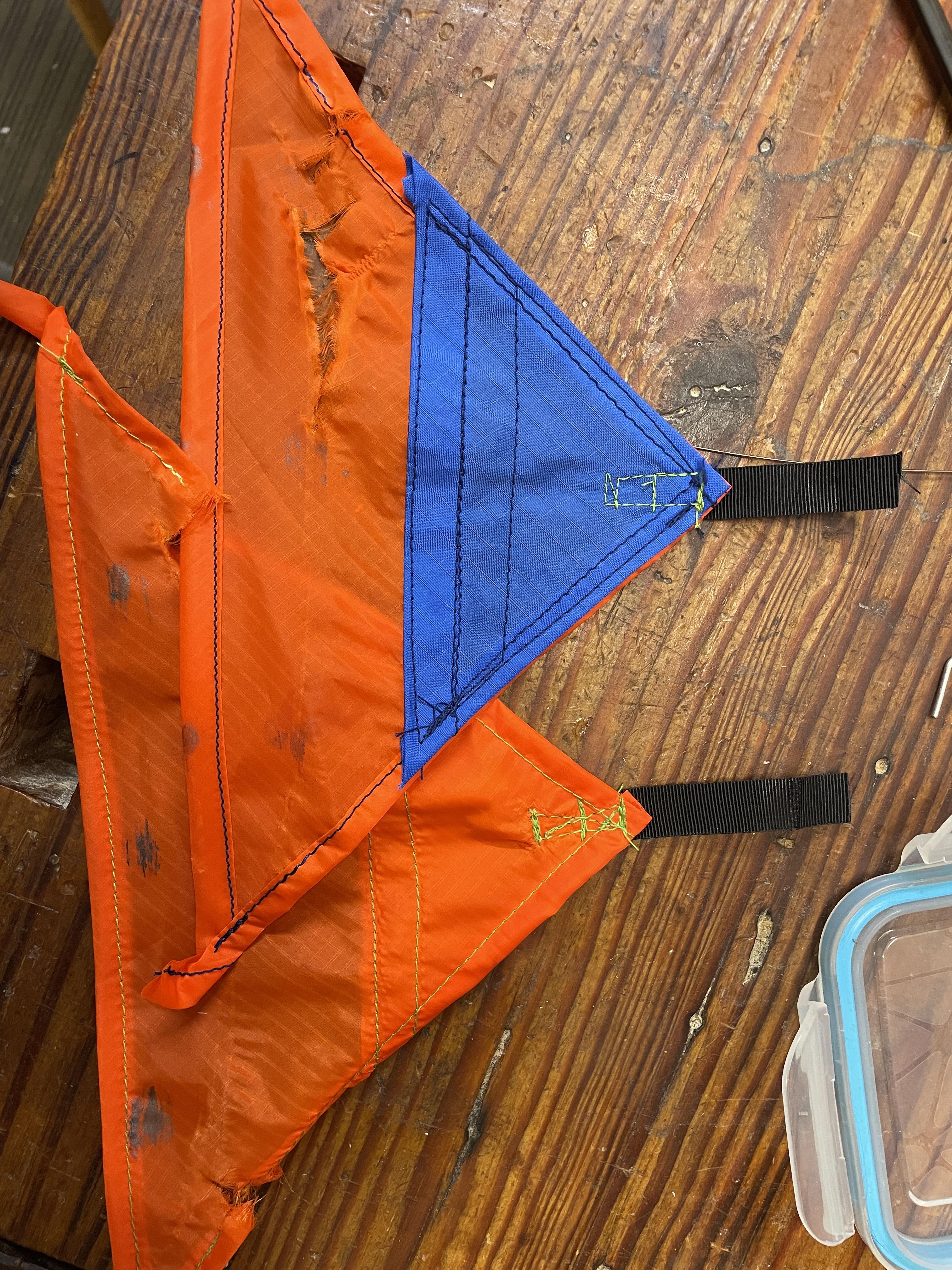
Sewn 1.9oz triangle, single ply; stronger than the silpoly fabric
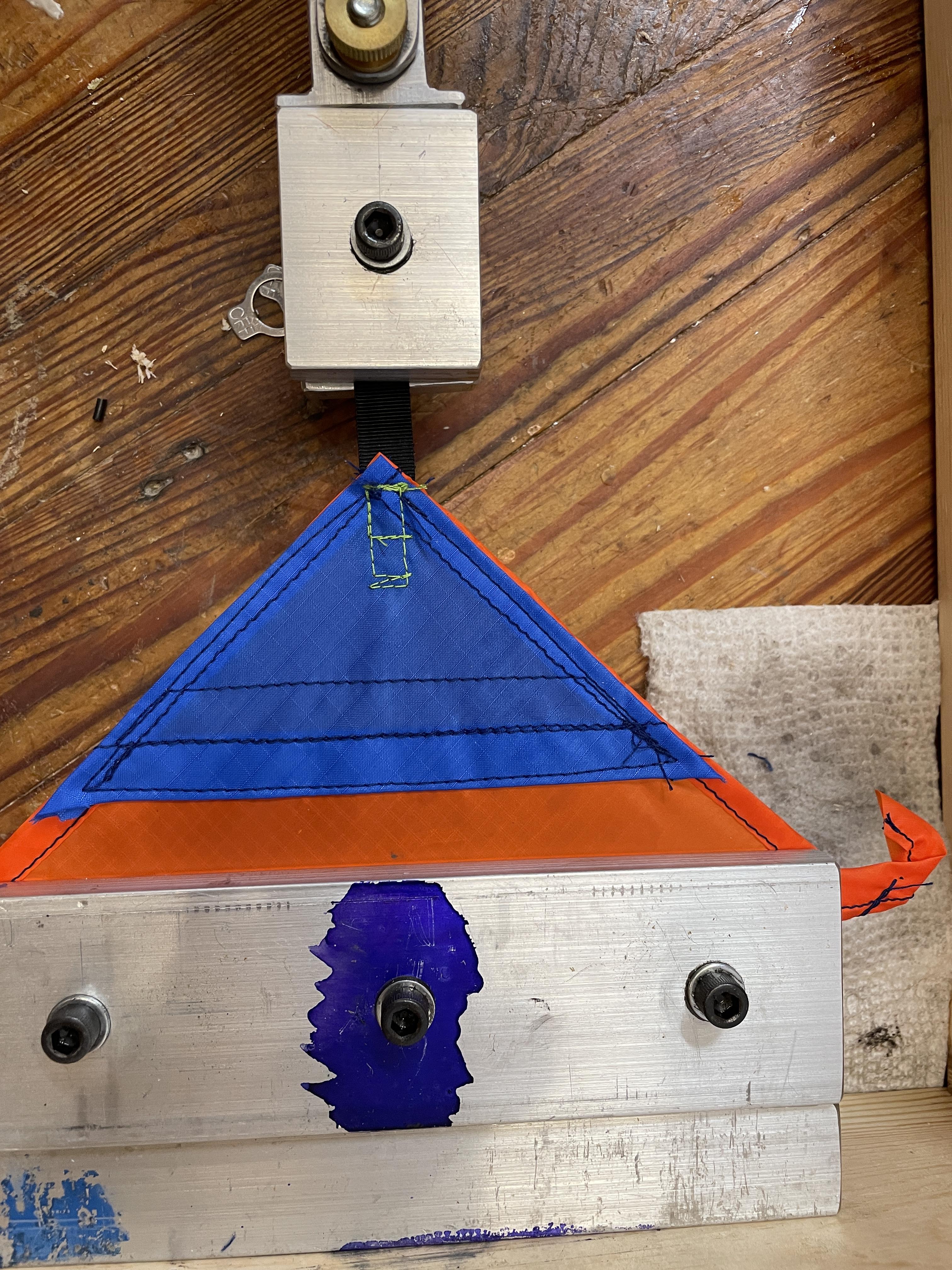
Sewn 1.1oz triangle, single ply; the folded over triangle attachment seam doesn’t seem to work well
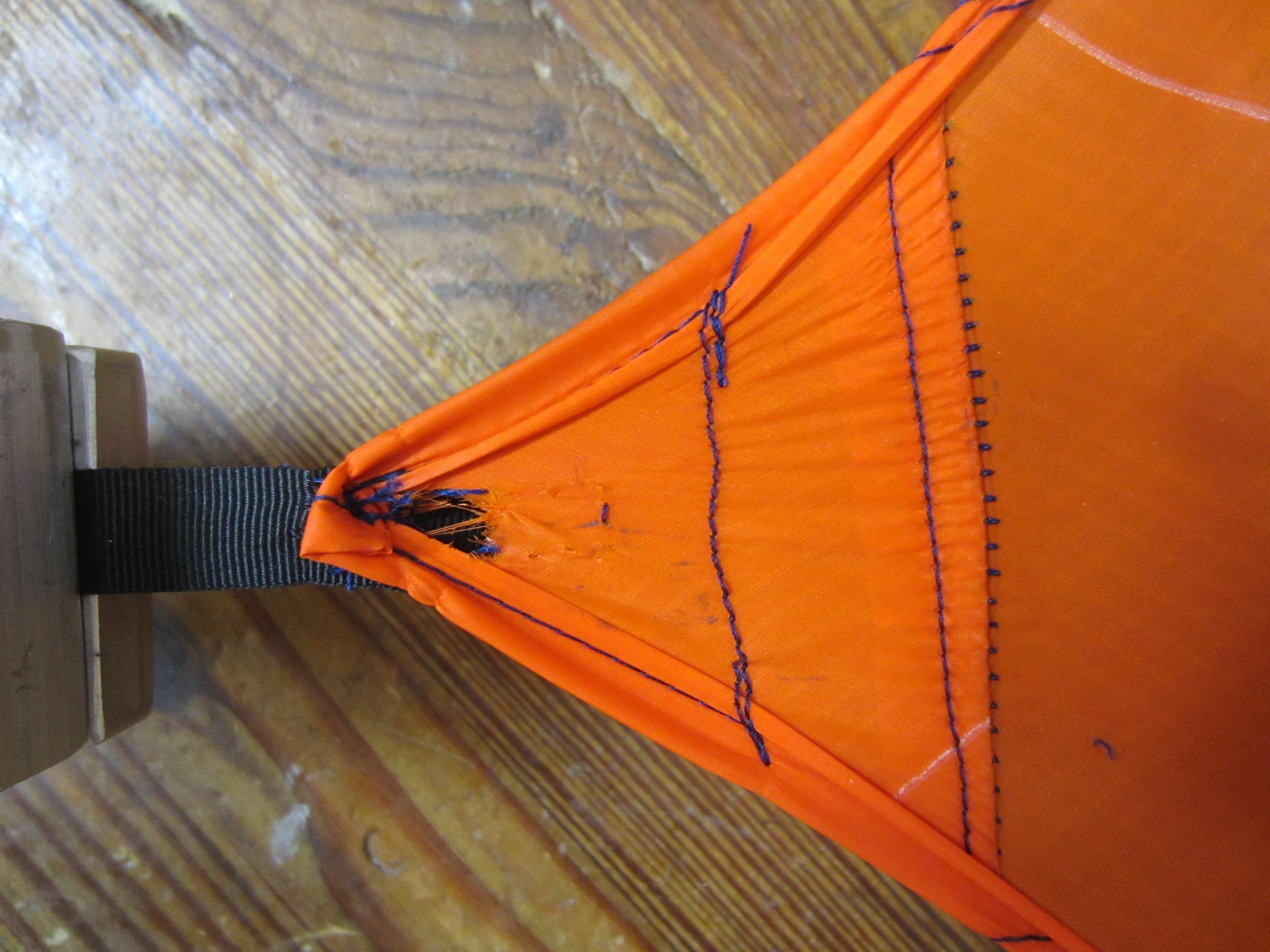
Sewn 1.1oz triangle, double ply; stronger than the fabric
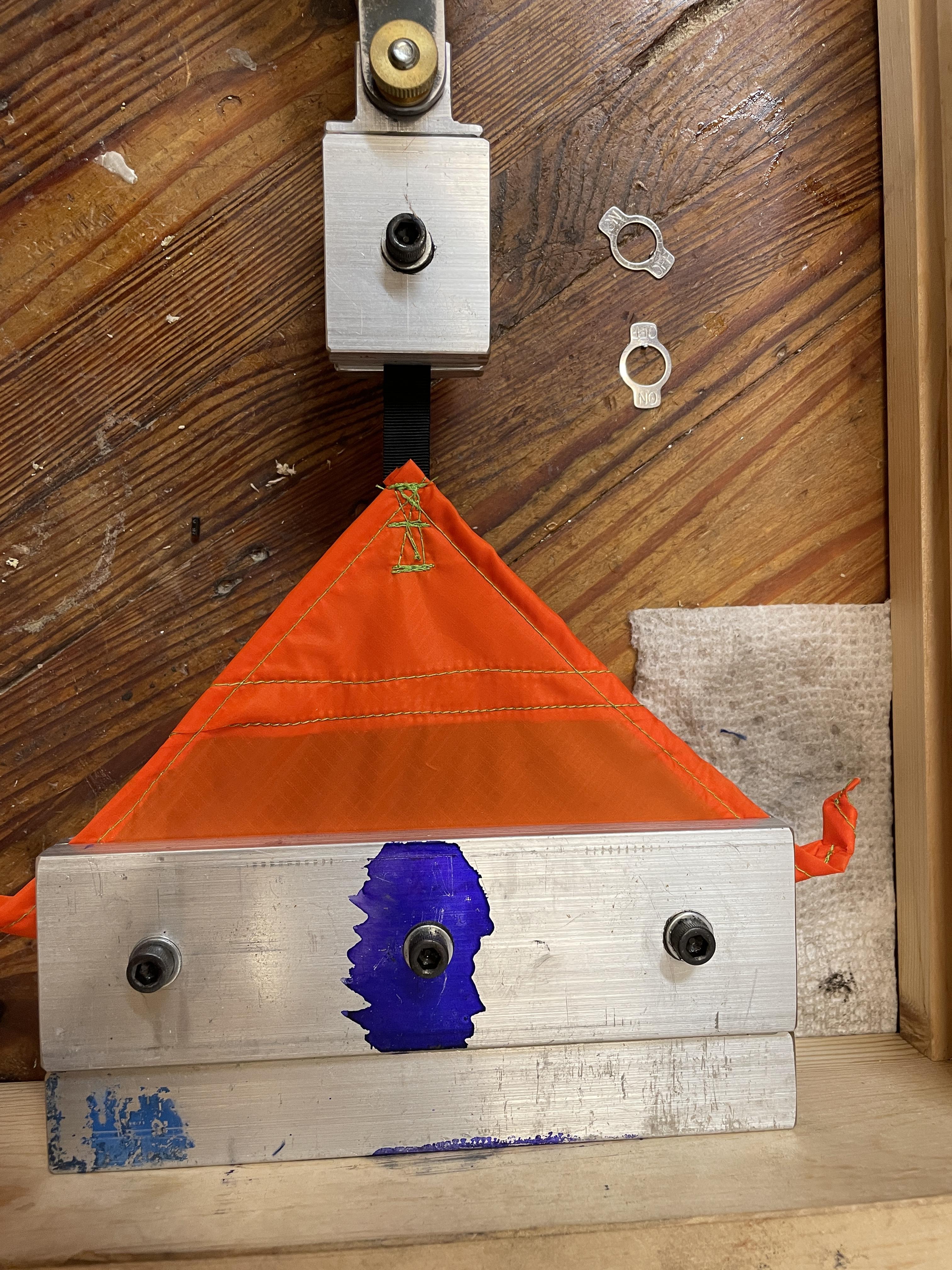
1.1 oz double ply and 1.9oz single ply sewn triangles after the test
PostedJan 4, 2026 at 4:03 pm

Really interesting results! Thank you for sharing. Thinking through ways to repair each type of failure if it happens in the field!

Jerry Adams BPL Member
PostedJan 4, 2026 at 4:54 pm

nice testing, nice instrumentation

When I have used a spring scale, I have measured that I don’t put more than about 40 pounds of force on the tent stake.  You are doing quite a bit more than that.  The tent stake will pull out.  At 40 pounds, the tent seems to be quite taut.  Of course, when it’s windy, it will be more.

So, it looks like 1.1 oz poly reinforcing triangle is good.  Maybe 6 inches wide and 4 inches from the corner?  With 2 rows of stitching?

On my mid, there is a seam running down to the corner.  There is a triangular piece of fabric on each side sewn together with flat felled seam.  Then, I just sew the grosgrain to the flat felled seam – 5 layers of fabric.  That has never failed.

Then, to maybe digress a little, when you pull on the fabric from the corner, it pulls along the bias.  Halfway between the horizontal and vertical (half way between warp and weft).  This is terrible because the fabric stretches a lot more on the bias than either the horizontal and vertical.  And then the fabric distorts.    So, I run polyester grosgrain from the corner where I make the tent stake loop, to the peak of the tent.  That does not stretch the fabric along the bias.  And then, you don’t need any reinforcement – the grosgrain takes most of the load.  The fabric stretches sidesways from the grosgrain a little.

It’s interesting that your fabric rips in many cases, above the reinforcement.  I wonder if this is just because you’re putting such a large load on it beyond the strength of 1.1 silpoly, or are there some reinforcement methods that make the fabric fail beyond the reinforcement.

Roger Caffin BPL Member
PostedJan 4, 2026 at 6:41 pm

Jerry and Ryan +1
A very nice home-built Instron tensile tester.

But I also agree with Jerry about the loads to be expected in the field. I do not think that testing to >100 lb is needed or all that useful. In my experience, and that of others, real loads in the field are far smaller.
Many years ago (2008) Will Rietveld did some test on the holding power of different sorts of carefully placed stakes. Not many of those stakes held more than 40 lb.
Later on in 2012, Ryan Jordan did some testing of the loads found in the guy ropes of an UL shelter. His data showed a peak load of <9 lb (once), with some peaks around 7.5 lb, and most of the load around 6 lb.


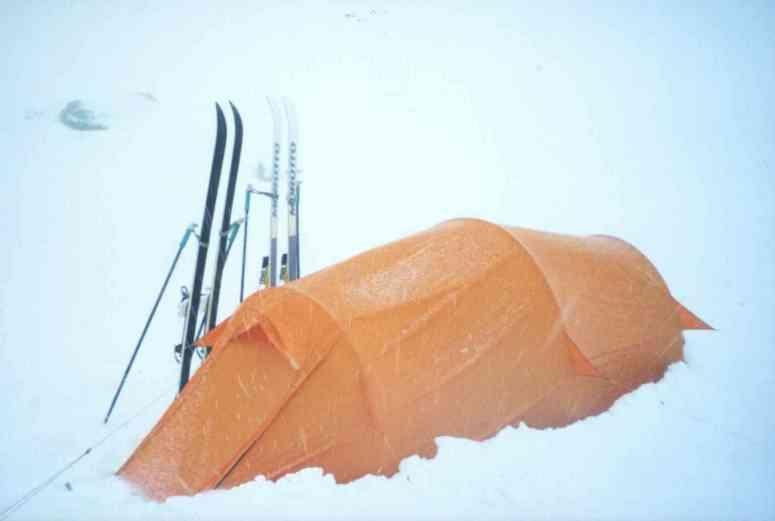
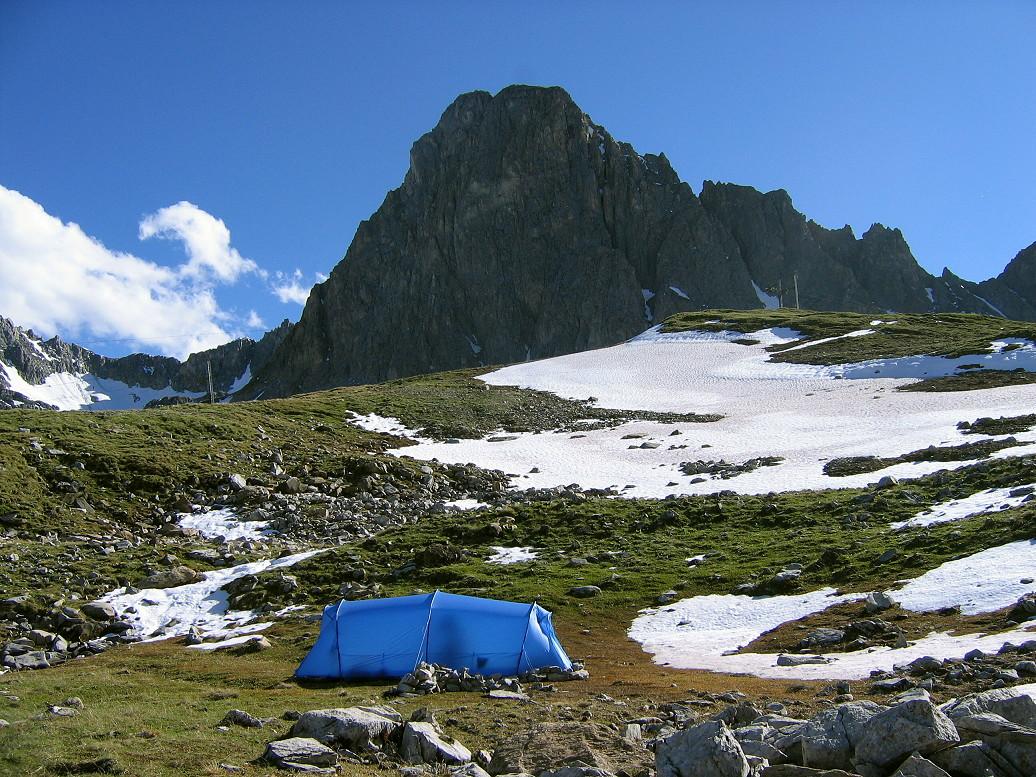
This is my orange winter tent: made from light PU-coated nylon. All seams had been ‘engineered’ rather than just thrown together. The tent was hammered all night, but we got bored and went to sleep. Yeah, the morning was a bit rough too, but the tent had no trouble.


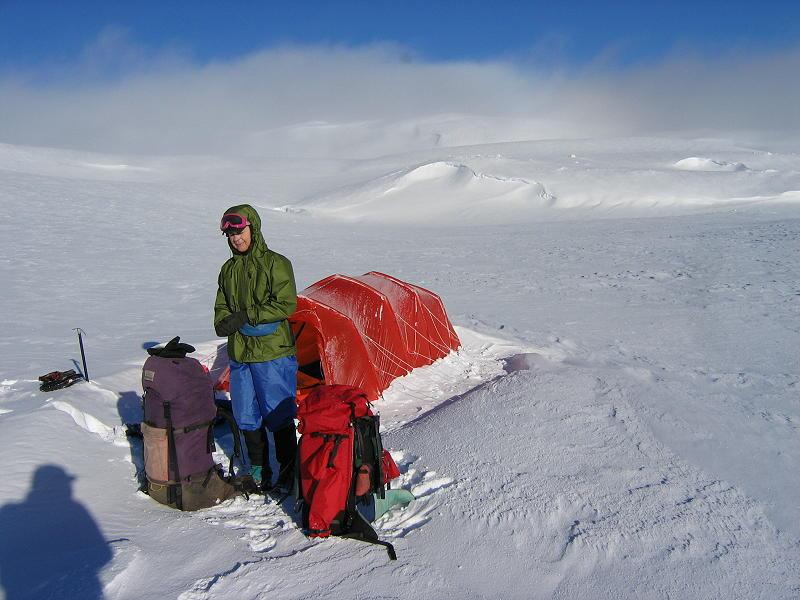
This is my second winter tent: light red silnylon. An even harsher test: a 100 kph storm on the second night, into the next day, but again without any sign of trouble with any of the seams or anchor points.

Can I imagine putting 100 lb anywhere on either of these tents? Not likely!
One thing I am careful about: I put the loads on reinforced multi-layer seams, not on a single line of stitching on a single layer of fabric. That has worked very well for me.

Cheers

Jerry Adams BPL Member
PostedJan 4, 2026 at 7:36 pm

“but we got bored and went to sleep”

Same thing has happened to me

My tent has also collapsed in the night, but it was from doing something stupid.  Too small pole.  Rock holding the stake down abraded the tent stake attachment.  Otherwise 1.1 silpoly us strong enough

Frank BPL Member
PostedJan 5, 2026 at 5:48 am

I totally agree that 100+lb is a silly load.  I was not expecting it!  I figured things would come apart between 20 and 40 lbs even with a reinforcement, and I wanted to know what style I should use.  Mainly, glued vs sewn, triangle vs quarter circle, and same fabric vs heavier fabric.

As a bonus, at least for me this also answers the silpoly vs silnylon debate.  Silpoly seems plenty strong, and I hate the sag my wet-from-condensation purchased silnylon tent gets in the morning, every morning.  One of its advertising points was the superior strength of silnylon, of course provided without context or data.  There are other vendors who claim the superiority of silpoly, also without data.  Well, perhaps both are more than strong enough, at least for 1.1oz fabric, leaving the debate to focus on other performance attributes.

I’ve done some very casual experiments with tent stakes and a fish scale, and 20lb seems to be the limit, at least in my backyard.  I suppose rocks placed on top of stakes could increase that somewhat.

My first silpoly project will of course be a tarp, maybe 8×10, as a cooking shelter, and that will be at least partially tied to trees, likely subject to higher wind loads as it is further out of the boundary layer than a tent, so loads will be higher – I have no feel for how much.  Of course, I’m pretty sure linelocs and 1.8mm paracord would not hold 100lb either, and that is my planned interface.  I suppose I could find out…

I also agree that for a trekking pole style tent where the tent body and the door come together with a felled seam, a reinforcement may not be needed at all.  That seam should be plenty strong.  Though if I ever get to making a tent, I would probably add one just because…


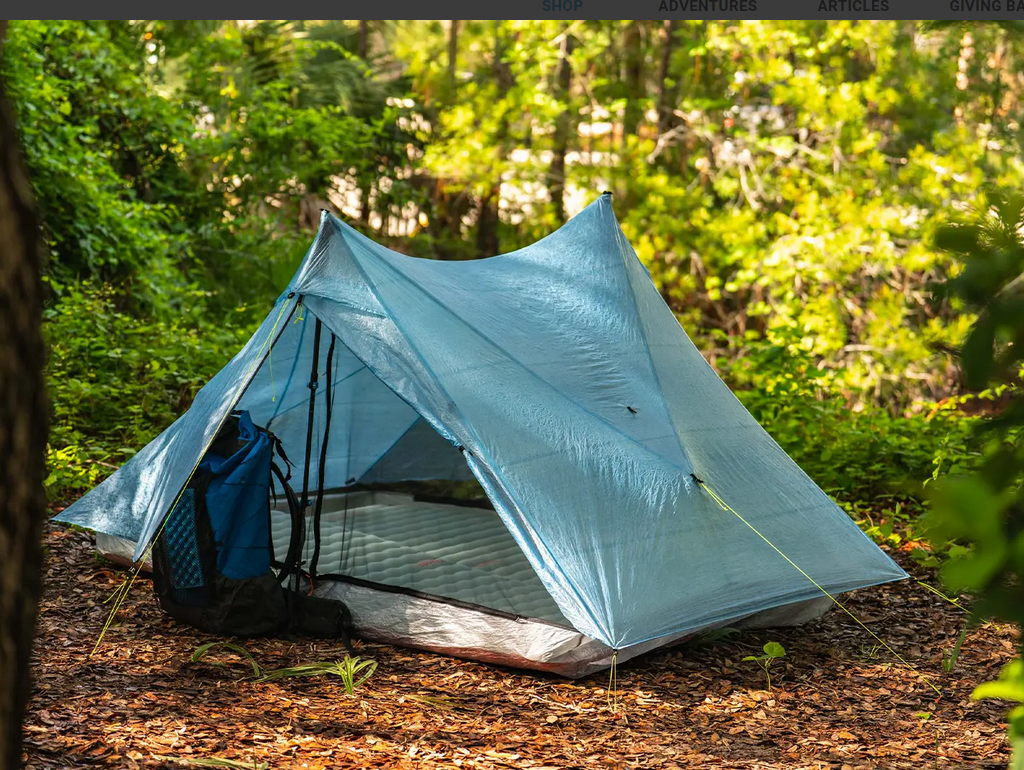
I am curious about the stake to peak reinforcement.  I have seen on some dyneema trekking pole tents with a guy-out in the middle of the panel (for head / foot room) two strips of tape running from the guyout to the two peaks, I assume to keep the fabric from deforming along the bias.  I have not seen anything running from a stake corner to the peak, so I am not sure I have the correct image in my head.

Jerry Adams BPL Member
PostedJan 5, 2026 at 8:15 am

on a mid, there is a flat felled seam running from corner up to the peak.

I have experimented with sewing a strip to the flat felled seam, going from corner to peak.  That strip then takes the load, rather than the flat felled seam which is on the bias.  You can put a lot of force on it so it doesn’t droop.  Maybe it holds up better in the wind.

I’ve also screwed it up – the strip was too long so it didn’t really take the load properly.  Probably best to just ignore all this : )

For the reinforcing strip, I’ve used a 3 inch wide piece of silpoly, folded over to make a 1/2 inch width of 6 layers.  That worked.  And I’ve used polyester grosgrain 1/2 inch.  I think those work equally well.

You say there’s strips of tape running from guyout to peak?  I wonder if they have this in mind.  Does dyneema have a warp and weft, and a bias?  When you pull on dyneema on the bias it seems like then the mylar layer would be taking the load rather than the fibers?  You really don’t want to pull dyneema on the bias?  Because it will cause the fabric to delaminate?

It’s an obvious idea, I wonder if any tent make has reinforced the ridge seam like this.

Jerry Adams BPL Member
PostedJan 5, 2026 at 8:38 am

Maybe this crude picture helps

Reinforce ridges

Otherwise, the sides will pull up a couple inches

Because the middle seams are on the grain so they stretch less

You can sometimes see pictures of mids where the sides are pulled up a couple inches.

That’s not all that important, but it helps understand the problem.  What you really want are very stiff ridges.

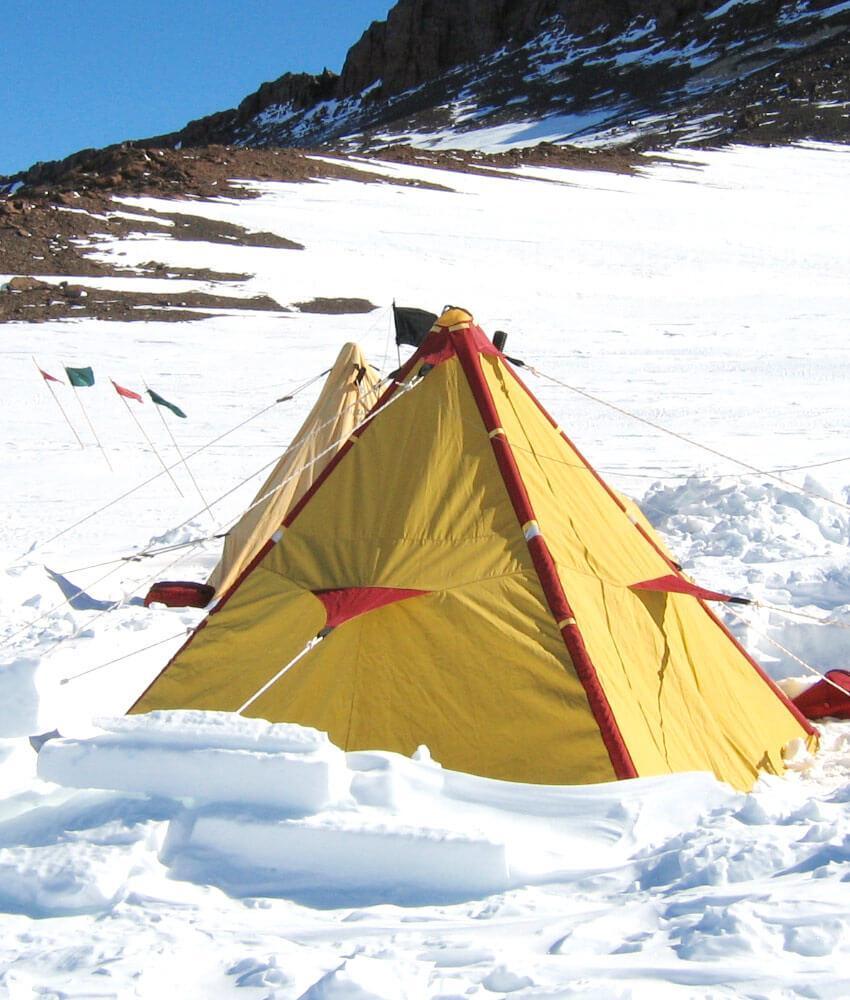
I’ve seen pictures of mids in antarctica.  They had poles in the ridges.  Very stiff.  Much better at heavy wind.  But heavy.

How could we duplicate this with less weight?  A strip running from peak to corner that’s pulled with a lot of force.

I dunno, maybe there’s a useful idea here.

Roger Caffin BPL Member
PostedJan 5, 2026 at 1:30 pm

I’ve seen pictures of mids in antarctica. They had poles in the ridges. Very stiff. Much better at heavy wind. But heavy.
Oh yes, heavy. But they are carried on sleds.


They are made by an Australian company to ANARE specs. (Australian National Antarctic Research Expedition) From memory, which might be wrong: 50 mm Al poles and 3 mm guy ropes.

Cheers

Jerry Adams BPL Member
PostedJan 5, 2026 at 3:45 pm

yeah, exactly.

it seems like if there was a line or webbing from peak down to corner stake and you put a lot of force on it you’d get some of the same effect.

Roger Caffin BPL Member
PostedJan 5, 2026 at 4:51 pm

I’m pretty sure linelocs and 1.8mm paracord would not hold 100lb either,
I use Spectra kite line. My blue tent has guys of slightly less than 1 mm, with a rating of 100 lb. Strong stuff, BUT a bit hard to knot and adjust. Linelocs can’t hold it: I had to develop my own.
You don’t need boat anchors for this.


The rocks around the edge were there for a reason. :)

Cheers

Frank BPL Member
PostedJan 6, 2026 at 8:14 am

I did not have a pyramid shape tent in mind – now the reinforcement strip makes more sense!  I wonder why the pyramid tents don’t run the weft along the corners and the bias along the base.  As a noob that’s probably what I would do, and then I would probably find out why it’s done the other way around.  Maybe the fabric stays tensioned better?  Too bad there isn’t free fabric FEA software :-)

This is the panel reinforcement I saw.  Zpacks.  You can see the reinforcement tape.  It makes structural sense.  A few years back I don’t think that was there.  My similar silnylon tent doesn’t have such reinforcement.  I suspect with frequent use the fabric deforms since it’s very weak on the bias, and then you HAVE to use the guyout or the tent sags into your face no matter how good the pitch.

The only thing on the bias in this type of tent would be the bottom (or maybe the opening sides) of the vestibule doors.

What is the blue quonset-hut tent type called?  It looks interesting, I have not seen that anywhere, I’d like to do some research.  Mostly I have seen the zpacks style trekking pole tents, the standard bent & crossed pole dome tents, and the robust cowboy camp / open tarp 8lb baseweight folks.  And hammockers.  Not that I am a prolific backpacker… I am definitely not.

If I have time I will see what a lineloc can hold, just for curiosity’s sake.

Jerry Adams BPL Member
PostedJan 6, 2026 at 9:40 am

That’s interesting.  It looks like that reinforcing tape would prevent stretching the tent on the bias

I haven’t read much about people designing tents taking account the weakness of stretching fabric along the bias.

That’s Roger’s tent.  I forget what it’s called.  I bought a similar tent from REI in ~1975.  Heavy.  It’s a common design.  Roger’s is better designed and executed : )

Roger Caffin BPL Member
PostedJan 6, 2026 at 2:08 pm

the blue quonset-hut tent
That is a tunnel tent.
The blue one is my summer tent; you will also see photos of my red winter tent on BPL: it took a 100 kph snow storm all night without a quiver. We slept well.

Cheers

PostedJan 11, 2026 at 8:58 pm

Without any testing but from “eyeballing” it here’s my similar story:

I had TWO layers of reinforcements glued to my DCF Tarptent NOTCH Li solo tent. I “sandwiched” a circle of adhesive DCF tape around the hem of the fly then sandwiched a larger 2nd layer of (again, self adhesive) Tenacious Tape over the first layer. That makes two layers of reinforcements on EACH side, 4 layers total. Then I had a tailor sew a grosgrain nylon tape loop to these reinforcements. Finally I took fairly heavy women’s elastic hair “rings” and girth hitched them to the sewn-on loops to have some “give”  and tension in the attachment to the stake.  This works well in high winds so far and has not appreciably stretched the DCF fabric that I can see, although this is a possibility I have been warned about.

Viewing 15 posts - 1 through 15 (of 15 total)
Loading...