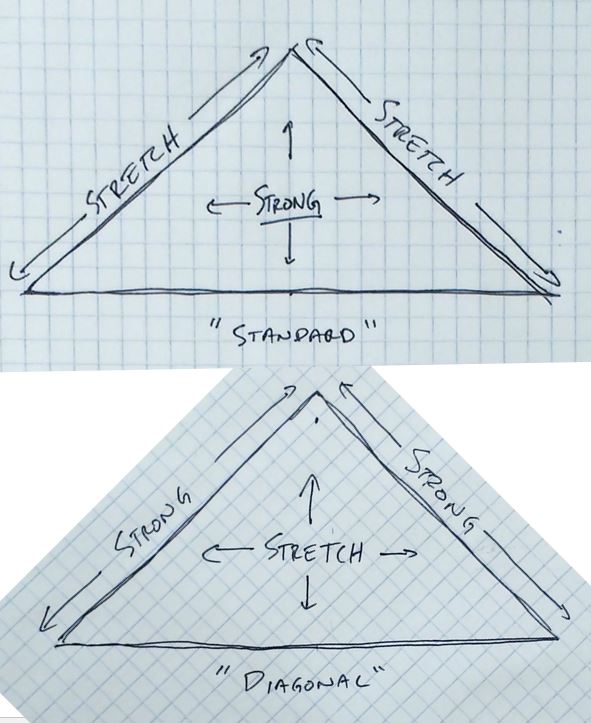
I think the traditional way is probably better because the stretchy edges curve outside of the 2D plane. This results in a saddle shape, so your fabric is pulled in to a form w/ 2 axis of curvature (in contrast, a bowed piece of paper has a single axis of curvature). Compound curves are more rigid than simple curves – this is why birds eggs are so strong for their weight.
In contrast, the alternate orientation puts the non-stretchy edge on the curved seams, so the panel won’t deform beyond a single axis of curvature. The stretchy edge is the free edge which has nothing to pull it out of the plane, such as an adjoining piece of fabric at a different angle.
A contributing factor in this is that the traditional way orients the fibers in the middle of the panel radially, so they go from the pole tip to the middle of the free edge. As the seams stretch, the straight fibers won’t. This makes them want to short cut the bowed surface defined by the seams w/ a straight line and pull the free edge in to an arc (you get a cat cut hem for free). This results in the saddle shape that gives mids a more rounded cross section towards the top and a smidge more internal volume.
You don’t get this with the alternate. The mid-panel fibers connect the seams with the stretchy free edge, so there’s nothing pulling them in to a straight line, away from the bowed surface. I would expect you’d see much less rounding in the cross section in this case.
The standard way may also be easier to pitch because the stretch is radial which gets deformed by raising the center pole. The alternative stretches around the circumference which requires tightening all the guy lines. So, taller vs. wider.
But this is all just theory. I made a large mid out of poly tarp for Burning Man, but I haven’t experimented with the form in anything like to 30D nylon.