Topic

Talk Me Out of Buying a Dyneema Tarp

Viewing 22 posts - 1 through 22 (of 22 total)
Volker64 BPL Member
PostedAug 14, 2026 at 8:44 pm

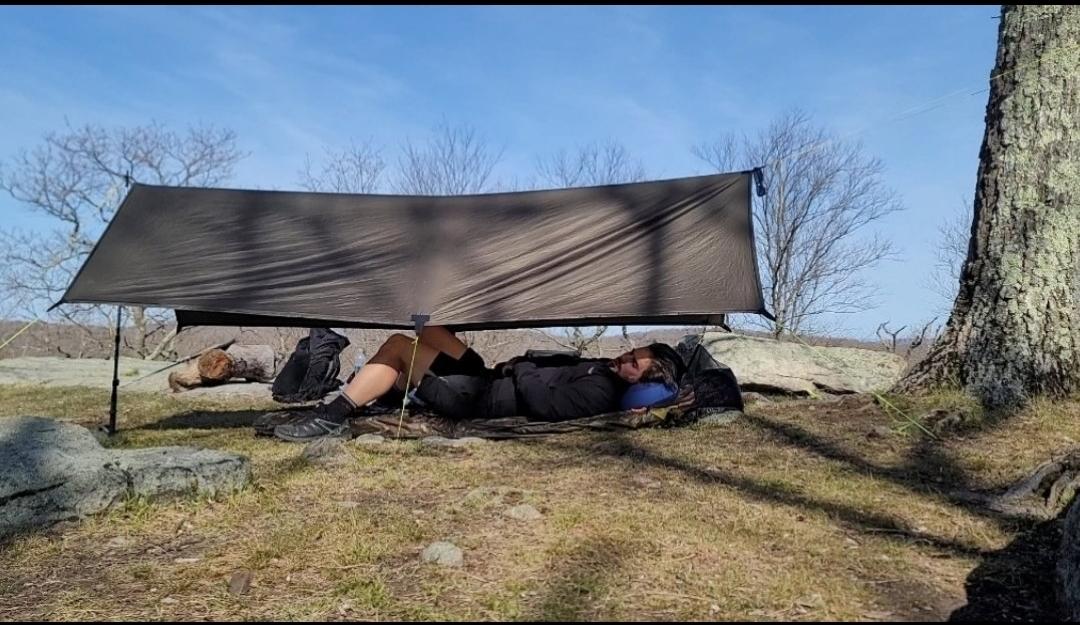
I’m curious to hear from those who have used dyneema tarps and whether their exp has been positive or negative. Do you use it as a main shelter for hammocking and cowboy camping or as a porch for a tent, or as a hangout area? Do you prefer a flat rectangle cut or a hex cat cut or some other shape? How large is your tarp?

I only realized recently that Dyneema is made in 8.5 ft sheets so that’s why you mostly only see it going to a width of 8.5′. Of course there are exceptions like the Zpacks 13×10 Big Ass Tarp but that is created from 3 pieces bonded together.

I’m not a hammock guy so I know that influences one’s use case. I would like to try cowboy camping this winter, but my typical use case is placing a tarp over part or sometimes all of a tent to provide a porch area in front of the main door during rain or snow storms. I usually make a fire – either open or with a small firepit so I have to be careful of embers and wind. If it’s not raining, the fire has to be further from the edge of the tarp. It’s easier to move a firepit as needed for rain starting or stopping and it helps to limit the size of the fire to control ember production.

I don’t plan on using it as a main shelter (except for a rare bit of cowboy camping) so I don’t mind the translucence. That’s even a good thing since rainy or snowy conditions have less light.

I don’t think the rain sound would bother me too much. I imagine loosening the pitch or adding small lengths of shock cord to guylines can reduce this. I know the lack of stretch makes a bit of shock cord helpful in case you snag a guyline – since the tarp has so little give.

I see Dutchware has a Hex tarp. They are sold out of the thinner fabric. Do most people think it’s better to go with the thinner fabric for a tarp? I lean that way. I don’t want to buy the thicker fabric and later regret not getting the thinner. It comes in an 11 or 12 foot length. But it only adds 7/10 of an oz to go with the thicker .75oz fabric over the .55oz. The larger pack size of the thicker fabric is something to consider as well. The 12 foot hex in .75oz fabric is 8.5oz. If I go for a cat cut hex tarp and dyneema only goes to 8.5′ wide, I figure I might as well go for a 12ft ridgeline for a tiny bit of extra weight. All my tarps have been flat rectangle or square shaped. I’ve never had a hex or catenary cut tarp.

Zpacks 8×10′ flat tarp is the other contender that appeals to me. Just 6.4oz with the .51oz fabric. But it only comes in olive drab. I prefer the white color of the Dutchware Hex.

One use case is when there is heavy snow; My hope is that with an A-Frame ridgeline and the sides pitched low, snow will not build up on the tarp. In rain, I could use the pull outs more readily to give more lateral space.

I already have several Aquaquest Guide tarps in various sizes. The Anda El Jefe 8×10 silpoly is my lightest tarp. I tend to reach for 10×10’s because I like the extra margin. I do sometimes use a 10×12 or 10×13. I have used a 12×12 and even a 15×15 as well but they are rather heavy for anything beyond glamping or car trips. The Anda only weighs 12.5oz and packs very small.

I tend to think I’d be afraid of using a dyneema tarp because of ember holes from fires. They can be patched with DCF tape but still that seems a lot more tragic on a $400 or more piece of fabric than on one that only weighs about 5-8oz more but costs 1/2 to 1/4th as much.

I hardly NEED a new tarp. The weight of a comparable non-dyneema tarp with similar coverage is only about an additional 4-6oz. But these tarps are more fragile. The sturdy and reliable Aquaquest 40D Guide is 21oz for a 10×10 and 29oz for a 13×10. So the Guide would be about 12-18oz heavier depending on size. But the incremental weight savings of dyneema over my lightest tarps would be very small. Spending $400 to shave 4-6oz off my minimum base weight is getting ludicrous. I can probably enjoy having a fire a lot more without using a dyneema tarp.

Adam BPL Member
PostedAug 14, 2026 at 8:56 pm

Honestly I think just stick to the Silpoly tarps that you have. The weight savings (yes this is blasphemy) are relatively minimal. The long term durability of the Silpoly is better, its more compact, and as you mention, the stress level is far, far less.

Use the several hundreds of $ you save by not buying more gear to go on more trips. Use it to save weight elsewhere. Heck, use it on a gym membership or class and put in 50 sessions over the next three months and then wonder why you ever cared about a few ounces.

Bob Shuff BPL Member
PostedAug 14, 2026 at 11:00 pm

I’m have a hammock gear standard tarp with doors that I use over an 11’ hammock. It’s 8.5’ as you suggest. I used it one night with cold rain all night and it was quite noisy – like a drum beat with each drop. With a hammock under tree cover the drops that come down are less often but maybe larger (just a guess). I have used solid and shock cord tieouts on the sides. Both create a taut pitch, which is the idea if weather is expected.

Is it acceptable?  For backpacking where I want to be as light as possible, definitely yes. I live in SoCal, so it’s often there to stop the wind and dew and it works great. In rain I’ll take the noise. I’ve since got a silpoly tarp to use when car camping. Hasn’t rained on it yet. If I lived in the NW or probably anywhere that gets lots of rain I would probably experiment with the dyneema and silpoly to decide which is best.

Terran BPL Member
PostedAug 15, 2026 at 6:12 am

A shaped tarp such as a hammock tarp will give you better coverage and is somewhat easier to pitch. There are some advantages to silpoly.  Putting a pole in the middle of a dyneema tarp tends to stretch it slightly. I’m reluctant to use a dyneema tarp on the ground. It produces lousy shade. Know that you need extra line, more stakes, and possibly a pole or two with any tarp.  I won’t talk you out of it. I’ve gotten good use out of my HMG 8×10. Note, any large tarp can catch large wind. If you have a use, a need, and almost as important the cash, buy it. For a little extra weight, it can turn a small tent into a palace.

PostedAug 15, 2026 at 7:21 am

Hammockgear offers large rectangular DCF tarps 8′ 6″ wide with lengths of 8′ 6″, 10,’ 11′ and 12′. Their prices are hard to beat. https://hammockgear.com/product/nomad-tarp/. They have big 20D silpoly flat tarps as well.

If being used only as an auxilary tarp the ZPacks 8′ X 10″ in .55 DCF should work fine, however HMG tarps made with .75 DCF are more durable and long lasting…their tieout reinforcements are superior. Anything from MLD is also very well made and durable. You can expect the lifespan of .55 DCF to be about half that of 20D silpoly or silnylon.

Slingfin offers a 10D NFT tarp 9.5′ X 10′ that has slight cat cuts around the perimeter and it would be hard to beat in terms of size to weight ratio for a woven tarp (12.3 oz). https://www.slingfin.com/products/nft


Volker64 BPL Member
PostedAug 15, 2026 at 10:07 pm

Now I’ve seen a camping video of Tony of AB Camping and Outdoors from New Zealand and he had Dutchware Gear make him a custom Dyneema tarp that is 4M x 3M or probably about 13ftx10ft. You could see it had 3 sections. Probably a similar size to the Zpacks Big Ass tarp 13×10. I like the white dyneema Dutchware uses over the olive of Zpacks.

This is somewhat tempting. But since it’s a custom job it’s probably ridiculously expensive. Probably more than $600 like the Zpacks. It is certainly a way to lower your baseweight. It’s exciting when you find a new item that can replace an existing piece of gear and be 40-60% lighter and do just as good of a job.

Volker64 BPL Member
PostedAug 15, 2026 at 10:13 pm

Here’s the video I’m watching now of Tony with his Dutchware Gear Custom 4×3 meter dyneema tarp:

Youtube video

I notice it doesn’t have any pull outs. He’s also had a smaller Dutchware dyneema tarp and a Samaya dyneema tarp.

I need to observe more usage of dyneema tarps to get a better idea of whether one might be right for me – and if so – which one to get.

But I’m in no hurry to get one. I’ve got plenty of other tarps.

Terran BPL Member
PostedAug 16, 2026 at 6:01 am

The HMG has tieouts.

A flat tarp can be set up in multiple positions. None that I consider ideal, unless there is no wind. The MLD Cricket can be set up in only one position with several adjustments possible, but it provides better coverage when needed in what I consider in general a more ideal configuration.

James Marco BPL Member
PostedAug 17, 2026 at 5:19 am

I believe there are a few more things to consider.

1) ease of use – generally this is setting things up as a shelter. Weather, winds and snow all effect how to pitch a tarp.
2) Weight – My aching Back!
3) Use – How a tarp is used. As a shelter, or, over or near a fire to keep it and fuel dry. Over a wood pile? Over other gear? As a ground cloth? Durability can easily be compromised by sleeping on a shelters wooden floor.
4) Cost – My wallet aches for a nice tarp. A nice sil nylon $40 tarp vs. a $400 dyneema one. For one trip or a hundred trips?

dirtbag BPL Member
PostedAug 18, 2026 at 6:36 am

I won’t ever buy a dcf tarp again. Silpoly 100%.  I had a new dcf tarp with doors shredded in a winter storm while hammock camping,  that could have been a serious problem had there not been a lean too shelter close bye for me to spend the night in.  Truth is, even a Silpoly tarp would have been destroyed.. but it would have been a lot cheaper to buy another one.  The Silpoly also packs away much smaller into my pack.. and let’s be honest here.. the weight savings is NOT that much of s difference.. cut the few ounces somewhere else if need.

Terran BPL Member
PostedAug 18, 2026 at 8:49 am

DCF makes lousy flags. I had some damage to a vestibule door that came loose and was flapping in the wind. Otherwise, I’ve had stakes pull, poles snap, lines come loose. Something has to give and it hasn’t been the DCF.

If you’re carrying minimal gear, the weight savings aren’t that important. It does start adding up though. I like the aesthetics and the translucency of dcf. I like how it sheds rain.

Price makes me hesitant. Some folks here have a lot more money than I do. Once I’ve used it a few times and the newness wears off, when my budget catches up, it becomes less important. It’s a tool. Use it.

Volker64 BPL Member
PostedAug 18, 2026 at 12:53 pm

I appreciate both the negative and positive feedback on dyneema tarps. I figure I’ll keep learning from others examples to see if it makes sense eventually.

The beauty of the dyneema tarp is that it decreases the marginal cost of deciding whether to bring a tarp or not at all. (And on multi-day rain trips the extra water weight on a nylon tarp that never gets time to dry out is quite significant). Just as it sucks to bring an umbrella when it doesn’t turn out to rain, it’s also an extra burden to bring a tarp and wind up not needing it. But if you know you can get by with a 12′ x 8.5′ Hex dyneema tarp that weighs 8oz then you have a very small weight penalty if you bring one and end up not needing it.

The less of a burden you feel bringing rain gear like a tarp, the more you feel emboldened to go on a trip on short notice even if the weather has suddenly turned ominous. Or even if it turns ominous after you’ve already left, you need not worry if you always bring the tarp anyway. This is truly liberating since it frees you from clinging to the maybes of a fair weather camper mindset. Rain or shine becomes an attitude and way of life. Seize the day.

The weight savings over a comparable sil-poly tarp may be marginal – like 5oz, but that’s still perhaps 40% lighter than your next best alternative (13.3oz vs 8oz). So reducing the marginal weight cost to as low as possible turns the tarp from being an optional extra into a no-brainer – don’t even need to think about it always carry item – unless you’re going on a desert trip.

Since I would usually still plan to bring a tent with rainfly, the light transparency is a good thing. It would brighten up the vibe when the weather looks grim.

If I do buy one eventually, I want to be sure I know exactly what would be the best size and shape of dyneema tarp for my typical use case since I won’t want to have to buy multiple of them.

I just my bought my first hexagonal shaped tarp. So that will teach me some new things.

Matthew / BPL Moderator
PostedAug 18, 2026 at 2:00 pm

Volker, You seem to want to try a DCF tarp. I think you should do so. That said, I do not think that large rectangular tarps are the best application for DCF.

My perception of large rectangular tarps is that they benefit from some stretch in order to get them tight. DCF does not stretch. I think a large DCF tarp is a floppy tarp that is not going to hold up well in the wind.

I’d keep the large rectangles in Silnylon/Silpoly and consider DCF for shaped tarps and cat cut A frame tarps like MLD’s Grace Tarp. My old DCF Grace came up to tension way better than my rectangular DCF tarp.

Volker64 BPL Member
PostedAug 18, 2026 at 2:47 pm

Thanks for the input Matthew. I’m in no hurry to buy a dyneema tarp yet as I don’t want to make a foolish choice. Sometimes I will use a 13oz nylon tarp or a 12oz silpoly but I’m usually preferring to use one of several larger nylon tarps that are typically more in the 20-29oz range. So Dyneema would offer significant weight savings over these. But this is only if I’m comfortable with the coverage I get from the narrower width that dyneema tarps tend to have.

But your insight on the shape of the tarp counts for a lot. The stretch of most tarps – which people usually complain about, is also helpful in some ways.

And yes, I’ve heard a cat cut tarp is better at wind diffusion than rectangular tarps. Therefore the stiffness of a rectangular dyneema tarp could be unforgiving in windy conditions. I don’t generally seek out windy conditions. They are definitely a challenge for tarps. They put your guyline system to the test. A good tarp and guyline system – sensibly set up, should be able to handle pretty strong gusts.

For snow trips, I want to be able to utilize an A-frame setup with enough steepness that snow does not build up too much and bring down the tarp. It’s very easy for this to happen if you don’t have very solid guyouts to strong trees and groundhog stakes in solid soils. But if done right, the sharpness of the angle of the ridgeline should direct the snow downwards to prevent build up.

If needed, I can add a few inches of shock cord to my guylines to add back some give to the dyneema.

The MLD Grace tarp is a huge weight saver if you camp under it without a tent. But I mostly use tarps as a hangout area that extends my tents like a porch. So it would be too small for that. That’s why I think the Dutchware Hex Tarp is my preferred choice at this point (among tarps that are in stock):

https://dutchwaregear.com/product/hex-tarp-with-dyneema-composite-fabric-options/

I’d go for the 12′ length to compensate for the cutaways and the width being 8.5′. They only have the thicker .75oz fabric in stock now but that should help durability. I’d get it in white with pullouts to add more volume in rain. This setup weighs 8.5oz.

So I’ll see how my cheap nylon Wise Owl 11′ x 9′ hex tarp does on upcoming trips. I’ll see how it meets my needs or not. It’s a hammock tarp. But I always use tents – not hammocks. But it can still do fine to create a hangout area. In torrential rain, it does feel more secure to have a larger tarp to give better coverage from splashback. And it helps to dig channels to direct water away from the campsite.

But most of the time that it rains, it is light to moderate – not cats and dogs.

To me, the point of the tarp is not as a tent replacement (though it can be once bug season ends). The point is so that I can enjoy being outside the tent even in stormy weather.


dirtbag BPL Member
PostedAug 18, 2026 at 3:07 pm

And shade from the blazing sun.. a big Pro for me when I carry my tarp.

Volker64 BPL Member
PostedAug 18, 2026 at 3:22 pm

I’m almost always in wooded areas where the sun is usually diffused. But it is true if I always carry a tarp because it’s lightweight and dyneema, then I can enjoy hiking more often in exposed areas where the unobstructed views are more enjoyable. I hadn’t thought about the sunshade benefit so much. Trekking poles, medium size rocks, and a couple of thick sticks can usually provide sufficient support in the absence of trees to guy out to or stakeable soil.

Volker64 BPL Member
PostedAug 21, 2026 at 12:00 pm

Thanks Matthew. I appreciate you letting me know. But this one is camo which is good for stealth. But I’d prefer a dyneema tarp in white.

HkNewman BPL Member
PostedAug 22, 2026 at 3:46 pm

Dirtbag said :


Silpoly also packs away much smaller into my pack.. and let’s be honest here.. the weight savings is NOT that much of s difference.

Second that.  More complicated DCF designs take up quite a bit more room in the pack and I was always left wondering if I’m damaging it when rolling it up, cinching down the pack w/contents including the oft weirdly rolled DCF, for very little weight savings on a mid for decently thick DCF 0.75 to 0.80.

Now for a trip where I’m using it rarely like once a month on a dry thru hike, .. or a very simple design like a MLD Grace Solo where I’m probably cutting lots of other weight?  I’d consider.  In and out on a constantly wet trip got old real fast as wet DCF never seems to roll or fold the same.

Viewing 22 posts - 1 through 22 (of 22 total)
Loading...