Topic

Sucrose vs Fructose in Trail Food

Viewing 22 posts - 1 through 22 (of 22 total)
PostedApr 20, 2017 at 3:54 pm

“Humans are capable of storing and using fructose in the liver and kidney, but as Park explains, we don’t have enough of the correct enzyme to create energy directly from fructose. Nor do we have enough of the proteins necessary to move fructose molecules into the cells of vital organs. Our cells have to convert it into glucose in order to use it.”

The article is about naked rat moles, but I find the comment about sugars and metabolism thought provoking.

PostedApr 20, 2017 at 8:47 pm

^^^

“[Richard D Feinman, the primary author]  has written popular articles for several publications including Diabetes Health, Muscular Development and for Fleishman-Hillard, Inc. whose client is the American Corn Refiners Association.”

From the same Nutrition and Metabolism article.


Laura D BPL Member
PostedApr 27, 2017 at 12:19 am

Interesting! It’s much like the fact that our bodies can use ketones instead of glucose and that is also oxygen-sparing and results in people being able to hold their breath much longer and handle oxygen deprivation far better! I wonder why that is not an option they brought up instead of figuring out how to make people’s bodies unnaturally be able to use fructose the same way as those moles. It seems it would make more sense to use the other metabolic pathway that is already there naturally.

Fructose, ugh . . . Too much in the liver causes fatty liver disease.

For trail food considerations, I know that for someone in my situation, who needs (or wants) to maintain ketosis as much as possible for medical (or performance/UL) reasons, fructose consumption can be disruptive to that goal and thus, the therapeutic/performance effects I rely on. Unfortunately, I do not know the exact fructose amount that triggers the shut off of ketone production for my body, but since I am fairly active and consume such little sugar, it is likely that I can burn through the small amount I may absorb from time to time. I couldn’t do all that if I ate like a typical hiker/backpacker though.

For a hiker, I think the impact of fructose in trail food depends so much on their diet on and off the trail, food sensitivities, blood sugar and adrenal health, small and large intestinal health, as well as the length and their goals for the trip. But as a nutritionist I would always recommend trying to keep fructose consumption lower and solely sourced from whole, unprocessed foods so all the other nutrients/co-factors that come with the fructose naturally can be digested, absorbed, and used as nature intended.

John S. BPL Member
PostedApr 27, 2017 at 1:34 pm

Sucrose (table sugar or sugar) is 50% glucose and 50% fructose. High fructose corn syrup is 55% fructose. Not much difference. Fruit juices are high in fructose.

Tang used to be sweetened with fructose. They suddenly changed to sugar (sucrose) several years ago.

Roger Caffin BPL Member
PostedApr 27, 2017 at 7:30 pm

The claim about fructose causing fatty liver disease may be just poor research. See
https://www.sciencedaily.com/releases/2014/02/140226075021.htm
I quote from the Abstract:

A meta-analysis of all available human trials says fructose in and of itself is not to blame for the increase in non-alcoholic fatty liver disease. Since the disease is closely linked to obesity and Type 2 diabetes, there’s a growing debate in the medical community about whether diet plays a role in its development, specifically the consumption of fructose. However, a new review suggests fructose is not to blame, but that excess consumption of calories can contribute to the disease, regardless of whether those calories came from fructose or other carbohydrates.

A lot of the rumoured ‘association’ may be due to overall diet rather that fructose itself. But people prefer to have something else to blame rather than their own diet.

Cheers

Laura D BPL Member
PostedMay 5, 2017 at 8:20 pm

Roger, that makes a lot of sense to me, thank you for sharing that! It is always more complicated when it comes to the body! :)

I also wonder if it’s not necessarily the CONSUMPTION level of fructose, but the lack of cycling through that fructose you consume. If you’re not utilizing it/burning through it quickly enough due to diet and exercise/lifestyle, then it is going to build up perhaps?

Also, I remember a lecture given by endocrinologist Dr. Robert Lustig showing how the body processes and “considers” fructose to be a poison, similar to alcohol, but I don’t remember the exact mechanisms, but that does sound like perhaps then we should be careful about not overdoing it with fructose consumption like we would want to not overdo alcohol consumption?

Roger Caffin BPL Member
PostedMay 7, 2017 at 1:54 am

Hi Laura

OK, I will stick my neck out a bit here and give some opinions which may clash with some others.

First of all, in my experience, few medicos have any understanding of what real scientific research is about. Far too many medical ‘researchers’ consider a few anecdotal tales with negligeable controls to be ‘proof’. It is not.

Second, I find many medicos have little understanding of real science. This is to be expected as they do not get that sort of training during their medical degrees. For instance, Lustig claims that But fructose is made in a lab. It’s anything but “real”. This is total crap. Fructose is a form of sugar found in fruits (hence the name), and humans and their ancestors have been eating fruit for the last 100,000 years as part of their NORMAL diet.

Of course, eating any form of sugar to excess is not going to do your body any good at all, and combining that excess of sugar with a gross deficiency of exercise is not going to be good. But then, eating an excess of ANYTHING without enough exercise is bad.

A SciAm article says:
“as fructose expert John White points out, fructose consumption has been declining for more than a decade, but rates of obesity continued to rise during the same period. Of course, coinciding trends alone do not definitively demonstrate anything. A more compelling criticism is that concern about fructose is based primarily on studies in which rodents and people consumed huge amounts of the molecule—up to 300 grams of fructose each day, which is nearly equivalent to the total sugar in eight cans of Coke—or a diet in which the vast majority of sugars were pure fructose. The reality is that most people consume far less fructose than used in such studies and rarely eat fructose without glucose.”
https://blogs.scientificamerican.com/brainwaves/is-sugar-really-toxic-sifting-through-the-evidence/

Also please note that using mice and rats in such studies tells you nothing about humans: they process fructose differently. But then, how many mice & rats eat fruit? Who designed that experiment in the first place? Not a good scientist.

It might be worth while reading the entire SciAm article for a far more balanced view. Lustig just has a bad mono-mania imho.

Cheers

John S. BPL Member
PostedMay 10, 2017 at 11:44 am

I was wrong on the tang thing. It used to be sweetened with 3 grams sugar and apsartame. Now it’s 22 grams sugar per serving.

Ben H. BPL Member
PostedMay 10, 2017 at 2:19 pm

You are probably thinking of the Country Time Lemonade.  The big canisters are still sugar and fructose, but the sell “on the go” pouches which they add artificial sweetener.  I think they do that so you don’t have to add as much powder.  Artificial sweetener is more concentrated sweetness than sugar.

Steve Thompson BPL Member
PostedJul 9, 2017 at 7:08 pm

My experience dayhiking Grand Canyon R2R2R indicates (at least for me) that I pay attention to whether I am consuming sucrose or fructose.  The first time doing this hike I was keeping track of calories but not paying much attention to where they were coming from.  On the return, at Phantom Ranch, I ate my calories in dried fruit…primarily fructose and about an hour out I bonked.  Other worldly bonked.

Turns out it takes about 4 hours for the liver to convert the fructose to sucrose.  A gel set me straight and once the dried fruit kicked in I finished strong.  But I spent 2 hours in a deep haze.

I pay much more attention now of where my calories are coming from to maintain a consistent, continuous fuel level.

Roger Caffin BPL Member
PostedJul 9, 2017 at 8:07 pm

I pay much more attention now of where my calories are coming from to maintain a consistent, continuous fuel level.
Right.
I think you need a mix of carbo, fruit, fat and protein.
Which sounds suspiciously like a simple decent non-fad diet of fresh NON-processed raw foods.

Cheerts

MJ H BPL Member
PostedJul 10, 2017 at 5:33 am

Why does it have to be raw? Cooking is pretty great, usually.

PostedJul 10, 2017 at 7:44 am

Eat Carbohydrates During Competition, Not Fat

“….Sugars are carried across your intestinal tract into your bloodstream and then into your muscles by special protein transporter molecules (Sports Sci, 2011;29 Suppl 1:S17-27). Glucose has its own specific transporter protein and so does another sugar, fructose. Your muscles can have 75 percent more sugar available when you take in both glucose and fructose, compared to taking in only glucose, because both types of transporter proteins can be used at the same time….”

What to Eat and Drink for Hot Weather Exercise

“….Take sugar no more than five minutes before you start your competition. Do not take sugar earlier than that because when you eat sugar and your muscles are not contracting….

….exercising muscles draw sugar rapidly from the bloodstream without needing insulin, so taking sugar during exercise or just before you start usually does not cause the high rise in blood sugar levels….”

Roger Caffin BPL Member
PostedJul 10, 2017 at 5:36 pm

Why does it have to be raw? Cooking is pretty great, usually.
My poor phrasing.
I meant starting with raw NON-processed foods. I fully approve of cooking – Scotch Filet with steamed vegies for instance.

Cheers

MJ H BPL Member
PostedJul 10, 2017 at 7:15 pm

Thanks for clarifying. That’s what I figured you meant, because the raw-foodist interpretation didn’t mesh with the earlier statements you made.

Roger Caffin BPL Member
PostedJul 10, 2017 at 8:07 pm

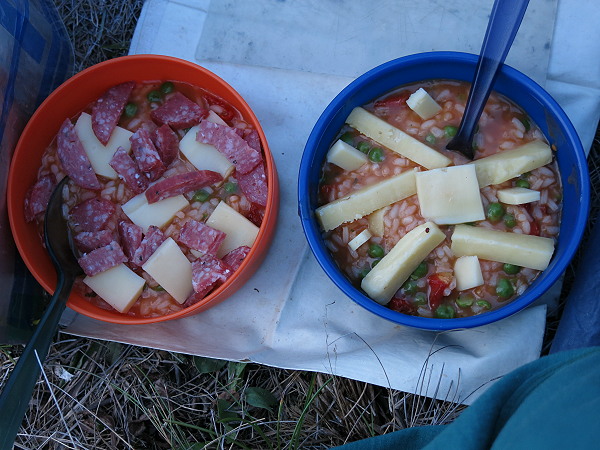
Rice, dried peas, sun-dried tomato, tomato soup, Jahlsberg cheese and Hungarian salami.
OK, the salami is sort-of processed…
At about 1,500 m.

Cheers

Steve Thompson BPL Member
PostedJul 11, 2017 at 8:28 pm

I think you need a mix of carbo, fruit, fat and protein

Pretty much.  And the easiest way I’ve found to get a good balance is to carry probars, my “go to” for extreme day (1/2 bar per hour), and also for midmorning and midafternoon snacks while backpacking.

Viewing 22 posts - 1 through 22 (of 22 total)
Loading...