Eric,
Deformation in DCF mostly occurs when you have forces that aren’t pulling in line (parallel) with the fibers. There are two common problems ways this happens, which are pulling diagonally and/or out on the fabric. I will explain:
1) If you pull diagonally on the fabric it slowly pulls the material apart because the fibers are strong but not woven together, so when the force is diagonal to the fibers it is essentially pulling apart the fibers. There is only the weaker mylar and adhesives there to resist this. They can slowly stretch/fatigue/crack leading to deformation and eventually the material breaking apart.
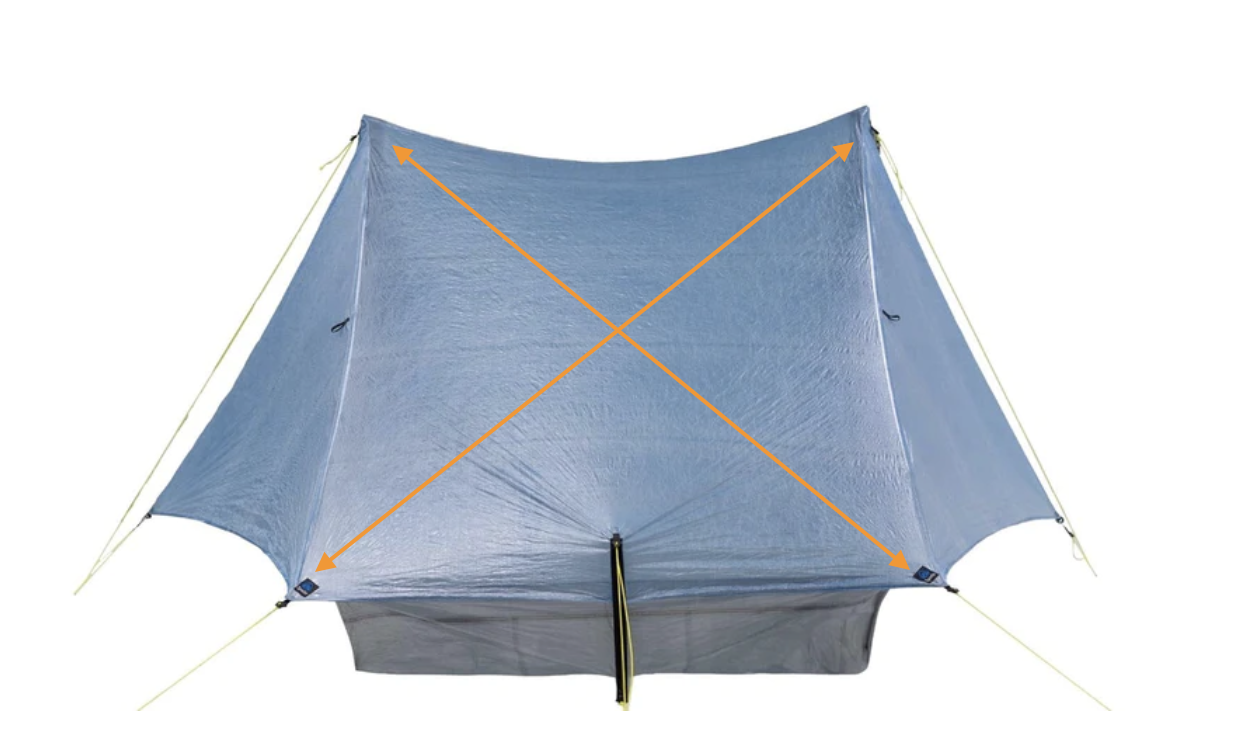
In the example below, there are fixed points (stake point or peaks) at the 4 corners of the panel. When you tighten one point it pulls on the other 3. The seams along the edge of the panel are fine since they are in line with the fibers, but there is also force running diagonally across the panel which is prone to pulling apart the material (depending on how tightly it is tensioned and how much use it has seen). This force is not “out” (it is on the same plane) but it is diagonal.

2) Secondly there can be deformation if you pull OUT on the fabric. So a force that is not acting on the same plane as the fabric. It may or may not be at the same direction as the fibers, but either way it is not pulling in line with the fibers because it is pulling out so the material will tend to deform as the mylar stretches and the fibers pull apart/reorganize.
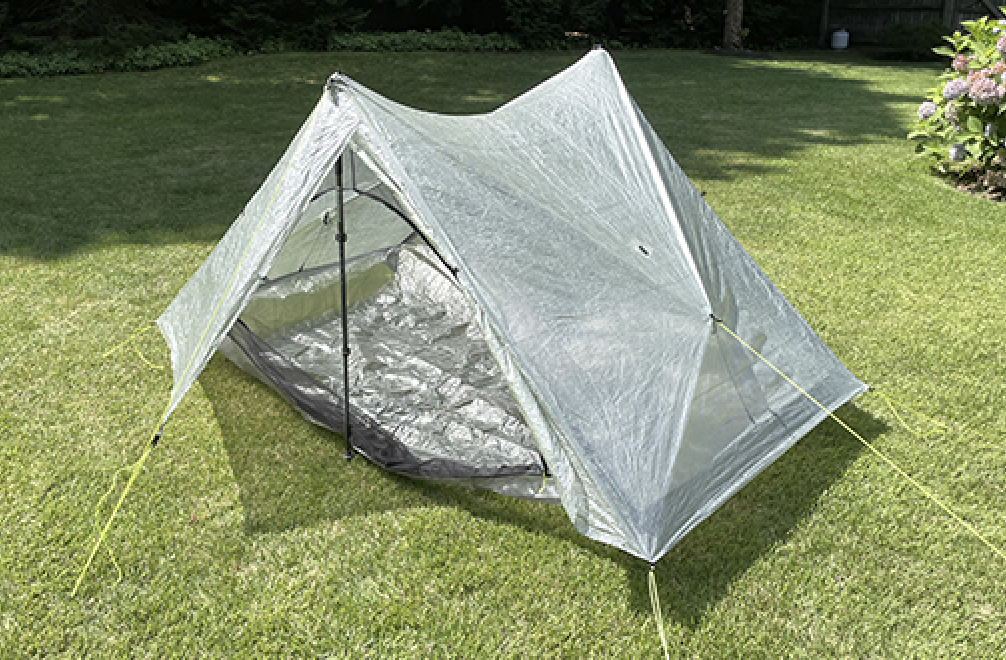
As an example, the tent below has the same diagonal problem as #1 but now a guyline is added that is additionally pulling “out” (not on the same plane). This is troublesome scenario for deformation because you have both issues occurring at one spot (pulling out and pulling diagonally). If you look at a tent like this that has been regularly, you will likely find it has been stretched outwards at the guyout point and hereafter needs this guyline to be used or there is loose material.

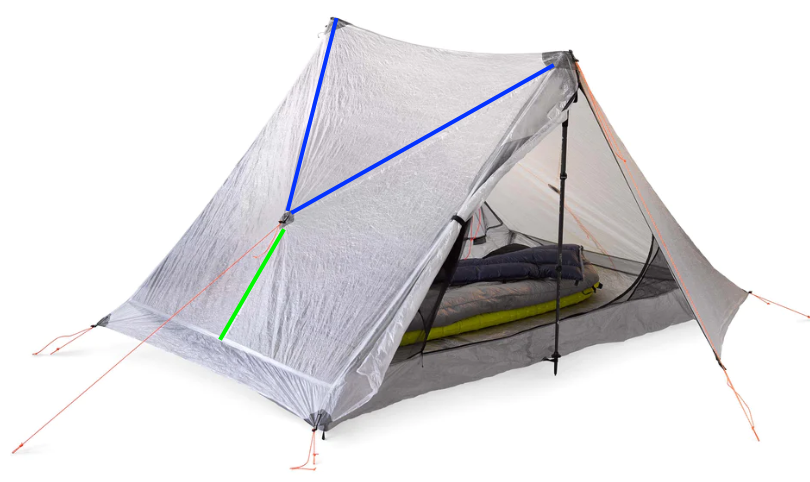
If we look at the Unbound 2P, HMG has added a “Y” of DCF backed tape. DCF backed tape is great because it has the DCF fibers in line with the tape so it can be added to stop deformation. On the Unbound, the tape is in a Y which is hard to see so I have added blue lines and a green line to show where the tape is. These two upper blue lines will meaningfully help since they reinforce the diagonals on the upper panel. The force is still OUT (depending on the angle of the guyline) so the problem is not fully solved but it is improved and would work well for the upper panel as long as the guyline isn’t pulled out too much.

What the Unbound tape does not do is solve diagonal stretch on the lower half of the panel. The lower (green) piece of tape is not useful for reducing deformation because it doesn’t run to a fixed point (e.g. stake point) so there is no major stress here that it is reinforcing. I’m not sure why the green tape exists (maybe the panel is two pieces so this is a seam). Ideally the blue pieces of tape would run all the way across the panel in an X to fully reinforce those diagonals, but since they do not there is still the potential for the material to deform/break apart on the lower half of the panel (e.g. at the lower corners). So it is definitely an improvement but not a 100% fix for either problem.
For your question, Tarptent has always done a great job understanding DCF, so vulnerabilities like this will be rare or non-existent on their shelters. This is why they have foregone some mid panel guyouts on some DCF shelters. If you want to add some, you’ll want to design them in a way that avoids problems #1 and #2, or if you can’t then add the appropriate reinforcement (if possible) or use them gently.
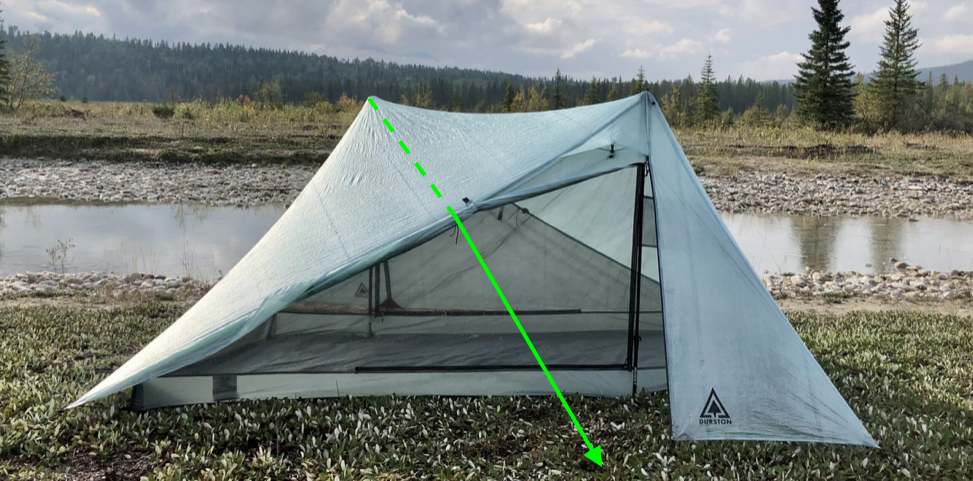
To explain how side panel guyouts can avoid these issues, see the side guyouts on the X-Mid Pro. Here the DCF roof panel is intentionally oriented so that the fibers run directly in line between the side guyout and the peak (dashed green line below). You can see the lines on the roof panel fabric below that show it’s orientation. Like this, when you pull on the side guyout the force runs directly in line with the fibers to avoid deformation. To use this side panel guyout optimally, you would run the line at the same slope as the roof panel (green line below) so it not pulling OUT but rather on the same plane as the roof panel so problems #1 and #2 are wholly avoided. This is easy to do because the door panel steepens so when you stake it 2-3′ from the edge of the fly is roughly on the same plane as the roof panel.
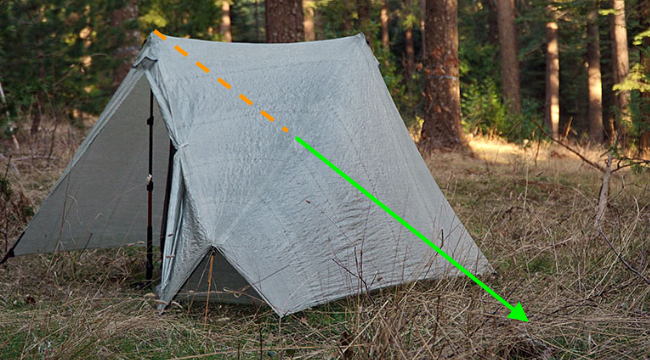
To finally answer your question, you could add side panel guyouts to your Notch Li and angle them to be at the same slope as the roof panel to avoid problem #2 (pulling out). However, this was not part of the original intention for this tent so the roof panel DCF is not oriented in such as way that the fibers are in line with this force. You can see the dashed orange line below is running about 45 degrees across the fibers (see the darker lines, which are clusters of fibers). So simply adding a guyout here would create problem #1 (pulling diagonally on the fibers).

Fortunately this easy to solve with DCF backed tape. So the answer is that yes you could add side panel guyouts there and minimize any deformation by matching the slope of the roof panel, but if you want to tension them substantially I would add DCF backed tape along the dashed orange line. DCF backed tape is available from many places and is better than tenacious tape because it’s lighter and would have a lot less stretch. I fear tenacious tape is stretchy so it might not actually help.