


Topic
Southwest Megadrought
Become a member to post in the forums.
- This topic has 61 replies, 13 voices, and was last updated 4 weeks, 1 day ago by
 .
.

Interesting article
Gemini said that a total of 12,00 to 18,000 acre feet of water would be required to build all the proposed solar projects around Desert Center
California uses 80,000,000 acre feet of water per year. 12,000,000 acre feet per year is taken out of the Colorado River. The amount required for solar panel projects is small comparatively.
It seems like it should be possible to find enough water – it’s just a one time usage to suppress dust during construction. Or find some other way to suppress dust.
The problem is they’re just pumping water which causes the local wells to run dry. I can see why the locals are pissed. The state has some plans, but federal lands aren’t included. They shouldn’t build solar panel projects there unless they can resolve this.
The same goes for the areas supplied by the Colorado River. Not enough water and the users don’t want to reduce their usage. Regional problem. The small amount for solar cell construction is a tiny part of the total problem.

Desert Center has been basically deserted for many years. There used to be a fair sized community near Eagle Mine. That’s been closed for years. Much of the water is highly mineralized and barely drinkable. The complaints come from the transmission lines cutting through residential and forest areas once they hit the mountains.
Solar is a scam and it shouldn’t be. The large solar fields can be moved to small fields and rooftops. A lot is just sells. Sell it to the homeowner, then pay another company to do all the work.
Backyard solar. A Chinese inverter with two 460W panels for around $550 can throw 3 or 4 KWh a day into your home grid. Except you had to do it last week . They’re banned this week. Spyware like your microwave. Outlaw power. An inverter from APSystems is $300. Add a couple 560W panels. About $1,000. There’s 4 connectors and 1 plug. Two of those and I’m getting about 14KWh a day. About 17 KWh total. A couple of stragically placed solar generators attached to their own panels. $5000 and you’re basically off grid. Much cheaper than rooftop plus you can do it a little at a time and keep adding. Eventually it pays for itself. Consider it a donation. Volunteer work that you can do at home and on your own schedule. The monetary results are secondary. A revolution. Power to the people. Literally.
A good read…
That isn’t a total solution. Very few people are willing and able to do that.
You need to provide electricity for everyone at the time of day they need it. And there’s more or less sun and wind at different places and times. Complicated problem you can’t just solve on the back of a napkin.
You’re dismissing the problems of the people whose wells are drying up, although that article may exaggerate the problem.

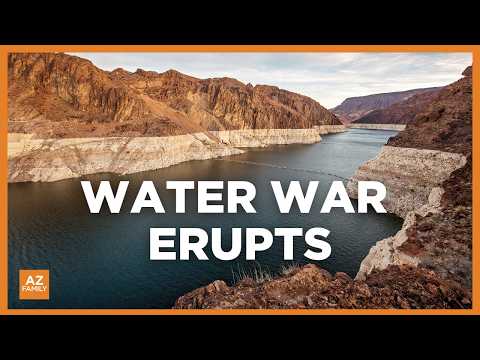
So it’s the lower basin states of Arizona, Nevada and California that are going to see the cuts, whereas the upper basin states of CO, UT, WY and NM are merely asked to conserve. Arizona politicians are saying “this is unacceptable” and that’s the same hackneyed phrase mayors and police chiefs use after the thousandth episode of gun violence in their city…just hollow words. The federal allotments won’t be finalized for a few more weeks, but what I’ve found over the decades is that when the feds tell you you’re going to do something you’re darn sure going to do it. The reporters mentioned Scottsdale getting 70% of their water from the Colorado, however their sense of entitlement won’t sway the feds.
Those who are able can be convinced. If neighbors help neighbors, the limiting factors are money and real estate meaning available sunny area. Someone could start for less than $1,000. $500 if shopping for used panels.
You’re supplying electricity only for yourself, so your demand is less during high consumption hours. A solar generator might work better for someone working all day.
Absolutely only a partial possible solution.
Drying up wells. More so India and other desert regions. Perhaps more and more of the U.S. I’m not informed.
I have restrictions on my water. The area is mostly grazing land. I’m allowed to water 1acre and I can have horses. I dont. If I put in a deeper $1000,000 well, I could have a lake.
Pertaining to the Colorado river, it’s piped to percolating ponds that feed the wells, or it travels through big and small canals. Canals supply The local farmers in Southern California from Blythe down to Yuma. The canals themselves supply food for many locals. Fish, bullfrogs, and crawdads. The local irrigation district has first rights. I think the courts may have decided with them. That’s good. It’s a major food source with an early season.
My dad convinced many of the farmers to line their canals with concrete to conserve water. In turn the district raised the rates. Oh well.
Running solar over waterways slows down evaporation and keeps the panels cooler. It’s also out of the way of heavy field equipment. It would provide transmission routes.
Technology needs to adapt and catch up. It needs to be able to solve many issues congruently. Nature works in unison. All things are one. One answer can solve many problems.
Yeah. Reservoirs also. Cooler panels are more efficient.
We are making amazing progress. Solar panels used to be ridiculously expensive, now they’re the cheapest. The vast majority of new electricity production is solar, wind, and batteries. Most people that have bought electric cars say they won’t go back to internal combustion. Texas and California often produce all their electricity from alternate sources.
Maybe if the authorities talked more about that, people would be more willing to go along with it, and be less depressed about impending catastrophe.
Trump’s legacy will be that he did more than anyone to advance non fossil fuels. People can not depend on fossil fuels so they’re switching to alternates.
Jerry said,
“You need to provide electricity for everyone at the time of day they need it. And there’s more or less sun and wind at different places and times. Complicated problem you can’t just solve on the back of a napkin.”
This is the crux of the matter. Any solution will not please everyone. There will be “winners and losers.”
We have a 6.72 kW solar system on our house. The difficulty is how the utility companies bill and how the state regulates them. California requires the utilities to provide a certain percent of power via renewables and it goes up over time until it is 100% sometime in the future, which I would have to look up. The utilities here now bill via Time of Use for solar systems. That’s where they can get you . . . adjusting the time of use rates. Our system size had to be approved by the utility, and it is sized so the power generated would equal the amount used on a monthly basis — generate excess power during the day and then use electrify from the grid at night. The utility is not interested in us generating more electricty than we use on an annual basis.
The average cost of electricity in the US is $0.20 per kWh. Here is what we currently pay with our solar system TOU:
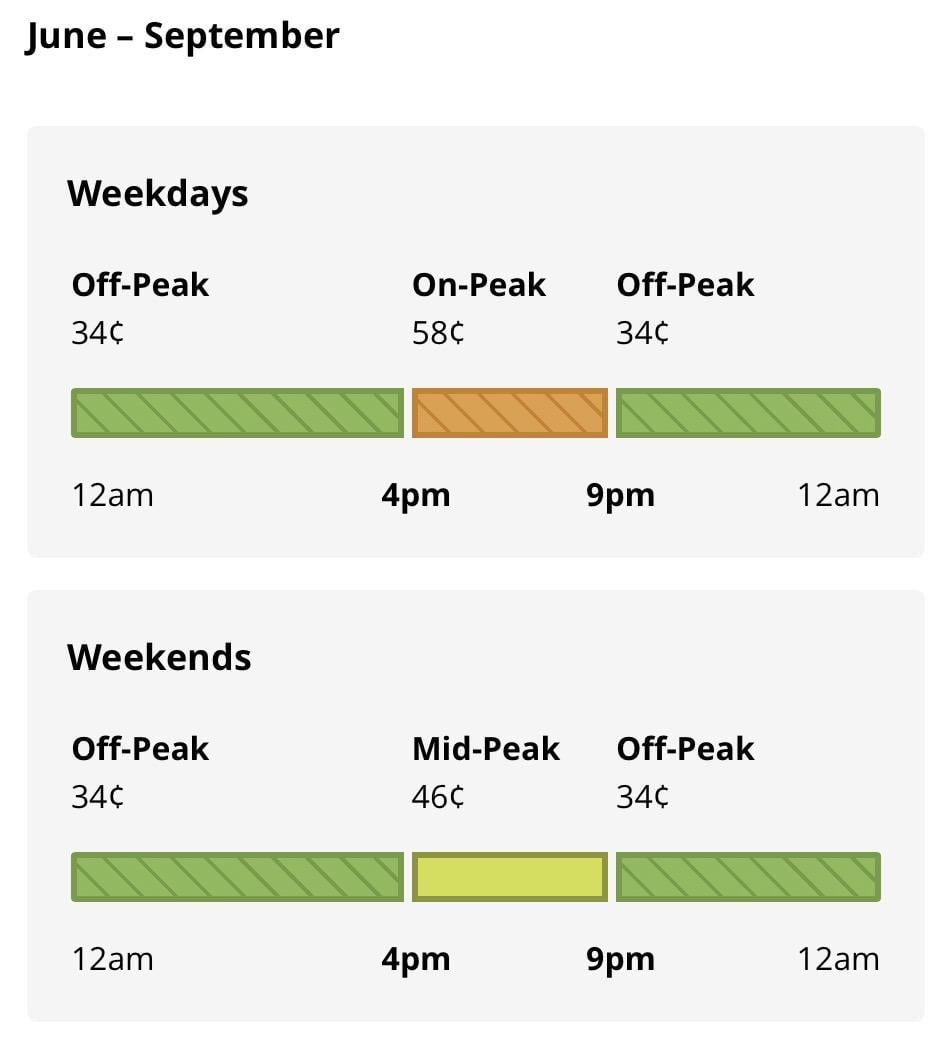
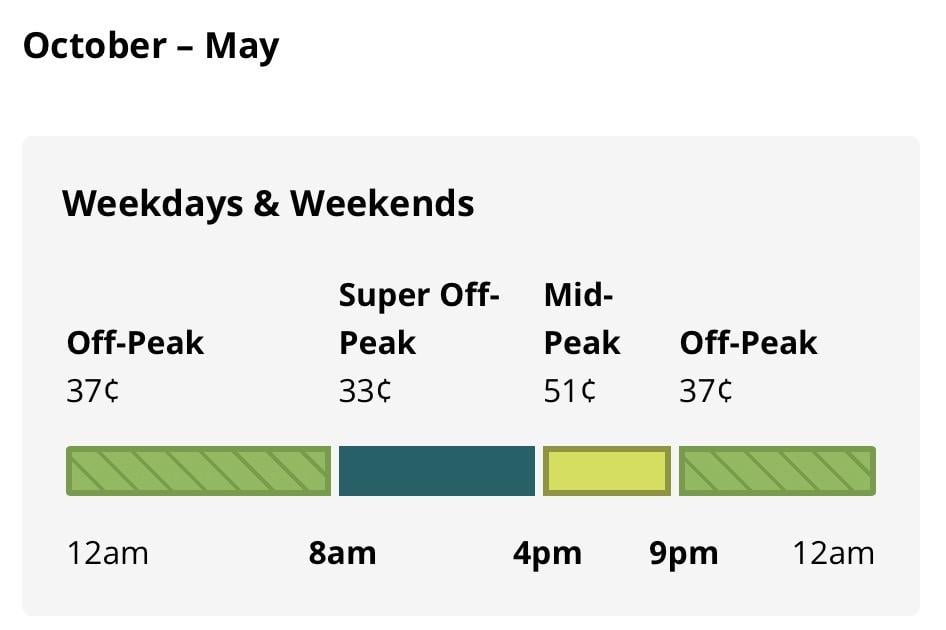
You can see they really hit us between 4pm-9pm when we aren’t generating power. I just got my 12 month bill and it was the first time in 6 years we owe money — about $400 for the year. Keep in mind we paid around $30K for our system back in 2020.
In 2023 California changed how it does solar. It is called NEM 3.0 (we are grandfathered in for 20 years under NEM 2.0). Today one has to purchase a battery system to zero out dollars for the year or go off grid. To go off grid I would need 4 Tesla Power Wall units in the summer, which would cost around $60K, plus I would need to add some panels.
I’ve had solar on our three different campers for 20+ years. Currently our travel trailer has 880W of solar and a 300AH LiFePo4 battery. We can camp indefinitely with this system as long as it is sunny most of the time . . . We have enough battery reserve to go 5 days with no sun. Even in summer, if it is really hot, we can run an evaporative cooler and keep our camper around 75° F when it is 105°F outside. So yes, small systems or balcony systems can provide some relief. However balcony systems are illegal in California. This might change as the state Senate passed a bill and needs to be passed by the state Assembly.
California NEM 3.0 (officially the Net Billing Tariff or Solar Billing Plan) is California’s solar policy that took effect on April 15, 2023, cutting the value of excess solar energy sent to the grid by roughly 75%. Thus there is no financial incentive to go solar without a battery system included.
The result was residential solar installations in California dropped by 75% – 80%.
I don’t know what has happened since Congress got rid of the 30% federal Clean Energy Credit when it passed the One Big Beautiful Bill Act last year — it probably further reduced installations.
But then we are still building new homes in Nevada, Arizona and California like crazy even though we don’t have enough water to support them.
You live in the desert. Just get water out of the fountains.
Another cheesy video. China has stepped up while we prop up our past failures.


Yeah, another one of those youtube videos with stock pictures.
The follow this formula – identify a good guy and a bad guy, in this case the bad guy is U.S. companies, good guy is Chinese companies. The U.S. companies were too stupid to do what was obvious, develop sodium batteries. Actually, they were working on this all along, but they do focus on short term profits so didn’t invest in sodium like the Chinese who are more long term strategic, willing to invest large amounts…
Not that the U.S. companies weren’t stupid, but that is a formula for those youtube videos – identify good and bad guys and play that out for 25 minutes. It takes advantage of human cognitive characteristics – we will watch such a video for 25 minutes. Movies and commercials also follow the same formula.
It’s not just good guy bad guy. American interest in practical development has dwindled while China is picking up the reins. Fossil fuels are subject to war and boycott. Drill baby drill will only destroy what we have and pollute our water sources. We follow the bubbles. A couple good bubbles will get you through life regardless of what you leave behind. It appears to work. Place tariffs on progress and nobody will know.
Yeah, totally agree
U.S. is into short term profits, China strategic long term, we are screwing ourselves.
There are many of those YouTube videos with a good guy bad guy formula. For example, a WWII soldier that has a good idea but the military bureaucracy threatens court martial, eventually the soldier perserveres and is a hero. Many humans will watch the story to the end. They must make money on ads so they want us to continue watching
And now they’re on your feed too😎
Potable water and usable salt. No cheese.

That is much better than a formulaic youtube video. It only consumed 1.5 minutes of my time to watch it.
I wonder if that’s scalable. Using a laser to create a super wicking black metal panel might not be.
They could use the sodium (and lithium) produced to make batteries :)
Somehow I missed some threads.
The water war has been going on for as long as I remember. When Goldwater was running for president, I was convinced he would attack California and take the water. Growing up near the river, swimming in the canals, I felt it was ours. One has to be more practical. Exporting water to major cities I think of Mulholland and the draining of Mono Lake.
I have 400w of panels on my truck along with two 200Ah batteries.
Plug in . solar, Colorado allows 1920watts. I understand that to be the back feed limit. I’ve asked for clarification. Meanwhile I’m using 3,100w for plug in, peaking out around 2,100W actual production. I have a couple tenants so I don’t back feed anything. I monitor my usage on the same app I use to pay my bill. It breaks it down to hour by hour.
I have another 3,000W running solar generators that run appliances. Everyready solar lanterns for light.
Considerably less than $30,000. Panels were a buck a watt. I’m paying around 50 cents. Still eating beans. Dirtbag solar? Power here is only 12.4 cents a KW with a dividend.
Tesla is buying back battery power in Texas and California.
Dust control used to be just water. Now it’s foam. Still the best place for solar is on your roof.
Plug-in solar kits (or “balcony solar”) let you mount small solar panels on a patio, railing, or yard and plug them into a standard 120V wall outlet to offset your electric bill. While popular and legally advancing via SB 868 (The Plug and Play Solar Act), plugging solar directly into a standard household wall socket currently operates in a strict regulatory gray area with major utility hurdles. [1, 2, 3, 4, 5]
Current Legal and Utility Status in California
Legislation: SB 868 passed the State Senate and is moving through the Assembly to exempt small units (up to 1,200W AC) from utility interconnection red tape and fees. [1, 2]
The Interconnection Rule: Until the bill becomes fully enacted law, major California electric utilities technically require formal applications and approval (interconnection) for any energy-generating device tied to your home’s wiring. [1, 2]
Net Metering Concerns: If you are on an older net metering plan like NEM 2.0, unauthorized backfeeding from unapproved DIY plug-in units can technically risk your tariff status, though small under-the-radar allowances exist. [1, 2]System Options & Pricing
Kit Costs: Systems generally range from $500 for a basic 400W–600W two-panel setup up to $1,000+ for larger 1,000W expandable kits.
Popular Brands/Options: Various suppliers market DIY components tailored for US markets, including systems from Plugged Solar, EcoFlow, and specialized advocates like Bright Saver. [1, 2, 3, 4, 5, 6]Safety and Installation Best Practices
Dedicated Circuits: To avoid tripping breakers or creating fire hazards, plug-in kits should be tied to a dedicated 120V circuit with its own breaker rather than a shared household outlet. [1]
Anti-Islanding Protection: Ensure any micro-inverter you purchase is UL-certified (such as UL 1741 compliance) so it automatically shuts off during a grid blackout for line-worker safety. [1, 2]
The population of the Southwest is simply too large in comparison to the ecosystem. At tremendous cost, the water of the Great Lakes could be piped in. But the Great Lakes area would never support that – nor should they.
Desalination is possible but that still requires a long pipeline from the Pacific. Theoretically, there is enough solar energy to run such an operation. But it would also require a huge investment.
Just like with building highways, once a major public works relieves the shortage of a service (be it roads, electricity, or water), a ton more demand is drawn to the service. This just exacerbates the original problem. The government shouldn’t be encouraging more people to move to the Southwest any more than it should to the Gulf Coast to build on flood prone land.
Still, every place has its own geographic challenges. For the people who’ve already lived in the SW for many years, I’m sure they will find a way to survive if they really want to stay. The SW has some amazing geography.
Some Youtube backpackers I’ve enjoyed who live in Arizona include:
Erik Hanson
Darwin On The Trail
Saif Binna
To misquote Field of Dreams. Build it and they will come. If you grade a dirt road, folks will drive faster and create washboards. Progress is self defeating. Building moratoriums lead to high prices and elitism. They tried it along the coast. Beaches became unaccessible. Trails were blocked. If you don’t build homes, you get the homeless. Everybody wants nice weather. Public land in encroached upon. Addictions increase. Progress is inevitable. It is needed and warranted.
That is sad. Then what’s the solution? Or, don’t worry about it, it’s hopeless, we’re going to be miserable?
Bait and switch.
Become a member to post in the forums.
advertisementYour privacy is protected: We do not transmit your user data to third-party ad platforms or advertisers, and we do not host third-party tracking pixels. Backpacking Light serves ads on its own custom, native, and internal platform.
 New Ultralight GearSee the latest releases in ultralight cottage-brand gear from small makers.
