Randy,
It’s good to know that Extrem Textil is back in business with foreign orders, hopefully including the USA. Thanks for that info.
Yes, the silpoly I mentioned was what they call “1.1 oz” (1.24 oz finished) from RBTR. Stephen Seeber tested it with his latest set-up, and the ~1500mm result was after simulated aging.
You may be thinking of his post about the RBTR “membrane” silpoly that he tested, with aged results that were no better than DWR (durable water repellent, but not waterproof) used on windshirts and the like. His results were posted on the gear forum. On that post, he also reported a test of some membrane from another poster on the thread, and got much better results in the waterproof (water resistant, not just repellent) range.
That is what led to the conclusion that water resistance can vary markedly between the same products, even from the same vendor, and even between rolls produced at different times; so we cannot assume that a particular fabric from the same vendor can be relied on to have the same water resistance reported in earlier tests. That is why I ordered enough yards of the RBTR silpoly “1.1” to be used for a tent and asked Steve to test it using samples from that order.
Also suggest that HH tests after an aging process are what matter most, and recall tests posted by Richard Nisley in the past that were OK on new fabric, but poor when he went back and tested after aging. The aging involves machine washing before testing; but do not know the details of the exact protocol used by Stephen and Richard. Regardless, the washing is intended to simulate only a few weeks of rain, and a fabric that loses waterproofness after such machine washing is not anything I’d want for an MYOG shelter, as it would not resist rain for long enough to justify the time and effort that went into making it.
One goal for the tent I’m working on is KIS (keep it simple), but as you mention, does involve different fabric panels for the vestibules and the canopy over the floor area. I’ve found that the simpler the design, the less chance for glitches in construction; but even with that, acknowledge that a double wall tent with vestibules is going to be both heavier and more complex than a single wall that is more akin to a tarp or bivy.
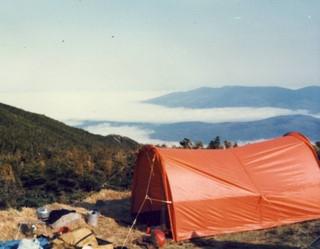
Years ago, I used a Gerry tarp modified to accept hoops to provide a simple tunnel shape. Here is a photo:

The tarp also included awnings, not shown in the photo, that came partially over the guylines that are visible on one end. Even with the awnings in place, there was a lot of ventilation through the open front and rear of the tunnel, which was four feet wide at the base. Yet there was a lot of condensation that would collect on the lower insides of the tunnel, and the sleeping bag ended up wet. That was the reason for the switch to double walls to keep dry.
Granted, you and others on BPL may seek the smallest and lightest, not to mention easiest to construct, shelters. My goal for MYOG is a spacious solo tent under 30 oz, with an outer fly covering just the occupied portion of the tent, but not the vestibules. The smaller fly will provide an outer wall to collect condensation, not to mention added stability, yet be much easier to install in the wind than the typical monster flies which include the vestibules. The 30 oz compares with under 20 oz for a single wall made with DCF or very light woven fabric with simple construction.
For me, staying dry with enough space to cook and eat in the rain is worth carrying the extra weight. Hiking mostly in the Rockies and northern New England typically for 5-10 days at a time always seems to result in rainstorms, serious in the East because they are lengthy, and in the West because of the altitudes and open terrain that make shelters much more vulnerable to storms. For a long time, I went out of the way to camp below timberline; but being able to stay on a high route and have secure and dry shelter in nasty weather is more enjoyable, and many would say, safer. So guess it depends on one’s priorities.
Sounds like you have a way to keep your nylon shelter reasonably taut without excessive sagging. However, after being hammered by wet weather for long periods in little space, you might find a few extra ounces are worth a great deal more comfort, convenience and safety. Or perhaps you live in “Sunny Cal.” Can’t recall even a drop of rain on the JMT (but plenty of shivering – the planet has been heating up though).
Granted also, that while we have had waterproof test results, courtesy of Stephen, the polyester tent fabrics have not yet proven how long and how well they will stand up to punctures, rips, abrasion and wear and tear in general. Especially compared to nylon 6.6. This is admittedly a risk to be taken in seeking to enjoy the benefits of alternatives to silnylon.