Topic

Snowshoeing Safety issue/ unusual conditions

Viewing 25 posts - 1 through 25 (of 36 total)
Sr Al BPL Member
PostedDec 27, 2015 at 4:50 pm

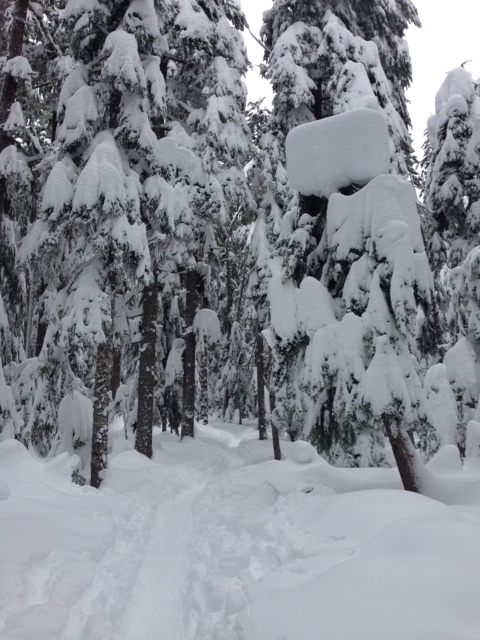
Hello all, Im posting to get some feedback on some unusual (to me) conditions that I ran into this weekend.  I snowshoed in to Lower Twin Lakes, near Mt Hood in Oregon.  When I went in yesterday, it was crisp, cold and definitely below freezing with insane amounts of snow.  Overnight there was a couple of inches of new snow.  This is what it looked like in general:
This morning as I was heading out, I noticed the trail conditions were weird.  There was a big area with cracks, fissures in the snow and the trail appeared to be iced over, even though yesterday it was all deep powder.  In this next photo you can see the trail, and the big fissures in the snow.  These big fissures and cracks were all over.
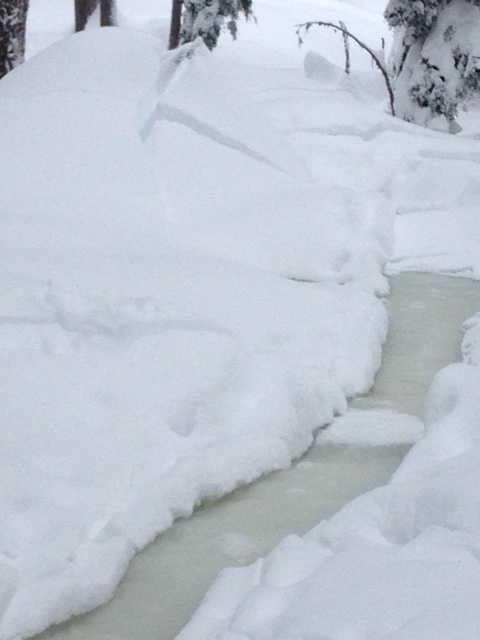
Heres another shot of the same area zoomed out a bit:

So I trudged on up that ice, pulling my new homemade pulk behind me.  About 15 more feet and I plunged through the ice, and into knee deep, freezing cold water.   This shot is well above the lakes surface. I couldn’t get my feet/snowshoes out.  All the ice, snow, and slush fell over top of my snowshoes and I struggled to get free.  I panicked and burst one foot up, snowshoe still attached.  The next few minutes, I had to stab my poles into the water to break up the ice and snow as well as yanking my whole foot and leg around to make a big enough hole to get my snowshoe back up and out.

I did finally free myself, with freezing, wet legs and feet.  Thank god I was wearing wool, within a half hour my feet warmed back up, albeit wet and sloppy in my boots.

However, once I looked around in this area, these fissures in the snow were covering a pretty large area and I had to take a sizable detour and bushwhack to join the trail at a higher point.  I also spotted many more suspect areas that I took some photos of.  This next shot is of a small one I came across, I stuck my pole down this one and it went a good 2 feet down into water.  You can see the fissures here on a mini scale compared to elsewhere:
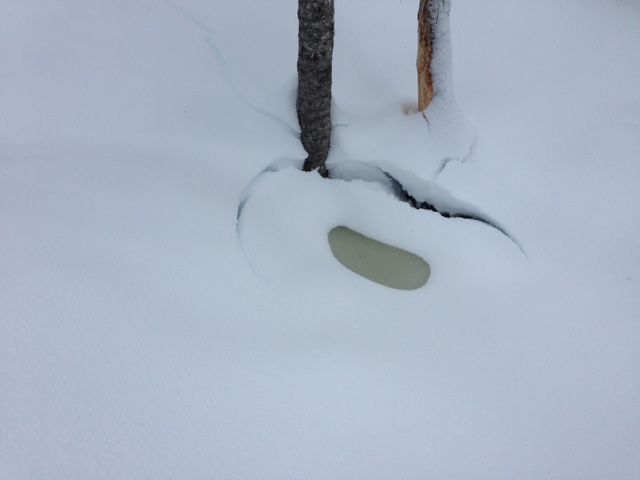
Here is another shot I got of a similar area from a bit of a distance:
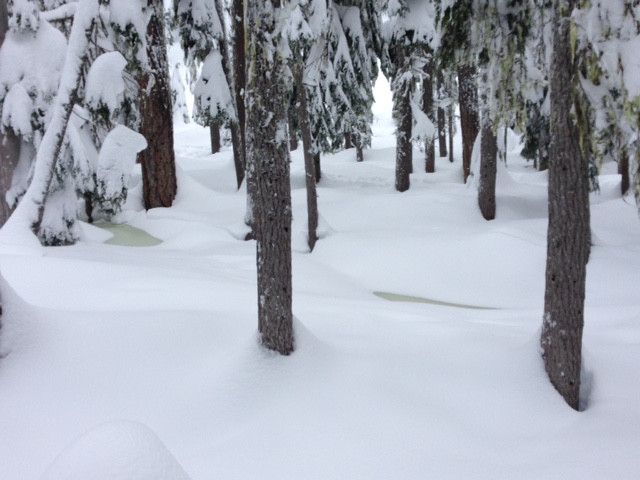
So my question is, what the hell is this?  I was on this trail a week ago… these features were not here.  I was on the trail yesterday, these features were not here.  This morning, after dropping down into the low 20’s (at least), we have large amounts of water, running under many feet of snow, and judging by fissures and cracks in the snow, over a large area (much larger than a normal creek bed for this area).   It has been cold and DUMPING snow all week.

I’m not saying I’m super experienced, but Ive been snowshoeing in the cascades many times and this is a first for me.  I warned everyone coming up the trail this morning.  One guy looked pretty surprised, because he had been up here a couple of times recently and had seen nothing like this either.

So, Id love to hear any of your thoughts/opinions on this… I’m all ears.  Thanks for reading.


PostedDec 27, 2015 at 5:04 pm

Wild Ass Guess –

A creek got dammed/frozen/locked-up and the “over flow” flooded the area.  The water is insulated from the air and warmed by the ground.  It flows until another dam freezes it’s route and it seeks low ground again, filling in all the low spots as it goes.

You are one lucky guy.


Sr Al BPL Member
PostedDec 27, 2015 at 5:10 pm

That makes a lot of sense, Greg.  I wish I took more photos so you could see how big the affected area was.  It was causing massive amounts of snow to crack and move.  Thanks for taking a look.

Bob Moulder BPL Member
PostedDec 28, 2015 at 8:17 am

Yep, looks like something got dammed and overflowed. Not at all unusual in the Adirondacks.

Swamps are another very dangerous type of landscape when snowshoeing. Even at -30°F the heat generated by decomposing plant matter prevents freezing, so you can step on a thin veneer of ice and snow above and find yourself stuck in muck up to your waist. Very nasty situation.

Roger Caffin BPL Member
PostedDec 28, 2015 at 1:03 pm

If you see that sort of snow – or ice rather, you KNOW there is water there, where there shouldn’t be. Which means that something funny has happened, and you do NOT know what is underneath. That’s a warning sign: heed it.

Educational, very educational. Glad you survived, and thanks for the pictures.

Cheers


PostedDec 28, 2015 at 2:49 pm

Wow that sounds scary. Thanks for posting and with photos to help others. I dont’ recall seeing this specific hazard in FOTHs.

I’m guessing a leg isn’t too bad, but have any of you fallen into a creek deep enough need to take action like fire or strip into a sleeping bag to warm up? Any tips for discerning hypothermia in others where you need to stop and take care of them? (I’ve seen this happen to a few backcountry skiers but they seemed pretty fine).

Paul S. BPL Member
PostedDec 28, 2015 at 6:47 pm

If you can keep moving then you can usually warm yourself up; throw on a puffy if you’re completely wet.

Sr Al BPL Member
PostedDec 28, 2015 at 8:26 pm

I was worried about becoming chilled… my boots were full of water, socks soaked and my pant leg started freezing.  My feet were painfully cold.  My adrenaline kept that in check temporarily.  However I had to bushwhack up a hill, and within about 20-30 minutes my feet were warm again.

Justin Baker BPL Member
PostedDec 28, 2015 at 8:35 pm

In a situation like this if you were spending the night, what would you do about your wet boots? Try and dry them out somehow? Just deal with numb feet for the entire trip?

PostedDec 28, 2015 at 9:26 pm

Depending on a lot of stuff, like how much of you is wet, how far to the car etc., building a raging fire is a worthwhile consideration.

Too often we equate surviving to getting out, when in fact, sitting tight in front of fire would make more sense.

PostedDec 28, 2015 at 10:01 pm

A while back someone linked to a story about the SEAL re-warming drills; I think this is a similar case.  But, this is a case where clothing matters; there’s a blog post by a guy in Ontario who decided to test this out in Lake Ontario.  He wore the PCU system and was able to nicely dry things out, while his buddy wore a mix of other items which stayed wet.  Of course, his buddy’s poly/cotton blend pants probably wasn’t the wisest choice, but his upper layers didn’t work either (wicking base, fleece, then softshell).

For the feet, I’d want dry socks and plastic bags.  Sticking things out with cold, numb feet doesn’t sound like a particularly good idea.

Paul S. BPL Member
PostedDec 28, 2015 at 10:04 pm

Justin,

When I go overnight I always plan on my footware getting wet. In winter I bring oven bags and spare socks for camp, sometimes a pair of thicker socks or neoprene socks for hiking if I’m worried the weather might turn for the worse.

Paul S. BPL Member
PostedDec 28, 2015 at 10:10 pm

I forgot to add, I post holed through a snow bridge into water before.  I quickly removed my shoes and wrung out my socks (merino sock liners), put them back on and carried on.  If it was colder I would have put on bags to warm up, but moving was the fix.

Tipi Walter BPL Member
PostedDec 29, 2015 at 10:40 am

Just think if you were camping a couple days before or a day before and atop one of these later-to-form fissures—wet tent floor for sure.

We don’t get near the conditions you show in the Southeast during winter, but we do get slushy ice patches that look similar to your pics.  Most of these can be broken thru with boots down to a depth of around 5 to 10 inches—no big deal.  We don’t wear snowshoes in the Southeast but we do wear microspikes.

I personally would not have hiked atop those ice paths as they look wet underneath.  Did you say you bushwacked around them in the deep snow and still got into water?

As far as wet boots and socks, well, it’s going to happen on a winter trip due either to a cold rain or hiking thru wet snow.  I do what Paul S mentions:  Remove wet boots and wring out socks and reboot and keep hiking.  Repeat a couple more times to better dry out the socks.

I do nothing to try and thaw out my hiking boots—and I have camp shoes or down booties anyway so I don’t have to look at my boots again in camp until the next morning.  I try to keep my all important winter boots dry as long as possible in a trip but sometimes this is impossible.

When it never gets above 0F and -10F or -15F at night, boots will turn rock hard.  Spread them apart before sleep and strap them on every morning.  They could stay soaked for 7 or 10 days and rock solid every morning.  It’s just part of winter backpacking.  I even had the leather tops of Sorel packboots freeze rock solid though the rubber bottoms stay flexible.  But these kind of boots are inefficient to backpack with—they are very clunky.

Sr Al BPL Member
PostedDec 29, 2015 at 12:40 pm

@tipiwalter

I think that if I had camped atop this, it wouldn’t have resulted in a wet floor…. more like a flooded tent with ice cold water and an emergency situation.   The snow depth is up to 5 feet deep, so I had little reason to suspect there was so much standing water beneath.  I had never encountered this… so I had no idea.  Now I do.  I thought it was just bootlpacked snow/ice, since it is exactly where the trail is/was.

When I bushwhacked, I still found suspect spots… indicating a large flooded area.  The snow was so deep I was up to my knees/thighs even with snowshoes… it was probably deeper than 5 feet deep to be honest.  So basically there was an insane amount of snow, over top of thin ice, then inches to feet of water below that depending on where.  If the snow or water was any deeper this could’ve been a much different scenario.

Roger Caffin BPL Member
PostedDec 29, 2015 at 2:31 pm

I’m guessing a leg isn’t too bad, but have any of you fallen into a creek deep enough need to take action like fire or strip into a sleeping bag to warm up? Any tips for discerning hypothermia in others where you need to stop and take care of them? (I’ve seen this happen to a few backcountry skiers but they seemed pretty fine).

It happens. The snow on the rock i was using was not as strong as I had hoped. But we had been going fairly hard so we had good core warmth. Strip wet clothing, wring out, replace, then go hard again.

Cheers


Tipi Walter BPL Member
PostedDec 29, 2015 at 4:47 pm

Sr Al—Let’s say you had to set up camp, would you have moved upslope (and away from the “lake”) and dug out a tent platform??  Did you bring a snow shovel?

Matthew / BPL Moderator
PostedDec 29, 2015 at 4:56 pm

I have nothing to add here other than snow scares me. Good thing I live in Phoenix.

Sr Al BPL Member
PostedDec 29, 2015 at 5:06 pm

Admittedly and embarrassingly I left my snow shovel in the car (forgot it).  In retrospect if I saw this first I would go well above this area, and quite some distance to the right or left of it.

Next purchase, PLB.

Tipi Walter BPL Member
PostedDec 29, 2015 at 8:25 pm

Unlike the SEALs and the Ultimate Alaska Adventure guys, I practice a time-honored solo backpacking tip to never get underwater with my gear at Zero degrees, intentionally or otherwise.  Crazy, I know.

Paul S. BPL Member
PostedDec 29, 2015 at 8:59 pm

They train for the unintentional accidientsl submersions so they don’t die…

Jerry Adams BPL Member
PostedDec 29, 2015 at 9:09 pm

The OP accidentally got wet.  Roger gave a worse example.  It’s good to have some techniques available to survive such an event.

Tipi Walter BPL Member
PostedDec 29, 2015 at 9:42 pm

The OP sank into cold water and ice down to his knees, a fairly common event for a solo winter backpacker.  One such event and the normal backpacker bushwacks left or right out of the problem.

This is different than totally submerging in ice cold water with all your gear at 0F on a solo trip.  It’s not something we do and in fact is something that thru experience should never happen.

Techniques to survive such a mistaken dunking?  I can think of one:  Milarepa’s Tummo—

http://www.newworldencyclopedia.org/entry/Tummo

Milarepa was a 12th century Himalayan yogi who stayed warm in the winter mountain snows by practicing Tummo—heat generated thru meditation.

PostedDec 30, 2015 at 8:48 am

“This is different than totally submerging in ice cold water ”

Knowing my limitations, I’m clumsy enough my first fear postholing into water would be tripping while trying to get out. Low probability, big personal fear.

When I was snowshoing in CO a couple weeks ago I was asking the REI guys how to evaluate frozen lakes for safety. They said there’s really only 1 or 2 ways to die snowshoeing and one of them is frozen lakes.

Viewing 25 posts - 1 through 25 (of 36 total)
Loading...