Topic

sleeping bag temp question

Viewing 11 posts - 1 through 11 (of 11 total)
Sebastian O BPL Member
PostedJul 4, 2016 at 8:54 am

Hey friends,

If when buying sleeping bag, I  take the bags temp ratings at face value for comfort and lower limit…..

-I should buy towards comfort temp right?

-Say a bag as a comfort rate of 36 and lower at 26….add my clothes and the tent. If i sleep avg for a man temp wise, what am I looking at when the temps hit 26?


jimmy b BPL Member
PostedJul 4, 2016 at 9:11 am

My answer to the first question would be yes if you are looking to use it as a stand alone piece of gear. I also believe some mfg.’s are much closer to the truth concerning their temp ratings EN or not. I would look for posts recommending brands that are proven to be accurate.

Many here will supplement their sleep system with other clothing carried for camp and sleep system so they may choose a higher temp rated bag to combine with the above. We would have to know what clothing you are planning to supplement with. (wt. fleece, wt. down puffy, wt. base layer ect.)

Keep in mind good down bags/quilts can be very expensive but given good care they can last a very long time. IMO this is not a place where you want to skimp. I cant speak for the above but I wouldn’t hesitate to buy a good lightly used WM or other quality bag over a brand new lesser quality brand.

PostedJul 4, 2016 at 9:22 am

For 26 degrees I’d go for a bag rated at 15* or 20*. Probably only Western Mountaineering and Feathered Friends sell bags that are true to their ratings.

James holden BPL Member
PostedJul 4, 2016 at 10:07 am

lower limit =  average man rating

comfort limit =  average woman rating

read more here …..

http://www.mammut.ch/documents/Schlafsaecke/Downloads/Sleep%20Well/Mammut_Sleep_well_pt1_E.pdf

ANY brand that is EN-tested should be relatively accurate allowing for differences in age and physiology

thats the wonderful thing of EN-ratings … its makes manufacturers relatively honest about the ratings of their bags …

as for WM .. their summerlite is rated to 32F but test to 35F for men … there was a whole discussion about it years ago here when one day folks claimed to easily take em down to the 20s, then latter when the EN-rating came out … plenty of BPLs admitted they felt cold in it into the 30s

on the other hand plenty of other WM bags do meet or exceed their ratings in testing … just not the summerlite

;)

James Marco BPL Member
PostedJul 4, 2016 at 10:39 am

EN ratings assume a fully clothed person, ie, a person in full long johns (weight not specified, so assume a heavy weight set of long johns) and a good pad (again, unspecified as far as R values, assume an R5.)So, the temps can vary as a good 10C degrees between manufacturers. This was not as bad as previous ratings, but pretty bad. Do not trust the temp ratings. Rather go with loft dimensions. The difference between 900fill and 600 fill is only about 1C (and weight, of course.) Then compare this with the average of couple known good numbers; I use Western Mountaineering, Feathered Friends and Marmot. Features can effect performance at the extremes.  Draft collars, zipper baffles, foot ventilation, etc. This will be around a degree or two. Use of a vapour barrier will help by a couple degrees.

Excerpted from EN testing: https://outdoorindustry.org/pdf/EN13537Mccullough062209.pdf
<div data-canvas-width=”29.054999999999996″>”EN Manikin Test Set-up</div>
<div data-canvas-width=”107.2″>Section 4.3.3</div>
<div data-canvas-width=”347.8566666666666″>states that the thermal properties of a sleeping bag and the comfort, limit,and extreme temperatures should be determined according to Annexes A, B, and C. Recommendations for Annexes A and B.It is recommended that the information in</div>
<div data-canvas-width=”784.1999999999998″>Annexes A and B be combined and rewritten to make the manikin calibration and test procedures</div>
<div data-canvas-width=”194.8″>more clear. Details are given below.Section A.4.1 states that the manikin should be dressed in a track suit(i.e., knit warm-up suit or thermal underwear) where the fabric insulation is 0.049 m2.K/W ±10%. Knee socks with a fabric insulation of 0.054m2.K/W ±10%should also be used. The method for measuring the fabric insulation of these garments is not specified. Since sock material stretches when it is on the body, and it comes in small pieces, it will be difficult for a lab to test the sock material and select the correct pair of socks. In addition, the length of the sock (i.e., how much of the calf it covers) is not specified.</div>
<div data-canvas-width=”35.9″>Annex B describes the procedures used at Hohenstein Institute to measure the calibration values or standard insulation values that all labs should match. This procedure states that a face mask was</div>
<div data-canvas-width=”265.03999999999996″>used with mummy bags during the testing, but this is not stated in the procedures given in Annex A</div>
<div data-canvas-width=”636.3999999999999″>and the face mask is not described. ( The face mask used by most labs is rather strange and would not be used by most consumers.)</div>
<div data-canvas-width=”625.6″>Section A.4.2 states that the manikin should be placed on an elevated board about 12 mm thick. Research by Kuklane (2009) has shown that using a thicker board does not affect the results. Therefore, the board specification is acceptable. The board is supposed to be covered by a pad (mat) that consumers might typically use. No specification of the ground pad is given, although Annex B states that a mattress with a thermal resistance of 0.85 m2.K/W ±7% should be used when the calibration bags are tested. Research has shown that the pad can make a huge difference in the insulation of a sleeping bag system (McCullough, Zuo, & Huang, 2009).”</div>
<div data-canvas-width=”625.6″></div>

James holden BPL Member
PostedJul 4, 2016 at 11:08 am

James …

there is no way one will see a 10C difference ratings in proper en-testing between labs

also in 2012 the en 13537 standard was updated to reduce any variance between labs

any bag tested to the new updated standard will be marked en 13537:2012

;)

Lori P BPL Member
PostedJul 4, 2016 at 11:18 am

If you are properly hydrated, fed, relatively healthy without metabolic wonkiness, not wearing sweaty/wet clothing, and have a shelter that keeps wind off you at night, have adequate sleeping insulation underneath (pad or insulated mattress) – and, you are using something EN rated from a reputable manufacturer, yes, you can trust the rating.

If you stop drinking because you don’t want to get up to pee, diabetic and not regulating yourself properly, not drinking enough generally, not eating enough, not getting good caloric intake if you are eating, buying a cheap junk sleeping bag, not using a properly rated sleeping pad, tend to sleep colder than many, cowboy camp on windswept ridges… not so much.

[/stating less obvious just in case]

Scott Smith BPL Member
PostedJul 4, 2016 at 2:37 pm

As other will validate, a HUGE factor is how cold.. or warm  … “YOU”  sleep..

I have a WM Summerlite and sleep VERY comfy at 30 degrees .. in nothing but a shirt  and underwear..

My wife, on the other hand, has a 20 degree bag, that she needs to put more clothes on .. to keep warm


Valerie E BPL Member
PostedJul 4, 2016 at 3:02 pm

I know those EN ratings are supposed to be objective…but personal experience tells me they aren’t!

Ask yourself how important being comfortable is to you.  The “comfort” rating is supposed to reflect the lowest temperature that you’ll feel warm and comfortable in that bag.  The “lower” or “survival” rating is supposed to reflect the absolute minimum temperature that you can survive in that bag (i.e., you will be cold and uncomfortable, but you will not die of hypothermia!).  Obviously, different folks have different tolerance for cold/heat; and some people are willing to be a bit cold all night in order to save pack weight.  Who am I to tell them how wrong they are, LOL! ;^)  But kidding aside, you need to decide how important being warm and sleeping well is to you.

Remember to also consider other factors that impact warmth — sleeping pad R-value, hydration, nutrition, tent/no tent, wind chill, etc.  And despite the EN certification, I agree that *most* manufacturers seem to  exaggerate their “comfortable” temperature range, except WM and FF (other than the Summerlite, apparently).

James holden BPL Member
PostedJul 5, 2016 at 12:41 am


folks … theres a bit of misunderstanding of EN-ratings

first of all … heres the definitions


EN13537 requires a thermal manikin test which produces four temperature results — upper limit, comfort, lower limit and extreme. These temperatures were worked for normal consumers.

The standard measures four temperature ratings:

Upper Limit — the temperature at which a standard man can sleep without excessive perspiration. It is established with the hood and zippers open and with the arms outside of the bag.

Comfort — the temperature at which a standard woman can expect to sleep comfortably in a relaxed position.

Lower Limit — the temperature at which a standard man can sleep for eight hours in a curled position without waking.

Extreme — the minimum temperature at which a standard woman can remain for six hours without risk of death from hypothermia (though frostbite is still possible).

For the purpose of these measurements, a “standard man” is assumed to be 25 years old, with a height of 1.73 m and a weight of 73 kg; a “standard woman” is assumed to be 25 years old, with a height of 1.60 m and a weight of 60 kg.

Second of all … other than giving what a “standard (wo)man” is comfortable at, the other main purpose is for a proper comparison of the insulation values between sleeping bags regardless of brands

there is nothing that makes a properly tested and rated bag of one brand SIGNIFICANTLY warmer than another brand, all other things being equal …. insulation is insulation … they all use more or less the same insulation materials between their types (high fill power, low fill power, synthetic) … theres nothing magical about it

the en-ratings are there to keep manufacturers honest … im not sure if many BPLers remembered but when REI and Montbell (which used to be quite popular on BPL before the EE/katabatic quilt craze) went to en-ratings they had to bump up the down fill of some of their bags to meet the claimed ratings

now en-ratings arent perfect, there are some issues with em … and how an individual sleeps matters of course …

but when comparing the sleeping bag … its the best comparison we have as it isnt based on fickle intraweb opinions, assumptions about loft or the amount of fill and how it correlates with “warmth”, etc …. as it measures the insulation capacity of the sleeping bag DIRECTLY

its based on FACTS and SCIENCE …. not assumptions and opinions

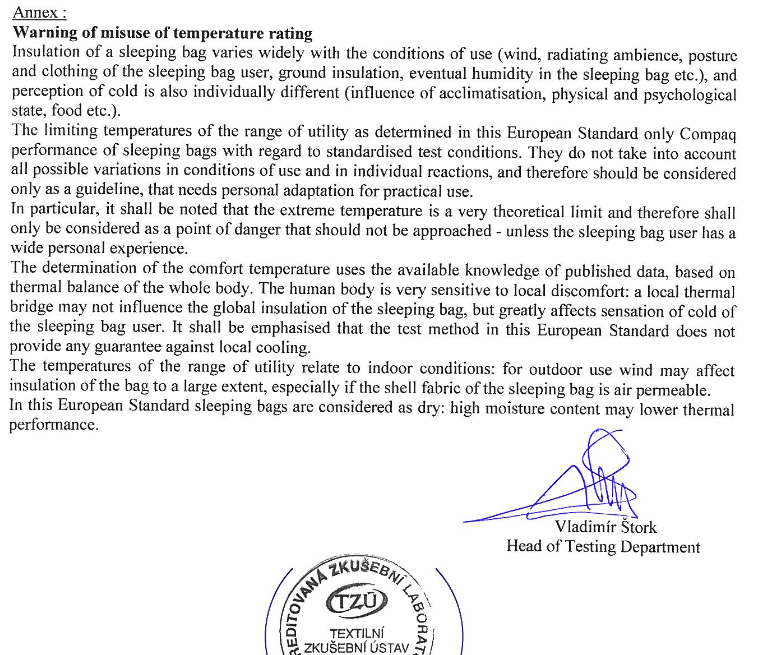
there is always the usual disclaimer …


;)

Viewing 11 posts - 1 through 11 (of 11 total)
Loading...