


Hello, I need to choose between a 10d and 20d outer fabric for a sleeping bag, my main criteria is warmth as I’m a cold sleeper, will the reduced breathability of the 20d give greater warmth?
Topic
Become a member to post in the forums.
.
Hello, I need to choose between a 10d and 20d outer fabric for a sleeping bag, my main criteria is warmth as I’m a cold sleeper, will the reduced breathability of the 20d give greater warmth?
20d will not necessarily have greater or lesser breathability or air permeability compared to 10d fabric. These qualities are entirely idiosyncratic to the particular fabric in question.
Now, if you are talking about a particular company’s 10d and 20d fabrics, for instance Enlightened Equipment’s, then there may be a known difference. EE do list their 10d fabric as more air permeable than their 20d fabric. Air permeability is not the same thing as breathability, however, although there is a weak correlation between them.
A more air permeable shell on a sleeping bag will not reduce its warmth in comparison to the same bag with a less permeable shell, unless your bag is exposed to wind, in which case the more permeable bag will probably be colder to sleep in.
So if you’re sleeping under a tarp without a bivy, the more permeable fabric will be colder; but if you’re in a four-season tent that effectively seals out the wind, there won’t be any difference, or not any difference worth talking about.
Thank you for taking the time to reply so extensively, that’s cleared up a misunderstanding I’ve had with breathability and permeability.
I always thought that the easier air can move through a fabric then heat will make that migration also.
Cheers

the shell fabric has little effect on warmth
shell fabric effects weight and sturdiness. If you cowboy camp a good DWR is important.
Could anyone recommend some articles on sleeping bag fabrics, construction and the principals behind the design.
Cheers
Just my (anecdotal) opinion: Wouldn’t a 20d outer actually be colder, if less vapor can get through it and therefor more condenses on the inside, wetting the down? I’ve never had that issue with my 10d quilt though I have seen a little bit of frost on the outside on a cold morning. !’ve never had a 20d quilt, so I can’t be sure. Can anybody that actually understands science explain?
Richard, I think the issue with condensation occurring inside a quilt or bag is due more to where the dew point is located, which has more to do with thickness of the down and outside temps than fabric breathability. If the outer fabric is more breathable, that might help some, but I think it would be a minor factor.
And as mentioned above, just because a fabric is more permeable to air does not necessarily mean it is more breathable (more permeable to moisture vapor). Enlightened Equipment lists the air permeability (in CFM) of their shell fabrics, but not moisture vapor transport (MVTR). We could assume that the more air permeable Enlightened Equipment 10d fabric also transports moisture better than their less air permeable 20d fabric, but we might be wrong.
The tried and true methods to prevent condensation inside a down sleeping bag/quilt are 1. put a synthetic overbag over the top, moving the dew point into that synthetic fill, where it won’t degrade loft (as much), or 2. wear vapor barrier lining clothing.
Unless it’s very cold, a little condensation in the bag is not a big deal anyway, unless for whatever reason you have zero opportunity to hang the bag in the sun for a bit each day.
If the temperature is below something like 20F and you’re doing multiple nights, that’s when you have the problem of water vapor from your body flowing through the sleeping bag and when it hits the place in your sleeping bag that’s the freezing temperature, the water vapor freezes and accumulates there.
If it’s warmer, the water vapor will flow through the sleeping bag and exit. Your body heat will dry out some water inside the sleeping bag.
Conditions usually aren’t conducive to drying my sleeping bag during the day. A couple hours in the sun would be good, but it’s usually not sunny and I’m hiking.
Sometimes I’ve had the opportunity
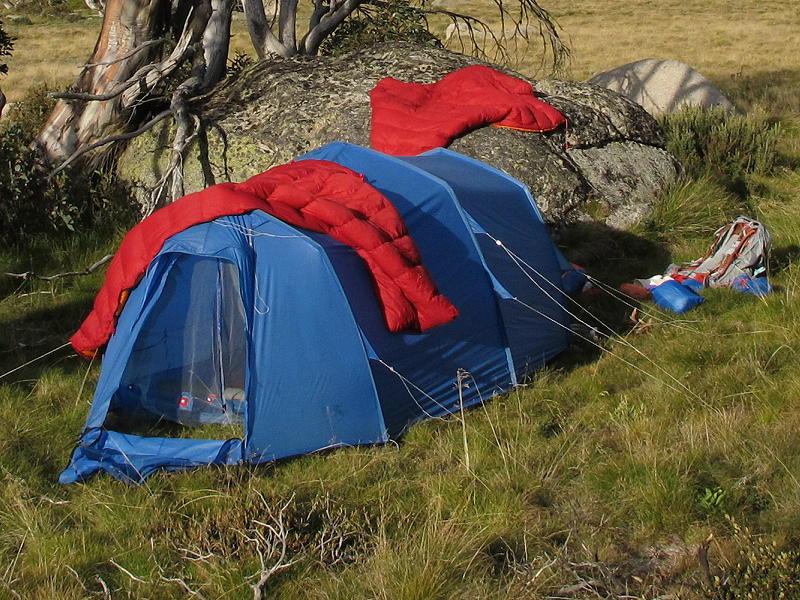
Drying in the sun: always a good idea.
Cheers
I agree with Roger.
Roger thanks for the article, it was very informative.
Previously someone said that the shell fabric had little effect on warmth, if someone could explain this as I don’t understand how that is possible?
I’ve done a little research into thermal radiation but I’m not sure that has really helped me.
Most heat loss in this case is by conduction through the air.
Down or synthetic block any air movement and are warm.
The fabric shell blocks the wind and keeps the down in place.
I am sure it is more complex than that, but it will do.
Cheers
Do we have any data on the minimum and maximum breathability (CFM) required to maintain the micro climate within a sleeping bag?
Danny; no, not that I’m aware of. In any case, it would vary based on exposure to wind and wind speed. If there is no wind exposure, CFM should not matter. It used to be said that 10 CFM or less was required to prevent down leakage through pores in the fabric; that doesn’t seem to be the case, as EE uses 35CFM fabric in their quilts. I wouldn’t worry about CFM very much. As Roger says, the fabric is there to keep the down in place.
Ideally, we would have low-CFM, high-MVTR shells on our sleeping bags. Why not? But no one has done the testing to figure that out.
But I’m an obsessive geek when it comes to quantifying gear performance and I don’t think this issue matters very much, for what that’s worth. For me, it would come down to: Is my quilt/bag going to be exposed to wind? Yes, then choose a low-CFM shell fabric. No, then it probably doesn’t matter that much. I would be more concerned about denier and durability. In my (limited) experience, there are distinct durability differences between various 10d shell fabrics on the market, for instance.
Thanks Stumphges.
if you’re only considering the down proof fabrics then it really seems the 20D or 15D will usually be less breathable than 10D. EE and nunatak both list this scenario. I’d guess the thicker thread is woven tighter to fight the down or the light calendaring affect may play a role. Nunatak lists the exact CFM for all their fabrics if you’re interested in some anecdotal information.
Become a member to post in the forums.
 Creamy Dijon ChickenCook-in-the-bag chicken, tarragon, and rice backcountry meal with 2 servings. Net weight 5.7oz | 162g
 © Beartooth Media Group Inc.
 Loading...